Most players pay somewhere between $5 and $12 per hour per table at a typical pool hall, though coin-op bar tables can run a single game for a couple of dollars. A 2026 pricing guide puts the national average at $5 an hour, with premium venues and private rooms pushing past $20. Here's the quick breakdown before we get into the details:
- Per-person hourly: $5 to $8, prorated by the minute at many halls
- Per-table hourly: $2 to $12 at standard venues, $22 to $25 at premium floors
- Coin-operated per-game: $0.75 to $2 per rack at bars and arcades
Key Takeaways
Playing pool typically costs $5 to $12 per hour per table nationwide, with per-person rates, minimums, and daypart surcharges determining your real total.
| Point | Details |
|---|---|
| Know your billing model | Confirm whether the venue charges per-table, per-person, or per-game before you sit down. |
| Watch the 30-minute minimum | Many halls prorate by the minute only after an initial 30-minute charge. |
| Split tables to save | Four players sharing one table rate often pay less per head than solo per-person pricing. |
| Time your visit | Weekday afternoons and happy hours run cheaper than weekend nights and holidays. |
| Q Billiards Arena offers scale | 25 tables, weekly tournaments, and free-pool promotions give Houston players more value per hour. |
Table of Contents
- How Much Does It Cost to Play Pool, and How Do Venues Charge?
- Quick Reference: Realistic Price Ranges by Model
- What Changes the Price: Factors to Watch For
- How to Play Pool for Less
- Sample Scenarios That Show How Costs Add Up
- What to Ask Before You Go
- What a Modern Dedicated Pool Hall Offers
- An Operator's Take on Pricing Transparency
- If You Want a Premium Dedicated Hall Experience
- Frequently Asked Questions
- Sources
How Much Does It Cost to Play Pool, and How Do Venues Charge?
Every hall picks one of five billing models, and knowing which one you're walking into changes how you calculate your night out.
- Per-table, per-hour: the whole table is rented at a flat hourly rate, split however many people are shooting.
- Per-person, per-hour: each player pays their own hourly fee, common at halls that want to discourage rail-sitting.
- Coin-operated, per-game: you feed the table for a single rack, typical in bars and arcades rather than dedicated clubs.
- Membership or day pass: a flat recurring fee unlocks discounted or unlimited hourly play.
- Full-hall or event rental: you book the entire space or a block of tables for a private function.
Most dedicated halls enforce what regulars call the "30 rule": a 30-minute minimum charge before the clock switches to per-minute proration. 946 Billiards uses exactly this structure, billing tiered rates by player count after that initial half-hour. Cue rental, chalk, and food-and-drink minimums can push your real cost above the posted rate.
Quick Reference: Realistic Price Ranges by Model
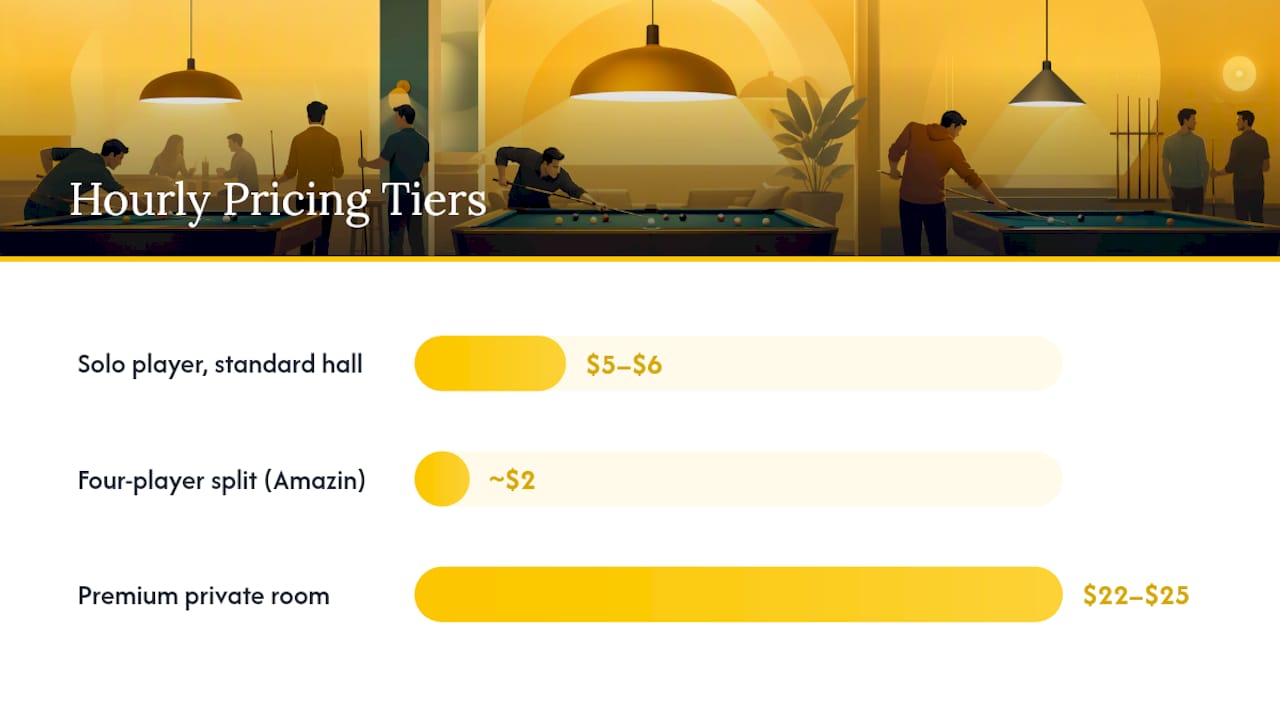
A solo player at a standard hall lands near the $5 to $6 mark hourly, per that same 2026 price guide. Two friends splitting a per-table rate often pay less per head than either would solo. Four players splitting a table at a venue like Amazin Billiards, which posts flat group rates for four or more players, can bring individual cost down near $2 per hour each.
Expect the high end of these ranges in entertainment districts and on weekend nights. Premium floors and private rooms, like the $22 to $25 hourly tiers at Galaxy Pool Lounge, sit well above the neighborhood-bar rate.
What Changes the Price: Factors to Watch For
Two halls three blocks apart can charge wildly different rates, and it usually comes down to a handful of variables.
- Daypart: weekday afternoons are cheapest; weekend nights and holidays carry surcharges.
- Local market: entertainment districts and dense urban cores charge more than suburban or rural spots.
- Table quality: slate tables and name-brand equipment (Brunswick, Diamond) often justify a higher hourly rate than coin-op bar tables.
- Membership status: Amazin Billiards publishes separate day and night rates plus a discounted member tier several dollars below walk-in pricing.
- Included extras: cue rental, chalk, and gloves are sometimes bundled, sometimes billed separately.
Pro Tip: Ask whether spectators count toward per-person pricing before you bring a group. Some venues only charge shooters; others bill everyone standing at the table.
How to Play Pool for Less
Cutting your bill doesn't require skipping the hall entirely. It requires timing and a few phone calls.
- Play during weekday afternoons or early-bird windows, when rates run lowest.
- Ask about happy-hour specials, which often knock a dollar or two off the hourly rate.
- Join a membership or league; recurring players frequently unlock discounted hourly rates and practice-time deals.
- Split a per-table rate among three or four players instead of paying per-person.
- Watch for food-and-drink promotions that bundle in free or discounted table time.
Pro Tip: If you're booking for a group or a private event, ask directly about flat-rate packages. Prepaid daytime sessions, like the flat $25 blocks some venues offer, can beat hourly billing once your group tops three hours. Community threads on Reddit's r/billiards back this up repeatedly. Players report free or steeply discounted play tied mainly to buying food or drinks during slow hours.
Sample Scenarios That Show How Costs Add Up
Running the math ahead of time keeps you from a surprise at the counter.
- Solo player, one hour, weekday: $5 to $6 at a per-person venue.
- Two players splitting a table, one hour: roughly $2.50 to $6 each, depending on whether the hall bills per-table or per-person.
- Group of four, per-table split, weekend night: $25/hour table rate divided four ways lands near $6.25 each, before tip or drinks.
- Weekday happy hour vs. weekend night, same table: a $5/hour daytime rate can jump to $11 or more after dark at the same venue, per Amazin Billiards' published day/night structure.
Cue rental, a food-and-drink minimum, or tipping staff at a full-service lounge can add a few dollars on top of any of these totals.
What to Ask Before You Go
A two-minute phone call or website check avoids most surprise charges. Confirm:
- The billing model (per-table, per-person, or coin-op)
- The minimum time block and how proration works after it
- Whether spectators are charged
- Reservation, deposit, or minimum-purchase requirements
- Membership or league discounts available to walk-ins
- The cancellation policy for booked tables or private rooms
- Current happy-hour or special-night windows
What a Modern Dedicated Pool Hall Offers
Q Billiards Arena in Houston runs 25 professional-grade tables across 11,000 square feet, covering American pool, snooker, and Chinese pool under one roof. The hall hosts weekly tournaments and league events, keeps late hours for players who want a table at midnight, and runs promotions including free pool with an equal purchase.
Sample rate signal: dedicated halls with tiered pricing, like the 946 Billiards model, show hourly rates scale with player count rather than charging a flat fee regardless of group size, a structure that rewards larger groups splitting one table.
- 25 professional-grade tables spanning multiple cue sports
- Weekly tournaments and recurring league events
- Late-night hours beyond typical bar closing times
- Free-pool promotions tied to food and drink purchases
An Operator's Take on Pricing Transparency
Run a hall long enough and you learn the complaints are never about the rate itself. They're about not knowing the rate ahead of time. A $6 hourly table feels fair; a $6 table that turns into $9 after a hidden minimum does not. Call ahead, ask about the 30-minute rule at your local hall, and ask what counts as a "player" before you rack up.
If You Want a Premium Dedicated Hall Experience
Bar tables and arcade coin-ops get you a quick game, but they won't give you tournament nights, 25 tables to choose from, or a kitchen open late. Q Billiards Arena is built for players who want the full hall experience in Houston: hourly rates you can check before you arrive, weekly league and tournament play, and food and drinks that don't require a separate trip.
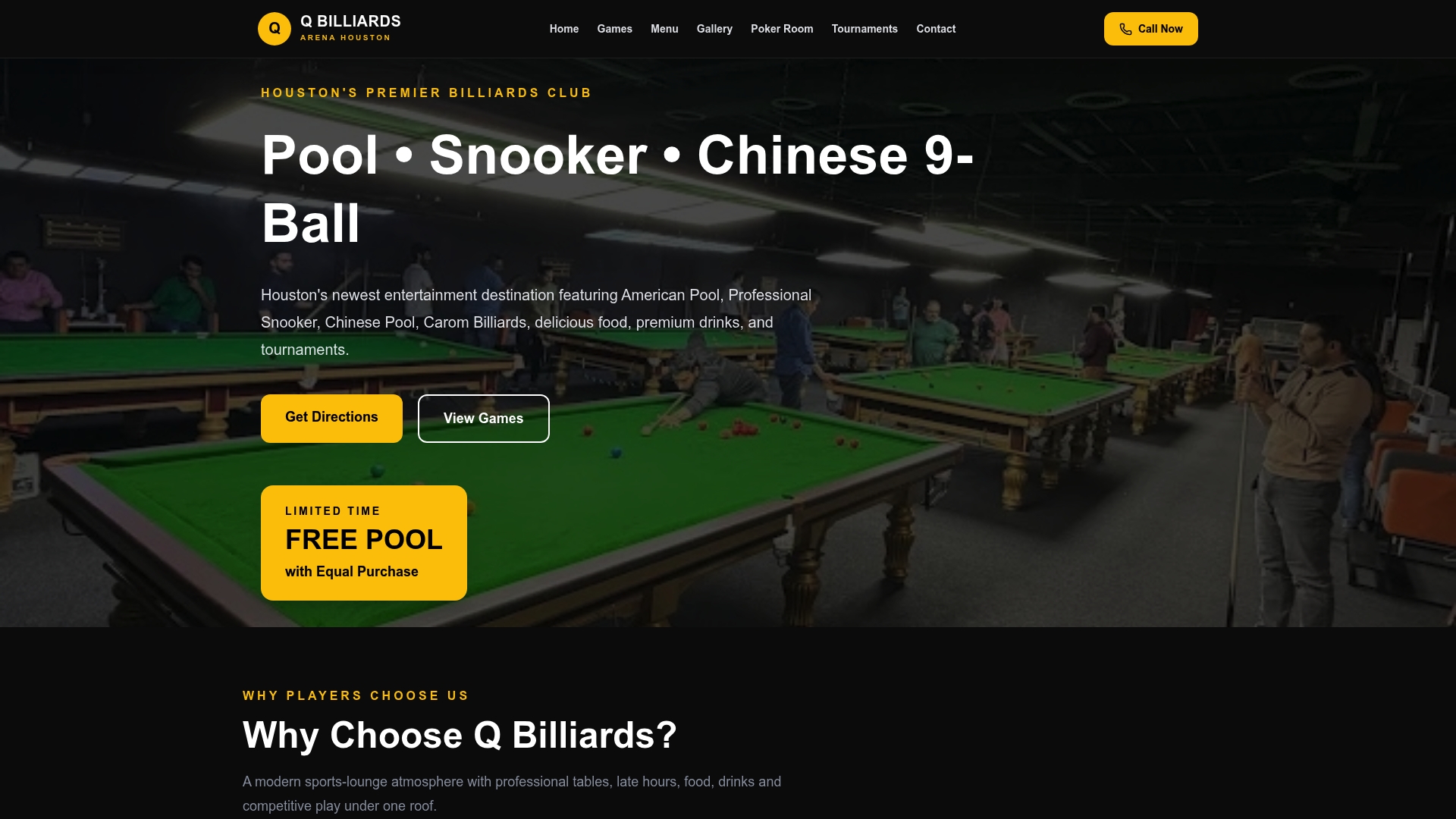
Check current hourly rates and table availability on the games and pricing page, or look at upcoming tournaments and league nights if you're planning to play regularly. Booking ahead means no surprise minimums when you show up.
Frequently Asked Questions
What is the average cost to play pool per hour? Most standard venues charge $5 to $6 per hour per table or per person, though rates run from $2 at the low end to $12 or more during peak hours, according to a 2026 price guide.
Why did I get charged more than the posted hourly rate? You likely hit a minimum time block, often 30 minutes, that rounds up your session even if you played for less. Ask about proration policy before you start the clock.
Is it cheaper to play pool alone or with a group? Splitting a per-table rate among three or four players almost always beats paying a per-person fee individually, since the table cost gets divided rather than multiplied.
Do pool halls charge for spectators? Some do, especially venues billing per-person rather than per-table. Always confirm this before bringing a group who won't all be shooting.
Can I play pool for free? Some venues run promotions that include free table time with a food or drink purchase, particularly during slow weekday hours.
Sources
- Pool tables and Snooker table — 946 Billiards
- Price List | Enjoy Pool Specials — Book Now — Galaxy Pool Lounge