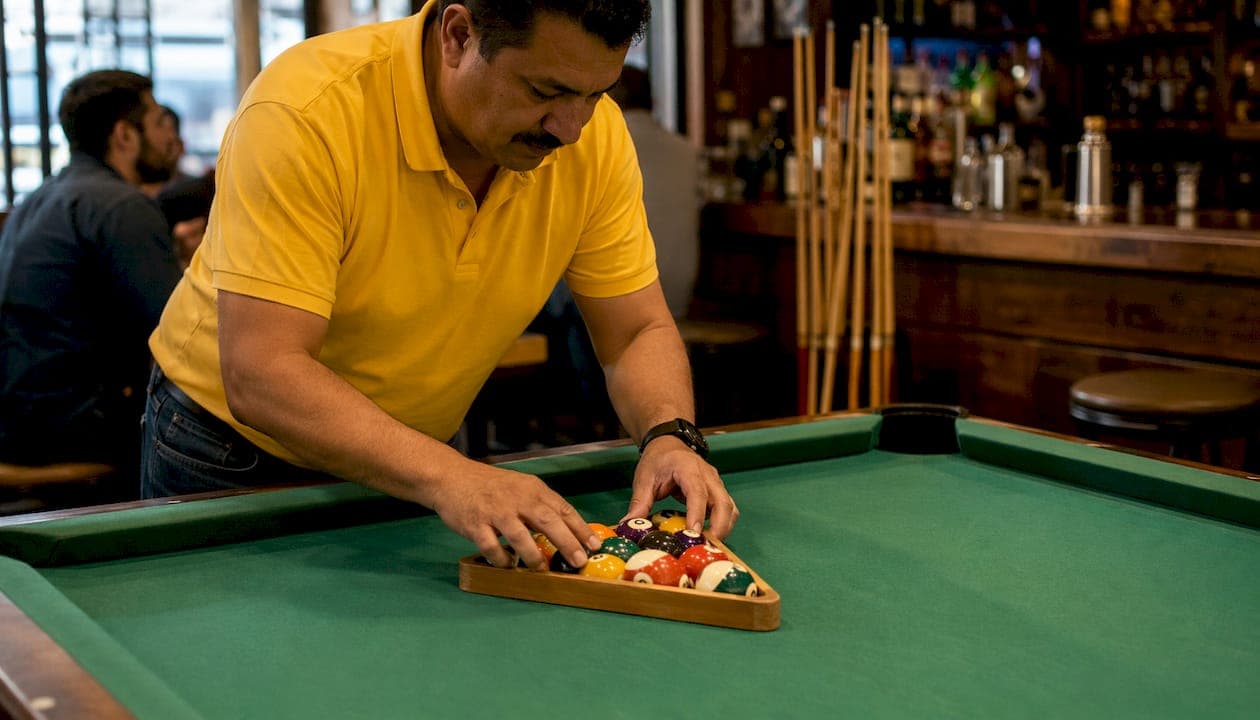
A legal 8-ball rack comes down to three fixed rules: the apex ball sits directly over the foot spot, the 8 ball goes in the center of the third row, and the two rear corner balls must be one solid and one stripe. Everything else — the other 11 balls — can go anywhere you like. Both the American Poolplayers Association (APA) and the Billiard Congress of America (BCA) anchor their racking rules to these three points. Get them right and your rack is tournament-legal. Miss any one of them and a referee can call a re-rack before the break even happens.
The quick checklist:
- Apex ball centered over the foot spot (front of the triangle)
- 8 ball in the center position of the third row
- One solid and one stripe in the two rear corner positions
- Remaining 11 balls placed randomly — no alternating pattern required
- All balls pressed tightly together ("frozen") before lifting the rack
Qbilliardshtx runs weekly tournaments and supervised practice sessions where these exact standards are enforced, making it a practical place to build the habit and an ideal spot to learn more from a darts for beginners: your complete starter guide.
Table of Contents
- How do you rack 8 ball correctly, step by step?
- What do official APA and BCA rules actually require?
- Where exactly does the apex ball go, and does the 8 ball sit on the dot?
- What rack types and tightening techniques produce the best results?
- What mistakes cause a re-rack, and how do referees handle them?
- Which house rules are myths, and which ones actually matter?
- Three drills to get faster and more consistent at racking
- Key Takeaways
- Why the corner split and tight rack matter more than most players realize
- Come practice your rack at Qbilliardshtx in Houston
- Useful sources and further reading
How do you rack 8 ball correctly, step by step?
Follow this checklist at the table and you will not need to second-guess yourself:
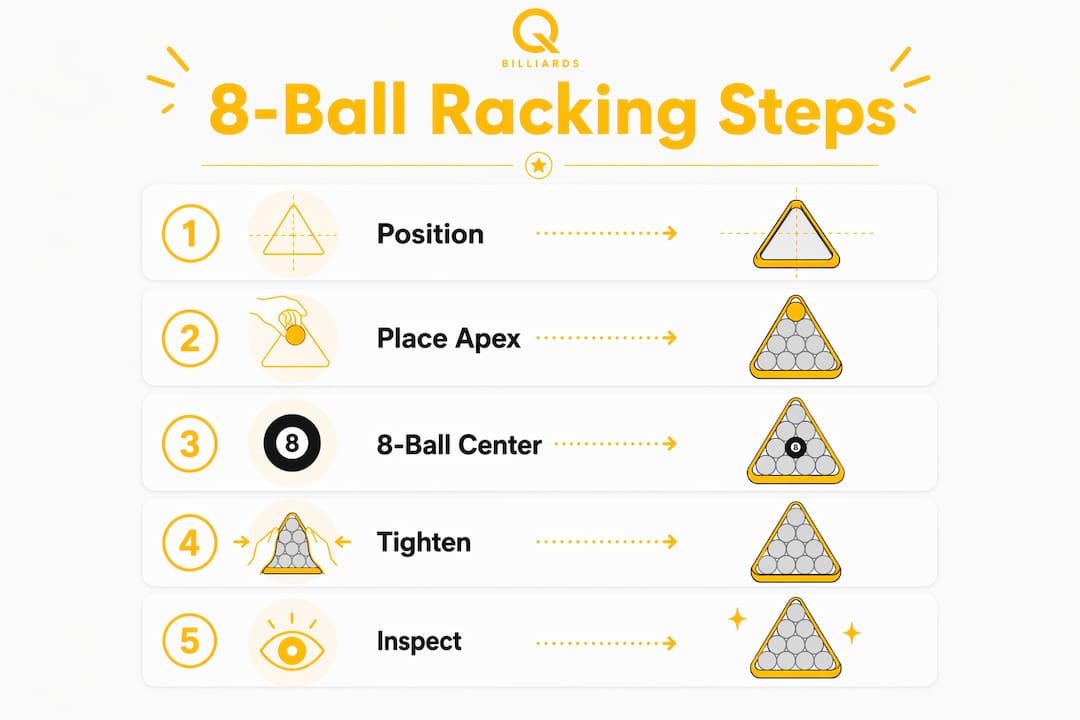
- Set the rack on the table and position the apex opening over the foot spot. The foot spot is the small dot roughly two-thirds of the way down the table from the head rail. If your table has no visible dot, use the diamonds on the long rails to locate it (more on that in the alignment section below).
- Choose any ball except the 8 for the apex position. Drop it into the front pocket of the rack so its center sits directly over the foot spot.
- Place the 8 ball in the center of the third row. The third row has three balls; the 8 goes in the middle one. This is the geometric center of the entire 15-ball triangle.
- Put one solid and one stripe in the two rear corner positions. It does not matter which corner gets which type — just make sure they are different.
- Fill the remaining 11 spots randomly. Toss them in without a pattern. Standard rules) intentionally leave these positions random so no one can "map" a favorable break.
- Tighten the rack. Press the balls together firmly, then push the entire rack forward about half an inch while keeping slight downward pressure. This slides the balls into each other and removes gaps.
- Lift the rack straight up. Keep it level and pull it directly upward. If any ball rolls or shifts, lower the rack and repeat the tightening step before lifting again.
Pro Tip: Before you lift, press each ball in the back two rows lightly with your fingertips to confirm none are floating. A single loose ball in the back row will scatter unpredictably on the break and may draw a re-rack request.
A quick sketch or phone photo of the apex and center positions during practice sessions is worth doing at least once. Seeing the geometry from above locks in the spatial memory faster than any written description.
What do official APA and BCA rules actually require?
The core requirements are consistent across the major governing bodies. APA league rules specify:
- Apex ball on the foot spot
- 8 ball in the dead center of the rack
- Back corners split: one solid, one stripe
- All balls frozen (touching) as tightly as possible
"All balls should be frozen (touching) as tightly as possible. Balls are typically racked by the non-breaking player, and the breaking player may request a re-rack per league rules." — APA Pool Rules, Racking
That last point matters in league play. The player who is not breaking racks the balls. The breaker has the right to inspect the rack and request a re-rack before striking the cue ball. If the 8 ball is off-center or the corners are wrong, the breaker can and should call it out before the break, not after.
The BCA and the World Pool-Billiard Association (WPA) follow the same three fixed-position rules. Tournament referees treat an improperly placed 8 ball as grounds for a mandatory re-rack because a misplaced 8 creates a measurable advantage for the breaker. In most sanctioned formats, the consequence is a re-rack rather than a foul on the first offense, but repeated or deliberate misracking can escalate to a foul and opponent's choice of play.

Where exactly does the apex ball go, and does the 8 ball sit on the dot?
This is the question that trips up more players than any other. The short answer: the apex ball goes on the dot, not the 8 ball.
The foot spot is a single marked point on the cloth. The center of the apex (front) ball should sit directly over that spot. The 8 ball then falls naturally into the center of the third row, which is a geometric consequence of the triangle's shape — not a second dot you need to find.
If your table has no visible foot spot, use the long-rail diamonds to locate it. The foot spot sits at the intersection of an imaginary line drawn between the second diamonds from the foot rail on each long side. Most house tables have a worn or faded dot you can find by looking at a low angle across the cloth.
A few practical notes on tolerances:
- Leagues generally accept a rack where the apex ball is within a ball-width of the foot spot, but tournament referees hold to a tighter standard.
- The 8 ball's center position is judged visually. If it is clearly off to one side of the third row, a referee will call it.
- On older tables with worn cloth, the foot spot may be invisible. Establish its location before the match starts, not mid-game.
What rack types and tightening techniques produce the best results?
The standard triangle rack is what most players use, and it works fine when handled correctly. Two other options are worth knowing:
- Diamond rack: Designed for 9-ball, not 8-ball. Nine balls in a diamond shape. Do not use it for a 15-ball setup. If you play Chinese 9-ball, the diamond rack is your tool.
- Template racks (magic racks): Thin plastic templates that sit flat on the cloth and hold each ball in a fixed position. Many venues adopt them for league nights because they produce a consistently frozen rack without the push-forward technique. The balls cannot shift when you lift the template.
For a standard triangle rack, the push-forward technique is the most reliable way to get a frozen pack. Place the rack, load the balls loosely, then push the entire rack toward the foot rail about half an inch while pressing down lightly. The balls compress against each other and the rack walls. Hold that pressure, then lift straight up. The goal is zero gaps between any two adjacent balls.
Pro Tip: After lifting the rack, tap the cue ball lightly on the cloth near the head string and watch the rack. If any ball in the back row wobbles, the rack was not tight enough. Re-rack before the break.
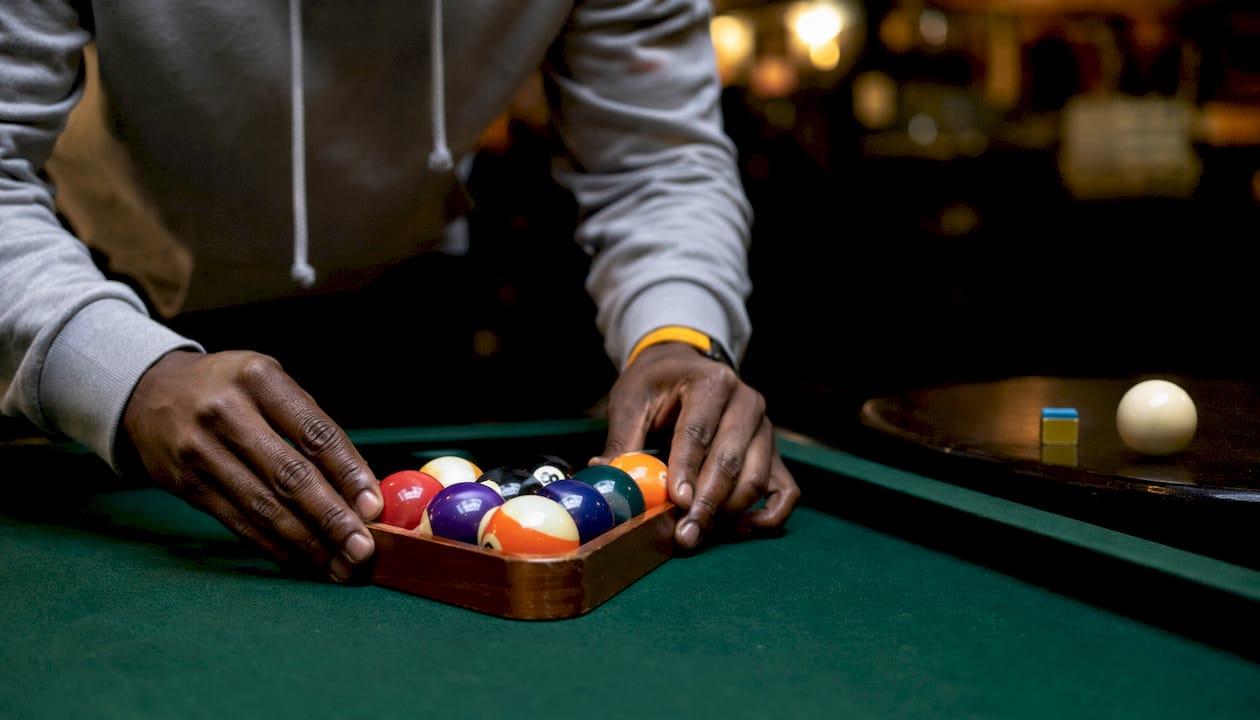
Dirty or humid balls grip the cloth and resist tightening. Wipe them with a clean microfiber cloth before racking if you notice resistance. Uneven cushions on older tables can cause the rack to sit slightly off-level; adjust your foot-spot alignment by eye rather than forcing the rack flat.
What mistakes cause a re-rack, and how do referees handle them?
Common errors that draw a ruling:
- 8 ball off-center: The most frequently called error. Even a half-ball shift is visible and gives the breaker a statistical edge.
- Both rear corners the same type: Two stripes or two solids in the back corners violates the split requirement and skews break odds toward one player.
- Loose rack: Gaps between balls mean the pack will not spread cleanly. A referee can call this before the break.
- Apex not on the foot spot: Shifts the entire rack geometry and changes cue-ball travel after the break.
- Moving balls while lifting the rack: Lifting at an angle or too quickly drags balls out of position.
APA enforcement follows a clear priority: the breaker inspects and requests a re-rack before striking. Once the break shot is taken, most leagues consider the rack accepted. A tournament director will typically order a re-rack for any of the above errors if caught before the break. Post-break rulings are rare and usually limited to situations where the 8 ball was clearly misplaced and the error is documented.
Which house rules are myths, and which ones actually matter?
The most persistent myth in casual play is that you must alternate solids and stripes throughout the rack. You do not. Official rules require only the three fixed positions: apex on the spot, 8 in the center, corners split. The remaining balls are deliberately randomized to prevent anyone from engineering a favorable spread.
A few other myths worth clearing up:
- "The 1-ball must go at the apex." Not in 8-ball. Any non-8 ball works. The 1-ball-at-apex rule applies to straight pool (14.1 continuous), not 8-ball.
- "The 8 ball goes on the dot." Wrong. The apex ball goes on the dot. The 8 sits in the center of the third row.
- "You have to alternate stripe-solid-stripe in every row." No official ruleset requires this. It is a house preference, nothing more.
If you are playing at a bar or a friend's house with different house rules, agree on the rack pattern before the first break. House rules are fine for casual play as long as both players accept them upfront. In any APA or BCA-sanctioned match, the official three-point rule applies regardless of what the venue normally does.
Three drills to get faster and more consistent at racking
Racking well under pressure is a skill, and it responds to deliberate practice. These three drills are short enough to run in a single warm-up session.
- Timed racking challenge. Set a timer and rack 10 consecutive times, aiming to complete each rack in under 60 seconds with a frozen pack. Check each rack before lifting: apex on the spot, 8 in center, corners split. The goal is to build muscle memory so the sequence becomes automatic.
- Tightness-check drill. Rack normally, then tap the cue ball from the head string at about 30% break speed. Watch how the balls spread. A tight rack produces a clean, symmetrical explosion. A loose rack leaves clusters and dead balls near the foot rail. Repeat until you can predict the spread from the sound of the break.
- Partner re-rack and judge drill. One player racks, the other inspects and calls any errors before the break. Switch roles every five racks. This simulates league play and trains both the racker and the breaker to spot problems quickly.
Practice these at least once a week if you are preparing for tournament play. Qbilliardshtx hosts weekly tournaments and drop-in sessions on its 25 professional-grade tables, where you can run these drills on the same cloth and equipment used in competition.
Pro Tip: Photograph your rack from directly above before lifting it. Review the image after the session to check apex alignment and 8-ball centering. Most players discover their apex drifts slightly toward one rail — a bias that is invisible from a standing position.
Key Takeaways
A legal 8-ball rack requires three fixed positions: apex on the foot spot, 8 ball in the center of the third row, and one solid plus one stripe in the rear corners — everything else is random.
| Point | Details |
|---|---|
| Three fixed positions | Apex on foot spot, 8 ball in center of third row, rear corners split solid/stripe. |
| Random fill for the rest | The remaining 11 balls go in any order; alternating is a myth, not a rule. |
| Frozen rack is mandatory | Press balls tight with the push-forward technique; re-rack if any ball shifts on the lift. |
| League racking protocol | The non-breaker racks; the breaker may request a re-rack before striking per APA rules. |
| Practice at Qbilliardshtx | Weekly tournaments and drop-in sessions on 25 pro tables reinforce correct racking habits. |
Why the corner split and tight rack matter more than most players realize
The corner split is not a formality. When one solid and one stripe sit in the rear corners, the break distributes both ball types across the table with roughly equal probability. Remove that requirement and a skilled breaker can exploit the geometry to pocket only their preferred type on the break, before the game has technically begun. That is why pro instructors treat the corner split as a fairness mechanism, not just a rule to memorize.
The tight rack matters for a different reason. A frozen pack transfers energy cleanly from the cue ball through the entire triangle. A loose rack absorbs that energy in the gaps, producing a dead, unpredictable spread. At Qbilliardshtx, we enforce both standards in every tournament because the quality of the break shapes the entire game. A sloppy rack does not just look bad — it changes who wins.
Come practice your rack at Qbilliardshtx in Houston
Knowing the rules is one thing. Executing a tight, tournament-legal rack under pressure is another, and the only way to close that gap is table time on real equipment.

Qbilliardshtx offers a large number of professional-grade tables in a spacious venue in Houston, open late, with fresh food and drinks on-site. Whether you want to run timed racking drills before a league match or just get comfortable with the foot-spot alignment, the tables are here. Weekly tournaments and events run regularly, so you can test your racking under actual competitive conditions. Check games and pricing to book a table or find out when the next tournament opens for entry.
Useful sources and further reading
These are the primary sources behind the rules and techniques in this article:
- APA Racking Rules: The official APA page covering who racks, re-rack rights, and frozen-rack requirements for league play. Start here for anything related to APA-sanctioned matches.
- Rack (billiards) — Wikipedia): A concise summary of world-standard racking rules including the three fixed positions and the rationale for randomizing the remaining balls.
- Nova Billiards: How to Set Up Pool Balls: Practical how-to guidance covering tightening technique, template racks, and the fairness logic behind the corner split. Good for technique questions.
- WikiHow: How to Rack in 8 Ball: Step-by-step visual guide useful for locating an unmarked foot spot and confirming ball placement. Best for beginners working through the geometry for the first time.
- BillardRule.com: 8-Ball Rack Rules: A rules summary that addresses the random-placement requirement and explains why alternating stripe-solid patterns are not mandated by official rules.