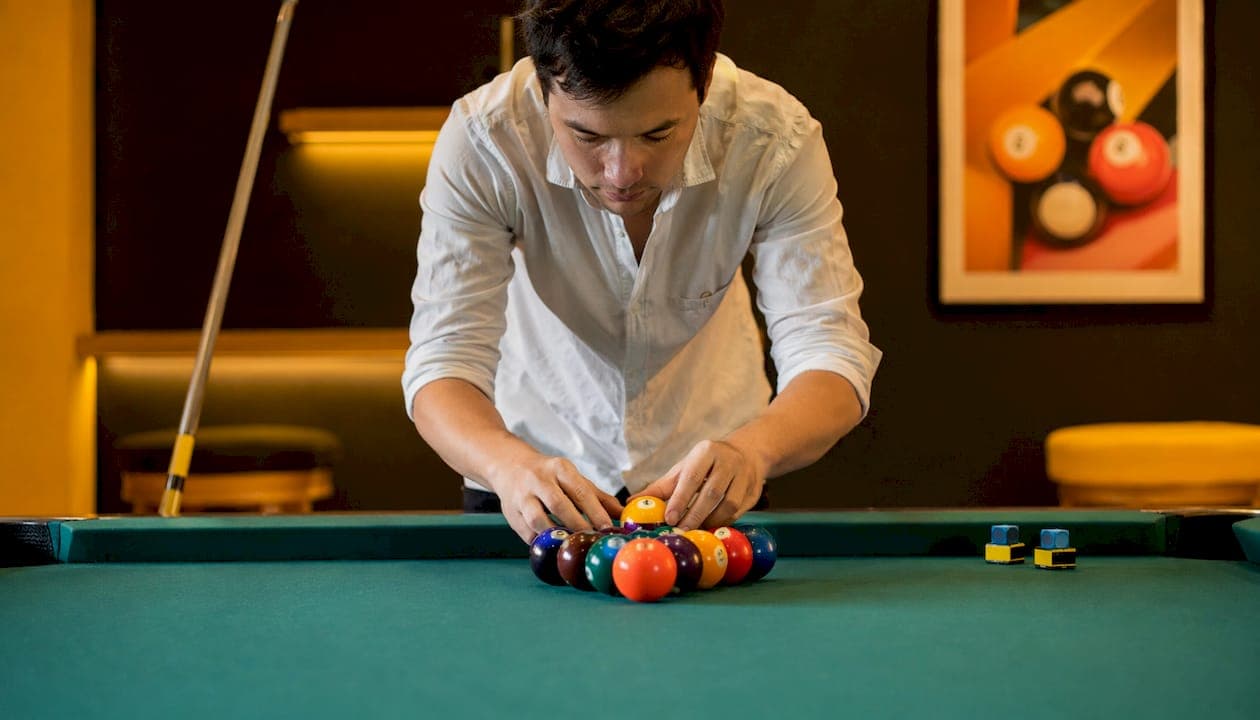
A correct 9-ball rack places the 1-ball at the apex on the foot spot, the 9-ball centered in the diamond, and all remaining balls packed tightly with no gaps. That's the WPA standard, which Qbilliardshtx enforces across every table at Q Billiards Arena in Houston.
Before your next break, run through this quick checklist:
- 1-ball position: Apex of the diamond, sitting directly on the foot spot
- 9-ball position: Dead center of the diamond formation
- Tightness: Every ball touching its neighbors — no floating balls, no gaps
- Balls 2–8: Placed randomly, no intentional pattern
- Who racks: In rack-your-own formats, the breaker racks; the opponent can demand a re-rack before the break if the rack looks loose or misaligned
A loose rack kills the break. When balls aren't frozen together, the kinetic energy from your cue ball scatters into the gaps instead of spreading the pack. Tight racks give you the explosive spread you're after.
Table of Contents
- How do you rack 9 ball step by step?
- What counts as a legal break in 9-ball?
- Common racking mistakes that wreck your break
- How should a venue standardize 9-ball racking?
- Short drills to improve your rack and break
- Key Takeaways
- The rack matters more than most players admit
- Play Chinese 9-ball on a properly racked table in Houston
- Useful sources
How do you rack 9 ball step by step?
Follow this sequence before every game and you'll have a legal, tight rack in under a minute.
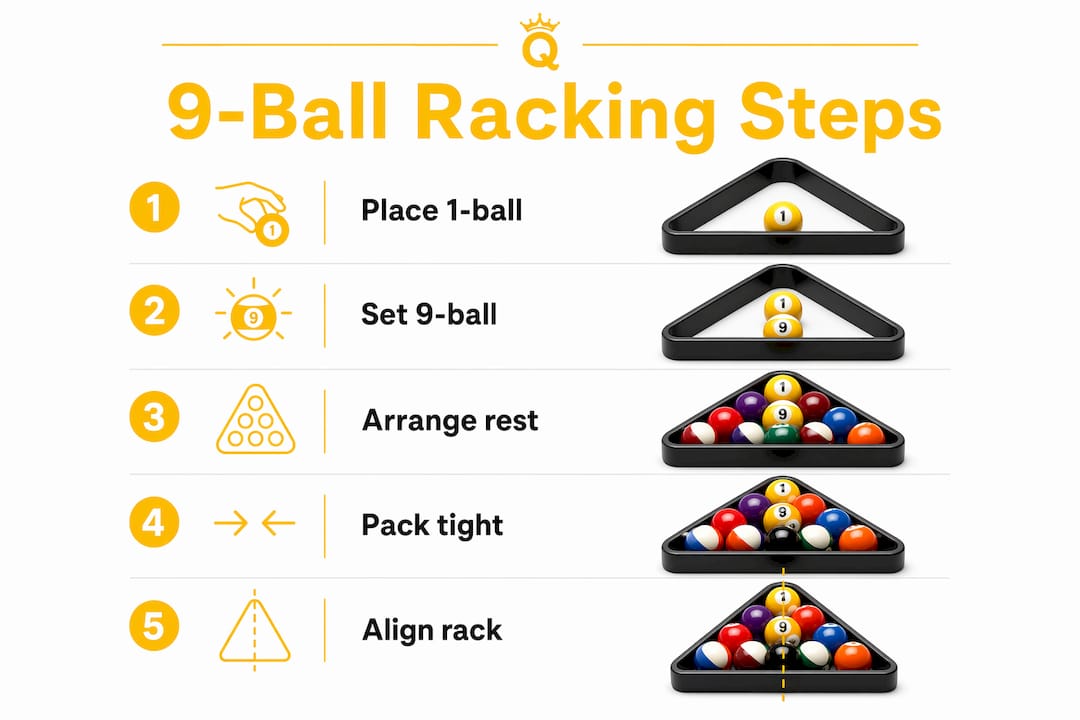
- Grab the diamond rack and position it with the single-ball point facing the foot rail (toward the shooter).
- Place the 1-ball at the apex directly on the foot spot — the marked dot at the center of the foot rail end of the table.
- Set the 9-ball in the exact center of the diamond formation. That's the middle position, surrounded by two balls on each side.
- Fill positions 2–8 randomly. Drop the remaining seven balls into the open spots without any deliberate order.
- Pack the rack tight. Press each ball firmly against its neighbors so every ball is frozen — touching with no daylight between them.
- Lift the rack straight up in one smooth motion. Don't drag or tilt it.
If any ball shifts when you lift the rack, reset everything and start over. A shifted ball means a loose rack, and a loose rack is grounds for a re-rack before the break.
Quick 3-second check before you step back:
- 1-ball on the foot spot? ✓
- 9-ball centered? ✓
- No gaps visible from the side? ✓
Pro Tip: Align the 1-ball by eye from the side of the table, not from behind the rack. Looking straight down at the foot spot while placing the ball is the fastest way to confirm it's centered.
A diamond-shaped rack is standard for 9-ball. If you're using a triangle rack at a recreational table, pack the balls into a diamond shape inside the triangle and take extra care to freeze the center 9-ball — the triangle's lip makes it harder to get a truly tight formation.
What counts as a legal break in 9-ball?
The break isn't just about hitting hard. It has to meet specific thresholds, or it's called illegal and the rack resets.
| Governing Body | Legal Break Requirement | Consequence of Illegal Break |
|---|---|---|
| WPA / BCA | Pocket at least one ball or drive a minimum of four object balls to rails | Re-rack; opponent may choose to break or force repeat |
| UPA | Pocket at least one ball or drive a minimum of three object balls to rails | Re-rack; opponent's choice |
| CueSports Australia | Pocket at least one ball or drive a minimum of four object balls to rails | Re-rack; standard foul consequences |
Most Houston league play follows WPA or UPA guidelines. The practical difference between "3 balls to rails" and "4 balls to rails" matters when a break looks borderline — know which ruleset your game is using before you sit down.
The standard rule: If the cue ball strikes the 1-ball and neither a ball is pocketed nor the minimum number of object balls reach a rail, the break is illegal. The incoming player typically gets the choice to re-rack and break themselves or force the original breaker to shoot again.
Calling an illegal break at the venue:
- Either player may call an illegal break immediately after the shot
- The rack is reset; the opponent decides who breaks
- In rack-your-own play, the new breaker is responsible for setting a legal rack before their attempt
Pattern racking — placing specific balls in deliberate positions to favor a particular break outcome — is prohibited in formal play and can be protested by the opponent or a referee. Randomizing balls 2–8 isn't just a suggestion; it's the rule.
Common racking mistakes that wreck your break
Most bad breaks trace back to the rack, not the stroke. Here are the mistakes that show up most often:
- Floating balls: One or more balls not touching their neighbors. Even a small gap absorbs enough energy to flatten the spread.
- 1-ball off the foot spot: Even a half-inch misalignment changes cue-ball deflection and can result in a protest.
- Pattern racking: Placing the heaviest or lightest balls in specific spots to control the spread. Illegal in league and tournament play.
- Wrong rack shape without adjustment: Using a triangle without carefully centering the 9-ball and packing the formation tight.
- Rushing the lift: Dragging or tilting the rack instead of lifting straight up, which nudges balls out of position.
How each mistake hurts you:
- A gap between balls absorbs kinetic energy — the pack doesn't spread, and you're left with a cluster.
- A misaligned 1-ball changes the angle the cue ball deflects after contact, making position unpredictable.
- Pattern racking gives one player a structural advantage and invites disputes that slow the game down.
- A tilted rack lift shifts the 9-ball off center, which your opponent will notice immediately.
30-second rack quality check:
- Crouch to table level and look across the rack from the side. No daylight between balls.
- Confirm the 1-ball is on the foot spot from two angles (side and behind the rack).
- Check the 9-ball is centered, not drifted toward any corner.
Pro Tip: When using a triangle rack for 9-ball, carefully push balls and compress the formation toward the foot spot before lifting. This helps create a tightly packed diamond shape and reduces floating balls.
How should a venue standardize 9-ball racking?
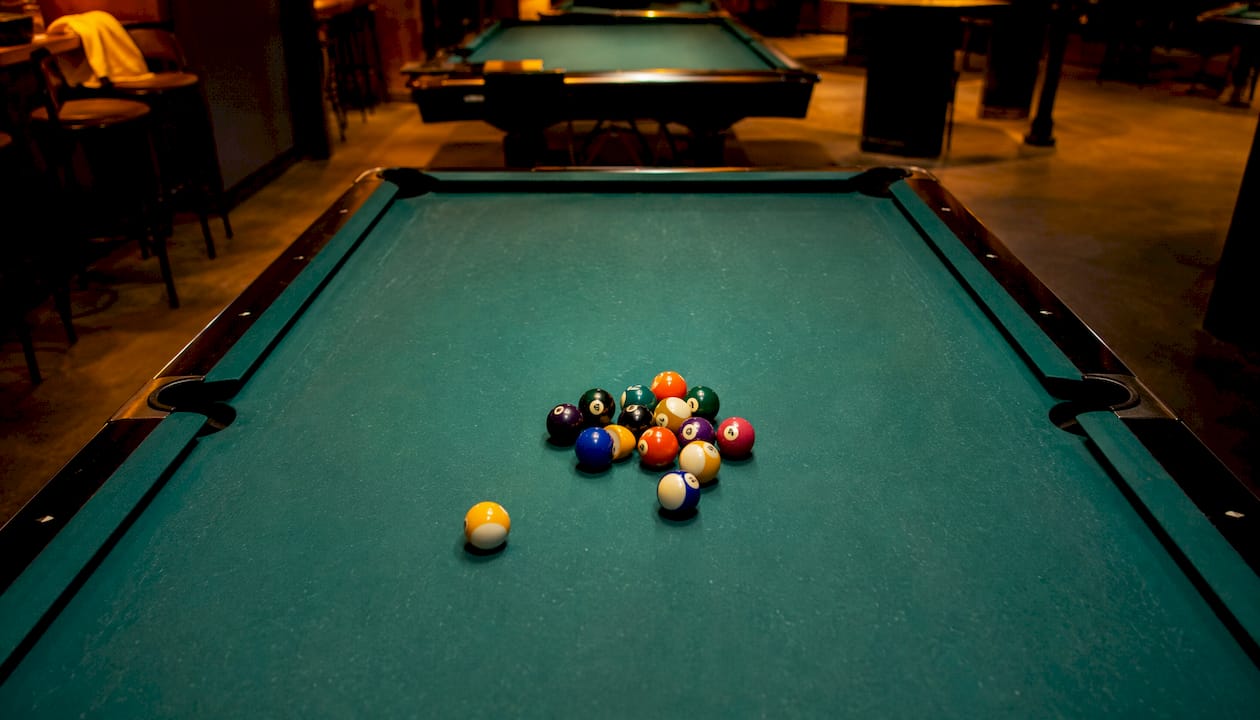
Consistency across tables is what separates a well-run venue from a casual bar setup. At Q Billiards Arena, the standard is WPA-aligned: the 1-ball at the apex on the foot spot, the 9-ball centered, balls 2–8 randomized, and the entire formation frozen tight.
Staff and host checklist:
- Confirm the diamond rack is used (or that a triangle rack is packed to diamond formation)
- Place the 1-ball on the foot spot; if a table imperfection prevents exact placement, rules allow positioning within a dime's radius of the foot spot to achieve a tight rack
- Randomize balls 2–8 — no deliberate order
- Freeze all balls before lifting the rack
- On league nights with coin-operated tables, substitute higher-numbered balls (10–15) when needed to keep play moving without interrupting the set
Venue policy in one sentence: Every rack must have the 1-ball on the foot spot, the 9-ball centered, all balls frozen, and no intentional ball pattern — any player may request a re-rack before the break if these conditions aren't met.
For tournaments, neutral staff racking is the most reliable way to prevent patterning disputes. Hosts should place the 1-ball dead on the foot spot and center the 9-ball on every rack without exception.
Pro Tip: Before a tournament match, have the host rack while both players watch. This removes any suspicion of patterning and keeps the match moving without disputes.
Short drills to improve your rack and break
These drills work on any table at Q Billiards and take 10–15 minutes.
- Repeat racking drill: Rack and lift 10 times in a row without breaking. After each lift, check for shifted balls. Goal: zero shifts in 10 consecutive racks.
- Controlled break drill: Rack tight, break with moderate power, and count how many balls reach a rail. Target: at least 3 balls to rails in 8 of 10 breaks.
- Visual gap check: After racking, crouch to table level before lifting. If you see any gap, repack before lifting. Do this 5 times until the habit is automatic.
Success criteria to track:
- Zero ball shifts on rack removal in a 10-rack set
- At least one ball pocketed or 3+ balls to rails in 8 of 10 breaks
- 9-ball centered and 1-ball on foot spot confirmed visually before every lift
Ask a staff member at Q Billiards to observe your rack during a practice session. A second set of eyes catches misalignment faster than self-checking, especially when you're still building the habit.
Key Takeaways
A legal 9-ball rack requires the 1-ball on the foot spot, the 9-ball centered in the diamond, all balls frozen tight, and balls 2–8 placed without any intentional pattern.
| Point | Details |
|---|---|
| 1-ball placement | Always at the apex of the diamond, directly on the foot spot — no exceptions. |
| 9-ball placement | Centered in the diamond formation, surrounded equally on all sides. |
| Rack tightness | Every ball must be frozen (touching); gaps absorb break energy and flatten the spread. |
| Legal break threshold | Pocket at least one ball or drive the minimum number of object balls to rails required by your ruleset (three per UPA, four per WPA/BCA or CueSports Australia). |
| Qbilliardshtx standard | Q Billiards Arena enforces WPA-aligned racks with staff racking available for tournaments. |
The rack matters more than most players admit
Most players blame their stroke when a break goes flat. The rack is usually the real problem. A single floating ball between the 5 and 7 can absorb enough energy to leave the pack barely moved, and no amount of power fixes that.
Pattern racking gets more attention than it deserves as a controversy. The simpler issue is that most amateur racks are just loose — not deliberately patterned, just not frozen. Fixing that one thing, consistently, will improve break results faster than any tip about stroke mechanics or bridge position.
Venues that enforce rack standards consistently also run better tournaments. When every rack is built the same way, disputes disappear and players focus on the game instead of arguing about setup. That's the practical reason WPA alignment matters beyond the rulebook.
Ask for a re-rack if something looks off. You have that right before the break, and a good venue will honor it without hesitation.
Play Chinese 9-ball on a properly racked table in Houston
Q Billiards Arena gives you 25 professional-grade tables, WPA-aligned rack standards, and staff who know the rules — so you spend your time playing, not debating setups. Whether you're running drills solo or competing in a weekly tournament, the tables are ready when you are.

Check games and pricing to book a Chinese 9-ball table, or come in on a tournament night to put your break to the test against real competition. Q Billiards Arena is open late, with food and drinks on-site — everything you need for a serious practice session or a competitive match.
Useful sources
- WPA — How to Play 9-Ball Pool: Official WPA rules covering rack setup, ball placement, and legal break requirements.
- UPA — 9-Ball Rules: US Professional Poolplayers Association rules including rack-your-own policy, legal break thresholds, and re-rack procedures.
- BCA 9-Ball Rules (University of Colorado): Billiard Congress of America official ruleset covering racking, legal breaks, and game structure.
- APA League Racking Rules: American Poolplayers Association guidance on rack types, ball substitution for coin-op tables, and league-night procedures.
- Dr. Dave Pool Info — Pattern Racking FAQ: Detailed explanation of why pattern racking is prohibited and how neutral racking works in sanctioned events.
- Q Billiards Arena — Chinese 9-Ball in Houston: Venue-specific information on Chinese 9-ball tables, formats, and events at Q Billiards Arena.