
The fastest ways in are national league signup or a quick call to a local host venue. Sign up with the American Poolplayers Association and use its host location finder, or call a pool hall on its league night and ask to join as a free agent. Both routes get you playing within a week or two.
Here's what to do right now:
- Search the APA host location finder for a league near you and note the contact for that area.
- Call or visit a local pool hall during its league night and ask the operator how free agents get placed.
- Ask about upcoming sign-up deadlines. Most leagues run in seasons, so timing matters.
Q Billiards Arena hosts league nights and tournaments year round, and the front desk can walk you through team openings the same day you call.
Key Takeaways
Joining a pool league takes three concrete steps: find an active league through an official directory or venue visit, confirm costs and age rules upfront, and sign up as a free agent or with a team.
| Point | Details |
|---|---|
| Use official directories first | Start with the APA host finder or a local sanctioned league site before relying on social media. |
| Confirm age and cost rules | APA sets 18 as its baseline, but some host venues require 21 due to liquor licensing; verify locally. |
| Know your format and handicap | 8-ball and 9-ball dominate league play, with systems like Equalizer® or Fargo Rate leveling the field. |
| Free agent signup is the easiest entry | Contact a local operator, share your availability and experience, and get placed on an open roster. |
| Venue-run leagues add consistency | Q Billiards Arena hosts league nights and tournaments across 25 tables, giving players steady access and a built-in social scene. |
Table of Contents
- How Do You Find a Pool League Near You?
- What Formats and Handicap Systems Do Pool Leagues Use?
- What Does It Cost to Join a Pool League?
- What Happens on Your First League Night?
- How Do You Actually Sign Up: Solo or with a Team?
- How Do You Choose the Right League for You?
- How Can You Improve Your Game Before Joining a League?
- What Rules and Etiquette Matter Beyond Your First Night?
- Where Can You Find Teammates or Fill an Open Roster Spot?
- What Q Billiards Arena Has Learned Hosting Leagues
- Ready to Join a League Night at Q Billiards Arena?
- Sources
How Do You Find a Pool League Near You?
Start with the official directories before scrolling social media. The APA's host location finder lists sanctioned locations by area and connects you directly to a league operator, which beats guessing from an old Facebook post. Local sanctioned circuits like the Houston USAPL publish their own host venues and season schedules, so check those pages too if you're in a market with multiple organizations running side by side.
Venue websites tell you more than a phone call sometimes can. Look for league night listings, season start and end dates, and posted standings from the current session. If a hall hasn't updated its standings page in eight months, that's a signal the league might be inactive or shrinking.
Showing up in person still beats research. Walking into a hall on an actual league night lets you watch the format, gauge the skill level, and talk to the operator about open roster spots. Combine that with a scan of Meetup groups or local pool Facebook communities, since teams often post there when they're short a player mid season. The mix of an official directory search, a venue visit, and a social media check covers almost every gap the others miss.
What Formats and Handicap Systems Do Pool Leagues Use?
Most leagues run on one of two core games, sometimes both in the same season.
- 8-ball rewards positional play and defense, and it's usually the entry point for new league players.
- 9-ball moves faster and rewards shot making, common in more competitive divisions.
- Team formats dominate weeknight leagues, while singles ladders and small round-robins show up more in casual or daytime sessions.
Handicap systems are what make league play fair between a beginner and a shark on the same night. APA leagues use the Equalizer® handicap system, which adjusts how many games or points each player needs to win based on skill rating. Independent leagues sometimes reference Fargo Rate, a numeric rating built from match history across venues.
A typical league night runs two to three matches per team over two to three hours, with seasons lasting roughly 8 to 16 weeks before playoffs. Top teams or players from a season often advance to regional or national events.
Pro Tip: Ask what handicap system a league uses before you join. A system that undervalues your actual skill level can mean playing up in a bracket that's more frustrating than fun.
What Does It Cost to Join a Pool League?
Budget for three separate costs, not just one membership fee.
- National membership: APA membership is priced to keep the barrier low for beginners and unlocks Equalizer handicap play plus eligibility for championship events.
- Weekly dues: most leagues collect a small per-night fee that goes toward prizes, awards, or regional entry fees.
- Table or venue time: some host locations charge separately for table time beyond league dues, so ask upfront.
Age matters too. The APA sets 18 as its baseline minimum age, but plenty of host venues bump that to 21 because of state liquor licensing on the premises. Confirm the age policy with your specific league office before assuming national rules apply everywhere.
Rosters typically run 4 to 8 players per team, with 2 to 3 required to show up on a given night. Most leagues allow substitutes, but check the sub policy so you know if a stand in player affects your handicap or standings.
What Happens on Your First League Night?
Walking in prepared beats winging it, and it takes almost no extra effort.
- Arrive 20 to 30 minutes early to meet your captain or the league operator and get your name on the lineup sheet.
- Warm up on an open table if one's available. Cold shooting your first competitive rack rarely goes well.
- Learn the scoring method, whether it's a paper scoresheet or a digital app, before your match starts so you're not fumbling mid-game.
- Watch the pace of play. Leagues run on a schedule, and slow play annoys opponents and the operator alike.
- Keep your phone off the table and handle any rule disputes calmly by asking your captain or the on-site official, not by arguing with your opponent.
Most first-night mistakes come from not knowing the local house rules on things like foul calls or ball spotting. Ask before you assume.
How Do You Actually Sign Up: Solo or with a Team?
Joining as a free agent is the simplest path if you don't already have a team lined up.
- Contact the local league operator or host venue directly and tell them you want to play as a free agent.
- Share your availability, rough skill level, and any prior league experience so they can place you fairly.
- Fill out a registration form and liability waiver, standard at almost every sanctioned league.
- Wait to be placed on a team with an open roster spot, which often happens within a week if the season hasn't started.
Building or joining a team takes a little more coordination. Team captains handle registration for the whole roster, confirm each player's availability against the league's match nights, and collect payment before the season locks in. If you're forming a new team, recruit at least the minimum roster size early, since scrambling for players after the schedule posts is a common rookie mistake.
Either way, have this ready before you call: contact info, any existing membership number, your typical weekly availability, and rough experience level.
Pro Tip: If you're new to league play, join as a free agent your first season. It's a low-pressure way to learn the format before committing to captain duties or recruiting a full roster.
How Do You Choose the Right League for You?
Not every league fits every player, and a quick checklist saves you from a bad-fit season.
- Match night and time: does it actually work with your schedule for the next 2 to 4 months?
- Game type: 8-ball, 9-ball, or a mix, and does the format match what you enjoy playing?
- Skill divisions: is there a beginner or intermediate bracket, or does everyone play in one pool?
- Total cost: membership, weekly dues, and any table fees combined.
- Make-up policy: what happens if you miss a night?
- Travel distance: is the host venue realistically close enough for a weekly commitment?
- Operator responsiveness: did they answer your questions quickly and clearly?
- Standings transparency: are results posted somewhere you can actually check?
Ask the operator directly: what's the buy-in, how are handicaps calculated, what's the sub policy, and does the league feed into regional or national events? A league built for casual social play answers those questions differently than one built for players chasing a championship berth, and neither answer is wrong. It just needs to match what you're actually looking for.
How Can You Improve Your Game Before Joining a League?
You don't need to be great before your first night, but a little prep keeps you from getting run over in week one. Spend time on the fundamentals that matter most in league play: consistent stance, a repeatable bridge, and pocketing balls from straight-on angles before worrying about fancy position play.

Practice with a purpose instead of just knocking balls around. Set up the same shot from five different angles and shoot it 20 times, tracking your make percentage. That kind of deliberate repetition builds muscle memory faster than random rack-after-rack play.
Position play separates decent players from league-ready ones. Work on leaving the cue ball in a spot where your next shot is easy, not just making the current ball. This single habit, more than raw shot-making, is what wins close matches in an 8-ball format where safety play and position matter as much as pocketing.
If money's tight before you're ready to pay league dues, there are ways to play pool for free in Houston to rack up practice time. Watching better players, even informally, teaches you shot selection and pacing you won't pick up from solo practice alone.
Finally, learn the basic rule set for whatever format you'll play. Knowing how ball-in-hand works, what counts as a legal break, and how fouls get called means you walk into your first match focused on your game instead of second-guessing the rules.
What Rules and Etiquette Matter Beyond Your First Night?
League etiquette gets less forgiving as the season goes on, since regulars notice repeat offenders faster than a one-time first-night stumble.
Respect the table rotation and shot clock culture even if your league doesn't enforce a strict timer. Chronic slow play frustrates opponents and backs up the whole night's schedule for every other match happening around you. Call your shots clearly when the format requires it, and don't argue a close call, ask for a second opinion from the operator or an uninvolved player instead.
Handle losses and wins the same way: briefly, respectfully, and without a scene. Trash talk that felt harmless in a casual game reads very differently in a league where you'll face the same opponents for months. Keep your cell phone off the table surface and off speaker, and step away from the table if you need to take a call.
Reporting scores accurately, whether on paper or a league app, matters more than it seems. Standings drive playoff seeding and sometimes regional qualification, so a sloppy or dishonest scoresheet affects more than just your own record. If your league uses a handicap system like the Equalizer, understand how wins and losses shift your rating over the season instead of being surprised when your handicap changes mid-year.
Substitute etiquette deserves its own mention. If you're subbing for someone, communicate your availability early, and if you can't make a match, tell your captain as soon as you know instead of leaving the team scrambling an hour before match time.
Where Can You Find Teammates or Fill an Open Roster Spot?
Plenty of solid players never join a league simply because they don't have four or five friends who also play. That's not actually a barrier.
League operators keep informal lists of free agents looking for a team, so telling the front desk or captain at any host venue that you're searching is often enough to get matched within a season or two. Social pool groups on Facebook and community boards on Meetup regularly post "team needs a player" requests, especially mid-season when someone drops out unexpectedly.

Venue-run leagues make this easier by default, since you're playing in the same physical space every week alongside other free agents and half-formed rosters. Striking up a conversation with someone on an adjacent table during open play is a legitimate recruiting strategy, and it's how a lot of long-running teams actually got built. Group game nights, like the ones covered in this guide to pool night group games, are also a low-pressure way to meet players before committing to a season together.
If you already have two or three players and need to round out a roster, ask your venue if they'll post a "team seeking players" note near the sign-up sheet. Most operators are happy to help since a full roster means a smoother season for everyone.
What Q Billiards Arena Has Learned Hosting Leagues
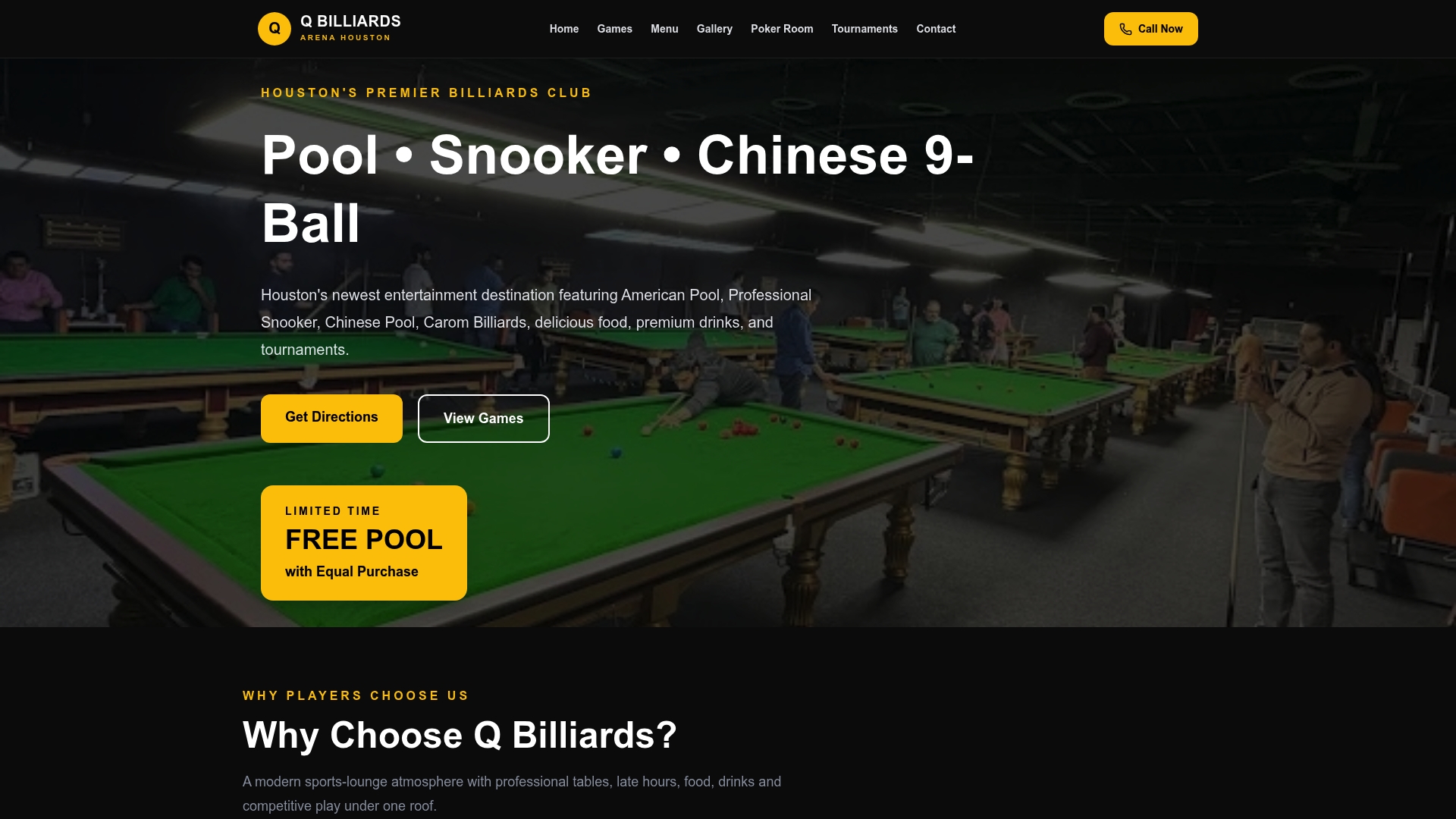
Running league nights across 25 professional-grade tables in an 11,000 square foot space teaches you what actually keeps players coming back: consistent table access, a social atmosphere where new and competitive players mix comfortably, and food and drinks that turn a match night into something worth looking forward to. Structured tournament pathways give both casual and serious players a reason to keep showing up week after week.
— Q
Ready to Join a League Night at Q Billiards Arena?
Q Billiards Arena runs league nights and tournaments across multiple professional tables, so you're not stuck waiting on one open table while three others sit idle on a busy night.
If you're ready to play, check the tournaments and league schedule for upcoming sign-up windows, or call the front desk to ask about open free agent spots or forming a new team. Not sure which game fits your budget or skill level yet? Review games and pricing before you commit, then stop by on a league night to see the room in action. Registration takes a few minutes, and most new players get placed within the current or next season.
Sources
- New Player Signup Host Location Finder
- How to Join a Pool League Near You: A Step-by-Step Guide for New Players