
The best pool night group games are Cutthroat, Kelly Pool, Bowlliards, Team 8-Ball (Scotch Doubles), Poker Pool, and One Pocket. Each fits a different group size and skill mix. Cutthroat handles 3–5 players and self-balances as the leader gets targeted. Kelly Pool scales up to 15 players with secret-number peas, making it the go-to for large parties. Poker Pool and Bowlliards level the field for mixed-skill crowds. One Pocket rewards strategy and suits smaller, advanced groups.
Quick Pick Table
| Game | Best Group Size | Skill Level | Pace |
|---|---|---|---|
| Cutthroat | 3–5 | Mixed | Medium (~20 min) |
| Kelly Pool | 3–15 | Beginner-friendly | Medium (15–25 min) |
| Bowlliards | 2–6 | Beginner-friendly | Fast (10–15 min) |
| Team 8-Ball | 4–8 | Mixed | Medium (20 min or more) |
| Poker Pool | 3–6 | Beginner-friendly | Medium (15–25 min) |
| One Pocket | 2–4 | Advanced | Slow (30 min or more) |
| 3-Ball | 2–6 | Any | Fast (5–10 min) |
Table of Contents
- Game cards: what you need to know before you rack up
- How to run a smooth pool night for any group size
- Concise rules and house-rule variants for each game
- What gear you need and how to set up tables for group play
- Sample 2-hour and 3-hour pool-night schedules
- What to ask a pool hall before you book a group night
- Staying safe while playing in a group setting
- Themed challenges and mini-tournaments that keep groups engaged
- Key Takeaways
- What actually makes a group pool night work
- Q Billiards Arena is where Houston groups come to play
- Where to learn official rules and find deeper game writeups
Game cards: what you need to know before you rack up
Each entry below gives you the essentials at a glance. Skill levels are honest, not optimistic.
Cutthroat — 3–5 players, mixed skill, medium pace. Each player owns a cluster of balls (1–5, 6–10, 11–15); pocket your opponents' balls and protect yours. The last player with at least one ball on the table wins. The built-in self-balancing mechanic keeps it lively: whoever runs hot gets ganged up on by everyone else.
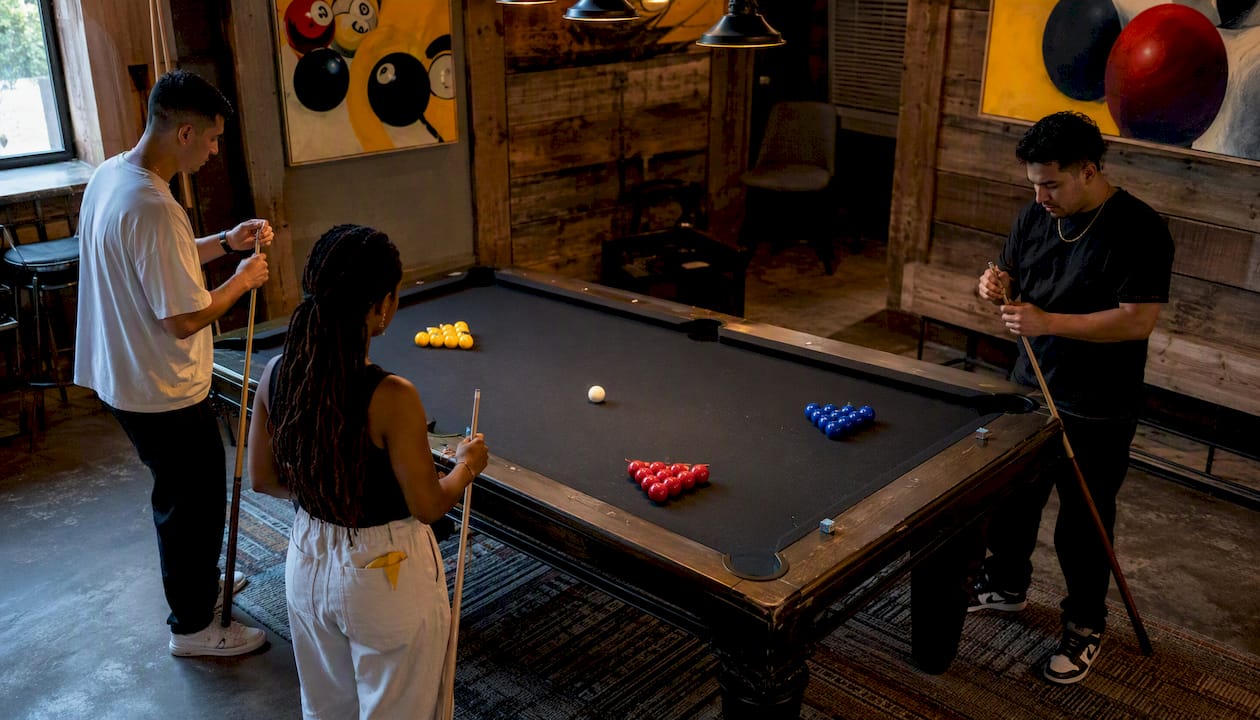
Kelly Pool (Pea Pool) — 3–15 players, beginner-friendly, medium pace. Each player draws a secret numbered pea from a bottle; your pea number is your ball. Pocket your ball before anyone else pockets theirs. The hidden-objective format means nobody knows who to target, which keeps the game social and fair across skill gaps.
Bowlliards — 2–6 players, beginner-friendly, fast. Uses a 10-ball rack arranged like bowling pins. Each player gets two shots per "frame" to clear as many balls as possible, scoring exactly like bowling. Bowlliards keeps tables moving and gives beginners a clear, familiar scoring system.
Team 8-Ball (Scotch Doubles) — 4–8 players (2 per team), mixed skill, medium pace. Standard 8-ball rules, but teammates alternate shots. Pairing a strong player with a beginner on each side is the simplest handicap you can run without any formal system.
Poker Pool — 3–6 players, beginner-friendly, medium pace. Each ball corresponds to a playing card; players pocket balls to build the best poker hand. The card-draw element introduces chance that limits any single player's dominance, which is exactly what you want when skill levels vary widely.
One Pocket — 2–4 players, advanced, slow. Each player is assigned one of the two foot pockets; you can only score in your pocket. Defensive play and shot selection matter far more than raw potting ability. Schedule this at a dedicated table for your strongest players.
3-Ball — 2–6 players, any skill, fast. Rack three balls in a triangle; lowest number of shots to clear all three wins. Perfect as a tiebreaker or a speed round between longer games.
Pro Tip: For Kelly Pool, buy a dedicated pea bottle set. Improvising with folded paper slips slows the game down and kills the momentum of a busy group night.
How to run a smooth pool night for any group size
Rotate every 20 minutes. That single rule keeps tables busy, prevents one group from camping, and gives beginners regular fresh starts.
Rotation and waitlist system:
- Assign each table a game type at the start of the night (e.g., Table 1: Cutthroat, Table 2: Kelly Pool, Table 3: Team 8-Ball).
- Set a timer. When it goes off, the losing player or team rotates to the next table; winners stay and challenge the incoming group.
- Keep a whiteboard waitlist at the host station. Anyone waiting gets the next open seat at any table.
- For groups over 10, run Kelly Pool on at least one table — it absorbs the most players per game.
Handicap and pairing options:
- Forced-object rule: stronger players must call every shot; beginners shoot freely.
- Coach-on-turn: a beginner can ask their stronger teammate for one tip per turn.
- Alternating breaks: rotate who breaks each game so one player does not dominate the opening.
Sample timing table:
| Format | Game | Slot Length |
|---|---|---|
| Speed round | 3-Ball | 5–10 min |
| Social rotation | Cutthroat | ~20 min |
| Social rotation | Kelly Pool | 15–25 min |
| Competitive set | Team 8-Ball | 20 min or more |
| Advanced table | One Pocket | 30 min or more |
Pro Tip: Assign one person as table marshal per four tables. Their only job is to start timers, settle disputes, and keep the waitlist moving. Without this role, group nights stall fast.
Concise rules and house-rule variants for each game
Setting rules before play starts prevents disputes, especially for games with hidden objectives like Kelly Pool and Poker Pool.
Cutthroat house rules:
- Setup: standard 15-ball rack, break from behind the head string.
- Winning condition: last player with at least one ball remaining.
- Common foul: scratch on the break — incoming player spots one ball per opponent's group.
- House variant: if a player pockets all opponents' balls in one turn, they win immediately (no need to wait for others to scratch).
Kelly Pool house rules:
- Setup: full 15-ball rack; peas drawn before the break.
- Winning condition: player whose secret ball is pocketed last wins, OR first to pocket their own ball (agree before you start).
- Common foul: pocketing the cue ball spots your ball back on the table.
- House variant: reveal your pea number when you're eliminated to add drama.
One Pocket house rules:
- Setup: standard rack; each player claims one foot pocket before the break.
- Winning condition: first to legally pocket 8 balls in their assigned pocket.
- Spotting rule: any ball pocketed in a non-assigned pocket is spotted back on the foot spot.
- House variant: allow one "pocket change" per game to keep beginners engaged.
Bowlliards house rules:
- Setup: 10-ball rack in a diamond/bowling-pin formation.
- Winning condition: highest score after 10 frames (bowling scoring).
- Common foul: cue ball scratch counts as a gutter ball for that shot.
Safety note: When moving around a table with multiple players, keep your cue pointed down and close to your body. Chalk at the table's edge, not mid-aisle. Never rest a cue against the table unsupported.
Pro Tip: Print a one-page rule card for each game and tape it to the wall above the table. Groups waste less time arguing and more time playing.
What gear you need and how to set up tables for group play
Packing checklist for hosts:
- Extra cues (at least 2 per table beyond the house set)
- Chalk (one cube per cue minimum)
- Triangle rack and 10-ball diamond rack (for Bowlliards)
- Spare cue balls
- Pea bottle set for Kelly Pool
- Standard playing card deck for Poker Pool
- Phone or timer for rotations
- Whiteboard or notepad for the waitlist
Table etiquette for group nights:
- Keep drinks and food off the table rail. Use a side table or the venue's designated surface.
- No more than 5 players standing around a single table at once. Observers wait at the waitlist station.
- Store unused cues in the wall rack, not leaning against the table.
- When racking 9-ball or 8-ball, the person who lost the previous game racks for the next.
What to ask the venue about equipment: Confirm they have clean cloths, working overhead lights, quality racks, and enough chalk before you arrive. A venue running 25 tables should have all of this on hand.
Sample 2-hour and 3-hour pool-night schedules
2-Hour Plan (fast rotation, social focus)
| Time | Activity |
|---|---|
| 0:00–0:20 | Arrivals, table assignments, rules briefing |
| 0:20–1:00 | Round 1: Cutthroat + Kelly Pool (rotate at 20 min) |
| 1:00–1:15 | Round 2: Bowlliards + 3-Ball speed rounds |
| 1:15–2:00 | Round 3: Team 8-Ball (Scotch Doubles) |
| 2:00–2:45 | Final round, tally scores, declare winner |
3-Hour Plan (mix of social and competitive)
| Time | Activity |
|---|---|
| 0:00–0:20 | Arrivals, drinks, table assignments |
| 0:20–1:00 | Social rotation: Cutthroat, Kelly Pool, Bowlliards |
| 1:00–1:15 | Break |
| 1:15–2:00 | Competitive sets: Team 8-Ball, mini-bracket (8 players, 4 matches) |
| 2:00–2:45 | Advanced table: One Pocket; others play 3-Ball or Poker Pool |
| 2:45–3:00 | Finals + scores |
Scoring formats:
- Round-robin points: 2 points for a win, 1 for a draw, 0 for a loss. Works for any game.
- Ladder scoring: winners move up a table number, losers move down. Simple and self-managing.
- Best-of-3 matches: use for Team 8-Ball when you have time.
- Running total: track cumulative Bowlliards scores across all frames for a team leaderboard.
Mixing fast games like 3-Ball with strategy games like One Pocket keeps the group activities paced well. Schedule One Pocket only at a dedicated table to avoid slowing the whole floor.
What to ask a pool hall before you book a group night
Core booking questions:
- How many tables can you reserve, and is a private section available?
- What is the hourly rate per table, and is there a group minimum?
- Do you offer group packages or promotions (e.g., free pool with equal food/drink purchase)?
- What are your cancellation and deposit policies?
- How late are you open? (Late-night hours matter for longer events.)
Equipment and staffing questions:
- Do you provide extra cues, chalk, and specialty racks (10-ball diamond)?
- Is there a staff member available to help manage rotations or resolve rule disputes?
- Can you accommodate a mini-tournament bracket on-site?
Food and drink:
- Ask whether outside food is allowed or if the venue has a full menu.
- Confirm where drinks can be placed near tables.
Check the Games & Pricing page before you call so you arrive with specific questions rather than starting from scratch.
Staying safe while playing in a group setting
Billiards is low-impact, but a crowded table area creates real hazards.
Keep cues horizontal and below shoulder height when moving between tables. A backswing in a tight space can catch someone in the face. Before you shoot, glance behind you. If another player is within arm's reach of your cue, ask them to step back.
Chalk at the table's edge, not while walking. Chalk dust on the floor creates a slip hazard. Wipe up spills immediately and tell venue staff rather than leaving it.
Cue cases and bags belong under chairs or against the wall, never on the floor mid-aisle. In an 11,000-square-foot venue with multiple active tables, a bag in the walkway is a trip risk.
Themed challenges and mini-tournaments that keep groups engaged
A straight rotation works, but a theme or bracket structure turns a good night into a memorable one.
Mini-tournament formats:
- Single elimination: fast, dramatic, works for 8 or 16 players in Team 8-Ball. Use the Tournaments & Events page to see how a venue like Qbilliardshtx structures bracket nights.
- Round-robin pool: every team plays every other team once. Best for groups of 6–10 where everyone wants table time.
- Pool-into-knockout: run a round-robin group stage, then take the top two from each group into a knockout bracket. Keeps more players competitive longer.
Themed challenge ideas:
- Trick-shot challenge: each player attempts the same preset shot; most successful attempts wins a round.
- Speed Bowlliards: 60-second shot clock per frame. Forces fast decisions and generates crowd noise.
- Poker Pool high-hand tournament: best poker hand across three racks wins the table.
- Blind draw doubles: partners are randomly assigned each round, so strong and weak players mix constantly.
Themed nights work especially well for adult birthday parties or corporate group bookings where the goal is social mixing, not pure competition.
Key Takeaways
The most effective pool night uses a short game shortlist matched to group size, a 20-minute rotation system, and clear house rules set before the first rack.
| Point | Details |
|---|---|
| Game shortlist | Cutthroat (3–5), Kelly Pool (3–15), Bowlliards, Team 8-Ball, Poker Pool, and 3-Ball cover every group size and skill mix. |
| Rotation system | Rotate every 20 minutes with a whiteboard waitlist; assign a table marshal for every four tables. |
| Essential gear | Bring a pea bottle, 10-ball rack, playing cards, extra chalk, and a timer — most venues won't have all of these. |
| Booking checklist | Confirm table count, hourly rate, group packages, cancellation policy, and late-night hours before you commit. |
| Qbilliardshtx | Q Billiards Arena offers 25 professional-grade tables, late-night hours, on-site food and drinks, and a free-pool promotion with equal purchase. |
What actually makes a group pool night work
The conventional wisdom is that you need the right games. You don't. You need the right structure around any game.
Groups fall apart at pool nights for one reason: dead time. Someone is waiting, someone is confused about the rules, and the one shark at the table has run three racks while everyone else watches. The games listed here are not magic. Cutthroat self-balances because the leader gets targeted. Kelly Pool hides objectives so nobody knows who to shark. Poker Pool injects chance. But none of that matters if you don't set a timer, assign a marshal, and print the rules before the first ball drops.
The other thing most articles miss: beginners need wins, not just participation. Bowlliards and 3-Ball give newer players a real shot at the leaderboard because accuracy over two shots beats raw potting speed. Schedule those games early in the night, before the competitive sets, and you'll keep the whole group engaged through the final rack.
Q Billiards Arena is where Houston groups come to play
If you want 25 professional-grade tables, late-night hours, fresh food and drinks, and a venue that already knows how to run group nights, Q Billiards Arena is the straightforward answer for Houston. The setup handles everything from a casual six-person rotation to a full bracket tournament in one visit.
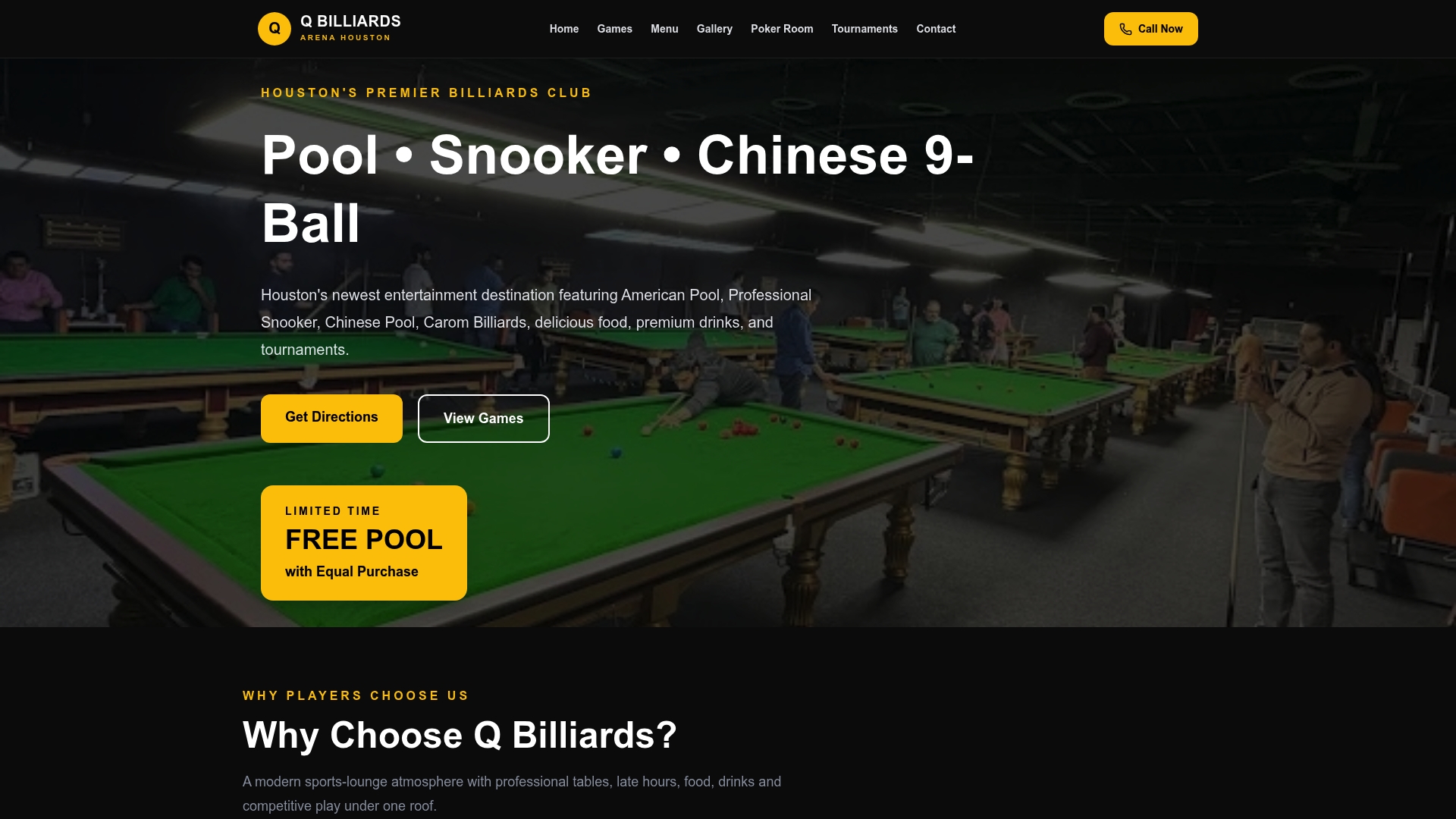
The free-pool-with-equal-purchase promotion makes group nights genuinely affordable. The private poker room adds a second act to any pool event. Check Games & Pricing for current hourly rates and package details, then call or book online to lock in your tables before the weekend fills up.
Where to learn official rules and find deeper game writeups
- Ozone Billiards blog — practical party-game writeups covering Kelly Pool, Poker Pool, and social variations.
- Presidential Billiards — clear house-rule guides for Cutthroat and other group formats.
- Classic Home Billiards — Bowlliards setup and scoring explained in detail.
- Q Billiards Arena group activities blog — real booking examples and event templates from the venue floor.
- Upstream Brewing billiard games guide — covers Seven-Ball, Fifteen-Ball, and Bank Pool for groups wanting to go beyond the standard shortlist.