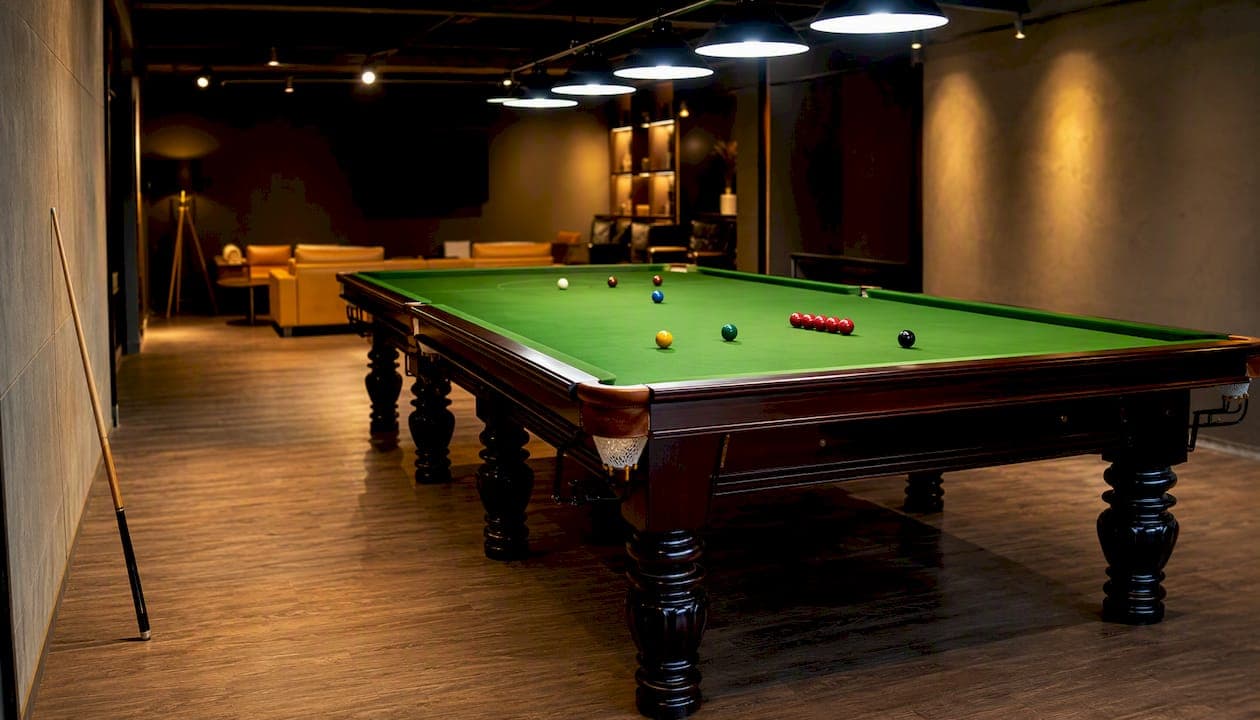
A tournament-grade snooker table has a playing area of 11 ft 8.5 in × 5 ft 10 in (3,569 mm × 1,778 mm) and needs roughly a room size allowing for adequate clearance around the table to play comfortably with standard cues. That room footprint accounts for approximately 5 ft of cue clearance on every side.
Here is the quick-reference breakdown:
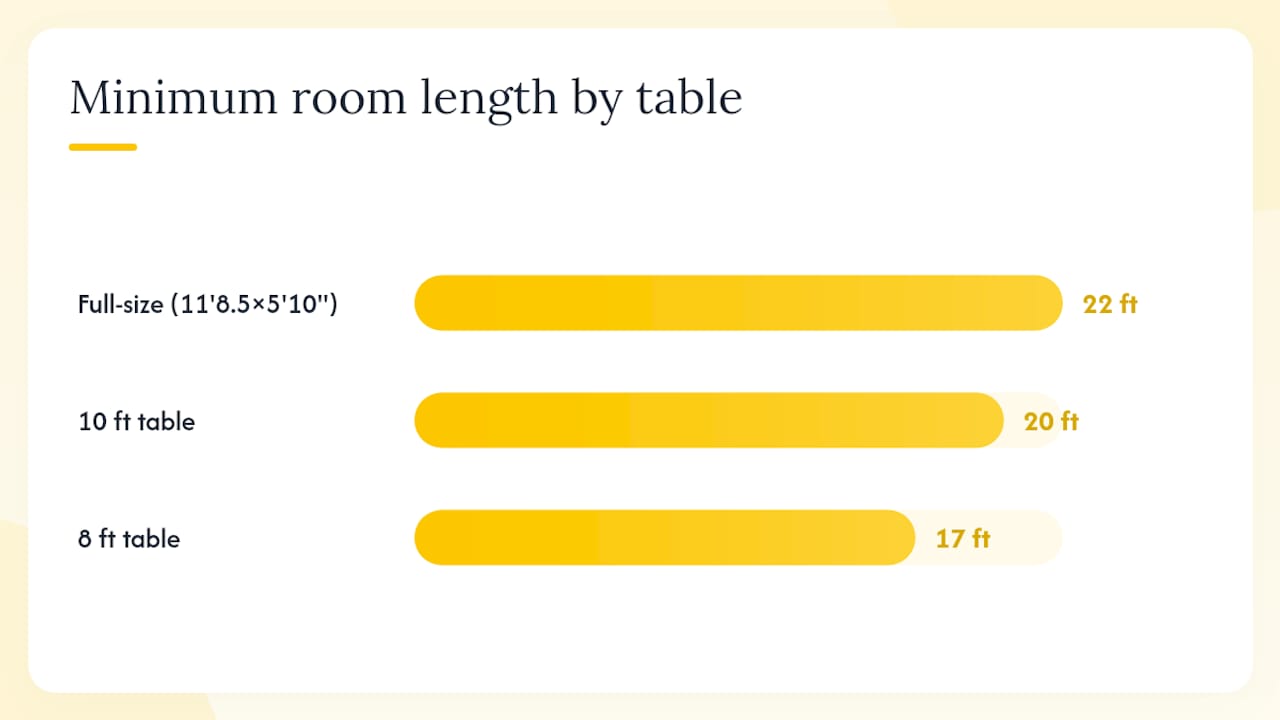
- Full-size (12 ft): Playing area 11 ft 8.5 in × 5 ft 10 in. Minimum room is 22 ft × 16 ft (6.7 m × 4.9 m) for comfortable play with standard cue clearance.
- 10 ft table: Playing area approx. 10 ft × 5 ft. Minimum room is 20 ft × 16 ft for comfortable play with cue clearance.
- 8 ft table: Playing area approx. 8 ft × 4 ft. Minimum room is 17 ft × 13 ft for comfortable play with cue clearance.
If your room falls short of 22 ft × 16 ft, a 10 ft or 8 ft table is a realistic path to snooker-style play without gutting your floor plan.
Table of Contents
- What are the official snooker table dimensions?
- What sizes do snooker tables come in beyond the full-size version?
- How does cue length affect your clearance and shot options?
- What are your real options when a 12 ft table won't fit?
- What do installers and serious players actually prioritize?
- Key Takeaways
- The room always tells the truth
- Useful sources and references
What are the official snooker table dimensions?
The World Professional Billiards and Snooker Association (WPBSA) sets the definitive standard. According to the WPBSA Official Rules of Snooker and English Billiards, the playing area measured cushion to cushion is 11 ft 8.5 in × 5 ft 10 in (3,569 mm × 1,778 mm), with a tolerance of ±½ in (±13 mm). Table height from floor to the top of the cushion rail runs between 2 ft 9.5 in and 2 ft 10.5 in (851–876 mm).
The overall external footprint of the table itself — rails, woodwork, and all — typically lands around standard full-size dimensions, though this varies by manufacturer. Pocket openings and cushion profiles are also specified in the rules document, which is the go-to reference for anyone setting up a competition-standard table.
| Specification | Imperial | Metric |
|---|---|---|
| Playing area (length) | The official size is specified with exact values in WPBSA documentation | |
| Playing area (width) | The official size is specified with exact values in WPBSA documentation | |
| Table height (floor to cushion) | The official table height is specified within a narrow range in WPBSA documentation | |
| Typical overall footprint | Generally around full tournament size; varies by manufacturer |
SnookerUSA.com's equipment rules confirm these figures and also detail the baulk-line position and the radius of the "D," which matters if you are marking up a table for competitive play.
What sizes do snooker tables come in beyond the full-size version?
Not everyone has a ballroom. The snooker world accommodates that with several standard non-tournament sizes, each with its own room footprint and play character. CueSports Australia's size reference maps these out clearly.
- 12 ft (full-size): — The tournament standard. Playing area 11 ft 8.5 in × 5 ft 10 in. Minimum room sufficient for comfortable play with cue clearance. Used in professional competition and serious club play.
- 10 ft table: — Playing area roughly 10 ft × 5 ft. Minimum room sufficient for comfortable play with cue clearance. A popular choice for snooker clubs and dedicated home game rooms — close enough to full-size that competitive practice transfers reasonably well.
Smaller tables do change the play feel in concrete ways. Pocket openings on an 8 ft table are not scaled down proportionally to the balls, which makes potting feel easier but long positional play harder. Cloth tension and speed also shift. For casual play that is fine; for anyone practicing for competition, the gap from a 10 ft to a 12 ft table is meaningful.
How does cue length affect your clearance and shot options?
Standard cues at 57–58 in drive the 5 ft clearance rule. That length is not arbitrary: it reflects the natural backswing arc a player needs to deliver a smooth, controlled stroke. Compress that arc and the stroke mechanics break down.
When clearance drops below 5 ft, your practical options are:
- Elevated cueing: — When a ball sits near the cushion and the wall is close, players are forced to elevate the butt. This is a real shot in snooker, but doing it constantly because of the room layout is fatiguing and bad for technique.
Pro Tip: If you are buying a shorter cue for a tight room, choose one with the same tip diameter and taper as your full-length cue. The muscle memory for tip contact transfers; the stroke length does not, so keep that variable isolated.
What are your real options when a 12 ft table won't fit?
The honest answer: a 10 ft table in a properly sized room beats a 12 ft table in a cramped one every time. Here is how to think through the trade-offs:
- Drop to a 10 ft table: — You lose roughly 20 in of playing length. Long pots and positional play are slightly compressed, but the game is recognizably snooker. For most home players, this is the right call.
What do installers and serious players actually prioritize?
Experience on the installation side consistently points to a few decisions that matter more than most buyers expect.
- Slate quality over table brand: A three-piece Italian or Welsh slate bed on a mid-range frame plays better than a cheap MDF-bed table at any size. Slate holds level; MDF warps.
- Cushion rubber specification: Tournament-spec cushion rubber (K-66 profile is the standard) gives the correct rebound angle. Non-spec rubber changes the geometry of every cushion shot.
- Preserve the official playing-area ratio if you can: The 2:1 length-to-width ratio of the WPBSA standard is built into every aspect of snooker's geometry. A table that deviates significantly from that ratio changes the angles. Snooker247's dimensions guide explains how size affects play in practical terms.
- Pre-order site survey: Measure every obstruction, confirm access from street to room, check floor level with a spirit level, and get professional delivery and leveling in writing before you pay a deposit.
The single most common installation mistake is ordering before measuring the access route. The table fits the room. The slate sections do not fit the stairwell. Always walk the delivery path with a tape measure.
Key Takeaways
A full-size snooker table requires a minimum room of 22 ft × 16 ft (6.7 m × 4.9 m) when using the standard 5 ft cue clearance formula on a table with an official playing area of 11 ft 8.5 in × 5 ft 10 in.
| Point | Details |
|---|---|
| Official playing area | WPBSA standard is 11 ft 8.5 in × 5 ft 10 in (3,569 mm × 1,778 mm) with ±½ in tolerance. |
| Room-size formula | Room = table length + 10 ft (length) × table width + 10 ft (width), using 5 ft clearance per side. |
| Common alternate sizes | 10 ft needs 20 ft × 16 ft; 8 ft needs 17 ft × 13 ft minimum room footprint. |
| Slate and installation | Full-size tables use sectional slate; professional leveling is required and non-negotiable. |
| Access check before ordering | Measure door widths, stair turns, and ceiling height on the full delivery path before placing an order. |
The room always tells the truth
Most buyers start with the table they want and then check whether the room fits. Installers start with the room and work backward. That difference in approach explains most of the bad outcomes: a 12 ft table ordered for a 20 ft room, slate sections that won't turn the landing, a door that opens into the clearance zone.
The WPBSA playing-area spec is not arbitrary. Every measurement in snooker — the "D," the baulk line, the spot positions — is calibrated to that 11 ft 8.5 in × 5 ft 10 in surface. When you drop to a 10 ft table, you are not just playing on a shorter surface; you are playing a slightly different geometric game. That is fine for home use. It matters if you are practicing for competition.
At Qbilliardshtx's snooker facility in Houston, the tables are set to professional dimensions in a purpose-built space with full cue clearance. If you want to feel what a correctly sized room actually plays like before committing to a home installation, that is the fastest way to calibrate your expectations. The difference between a cramped 8 ft setup and a properly cleared full-size table is not subtle.
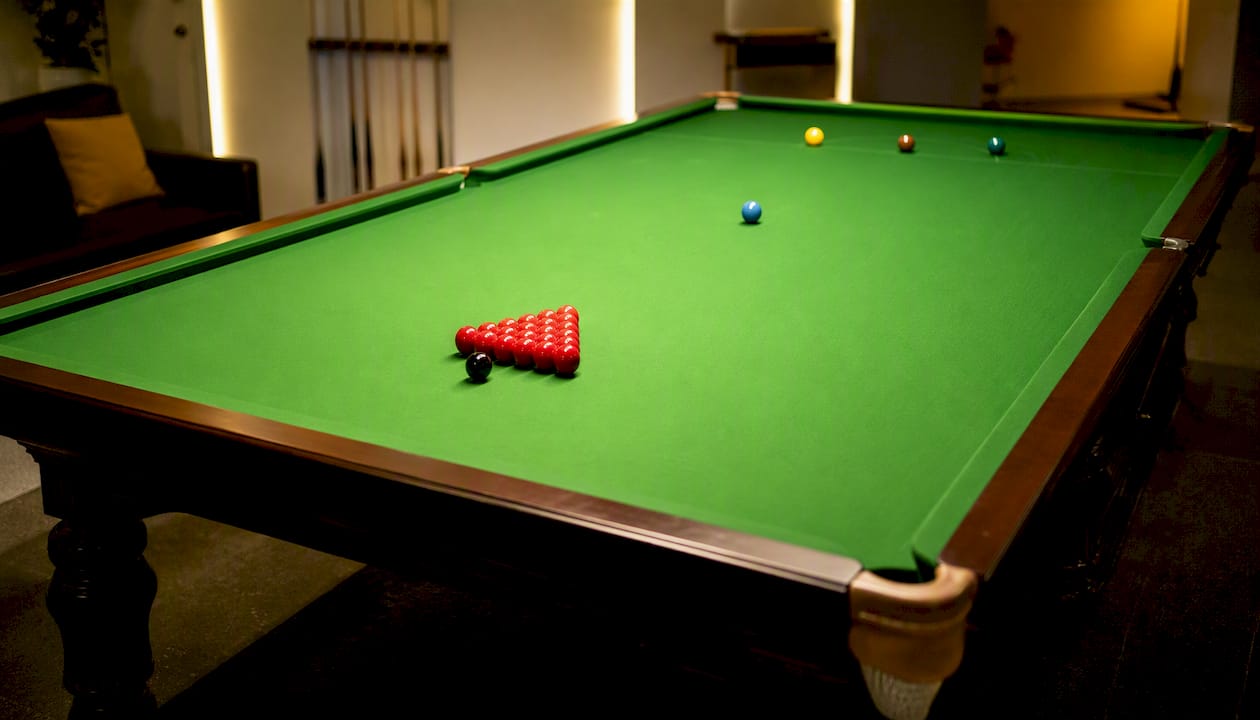
One thing the numbers do not capture: the first time you play on a table with genuine clearance, the game opens up. Shots you were unconsciously avoiding because of the wall suddenly become part of your repertoire. That is what the room-size formula is actually protecting.
Useful sources and references
These are the primary references used throughout this article. Each covers a distinct part of the topic.
- World Professional Billiards and Snooker Association (WPBSA)
- Snooker table size and measurements — CueSportsAustralia
- Snooker Table Dimensions: Official Sizes, Space Requirements & Buying Guide — CueBall Chronicles
- Understanding snooker table size, dimensions and specifications — Snooker247
- SnookerUSA.com — About Snooker - Rules & Regulations - Section 1 The Equipment
- Prince Gold 12ft Full Size Snooker Table | Homegames | Home Games