
Most pool tournament payouts follow a percentage-based or tiered model, paying roughly 10 to 15% of the field, with the winner's share ranging from 25% to 40% in small events down to 10 to 20% in large ones. The core formula never changes: prize pool equals entrants multiplied by entry fee, minus house take. Everything else is just deciding how to slice that number.
TL;DR:
- Most pool tournaments pay out 10 to 15% of the field, with the winner receiving between 25% and 40% of the total prize pool.
- Payouts are calculated by deducting house take from the total entrants multiplied by entry fee, then distributing the remaining pool according to the chosen ladder.
- Common payout structures include percentage-based, flat, tiered, and hybrid models, each suited to different event types and player engagement goals.
- The number of paying places generally corresponds to about one per 10 entrants, with a minimum cash floor of 1.5 to 2 times the entry fee to keep casual players interested.
- Side pots and add-ons should be kept separate from main payouts to avoid confusion, with clear rules and payment processes established beforehand.
Table of Contents
- What Determines Pool Tournament Payouts?
- How Are Pool Payouts Calculated?
- Payout Templates for Small, Medium, and Large Fields
- How Many Places Should You Pay?
- Should You Run Side Pots and Add-Ons?
- Organizer Checklist Before Sign-Ups Open
- How Payout Calculators Can Help
- How Q Billiards Arena Runs Tournament Payouts
- What Legal Rules Apply to Pool Tournament Prize Money?
- Do Pool Tournament Winners Pay Taxes on Prize Money?
- How Do You Distribute Prizes After a Tournament Ends?
- How Do You Handle Ties in Pool Tournament Payouts?
- Why Simple Payout Ladders Win
- Book Your Next Tournament at Q Billiards Arena
- Sources
- FAQ
What Determines Pool Tournament Payouts?
The structure you pick shapes how players feel about the event before a single ball drops. Four models cover almost every pool tournament payout you'll ever build.
- Percentage-based: Each paid spot gets a fixed share of the total pool (50/30/20 for three spots, for example). This scales cleanly regardless of field size and is the default for most club nights.
- Fixed/flat payouts: Every paid finisher gets the same dollar amount. Simple to announce, but it can feel anticlimactic for a strong field because nobody gets rewarded extra for winning it all.
- Tiered/top-heavy: Prize money drops sharply after 1st and 2nd, rewarding deep runs disproportionately. Pro events and satellites lean this way to create a real incentive to win, not just cash.
- Flat with min-cash floor: A hybrid where everyone who cashes gets close to the same amount, with a modest bump for the top two or three. Charity events and recreational leagues often use this to keep the room happy.
Club nights and league play tend to favor flatter, more forgiving ladders because retention matters more than drama. Pro events and satellites go top-heavy on purpose. Getting this choice wrong, like running a top-heavy ladder at a casual bar league, tends to shrink your entry list the next time around.
How Are Pool Payouts Calculated?
The math behind pool tournament payouts is simpler than most first-time organizers expect. Follow these steps in order:
- Calculate the raw pool. Entrants × entry fee = total collected. Ten players at $10 each is $100.
- Subtract the house take. If you're running a $100 + $10 model (a $10 entry fee split into $100 to the pool and separate cost recovery), your payout pool stays at $100 flat. Many organizers instead take 8 to 12% off the top of the full amount collected for tables, staff, or trophies.
- Decide how many places get paid. A workable rule of thumb is one paid spot per 10 entrants, so a 40 player field pays about four spots.
- Convert percentages to dollars. Apply your ladder (50/30/20, for instance) directly to the post rake pool.
- Round to nice numbers and check the total. Payouts should sum exactly to the pool; rounding errors of a dollar or two need to come from somewhere logical, usually the smallest cash spot.
Quick math check: On a $500 pool with 15% of the field paid, four spots split under a 50/30/12/8 ladder come out to $250, $150, $60, and $40. That adds up to exactly $500, with no leftover cents to argue about at the payout table.
For a longer ladder, say eight paid spots, the drop-off should still feel gradual near the bottom. A jump from $60 for 7th to $15 for 8th reads as unfair even if the math works. Smooth the curve instead of letting it cliff.
Payout Templates for Small, Medium, and Large Fields
Most organizers don't need to invent a ladder from scratch. These templates cover the range you'll actually run.
Standard percentage ladders:
- 3 spots paid: 50/30/20
- 5 spots paid: 35/22/18/14/11
- 10 spots paid: winner around 27 to 30% of the pool, tapering down through the field
Here's how those percentages translate into real dollars across different field sizes:
| Field size | Entry fee | Total pool | 1st place | 2nd place | 3rd place |
|---|---|---|---|---|---|
| 12 players | $20 | $240 | $120 | $72 | $48 |
| 40 players | $75 | $3,000 | $1,050 | $660 | $540 |
| 120 players | $150 | $18,000 | $5,400 | $3,960 | $3,240 |
The 12-player example uses a straight 50/30/20 split. The 40 and 120-player examples spread across a moderate number of paid places respectively, then round each spot to a clean number rather than leaving odd cents on the table.
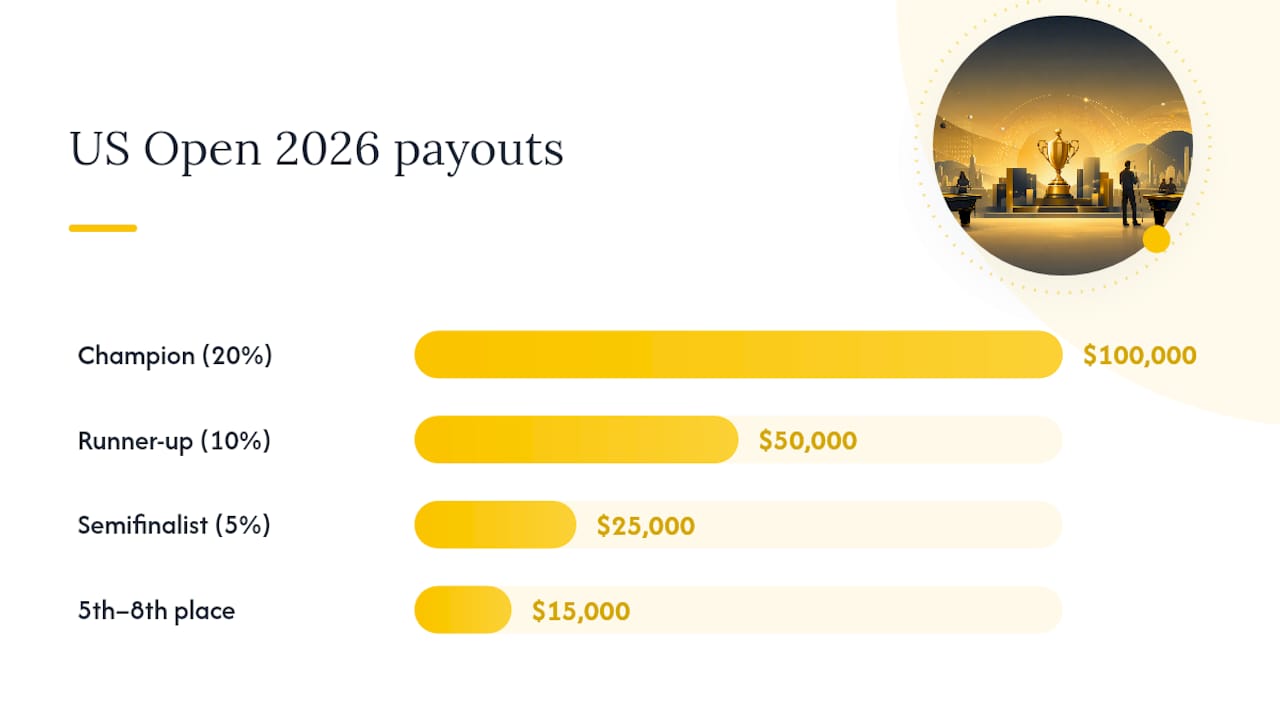
For a benchmark on how far this scales at the top of the sport, the 2026 US Open Pool Championship distributed a $500,000 prize fund with the champion taking home $100,000, or 20% of the total pool, runner-up at $50,000 (10%), and semifinalists at $25,000 (5%) each before scaling down through 5th to 8th place at $15,000. That's a top-heavy, tiered structure built for a professional field where deep runs matter more than simply cashing.
How Many Places Should You Pay?
A 60-player club event paying 15% covers nine spots; a casual charity fundraiser with the same field might pay 15 to 20 spots instead.
Min-cash convention: The smallest payout, the "min-cash," should land at roughly 1.5x to 2x the entry fee. Anything less feels like a consolation prize not worth chasing, and casual players stop entering.
Here's the trade-off nobody explains well: paying deeper eats into the top prizes. Take a $2,000 pool. Pay 10 spots at the same floor and you've committed $800, leaving a flatter, less exciting top end.
- Deeper fields reward participation but flatten the drama at the top.
- A meaningful min-cash keeps casual players coming back even when they don't win.
- Every extra paid spot is money pulled directly from the top prizes, so the trade-off should be calculated before the ladder is set, not after the money's already collected.
Should You Run Side Pots and Add-Ons?
Side pots like "big fish," bounty formats, or daily high-run bonuses work best when they're collected and paid as entirely separate pools from the main tournament payout. Mixing them into the main ladder is the fastest way to confuse players and create disputes on payout day.
- Announce the side-pot buy-in and format separately from the main entry fee.
- Track side-pot cash in its own envelope or ledger line, never blended with the main prize pool.
- Pay side pots immediately after the relevant match or session, not bundled with final payouts.
Pro Tip: Write the side-pot rules on the same sheet as your main payout ladder, but in a clearly separate box. Players read faster than they listen, and a shared sheet stops the "wait, was that included?" conversation at the payout table.
Organizer Checklist Before Sign-Ups Open
Run through this before you post the entry form, not after:
- Decide your house take and disclose it. Whether it's 8% or 12%, state what it covers (tables, staff, trophies) so players aren't guessing.
- Round every payout to a nice number. Nobody wants a check for $47.33. Round to the nearest $5 or $10 and adjust the smallest spot to balance the total, a practice backed by payout-design research that favors limited bucket counts for readability.
- Cap the number of paid places to something readable. A ladder with 20 rows is harder to trust than one with 6 clean ones, even if the math is identical.
- Publish the full ladder before registration closes. Players enter differently when they know exactly what they're playing for.
- Prepare a payout ledger in advance. List every spot, the dollar amount, and a signature line so payout day takes minutes, not an argument.
How Payout Calculators Can Help
A calculator only saves time if you feed it the right inputs: number of entrants, entry fee, house take percentage, number of paid places, and a ladder template (flat, tiered, or top-heavy). Tools like the calculator from SplitGenius AI let you plug those in and generate an instant ladder with rounding options built in.
Before you trust any output, check three things yourself:
- Do the individual payouts sum exactly to your total pool after the house take?
- Did the rounding push any spot below your min-cash target?
- Are side pots kept separate from the main ladder, not folded into the same total?
Calculators are fast, but they don't know your player base. Always eyeball the final numbers against what you'd actually want to hand a player.
How Q Billiards Arena Runs Tournament Payouts
At Q Billiards Arena, weekly events like the Tuesday and Friday night pool tournaments publish their payout ladder before the sign-up sheet fills, so players know exactly what they're competing for. Side pots, when run, stay on a separate tally from the main bracket payout. House take is kept modest and disclosed upfront rather than buried in fine print.
That approach comes straight from running events in an 11,000 square foot room week after week: players return more often when the numbers are simple and the payout table has no surprises waiting on it.
What Legal Rules Apply to Pool Tournament Prize Money?
Most casual and club-level pool tournaments operate as skill-based competitions, which generally puts them in a different legal category than games of chance in most states. That distinction matters for whether an event needs a gaming license at all, but rules vary by state and by whether the venue serves alcohol alongside cash prizes.
Organizers running for-profit tournaments with cash payouts should check local and state regulations before advertising a prize pool, particularly around whether a portion of entry fees can legally be retained as a house take versus fully redistributed to players. Some jurisdictions treat any retained percentage differently depending on whether the event is billed as a private club activity or open to the public.
Venues hosting private poker room rentals face a separate layer of scrutiny, since poker sits closer to a game of chance in most state statutes than pool or snooker does. If your event blends formats, cue sports tournaments alongside a poker night, treat each under its own applicable rule rather than assuming one license or exemption covers both.
None of this replaces legal advice specific to your city and state. A quick call to your local alcohol and gaming authority before your first paid event saves a lot of trouble later, especially if you plan to make the tournament a recurring fixture rather than a one-off.
Do Pool Tournament Winners Pay Taxes on Prize Money?
Cash prizes won in pool tournaments are generally treated as taxable income in the United States, regardless of the amount. There's no minimum threshold below which winnings are automatically tax-free just because the tournament was small or informal.
Organizers running larger events, especially anything approaching the scale of a regional or professional tournament, may have reporting obligations once a single payout crosses certain federal thresholds, similar to how other contest and gambling winnings get reported. Club-level tournaments with modest payouts rarely trigger formal reporting paperwork, but the tax liability for the winner doesn't disappear just because no form gets issued.
Players who cash regularly in league play or local tournaments should keep their own simple record: date, event, and amount won. It's far easier to reconstruct at tax time than trying to remember six months of cashes from memory.
This isn't tax advice specific to your situation. Anyone winning a meaningful five-figure or six-figure prize, the kind seen at events like the US Open Pool Championship, should talk to a tax professional before spending a dollar of it.
How Do You Distribute Prizes After a Tournament Ends?
Prize distribution should happen the same day, ideally within an hour of the final match, while players are still on-site and the ledger is fresh. Waiting days to mail checks or transfer funds is where trust in an organizer starts to erode.
Have your payout ledger printed or on a tablet before the final match begins, not scrambled together after. Each paid finisher signs next to their line item as they receive cash or a transfer confirmation. That signed record protects you if a dispute comes up later about who was paid what.
For cash payouts, having exact bills ready in the amounts your ladder specifies, this is another reason rounding to nice numbers matters, saves you from making change at the table while a line of players waits. For electronic transfers, confirm the recipient's information before the tournament, not after they've already left the building.
Side pots and add-ons get paid separately from the main ladder, using their own quick tally, so nobody has to do mental math to figure out which check covers which win.
How Do You Handle Ties in Pool Tournament Payouts?
Ties in pool are rare in single-elimination brackets since matches are played to a finish, but round-robin formats and double-elimination brackets with tiebreaker scenarios do produce them, especially at the bottom of the paid places.
The cleanest solution is a split payout: combine the prize money for the tied spots and divide it evenly between the tied players. If 4th and 5th place finish tied and each spot was worth $150 and $100, both players receive $125.

Some organizers prefer a tiebreaker match, a single race to a set number of games, instead of splitting money. This works well when time allows and both players are on-site, but it's not always practical late in a long event when tables and time are running out.
Whichever method you choose, decide it before the tournament starts and state it in your published rules. Deciding on the fly, in front of two frustrated players who both think they deserve the higher prize, is the worst possible time to make that call.
Why Simple Payout Ladders Win
Convoluted ladders with a dozen tiers might look thorough on paper, but they rarely earn back the confusion they create at the payout table. Clarity beats cleverness every time. A meaningful min-cash keeps casual players coming back even when they don't win, and that repeat traffic matters more than optimizing the last two percentage points of a payout curve. Publish the ladder early, walk your staff through it before doors open, and review what worked once the tables are cleared.
— Q
Book Your Next Tournament at Q Billiards Arena
Running the math on a fair payout ladder is only half the job. You still need tables, staff who understand how the payout table works, and a room that can hold your field without cramming players elbow to elbow. A venue like this gives organizers a full set of professional tables, ample space, late hours for tournament play, and experienced staff to help set up payout ladders without disputes.

Whether you're planning a one-night club event or something closer to a recurring league, the Tournaments & Events page covers hosting details for organizers who want a venue partner rather than a rented room and a folding table. If you just need to check table availability and pricing for American Pool, snooker, or Chinese 9-Ball before you commit to a headcount, the games and pricing page has the current rates. Reach out through either page to get your next tournament date on the calendar.
Sources
The payout figures and formulas here draw from the 2026 US Open Pool Championship's published prize breakdown, the ladder templates and rounding guidance from WeighBook's payout calculator guide, the standard percentage ladders documented by SplitGenius AI's payout calculator, and the algorithmic rounding principles outlined in research on tournament payout structures. Each source provides either a real-world ladder or a repeatable formula rather than a one-off opinion.
- 2026 US Open Pool Championship Results, Prize Money, Player Ratings & Statistics | Inside Spin
- Tournament Payout — SplitGenius AI
- Tournament Payout Calculator & Guide | WeighBook Blog
- Algorithms for Determining Tournament Payout Structures
FAQ
How Much Do Pro Pool Players Get Paid?
Top pro pool players can earn six figures from a single major event. The 2026 US Open Pool Championship paid its champion $100,000, which was 20% of the $500,000 total prize fund, with runner-up at $50,000.
How Is Pool Tournament Prize Money Distributed?
Prize money is distributed according to a published ladder, usually a percentage of the total pool assigned to each paid finishing place. Most events pay 10 to 15% of the field, with the top spot receiving the largest single share and payouts tapering down through the remaining paid places.
How Do You Work Out 1st, 2nd, and 3rd Prize Money?
Multiply your total prize pool by the percentage assigned to each place in your ladder. A common three-spot split is 50/30/20, so the prize splits give the winner half, the second place 30%, and the third place 20% of the pool.
What Percentage of the Field Should Get Paid in a Pool Tournament?
Most live events pay 10 to 15% of entrants, while charity or recreational tournaments often pay 20% or more since participation matters more than competitive intensity. A 40-player field at the standard rate typically pays four to six spots.
Does Q Billiards Arena Help Organizers Set Up Payout Ladders?
Q Billiards Arena runs its own weekly tournaments with published payout ladders and can support organizers hosting events at the venue. Details on hosting and current tournament pricing are available on the Tournaments & Events page.