
Every pool tournament comes down to three core structures: single elimination, double elimination, and round robin (or pool play). Pick single elimination when tables and time are tight, double elimination when fairness and a second chance matter more than speed, and round robin when the priority is guaranteed playing time over a competitive shakeout. The right call depends less on preference and more on how many tables you have, how many hours you can run, and what your players actually expect from the night.
TL;DR:
- Single elimination is most suitable for short events with limited tables and time constraints, requiring fewer matches and ending quickly.
- Double elimination offers fairer competition by allowing players a second chance but nearly doubles the number of matches and time needed.
- Round robin guarantees each player multiple matches, making it ideal for social groups, but it is less practical for larger fields due to extended duration.
- Match length varies significantly with game type, with 8-ball generally taking longer than faster rotation games like 9-ball or 10-ball.
- Proper scheduling, consistent rules, and pre-set race lengths are crucial for smooth tournament operation and fair play.
Table of Contents
- What Is Single Elimination in Pool Tournament Formats?
- How Does Double Elimination Work in Pool?
- What Is Round Robin Pool Play and When Should You Use It?
- Does the Game You Choose Change the Format?
- How Do You Choose the Right Tournament Format?
- How Do You Calculate Tournament Match Math and Scheduling?
- How Do You Handicap a Mixed-Skill Pool Tournament?
- How Q Billiards Arena Schedules Its Weekly Tournaments
- What Does a Practical Tournament Running Checklist Look Like?
- An Organizer's Take on Balancing Fairness and the Clock
- Book Your Next Tournament at Q Billiards Arena
- Where to Find Official Pool Tournament Rules
- Sources
- FAQ
What Is Single Elimination in Pool Tournament Formats?
Single elimination is the format most people picture when they hear "bracket": lose once, you're out. It's the backbone of bar leagues and quick weeknight events because it's brutally efficient. The math is simple and it scales cleanly no matter how many players show up.
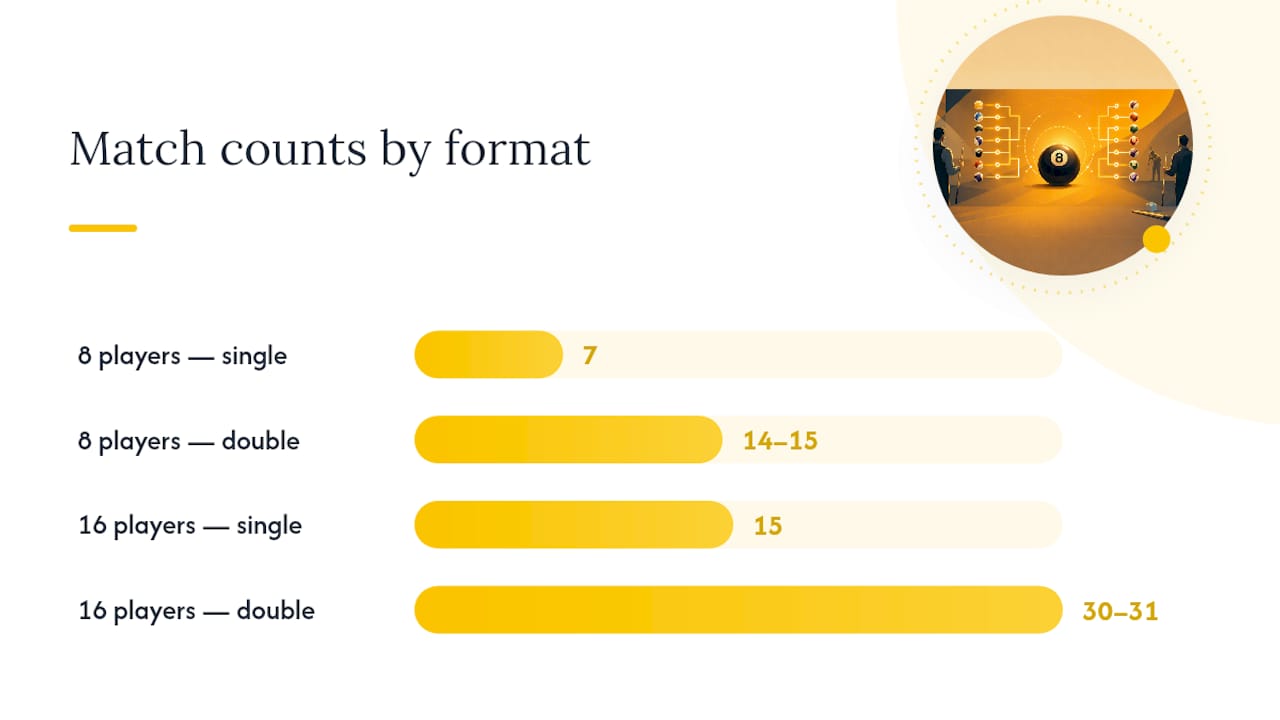
The formula is matches = N − 1, where N is the number of players. An 8-player field plays 7 matches. A 16-player field plays 15. A 32-player field plays 31, and according to the NTC rules and tournament structures, that 16-player, 15-match structure is one of the most common setups in organized pool play.
Statistic Callout: A 32-player single-elimination bracket needs exactly 31 matches to crown a champion, regardless of how the bracket is seeded.
Single elimination's biggest strength is also its biggest weakness.
- Pros: Fast, easy to run on a whiteboard, requires no special software, and finishes predictably within a few hours.
- Cons: Half your field is done after one match. A player who drove across town and paid an entry fee can be eliminated in fifteen minutes.
- Best for: Bar nights, casual weeknight events, or any situation where you have more players than table hours.
That last con is the real cost. Retention suffers when half the room is watching instead of playing by round two, and that empty rail time doesn't do your bar tab any favors either.
How Does Double Elimination Work in Pool?
Double elimination gives every player two lives instead of one. Lose a match and you drop into the losers bracket instead of going home; lose twice, and you're actually out. It's the format most competitive pool leagues default to because it rewards a bad night without eliminating anyone unfairly.
The mechanics involve two parallel brackets. The winners bracket runs like a standard single-elimination ladder. Players who lose there fall into the losers bracket, which reshuffles them against other one-loss players. Eventually the winners-bracket champion meets the losers-bracket champion in a grand final. Because the losers-bracket finalist has already lost once, most formats require a grand-final reset: if that player wins the first grand-final match, a second match decides the title, since both players now have one loss. FACEIT's tournament format guide breaks down this reset mechanic in more detail.
Statistic Callout: According to match-count formulas widely used by bracket software, an 8-player double-elimination event runs 14 to 15 matches versus 7 for single elimination, and a 16-player field jumps to 30 or 31 matches versus 15.
- Pros: Far fairer to players; one off-night doesn't end your tournament; feels more like real competition.
- Cons: Nearly double the matches means nearly double the time; bracket management gets confusing without a printed chart or software; scheduling around a grand-final reset requires a time buffer.
What Is Round Robin Pool Play and When Should You Use It?
Round robin means everyone plays everyone else in their group, no early exits. It's the format to reach for when guaranteed playing time matters more than crowning a champion fast, which makes it a natural fit for casual leagues and social nights where nobody wants to pay an entry fee and get bounced after one game.
- Split the field into groups of 3 to 4 players, which tournament guides commonly recommend for balancing playtime against total event length.
- Guarantee each player 3 to 4 matches within their group before anyone gets cut.
- Advance the top one or two finishers from each group into a single or double-elimination playoff bracket, often called pool-to-bracket play.
- Break ties using head-to-head result first, then game or rack differential if scores are tracked.
Our guide on running a round-robin pool tournament walks through the group-stage math step by step.
Does the Game You Choose Change the Format?
Your format decision doesn't happen in a vacuum. Whether you run 8-ball, 9-ball, or 10-ball changes how long each match takes, and that directly affects how many rounds you can realistically fit into an evening.
Eight-ball uses all 15 object balls and tends to run longer, especially at casual skill levels, which is why organizer guides list it as the default for venue-level events. Nine-ball and 10-ball are rotation games where players must contact the lowest-numbered ball first, and games end the moment that final ball drops, so matches move faster and suit competitive circuits with tighter time windows. Our breakdown of 9-ball break and push-out rules covers how those specific rules shift match length.
- 8-ball: Race to 3 or 5 for casual nights; runs longer due to more balls on the table.
- 9-ball/10-ball: Race to 5 or 7 in competitive settings; faster individual racks but often more racks per match.
- Rule variables that add time: alternating breaks versus winner breaks, allowed push-outs, and whether a shot clock is enforced.
Check the current games and pricing options before locking in a discipline for your event.
How Do You Choose the Right Tournament Format?
Match the format to your constraints, not your preferences. Before you commit, run through five factors: table count, participant count, your time window, prize level, and what your players actually expect walking in.
- Few tables, big field, short window? Single elimination is close to your only realistic option.
- Enough time and tables for nearly double the matches? Double elimination rewards the extra hours with a fairer outcome.
- Small, social crowd that wants to play more than they want to win? Round robin or pool play keeps everyone on a table longer.
Three quick scenarios: a 32-player bar night with 4 tables and 4 hours calls for single elimination. A 16-player league championship with 8 tables and a full Saturday calls for double elimination. An 8-player weekly social with 4 tables and no real prize money calls for round robin.
Pro Tip: Test a new format on a low-stakes night with a small entry fee before you charge a full prize-pool buy-in on it. Timing estimates always look better on paper than they run in real life.
How Do You Calculate Tournament Match Math and Scheduling?
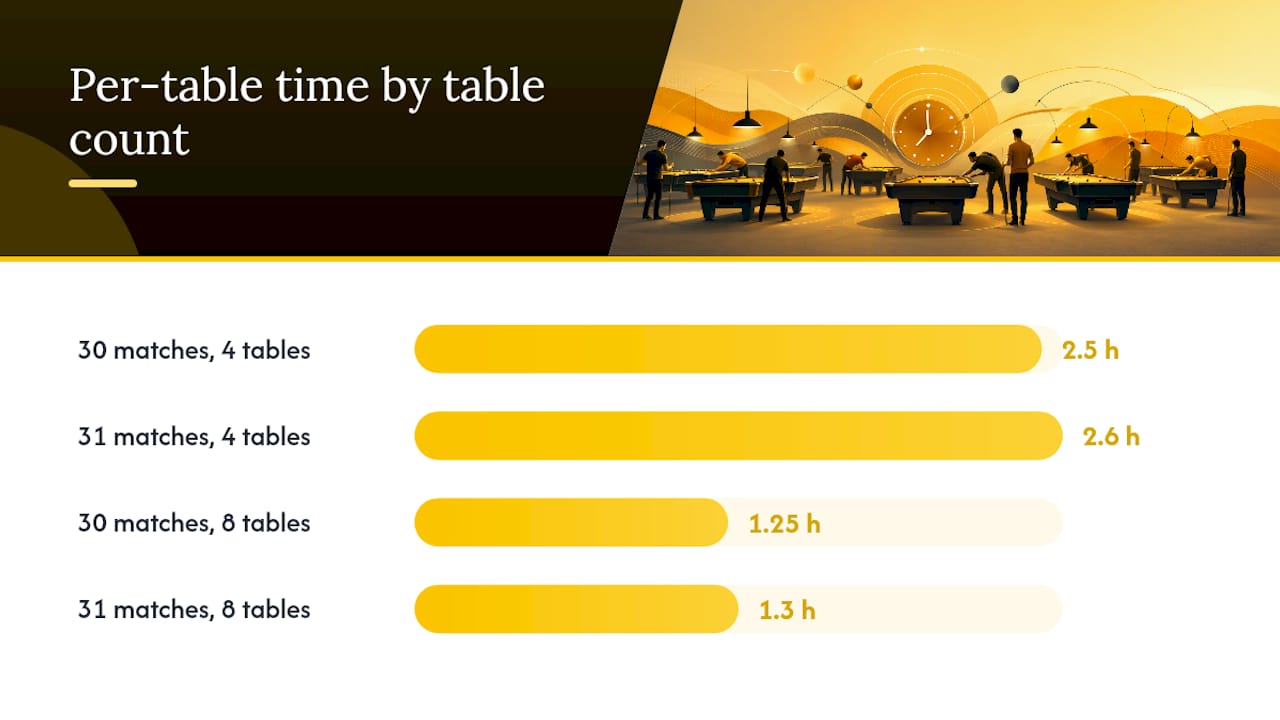
Convert total matches into hours by dividing matches by table count, then multiplying by your average match length. A 16-player double-elimination event running 30 to 31 matches on 4 tables at 20 minutes per match needs roughly 2.5 to 2.6 hours of table time per table, assuming no delays. Running the same field on 8 tables cuts that time closer to half. Building in buffer slots and capping match length prevents one slow table from stalling the whole bracket, a scheduling approach detailed in our double-elimination operations guide.
How Do You Handicap a Mixed-Skill Pool Tournament?
Handicapping keeps a tournament fun when your field ranges from weekend players to league sharks. The most common methods adjust the race length based on skill rating, spot certain balls for weaker players, or apply a rating-based modifier to final scores. Handicapping guidance from instructional resources notes that simple race adjustments tied to league ratings work well for weekly venue events without heavy administration.
- Race adjustments: A stronger player races to 7 while a newer player races to 4.
- Ball-spot handicaps: Weaker players get a ball or two "on the table" before the rack starts.
- Rating modifiers: Applied to running standings rather than individual racks.
Posting the handicap chart before play starts avoids disputes and keeps trust intact.
How Q Billiards Arena Schedules Its Weekly Tournaments
The venue runs multiple formats in parallel without bottlenecking a single bracket. Weekly events lean on shorter race lengths to keep the field moving, while promotions around those nights help fill tables during off-peak hours.
What Does a Practical Tournament Running Checklist Look Like?
Running a clean tournament comes down to five operational decisions made before a single ball is racked, not improvised mid-event.
Race-to length: Set it based on your game and time window. A race to 5 in 9-ball moves faster than a race to 5 in 8-ball because rotation games end sooner. Announce it before registration closes so nobody argues about it at 9 p.m.
Break rules: Decide winner-breaks or alternating breaks and lock it in for the whole event. Mixing rules mid-bracket is one of the fastest ways to trigger a dispute.
Scheduling buffers: Build 10 to 15 minute gaps between rounds, especially in double elimination where the losers bracket can lag behind the winners bracket. A single slow match shouldn't hold up four other tables.
Payout structure: Post the prize split by placement before entries open, not after. Players make different risk decisions when they know whether it's winner-take-all or a top-four split.
Rules consistency: Whatever governs push-outs, foul calls, or table etiquette needs to be the same for every match, not adjusted table to table based on who's watching. Print the rule sheet and tape it near the sign-in table. Our event-day operations guide covers how to keep these five moving parts from colliding on a busy night.
An Organizer's Take on Balancing Fairness and the Clock
The format debate gets treated as a fairness argument, but it's really a scheduling argument wearing a fairness costume. Consistent rules and a schedule you can actually hit matter more to players than which bracket type you picked. Guaranteed play wins on social nights; fairness through a second chance wins when real prize money is on the line. Run a pilot night before trusting your timing math on a paying crowd.
— Q
Book Your Next Tournament at Q Billiards Arena
Most organizers renting a hall somewhere have to negotiate table count, hours, and food service separately, and hope it all lines up on event night. This venue removes that juggling act: many tables under one roof, late hours, and a kitchen that keeps players fed without them leaving the building mid-bracket.
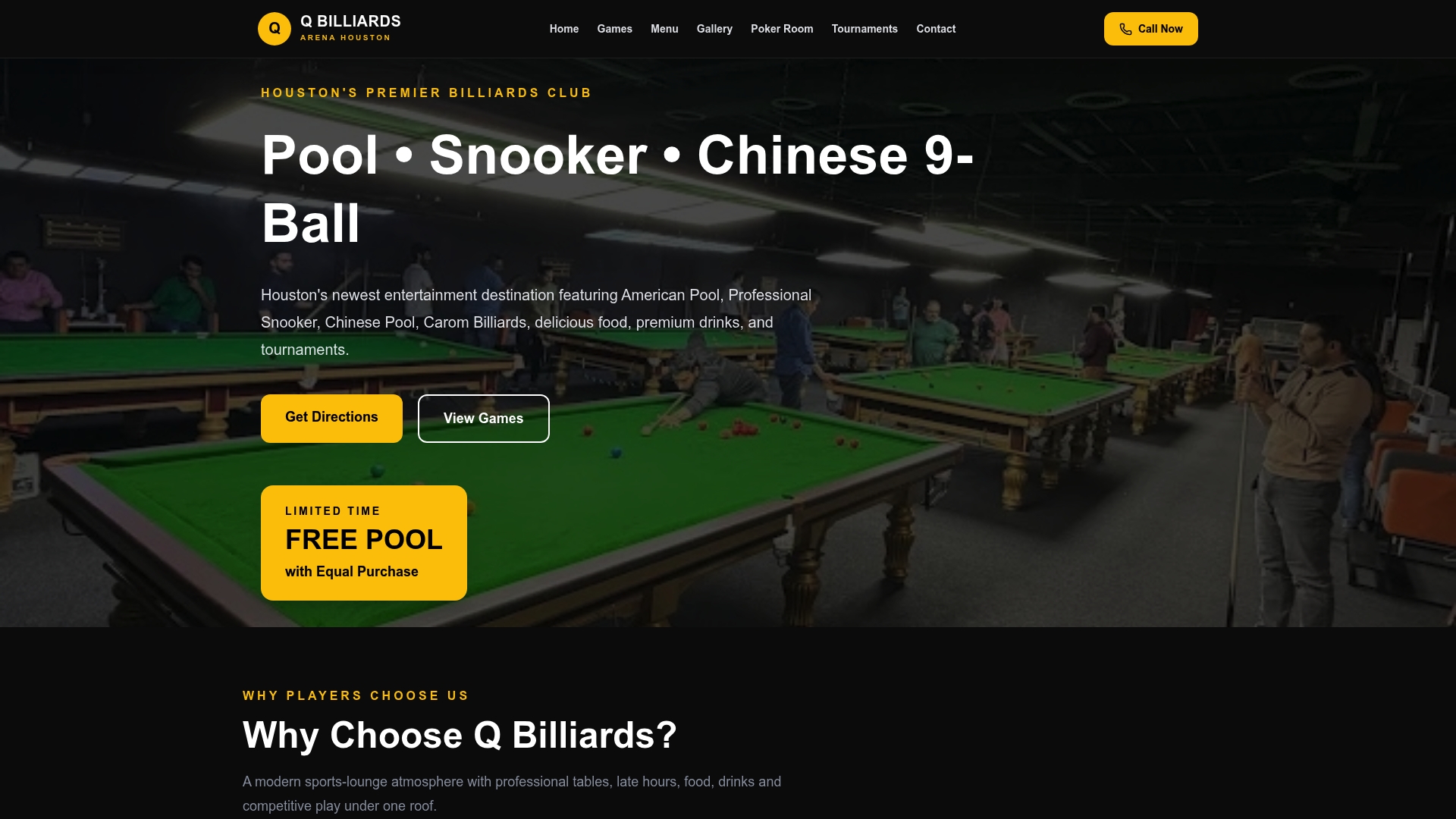
Whether you're running a single-elimination bar night or a full double-elimination championship, weekly Tuesday and Friday night pool tournaments show the format in action, and the games page lists several disciplines along with hourly rates. Organizers planning something bigger, including private events, can check the tournaments and events page for booking details or reserve a private poker room for a side event. Reach out through the events page to lock in a date before your preferred night fills up.
Where to Find Official Pool Tournament Rules
For sanctioned events, always defer to an official rulebook rather than a general guide. The NTC rules and tournament structures document covers format definitions in detail, while the QuickScores tournament guide is useful for pool-play group sizing, and TournamentBracketMaker's format comparison is a solid reference for match-count math on larger fields.
Sources
- How to organize a pool tournament (Score7 knowledge base)
- QS Pool Tournament Guide (QuickScores)
- Single vs Double Elimination - Which Format to Pick (TournamentBracketMaker)
FAQ
What Are the Main Types of Pool Tournament Formats?
The four formats organizers use most are single elimination, double elimination, round robin, and pool play feeding into a bracket, with the first two being the most common for competitive pool events.
What Are the Different Bracket Formats for Pool?
Single elimination uses one bracket where a loss ends participation, while double elimination uses two parallel brackets (winners and losers) with a grand-final reset if the losers-bracket finalist wins the first match.
What Is the Best Pool Tournament Format?
There's no single best format; single elimination suits short, table-limited events, double elimination suits fairness-focused competitive events with enough time, and round robin suits small social groups wanting guaranteed matches.
How Do You Organize a Pool Tournament?
Pick a format based on your table count, player count, and time window, set consistent race-to and break rules, build scheduling buffers, and confirm payouts before registration opens. Venues like Q Billiards Arena run weekly Tuesday and Friday night tournaments that follow this same structure.
How Many Matches Does a 16-Player Tournament Need?
A 16-player single-elimination bracket needs 15 matches, while a 16-player double-elimination bracket needs roughly 30 to 31 matches, according to standard bracket math.