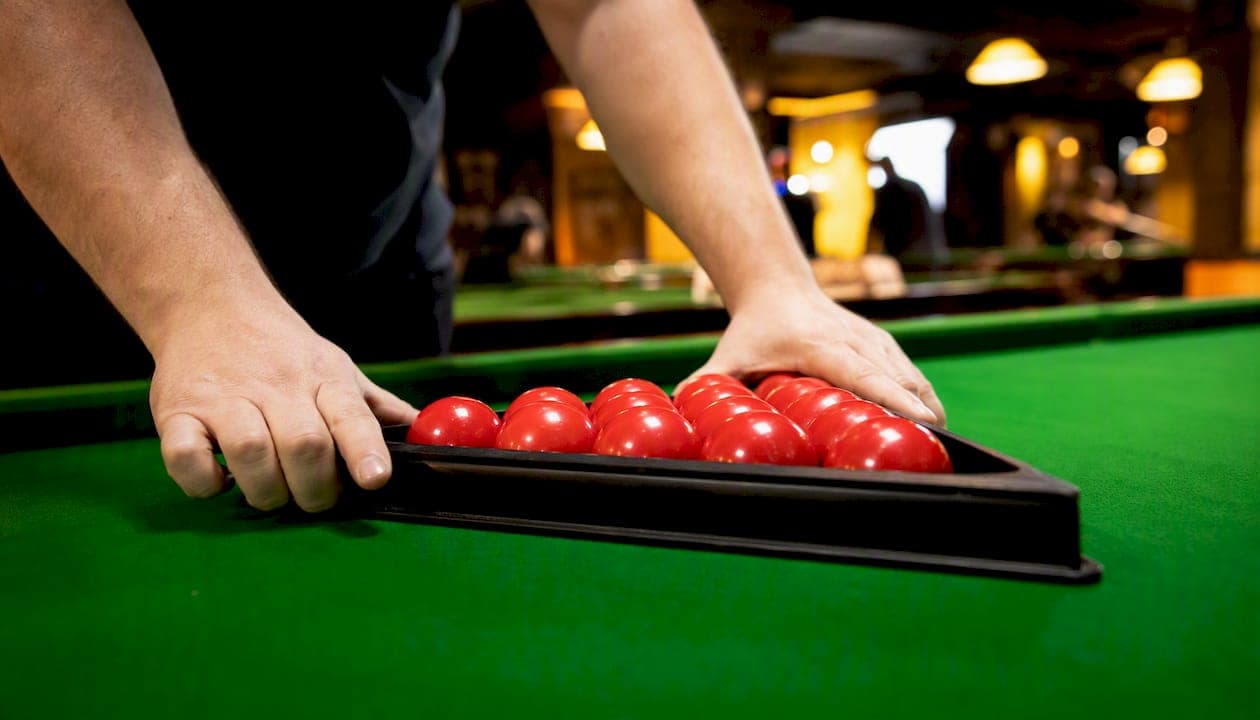
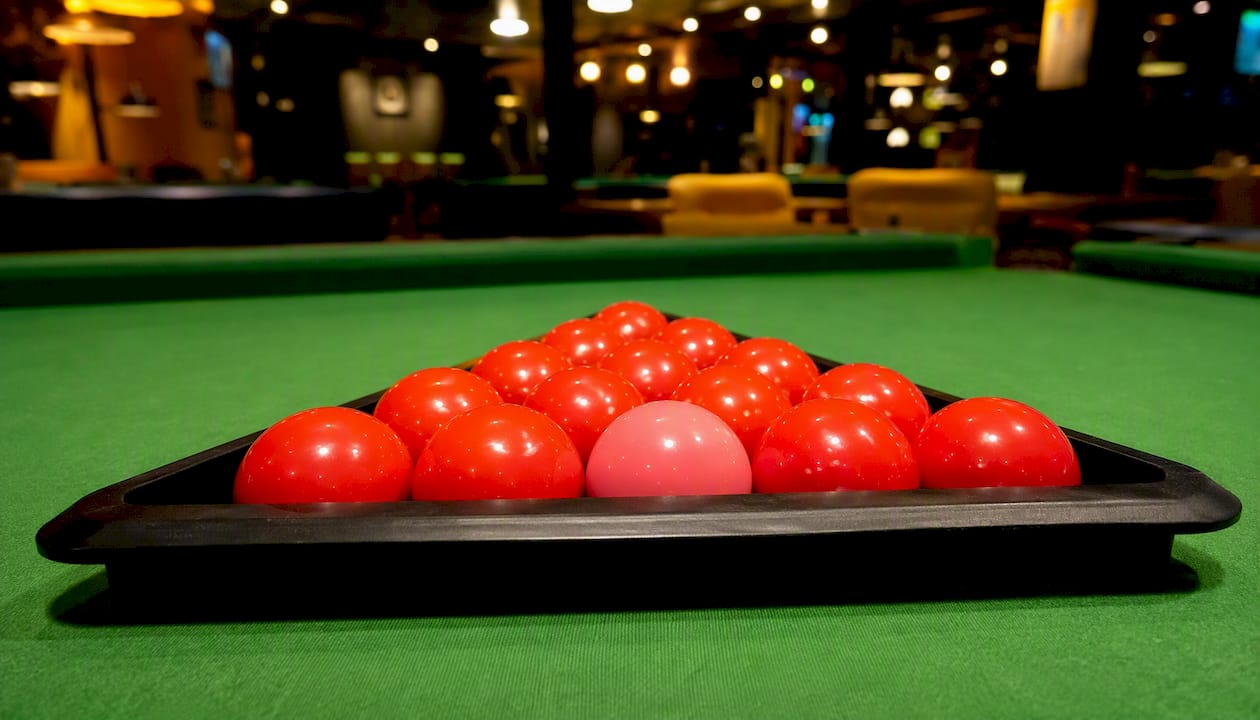
Place all 15 red balls in a tight triangle with the apex red sitting as close as possible to the pink ball without touching it, then set each of the six colored balls on its fixed spot. That single routine, done correctly, is how racking snooker starts every legal frame. The WPBSA official rulebook governs every detail, from ball counts to referee duties, and it's the standard used in every serious club and tournament.
Before the break, run through these five checks:
- Apex red is on or directly behind the foot spot, pointing toward the top cushion
- All 15 reds are packed tightly with no visible gaps
- Each colored ball sits on its correct spot (yellow, green, brown, blue, pink, black)
- The triangle is square to the side cushions, not angled
- The cue ball is placed anywhere inside the "D" by the breaking player
Key Takeaways
Correct racking snooker technique starts with the apex red on the foot spot, a tight compressed pack, and all six colors on their fixed spots before the break.
| Point | Details |
|---|---|
| Apex placement | The apex red sits as close to the pink as possible without touching it, on the foot spot. |
| Ball specifications | WPBSA rules require 52.5 mm diameter balls with a maximum 3 g weight spread across all 22 balls. |
| Six colored spots | Yellow, green, and brown sit on the baulk line; blue at center; pink between blue and the reds; black near the top cushion. |
| Re-rack triggers | A re-rack is ordered when reds scatter unplayably, a color is found on the wrong spot, or a ball is missing from the original rack. |
| Practice at Qbilliardshtx | Q Billiards Arena in Houston offers professional snooker tables with correctly marked spots for hourly rental and tournament play. |
Table of Contents
- How to rack snooker balls step by step
- Where do the six colored balls go?
- What equipment and ball specs do you need?
- What do the official rules say about racking and re-racks?
- Common racking mistakes and how to fix them
- Pre-frame checklist
- Pro tips from Q Billiards Arena staff for consistent racking
- What order should you place the red balls inside the triangle?
- How to check ball placement and prevent positioning fouls
- Visual guides for understanding snooker ball placement
- Why colored balls sometimes won't sit on their spots
- A note on why racking precision matters more than most players think
- Ready to practice your snooker setup in Houston?
- Sources
How to rack snooker balls step by step
Getting a tight, square rack takes about 90 seconds when you know the sequence. Here's the routine:
-
Clear and brush the foot spot area. Remove any chalk dust or debris from the center of the table before placing anything down. A clean cloth surface helps the balls settle without rolling.
-
Place the triangle on the table. Set the snooker triangle on the cloth with the apex pointing toward the top cushion (the end away from the "D"). Don't drop it; lower it flat.
-
Load the reds into the triangle. Place the 15 red balls inside the frame one at a time. Start from the back row (five balls), then the four-ball row, then three, two, and finally the apex ball. This order lets you pack from the base forward.
-
Align the apex to the foot spot. Slide the entire triangle forward until the apex red sits as close to the pink ball as possible, without touching it. The Pool Table Store guide describes this as the single most important alignment step for consistent breaks.
-
Compress the pack. Press down gently on the top of the reds with your palm while pushing the triangle forward slightly. This closes any gaps between balls without forcing them out of position.
-
Check the triangle is square. Look from the baulk end. The back row of five reds should run parallel to the top cushion. If it angles left or right, nudge the frame until it's straight.
-
Remove the triangle carefully. Lift the back of the frame first, then tilt it forward and off the apex ball. Never drag it sideways across the cloth.
Pro Tip: Slide the triangle over the balls rather than dropping balls into a stationary rack. When removing it, always lift the back edge first so the frame doesn't catch the apex ball and scatter the pack.
A diagram showing the apex position, the center line of the table, and the pink ball's relationship to the reds is worth keeping near the table for new players. The Wikimedia Commons billiard rack image collection has reference images that work well for this purpose.
Where do the six colored balls go?
The colored balls have fixed spots defined by the WPBSA rules. None of them are approximate; each has a precise location tied to table markings.
| Ball | Spot Location |
|---|---|
| Yellow | Right corner of the "D" on the baulk line |
| Green | Left corner of the "D" on the baulk line |
| Brown | Center of the baulk line, between yellow and green |
| Blue | Exact center of the table |
| Pink | Midway between the blue and the apex of the red triangle |
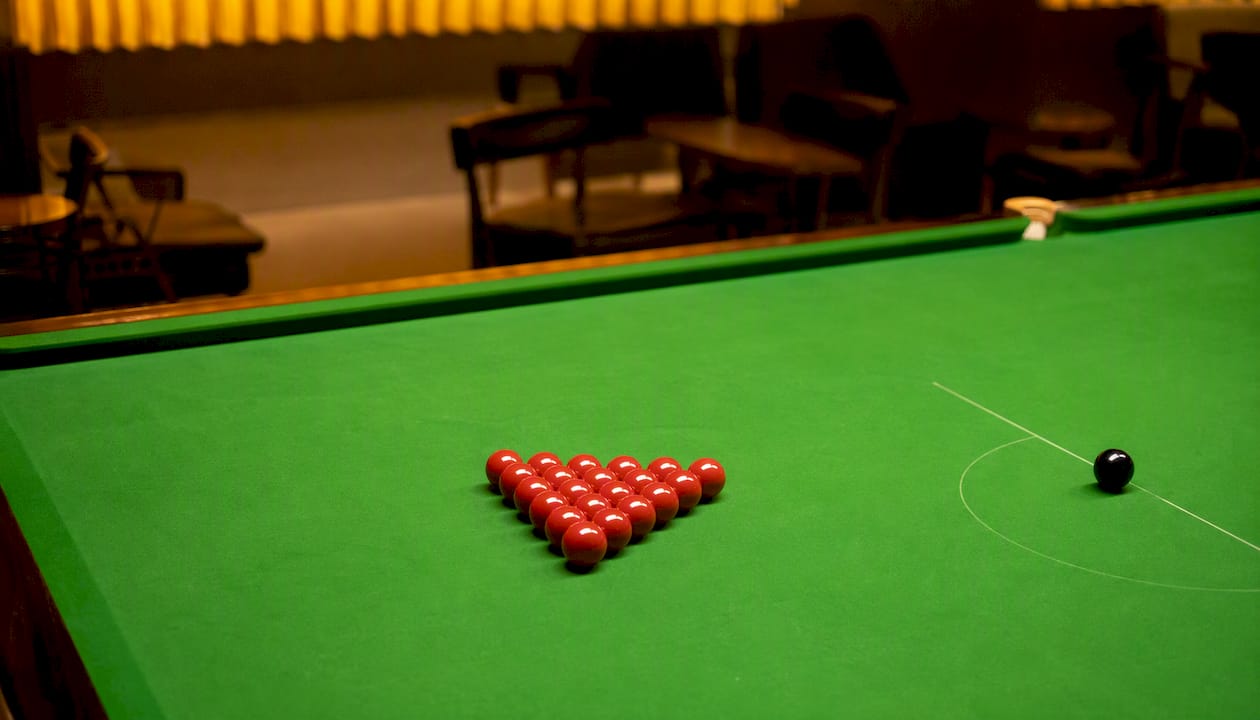
| Black | 324 mm from the top cushion, on the center line |
Finding each spot is straightforward once you know the table markings. The baulk line is the straight line drawn across the table near the bottom cushion; the "D" is the semicircle on the baulk end. Yellow goes to the right corner of the D, green to the left, brown dead center on the line. Blue sits at the geometric center of the playing surface. Pink falls midway between blue and the apex red. Black sits on its own spot near the top cushion.
The pink's position relative to the reds matters practically: the apex red should be as close to the pink as possible without making contact. If the pink is displaced even slightly before the break, it's a foul.
Quick checks before the frame starts:
- Brown is centered on the baulk line, not drifted left or right
- Blue is at the true table center, not estimated
- Pink is on its spot and not touching any red
- Black is on its spot and not overhanging the top cushion
What equipment and ball specs do you need?
A snooker triangle is not interchangeable with a standard American pool triangle. Pool triangles are built for 2.25-inch (57 mm) balls arranged in a 5-row formation; snooker triangles are sized for 52.5 mm balls in the same 5-row layout. Using a pool triangle on snooker balls leaves gaps that make a tight pack nearly impossible.
According to the WPBSA official specifications, snooker balls must measure about a standard size in diameter with a slight tolerance, and all 22 balls in a set must be of equal weight within a small tolerance to ensure consistent play.
That 3-gram spread matters more than most casual players realize. A noticeably heavier ball behaves differently off a cushion and can cause the pack to scatter unevenly on the break.
Essential equipment for a correct snooker rack:
- Purpose-built snooker triangle (sized for 52.5 mm balls)
- A racking cloth or thin template (optional but protects the table surface and speeds setup)
- Spot markers or chalk dots if the table's printed spots have worn away
- A clean, lint-free cloth for wiping balls before racking
Pro Tip: Wipe each ball with a dry cloth before racking. Oil from hands builds up on the surface and causes balls to slide rather than settle, which opens gaps in the pack over time.
Maintain the triangle by checking it for warps or cracks every few weeks. A bent frame won't sit flat on the cloth, which means the balls inside it won't compress evenly. Store triangles flat, not hanging, to prevent warping.
What do the official rules say about racking and re-racks?
The WPBSA rulebook assigns table setup to the referee in formal play. In club play without a referee, the non-breaking player typically sets the table, though house rules vary.
Key rule points that affect racking:
- All 15 reds must be in the triangle before the frame begins
- Each colored ball must be on its designated spot
- The cue ball must be played from within the "D" on the opening shot
- If a color cannot be placed on its spot because another ball occupies it, the color is placed on the highest available spot
"The referee shall be the sole judge of fair play. The referee shall take whatever action is necessary to ensure that the rules of the game are observed." — WPBSA Official Rules of Snooker
A re-rack is ordered when the frame cannot continue fairly. Common triggers include:
- The break shot scatters the reds so severely that the frame is unplayable
- A colored ball is found to have been on the wrong spot after play has started
- A ball is discovered to be missing from the original rack
According to Billiards Base, a re-rack can also be called when both players agree the table position is unresolvable, though this requires mutual consent or a referee decision in formal play.
Steps to handle a re-rack in club play:
- Stop play immediately when the issue is identified
- Return all balls to their starting positions
- Re-rack the reds and replace all colors on their spots
- The same player breaks again unless the rules specify otherwise
For tournament play, always consult the current WPBSA rulebook directly. Rules are updated periodically, and club-level interpretations sometimes differ from the formal standard.
Common racking mistakes and how to fix them
Most racking problems fall into three categories: gaps in the pack, a misaligned triangle, and colors off their spots. Each has a straightforward fix.
Visible gaps between reds. This usually means the balls weren't compressed before the triangle was removed. Re-seat the triangle over the reds, press down firmly with your palm, and slide the frame forward slightly before lifting it off again. Pool and Billiard Cue Sticks notes that finger pressure applied to individual balls while they're still in the frame is the most reliable way to close stubborn gaps.
Triangle angled to one side. Sight down the center line of the table from the baulk end. The back row of five reds should be perfectly parallel to the top cushion. If it's off, slide the frame left or right until it squares up before compressing.
Colored ball not sitting on its spot. On worn cloth, the printed spots fade and balls drift. Use a spot marker or a small piece of chalk to re-mark the position, then place the ball. Never estimate; a pink that's 10 mm off its spot is technically a foul if the referee catches it before the break.
Cloth conditions affecting pack tightness. Humid conditions cause the cloth to swell slightly, which can make balls grip and resist compression. On a humid day, apply slightly more palm pressure when compressing the pack. Worn cloth has the opposite problem: balls slide too freely and gaps open after the triangle is removed. In that case, compress, remove the triangle slowly, and check immediately before stepping away.
Pro Tip: After removing the triangle, crouch to table height and sight across the pack from the side. Any gap larger than a credit card's thickness is worth correcting before the break.
When to accept minor imperfections: small gaps caused by ball wear are tolerated in most club play. The WPBSA standard in practice is consistency, not a vacuum seal. If you're playing casually, a near-tight pack is fine. In a tournament, call the referee.
Pre-frame checklist
Run through this before every frame. It takes 20 seconds and prevents most disputes.
- 15 red balls in the triangle, no ball missing
- Apex red on or directly behind the foot spot
- Apex red as close to the pink as possible without touching
- Triangle square to the side cushions (back row parallel to top cushion)
- Yellow on right corner of the "D"
- Green on left corner of the "D"
- Brown centered on the baulk line
- Blue at the exact table center
- Pink on its spot between blue and the apex red
- Black on its spot near the top cushion
- No loose debris or chalk on the cloth
- Cue ball to be played from inside the "D"
When time is short during a league night, prioritize apex alignment and colored spot placement. Those two checks catch the most common fouls before they happen.
Pro tips from Q Billiards Arena staff for consistent racking
At Qbilliardshtx, staff set up multiple snooker tables before tournament nights across 25 professional-grade tables. Speed and consistency matter equally. Here's what works in practice:
- Use a racking cloth. A thin template placed under the triangle protects the cloth surface and makes the triangle slide more smoothly when aligning. A SportsBoom guide confirms this as a practical step for venues that rack frequently.
- Mark the foot spot with a small chalk dot if the table's printed spot is worn. It takes five seconds and eliminates guesswork on apex placement.
- Develop a consistent loading order. Load the back row first, every time. Muscle memory reduces errors during busy tournament turnover.
- Clean balls before racking, not after. Wiping balls after they're in the triangle disturbs the pack. Wipe them in a bucket or tray first, then load.
- Store triangles flat between sessions. Hanging a triangle by one corner warps the frame over weeks, which opens gaps you can't close with finger pressure.
Pro Tip: During tournament turnover, one person handles the reds while a second places the colors. Splitting the task cuts setup time roughly in half and reduces the chance of a color ending up on the wrong spot.
For clubs running weekly leagues, inspect triangles monthly. A frame that's slightly out of square is easy to miss until you notice the pack consistently drifting to one side on the break.
What order should you place the red balls inside the triangle?
The WPBSA rules don't specify a loading order for the reds inside the triangle; any arrangement of all 15 is legal. In practice, though, a consistent order produces a tighter pack.
The standard approach used by most clubs:
- Place the back row of five balls first, pressing them against the back edge of the triangle
- Add the four-ball row in front, pressing forward
- Add the three-ball row
- Add the two-ball row
- Place the apex ball last, pressing the entire stack forward toward the pink
Loading from the back means each new row has a wall of balls behind it to press against. This is why the back-to-front order produces fewer gaps than loading randomly or front-to-back. The apex ball goes in last because it's the one that needs to sit closest to the pink, and placing it last lets you fine-tune its position before compressing.
How to check ball placement and prevent positioning fouls
A ball that looks on its spot from standing height can be off by several millimeters when you crouch to table level. Positioning fouls, where a colored ball is not on its correct spot at the start of the frame, are avoidable with a 10-second check.
After placing all six colors, crouch to table height and sight along the center line. Blue should sit directly on that line. Pink should also sit on the center line, between blue and the apex red. Black should be on the center line near the top cushion. If any of those three are visibly off-center, correct them before the break.
For yellow, green, and brown, sight along the baulk line. All three should sit exactly on that line, with brown centered and yellow and green at the corners of the "D." A common error is placing yellow and green slightly inside the "D" rather than on the line itself.
After any correction, press the ball gently onto its spot rather than sliding it. Sliding a ball across worn cloth can leave a small track that makes the spot harder to find next time.
Visual guides for understanding snooker ball placement
A standard snooker table diagram shows the playing surface as a rectangle roughly twice as long as it is wide. The key reference lines and spots are:
- Baulk line: drawn across the table approximately one-fifth of the way from the bottom cushion
- The "D": a semicircle on the baulk end, with its flat edge on the baulk line
- Foot spot: the point on the center line where the apex red is placed, roughly one-quarter of the table length from the top cushion
- Center spot: the geometric center of the table, where the blue sits
- Pink spot: midway between the center spot and the foot spot
- Black spot: on the center line, close to the top cushion
For a visual reference, the Wikimedia Commons billiard rack category includes rack diagrams and table layout images that illustrate these positions clearly. Printing a simple table diagram and laminating it for the venue is a practical solution for clubs with new players.
Why colored balls sometimes won't sit on their spots
A colored ball that won't stay on its spot usually has one of three causes: a worn or indented spot on the cloth, a chipped ball with a flat edge, or a spot that was never correctly marked in the first place.
Worn cloth indentations. Repeated ball placement in the same location compresses the cloth fibers over time, creating a small hollow. A ball placed in that hollow will sit slightly lower than the surrounding cloth and may roll if the table isn't perfectly level. The fix is to re-mark the spot with a spot sticker or chalk and, if the indentation is deep, have the cloth re-stretched or replaced.
Chipped or flat-spotted balls. A ball with a nick or flat edge won't sit still on any spot. Hold the ball up and roll it slowly across your palm; a damaged ball wobbles noticeably. Replace it. Using a chipped ball in a frame is a practical problem, not just an aesthetic one, since it affects how the ball travels after contact.
Incorrectly marked spots. On tables where the original printed spots have faded, someone may have re-marked them by eye rather than by measurement. The black spot, for example, should be 324 mm from the top cushion on the center line. If it's been marked even 20 mm off, every frame starts with a foul position. Re-measure and re-mark using a steel tape measure.
A note on why racking precision matters more than most players think
Most players treat racking as a formality. It isn't. A loose pack changes the break entirely: the reds scatter unpredictably, clusters form in awkward positions, and the frame's opening pattern becomes harder to read for both players. A tight, square rack gives the breaking player a consistent spread and gives the opponent a predictable table to work with.
At Qbilliardshtx, where 25 professional-grade tables run through weekly tournaments and league nights, the difference between a well-racked table and a sloppy one shows up in the quality of play within the first three shots. Players who rack correctly, every time, spend less time arguing about re-racks and more time playing.
The conventional wisdom is that racking is the easy part. The experienced view is that it's the part most people do carelessly, and it costs them more frames than they realize.
Ready to practice your snooker setup in Houston?
Qbilliardshtx gives you the right conditions to put this routine into practice: professional-grade snooker tables, properly marked spots, and staff who set up for tournament play every week. That's a different experience from practicing on a pool table with improvised spots.

Whether you're building consistency before a league night or learning the game from scratch, the snooker tables at Q Billiards Arena are available for hourly rental with late-night hours and a full food and drinks menu. Check table availability and pricing and book your session at the venue.
Sources
The following sources were used in this article. The first two are official governing-body rulebooks; the remaining three are practical how-to references.
Official rules:
- Snooker rules regarding racking — Billiards Base
- How to Set Up a Snooker Game: Rules, Rack, and Layout Tips — Pool Table Store
- Mastering the Art of Racking Snooker Balls: Tips for Perfect Setup — Pool and Billiard Cue Sticks
Practical how-to references: