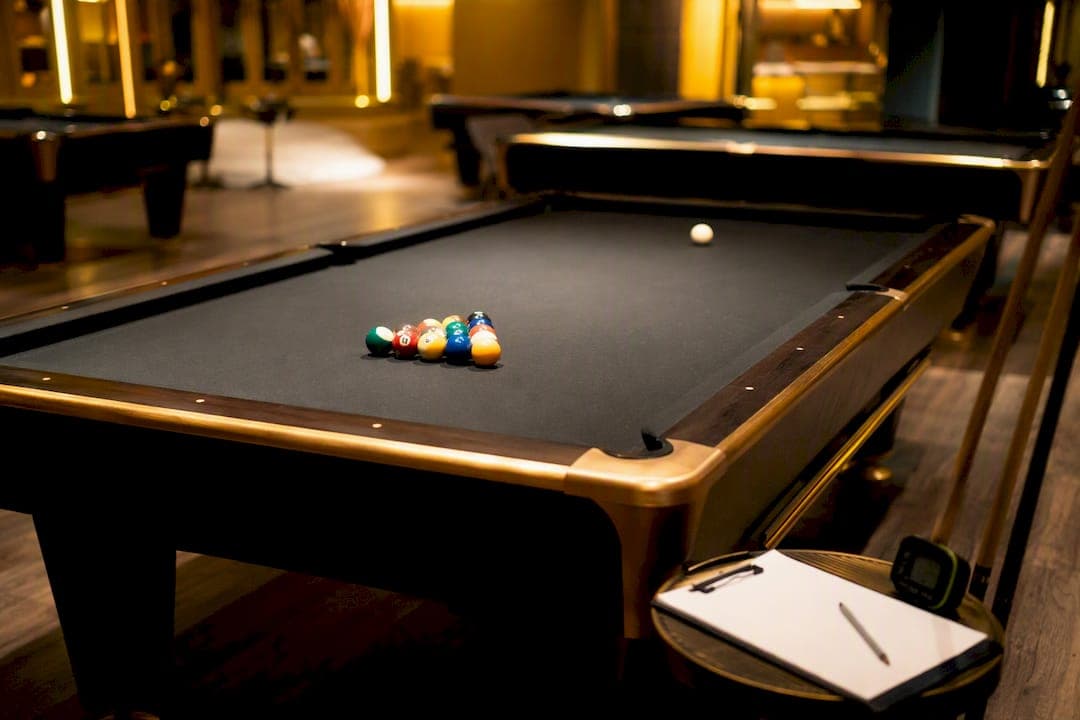
A round robin pool tournament means every player in a group plays every other player exactly once, and standings get decided by results, not luck of the bracket. Choose it when guaranteed match time and fair rankings matter more than a fast finish. In a single round robin with n players, each competitor plays matches against all others, and the group plays a total number of matches based on the tournament size. Double round robin just runs that twice, home-and-home style.
Here's what this guide covers:
- The math behind pool sizes, from 4 players to 8-player splits
- The circle method and Berger tables for building fair schedules
- Tiebreaker rules, seeding options, and playoff hand-offs
- Copyable templates you can hand to a scorekeeper tonight
Key Takeaways
Round robin pool tournaments work because every player gets guaranteed match time and the standings reward consistent play across n-1 matches, not a single elimination draw.
| Point | Details |
|---|---|
| Know your math | Total matches equal n*(n-1)/2; each player plays n-1 matches in a single round robin. |
| Pick the right pool size | Pools of 4 to 6 balance fairness with time; 4-player pools are the practical sweet spot for club nights. |
| Use the circle method | Fix one player, rotate the rest, and read off pairings for a fair schedule every round. |
| Publish tiebreakers first | Head-to-head, then rack differential, then total racks, then a mini-table playoff. |
| Book a venue built for it | Q Billiards Arena runs pools in parallel across 25 tables with event support for organizers. |
Table of Contents
- What Is a Round Robin Pool Tournament, Exactly?
- When Should You Choose Round Robin Over a Bracket?
- How Many Matches Does a Round Robin Actually Require?
- How Do You Build a Fair Schedule for Every Round?
- How Do You Seed Pools and Break Ties in the Standings?
- How Do Round Robin Pools Feed Into a Playoff Bracket?
- Copy These Schedule Templates for Your Next Event
- What Should You Look for in a Scheduling Generator?
- Venue-Tested Tips for Running Round Robin Night
- What Match Format Fits a Pool Round Robin?
- How Do You Keep Table Assignments Fair Across the Pool?
- What Rules Should Every Round Robin Pool Tournament Publish?
- How Do You Keep a Round Robin on Schedule?
- Why Round Robin Rewards Honesty in Tournament Design
- Host Your Round Robin at Q Billiards Arena
- Frequently Asked Questions
- Sources
What Is a Round Robin Pool Tournament, Exactly?
A single round robin puts everyone in one group and has each person play every other person one time. A double round robin runs the same matchups twice, which doubles both the fairness and the table time required. Most club nights stick to single round robin because double round robin for eight players means a significantly higher number of matches, which can take a whole weekend to complete, which eats an entire weekend on most table counts.
Round robin differs from a knockout bracket in one big way: nobody goes home after one loss. A knockout is single elimination, fast but brutal. Swiss format sits in between, pairing players by current record round after round instead of a fixed schedule, which works better for large fields where a full round robin would take too long.
Common uses for round robin pool tournaments include:
- Group stages that feed into a knockout playoff
- Small weekly leagues with 4 to 8 regulars
- Club nights where organizers want every paying player guaranteed multiple matches
- Seeding rounds before a bigger single-elimination event
The round-robin tournament format has been used in everything from chess to team sports for exactly this reason: it rewards consistency over a single hot streak.
When Should You Choose Round Robin Over a Bracket?
The sweet spot for a straight round robin is generally between a few players and around ten players. Smaller groups may feel too small, and larger groups cause the number of matches to increase quickly, making pools a better approach.
Round robin makes sense when your goal is fairness and guaranteed play. Nobody pays an entry fee and walks out after one 15-minute loss, which matters at a club night where players expect their money's worth. It also produces a more defensible champion, since the winner beat everyone in the group rather than just surviving a lucky draw. Round robin's core tradeoff is time: it simply takes longer than knockout, so weigh your table count and available hours honestly before locking the format.
Practical constraints matter as much as philosophy. If you've got two tables and twelve players showing up at 7 p.m. wanting to be done by 10, round robin alone won't fit. That's when pools or a shortened race format come into play.
Pro Tip: Count your tables first, then work backward into player count. A four-table venue running 15-minute matches can realistically handle a 6-player round robin in about two hours, playoffs included.
How Many Matches Does a Round Robin Actually Require?
The formula is simple: total matches equal n*(n-1)/2, where n is the number of players. Each individual player plays n-1 matches, since everyone plays everyone but themselves once.
Here's what that looks like at common pool sizes:
- With a small number of players, each plays several matches and the total matches grow accordingly
- Pools of four players are widely considered practical for club nights because each player gets several matches without overstretching the schedule
That jump from 6 to 15 matches when you go from 4 to 6 players is the number that trips up most first-time organizers. Pools of four are widely considered the sweet spot for club nights because each player still gets three real matches without the schedule stretching past a comfortable evening.
To estimate event length, multiply total matches by average match duration, then divide by tables available and add turnover time between matches. A 15-minute race format with 3 tables running a 6-player pool (15 matches) works out to roughly five rounds of parallel play, closer to 80 to 100 minutes before playoffs.
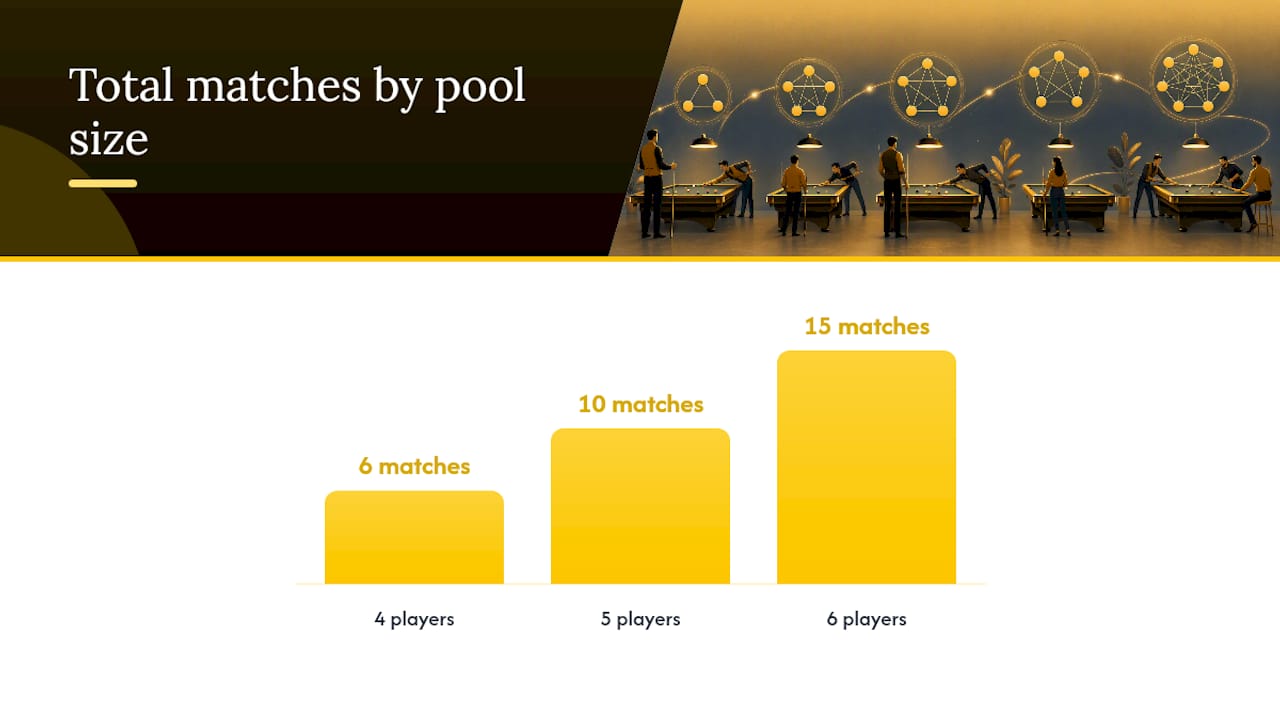
Odd numbers of players need a bye each round, meaning one player sits out while everyone else plays. A 5-player round robin still produces 10 total matches, but the schedule needs to rotate byes evenly so nobody sits out twice while someone else never rests at all.
How Do You Build a Fair Schedule for Every Round?
The circle method, sometimes packaged as a Berger table, is the standard way to generate a fair round robin schedule without guesswork. Here's how it works:
- Arrange all players in two rows facing each other, like a clock face split down the middle.
- Fix one player in place (this matters most for odd numbers, where that "fixed" slot rotates to become the bye).
- Rotate every other player one position clockwise after each round.
- Read off each round's pairings directly from the new arrangement.
- Repeat until every player has faced every other player exactly once.
Berger tables are just precomputed versions of this same rotation, published as reference charts so organizers don't have to draw circles by hand. You can find printable versions through sites like PrintYourBrackets if you want a chart to hand your scorekeeper instead of building one from scratch.
Adapting the schedule depends entirely on your table count:
- Single-table day: run the rounds in strict sequence, one match at a time, since there's nowhere else for a match to happen.
- Four-table night: split each round across tables so up to four matches run simultaneously, cutting total event time by roughly 75%.
- Parallel pools: if you've split a big field into multiple round-robin pools, running those pools simultaneously means the whole phase finishes in roughly the time it takes to complete one pool, not all of them stacked end to end.
That last point is the one most first-time organizers miss. A four-pool event isn't four times longer than one pool. It's the same length, run in parallel, if you've got the tables to support it.
How Do You Seed Pools and Break Ties in the Standings?
Seeding decides who lands in which pool before a single ball gets racked. Random seeding is the simplest and fairest for casual club nights. Seeded placement, where known strong players get spread across pools based on rating or past results, works better for competitive events where stacking one pool with all the best players would be unfair. Snake seeding (1-2-3-4, then 4-3-2-1 into the next round of assignments) is the standard way to balance skill across multiple pools without hand-picking matchups.
Ties in the standings happen constantly in round robin, especially in small pools, so publish your tiebreaker order before the first rack is broken. The standard order most pool competitions use runs:
- Head-to-head result between the tied players first
- Rack or point differential (racks won minus racks lost across all pool matches)
- Total racks scored if differential is also tied
- Playoff or mini-table as a last resort when the numbers simply won't separate them
Three-way ties are messier, since head-to-head alone can loop (A beat B, B beat C, C beat A). When that happens, fall back to combined rack differential across all three players' matches, and if that's still tied, run a short mini round robin among just the tied players.
Pro Tip: Print your tiebreaker order on the same sheet as the schedule. Disputes happen fast and get personal fast; a printed rule ends the argument before it starts.
Sample rule text you can copy directly onto a tournament flyer: "Standings ties will be broken by (1) head-to-head result, (2) rack differential, (3) total racks won, (4) a single-rack playoff."
How Do Round Robin Pools Feed Into a Playoff Bracket?
The most common pattern sends the top one or two finishers from each pool into a single-elimination bracket. Top-1 advancement keeps the playoff bracket small and fast. Top-2 advancement gives more players a shot at the title while still rewarding pool performance.
A practical example: 16 players split into 4 pools of 4. Each pool plays a full round robin (6 matches per pool, 24 total), then the top 2 from each pool advance to an 8-player single-elimination bracket. That's a full night's structure that scales cleanly on 3 to 4 tables.
Seeding the playoff bracket matters just as much as seeding the pools. A few rules keep it fair:
- Pool winners should never face each other in the first playoff round if avoidable.
- Cross-seed so a pool's winner faces a different pool's runner-up, not their own pool's second-place finisher (an early rematch nobody wants to watch twice).
- Reserve wildcard slots only for events where pool sizes are uneven and you need to fill bracket slots fairly.
- Fixed brackets are simpler to run; reseeding after each round is fairer but requires more staffing to manage live.
Copy These Schedule Templates for Your Next Event
A 4-player single pool needs just three rounds. Round 1 pairs players 1v4 and 2v3, round 2 pairs 1v3 and 2v4, round 3 pairs 1v2 and 3v4. At 20 minutes per match with one table, that's a two-hour block; with two tables running rounds in parallel, it drops to roughly an hour.
For a 5-player pool, one player sits out each round on rotation:
- Round 1: Player 5 sits out; 1v4, 2v3 play.
- Round 2: Player 4 sits out; 5v3, 1v2 play.
- Round 3: Player 3 sits out; 4v2, 5v1 play.
- Round 4: Player 2 sits out; 3v1, 4v5 play.
- Round 5: Player 1 sits out; 2v5, 3v4 play.
For 8 players on limited tables, split into two pools of 4 and run both pools' Round 1 matches simultaneously across four tables, then repeat for Rounds 2 and 3.
When exporting or printing any of these, include player names, round number, table assignment, and a blank score column organizers can fill in by hand. A generator like BracketDraw will output this in CSV or PDF automatically, but even a plain spreadsheet with those four columns works fine for a club night.
What Should You Look for in a Scheduling Generator?
A solid generator saves real time on event day. Look for PDF and CSV export, live standings that update as scores get entered, and automatic tiebreaker calculations so you're not doing rack differential math by hand between rounds.
Before trusting any generator for live play, check that it:
- Exports a clean printable chart your scorekeeper can actually read at a glance
- Applies your specific tiebreaker order, not a generic default
- Handles odd player counts with proper bye rotation
- Lets you adjust match format (race to 5, race to 7) without rebuilding the whole schedule
Some tournament-management platforms built for other cue sports and card games, like Shuffle Up and Deal's poker tournament tools, show what a well-built live-standings interface looks like even outside pool specifically. Adapt the output format to your audience: a casual club night needs a big-print wall chart, while a sanctioned event needs a signed scoresheet for the record book.
Venue-Tested Tips for Running Round Robin Night
Running round robin across 25 tables at Q Billiards Arena has taught us that turnover speed, not match speed, decides whether a night runs on time.
- Rack and rerack between matches before the next pair even sits down.
- Assign one referee per two tables during pool play to catch disputes early.
- Collect scores immediately, not at the end of the round, so standings stay current.
- Budget extra changeover time on nights with a full food and drink menu running.
What Match Format Fits a Pool Round Robin?
Race-to formats are how pool tournaments turn "a match" into a concrete, timeable unit. A race to 5 means first player to win 5 racks takes the match, and it's the standard for club-night round robins because it balances fairly quickly, usually 15 to 20 minutes per match depending on skill level.
Race to 7 or race to 9 shows up in more competitive formats where organizers want deeper matches, but that length multiplies your total event time fast. A 6-player pool at race to 5 might run 90 minutes; the same pool at race to 9 could push past three hours.
For 9-ball specifically, matches move faster than 8-ball because there are fewer balls on the table and the rack format encourages combos and break shots that end games early. If your round robin mixes formats (9-ball for speed rounds, 8-ball for finals), say so on the printed schedule. Players need to know the target rack count before they sit down, not after.
Scoring should be simple: one point per rack won, tallied on the schedule sheet itself. Avoid handicap systems inside a round robin pool unless every player agrees to it beforehand, since a mid-event handicap dispute is one of the fastest ways to derail an otherwise smooth night. If you're running a 9-ball pool, the rack itself matters too; a badly set diamond rack skews results before the first shot is even taken, so review proper 9-ball racking technique with anyone running the table.
How Do You Keep Table Assignments Fair Across the Pool?
Table assignments feel like a small detail until someone complains about it. Different tables can have different pocket sizes, cloth speed, and lighting, and a player stuck on the "slow" table all night will notice if everyone else gets faster cloth.
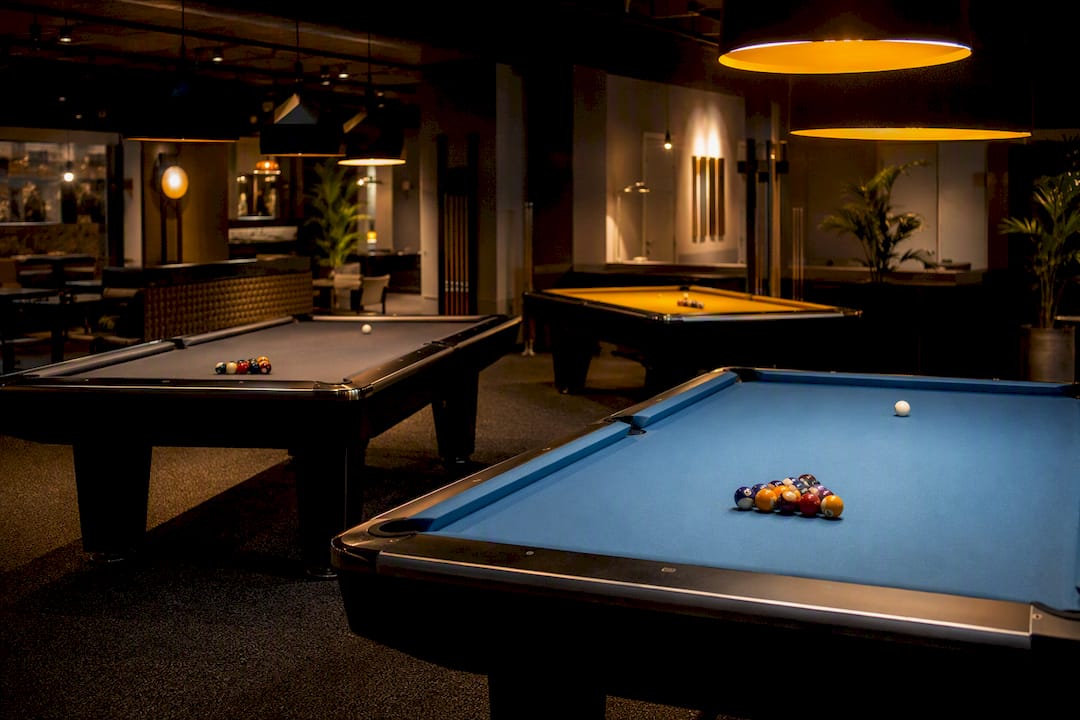
Rotate table assignments round by round instead of locking players to one table for the whole pool. If you've got four tables and four rounds, make sure each player spends at least one round on each table type over the course of the event. This is especially important in mixed venues where some tables are bar-box size and others are full 9-foot tournament tables.
Publish the table rotation alongside the match schedule so nobody can claim they got stuck with the worst setup by accident. Transparency here does double duty: it prevents complaints and it makes the standings feel earned rather than lucky.
A few practical guidelines keep assignments balanced:
- Never let one player play every match on the same table unless venue layout genuinely forces it.
- If tables differ in size or speed, rotate players through all of them evenly across the pool.
- Assign referees to spot-check unusual outcomes rather than hovering over every shot.
- Post table assignments at the same time you post the round schedule, not separately.
What Rules Should Every Round Robin Pool Tournament Publish?
Every round robin needs a written rule sheet before the first break, not a verbal explanation shouted across the room. At minimum, that sheet should define the game (8-ball, 9-ball, or straight pool), the race format, the tiebreaker order, and what happens on a no-show.
Standard rules worth including cover shot clock or time limits per turn if you're running a tight schedule, whether a scratch on the break results in ball-in-hand, and how disputes get resolved (usually a designated tournament director's ruling is final). Most clubs also specify equipment standards, like whether players can bring their own cues or must use house cues only.
Late arrivals and no-shows need a clear policy too. A common approach: a player who isn't at the table within 5 minutes of their scheduled match forfeits that match, and their opponent gets a win by default. Write this down and post it, because verbal rules get disputed and written rules don't.
If your event doubles as a sanctioned league night, check whether a governing body's rulebook applies on top of your own house rules. Most casual club round robins don't need this level of formality, but it's worth confirming before entry fees change hands.
How Do You Keep a Round Robin on Schedule?
Time management is where most round robin tournaments actually fall apart, not in the scheduling math. The formula tells you how many matches you need; it doesn't account for the player who takes an extra ten minutes between racks or the table that needs recloth mid-event.
Build in changeover buffer between every match, not just between rounds. A 15-minute race format realistically needs 18 to 20 minutes of table time once you count racking, score reporting, and the next pair getting settled. Venues with food and drink service running need even more buffer, since players wandering off for a snack between matches is normal and should be planned for, not fought against.
Set a hard cutoff time for each round and stick to it publicly. If a match is running long and threatening to push the whole schedule, a soft time limit (extend to next rack win, or sudden-death final rack) keeps one slow match from eating everyone else's night. Post the projected finish time at the start of the event so players can plan around it, and update it out loud if reality drifts from the plan.
Why Round Robin Rewards Honesty in Tournament Design
Round robin only works as advertised when organizers commit to the format's honesty and don't shortcut it halfway through. The appeal of round robin is that the schedule can't be gamed. Nobody can dodge a tough opponent, and nobody wins on a single lucky bracket draw. That's precisely why publishing rules, tiebreakers, and table rotations matters more here than in a knockout event, where a single loss ends the conversation anyway.
What surprises a lot of first-time organizers is how much of the format's fairness depends on decisions made before a single match is played, seeding, table rotation, tiebreaker order, not during it. Get those right and the event runs itself. Get them wrong and you'll spend the whole night fielding complaints instead of watching pool.
If you're organizing a club night, publish everything: the schedule, the tiebreaker order, the table rotation. And if you want a second set of eyes on the plan, reach out to the team running events on the floor every week.
Host Your Round Robin at Q Billiards Arena
Running a round robin on borrowed tables at a bar means fighting for space and hoping nobody needs the table you scheduled. Q Billiards Arena gives organizers 25 professional-grade tables across 11,000 square feet, which means a 16-player, four-pool round robin can run in parallel instead of queuing up on two tables all night.
Q Billiards Arena supports organizers with table booking, food and drink service so players don't have to leave mid-round, and late hours that let a full round robin plus playoff bracket actually finish without rushing the final matches. Check table types and pricing to plan your table count, or if your event includes a poker side game or needs a private space, look at poker room rental for a dedicated area. Ready to lock in a date? Visit the tournaments and events page to check availability and get your round robin on the calendar.
Frequently Asked Questions
What's the difference between round robin and pool play? They're closely related. Round robin describes the format itself (everyone plays everyone), while pool play typically means dividing a larger field into several smaller round-robin groups, then advancing top finishers to a playoff bracket.
How many players is too many for a straight round robin? Past 10 to 12 players, a single round robin usually takes too long for a normal event window. That's the point where splitting into multiple pools makes more sense than forcing one giant group through every matchup.
Can round robin work with just one table? Yes, but budget accordingly. A single-table 6-player round robin (15 matches) at 20 minutes each runs roughly five hours before any playoff, so single-table events usually work better with 4 or 5 players.
What happens if a player has to leave early? Most organizers treat unplayed matches as forfeits or apply a standard "loss by default" rule, which should be written into the rule sheet before the event starts, not decided on the spot.
Is double round robin worth the extra time? Usually only for smaller, more competitive fields where a single result feels too random. For 4 or 5 players, doubling the schedule adds meaningful data. For 8 or more, double round robin usually isn't worth the time cost for a casual club night.
Sources
- Round-robin tournament — Wikipedia
- Round Robin — BracketDraw
- Round Robin Tournaments — How They Work — SportsBracket
- Pool Play Tournament Guide - Brakto