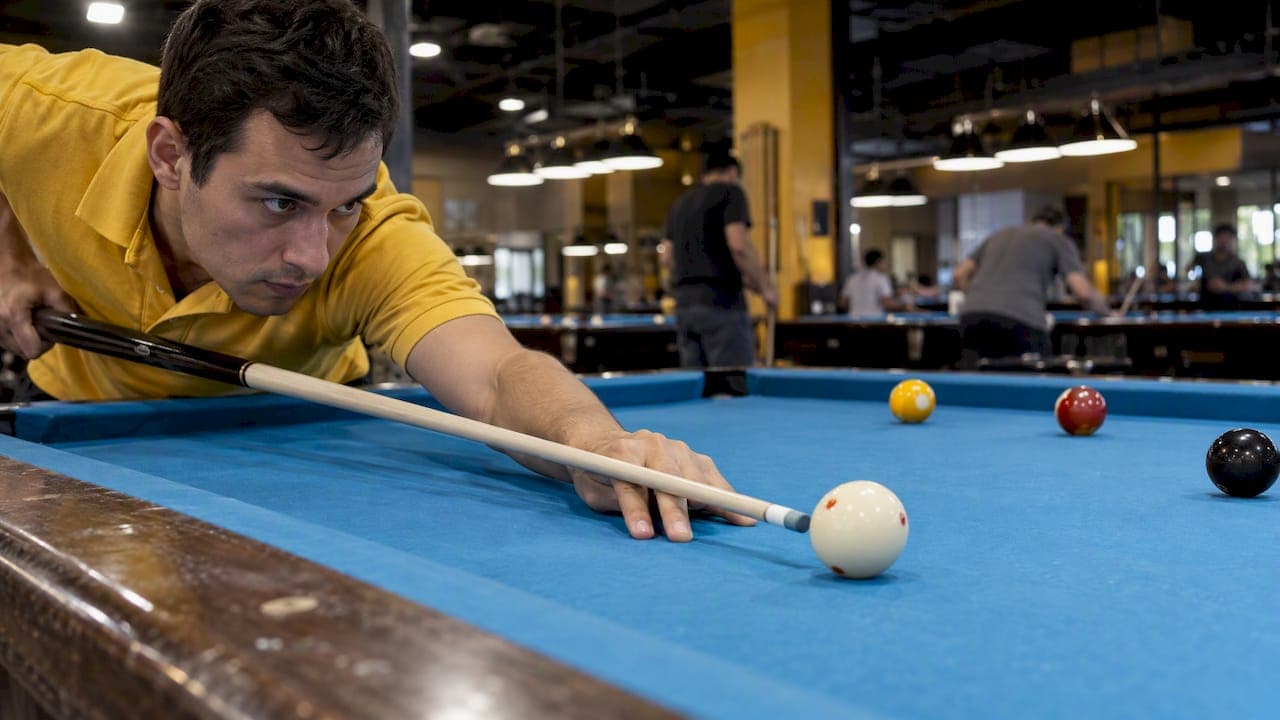
Yes, side spin changes how the cue ball leaves a cushion, and it can push the object ball off its line at contact. Use small, deliberate English and adjust your aim instead of leaning on big amounts of spin. Below is a shot-by-shot aiming routine, plus drills we use at our tables to make it repeatable.
TL;DR:
- For short, firm shots with a level cue, aim slightly toward the spin; on long, slow shots, account for swerve pulling the cue ball back.
- Start just off center, keep the cue level, and change one variable at a time; add spin or distance only after your results become consistent.
- Use running English to open the cushion angle and reverse English to shorten it; choose based on the cue ball’s intended path, not habit.
- Before a spin dependent match shot, test a rail rebound and short cut because cloth speed, ball cleanliness, and rail condition alter spin and throw.
Table of Contents
- What is English and when should you use it?
- How does side spin change the cue-ball path?
- How do you aim a shot with side spin?
- Which drills build consistent side spin?
- Is left or right side spin better?
- How does side spin work with follow and draw?
- How do table conditions change side spin?
- What a coach sees when players learn English
- Learn English faster with our snooker coaching camp
- FAQ
- Sources
What is English and when should you use it?
English is side spin on the cue ball, created by striking it left or right of center with the tip. Hit right of center and you give the cue ball right English. Hit left of center and you give it left English. The farther from center the tip lands, the more spin you create, and the more everything else on the shot changes.
Spin comes in three basic types: topspin, backspin, and sidespin. Follow and draw spin the ball along its vertical axis. Side spin acts horizontally, which is why it steers the cue ball sideways off rails and nudges the object ball at contact. It is also the hardest of the three to control at first, and consistency comes from repetition.
Players reach for English in a few situations:
- Position play: opening up the cue ball's path to the next shot after a cut.
- Rail steering: widening or narrowing the angle off a cushion.
- Avoiding scratches: killing the cue ball's run toward a pocket.
- Breaking up clusters: controlling where the cue ball lands after contact.
If a shot works with a center-ball hit, skip the English.
How does side spin change the cue-ball path?
Several effects can influence your aim and pull it off the line you see.
- Squirt: the instant your tip hits off-center, the cue ball leaves slightly opposite the side you struck. Right English squirts the ball left. A level cue and a straight, consistent stroke keep this effect predictable.
- Swerve: if your cue is elevated even a little, or the shot is slow, the ball curves gradually as it travels. Swerve grows with elevation and distance, so a level cue and firmer pace shrink it.
- Impact throw: at contact, the cue ball's spin drags the object ball slightly off the line it would take with no spin. Slower shots and thinner cuts show more throw.
Here is the useful part: sidespin primarily affects horizontal trajectory, producing a lateral curve or kick, and controlling it comes down to three variables: contact position, swing path, and compensating for body position. In pool terms, those translate to tip placement, stroke line, and your aim adjustment.
A rule of thumb for net error: squirt pulls the cue ball one way, while throw pushes the object ball the other. For a short, firm shot with a level cue, expect to aim slightly toward the side you are spinning. For a long, slow shot, expect swerve to join in and bring the ball back. Test it on your table before trusting it in a match.
How do you aim a shot with side spin?
Run the same routine on every spin shot so your adjustments stay small and repeatable.
- Check your setup first. Confirm your stance, bridge length, and sight line on a plain center-ball shot before you add anything.
- Pick the minimum spin that solves the problem. Start with a small offset from center, not the edge of the ball.
- Pivot to your aiming line. Aim at your normal contact point, then shift your tip to the English side while keeping the cue parallel to that line.
- Offset your aim slightly toward the spin. For right English, aim a touch right of your normal line, and mirror it for left. Raise the offset in small steps only after you see results.
- Stroke smoothly. Accelerate evenly, keep the cue level, and finish with a consistent follow-through. A jab or an elevated butt adds unwanted swerve.
- Review the result. Note where the object ball went and where the cue ball finished, then adjust one variable at a time.
Pro Tip: Chalk, set your tip on the cue ball, and hold your pause there for a beat before you pull back, so your eyes confirm exactly where you are striking.
On side choice: running English (spin that follows the direction the ball travels off the rail) opens angles and lets the cue ball roll on past the cushion. Reverse English checks the ball and shortens the angle, which helps when you need to stop the cue ball tight to a rail or avoid a scratch. Learn one side thoroughly before you blend the two.
For more on the position-play side of this, our own cue ball control drills pair well with this routine.
Which drills build consistent side spin?
Spin skills grow from short, repeated sets with a clear goal. A few drills cover tip placement, rail behavior, and throw.
- Progressive tip drill: set the object ball and cue ball a diamond apart on a straight shot. Hit with center ball, then one tip left, then one tip right, and note how far the object ball drifts. Repeat to observe squirt with your own cue.
- Cushion-aim drill: shoot the cue ball to a marked point on a rail with center ball, then with left and right English at the same speed. Watch how the rebound angle widens or narrows.
- Throw-observation drill: line up short-angle cuts into a corner pocket. Shoot them with and without English at a medium pace and notice which side the object ball favors. Then correct your aim and repeat until you can pocket the ball consistently.
- Slow-versus-firm pairing: repeat any of the above at different speeds so you see how swerve and throw change with pace.
For progression, run a selection of drills per session, repeating each one over several sessions. Track how often shots finish where you intended. When your results become consistent, add a little more spin or distance. If you want to build these into a bigger plan, our snooker practice routines show how to structure a full session.
Is left or right side spin better?
Neither is better. They are mirror images, and your strong side will usually feel more natural, so you will use it more. The strategic difference comes from where the cue ball needs to go next.
Right English sends the cue ball to the right off a cushion and tends to move the object ball slightly left at contact. Left English does the opposite. When you know the direction you need the cue ball to travel after contact, pick the English that sends it there, then check whether it is running or reverse relative to the cushion you will hit.
Many players find one side easier to aim with spin than the other, usually because of cue alignment, eye dominance, or the way their bridge hand sits. Don't ignore your weaker side. Spend a set or two on it in every practice session, because a position problem on the table rarely lines up with the English you prefer.
A useful habit is to name the spin before every shot: "left, running" or "right, reverse." Calling it out forces you to match the spin to the path you want, rather than reaching for the English you are used to.

How does side spin work with follow and draw?
Most real shots combine side spin with follow (topspin) or draw (backspin), and the two interact. Follow and draw control how far the cue ball travels forward or back after contact. Side spin controls where it goes laterally, especially off a rail.
Add follow to side spin and the cue ball keeps rolling forward after it comes off the cushion, with the English steering the angle. Add draw and the cue ball tends to check and pull back, with the English adjusting how sharply it kicks sideways. Sidespin shows its true effect on cushions most clearly when it is paired with a controlled vertical component.
Mixing them also increases the number of variables that squirt and swerve act on. A tip placed high and to the right changes the cue ball differently than the same horizontal offset at center height. Keep the vertical component modest while you are learning, change only one axis at a time, and keep the cue as level as the shot allows.
A good test is to shoot the same cushion shot three ways: pure side spin, side spin with follow, and side spin with draw. Mark where the cue ball finishes each time. That comparison will teach you more about combined spin than any diagram.

How do table conditions change side spin?
The same stroke behaves differently from table to table. Cloth speed is the biggest factor: on a fast cloth, the cue ball holds its spin longer and rails return it more sharply, so English is more pronounced. On a slow cloth, spin dies sooner and rebounds are softer.
Cleanliness matters just as much. Chalk dust, dirt, or humidity on the cloth or the balls can add or reduce friction, which changes throw at contact and how the cue ball grips the cushion. Dirty balls tend to throw more, and a ball that grips the cloth takes spin more strongly.
Cushion condition also shapes the rebound. Firm, true rails give predictable angles, while worn rails can absorb or distort the spin. Even the same table can play differently over the course of an evening as play continues.
Before you commit to a spin-dependent shot in a match, take a few practice rolls and a rail shot or two. Check how far the cue ball runs, how much it kicks off a cushion, and how much throw you see on a short cut. A little calibration beats a series of missed shots.
What a coach sees when players learn English
At our club, the same patterns come up. New players add too much spin too early, jab at the cue ball, and forget to adjust their aim. Most improve fast once someone watches their stroke and shows them where the squirt is coming from. Feedback can make flaws in cue alignment and finish obvious in a way that feel alone cannot. We suggest trying these drills with a coach nearby the first few times, so bad habits don't set in.
— Q
Learn English faster with our snooker coaching camp
Solo drilling works, but feedback speeds everything up. Our Snooker Coaching Camp offers an opportunity to work on your game. See dates and details on our events page and reserve your spot. Coaching can help you identify and work on squirt and aim errors more directly than solo practice. See dates and details on our events page and reserve your spot.

FAQ
What are the different types of spins in pool?
The main types are follow (topspin), draw (backspin), and side spin, also called English. Follow and draw act along the vertical axis, while side spin acts horizontally. Players often combine them, and spin generally divides into topspin, backspin, and sidespin across table sports.
How much side spin should a beginner use?
Start with a small offset from center. That is enough to see squirt and cushion effects without making the shot unpredictable. Increase only in small steps once your results are consistent.
Does side spin change where the object ball goes?
Yes, through throw at contact. Spin on the cue ball drags the object ball slightly off its normal line, especially on slower shots and thinner cuts. Adjust your aim a touch toward the spin direction and check the result.
Why does my cue ball curve when I use English?
A curve usually comes from swerve, which appears when the cue is elevated or the shot is slow. Keep the cue level and shoot a little firmer to reduce it. Squirt and throw also shift the line, so correct one factor at a time.
Sources
- How to Hit a Pickleball Sidespin Serve: Stance, Swing & Placement
- How do you make a table tennis ball spin? - ActiveSG