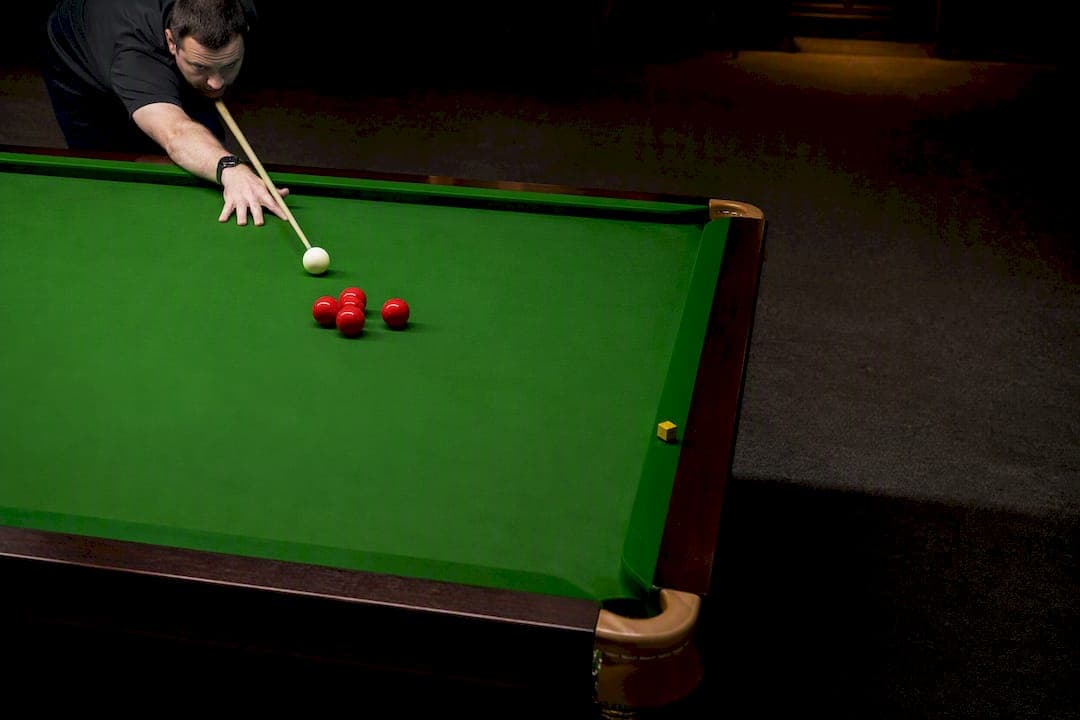
A correct safety shot does one thing: it removes clear scoring options from your opponent by leaving the cue ball and object ball in positions that block natural potting angles. That single objective drives every decision in snooker safety play, from a tight cushion nudge to a screw-back snooker behind the pack. This guide breaks down the principles, shot types, decision rules, drills, and rulebook details that turn defensive theory into frame-winning habit.
TL;DR:
- Safety shots should focus on angles and table geometry, aiming to leave the opponent with limited or awkward options rather than just hiding the cue ball.
- Pace control is more critical than spin, especially on unfamiliar tables, as speed errors tend to be more punishing than spin misjudgments.
- Repetitive practice of common safety patterns and pressure drills builds match resilience and improves decision-making under pressure.
- Players must strictly follow fouling rules, such as striking the ball on first and contacting cushions or balls legally, to avoid penalties and loss of frame.
- Elite safeties involve incremental, micro-angle adjustments that progressively restrict the opponent's options, often requiring tactical patience over multiple shots.
Table of Contents
- What Are the Core Principles of Snooker Safety Play?
- What Are the Most Common Safety Shots and How Do You Play Them?
- When Should You Play Safe Instead of Going for the Pot?
- How Do You Practice Safety Play?
- What Rules and Fouls Affect Safety Play?
- What Advanced Safety Patterns Do Pros Use?
- Applying These Techniques at the Table
- Practice Safety Play at Q Billiards Arena
- Sources
- FAQ
What Are the Core Principles of Snooker Safety Play?
Cue-ball control is the whole game. Every safety shot lives or dies on pace, spin, and the line you leave. A safety played half a yard too hard turns into a gift; one played too soft can leave your own cue ball hanging over a pocket. The goal isn't to hide the cue ball somewhere vague. It's to park it exactly where the geometry works against your opponent.
Think in terms of angles, not distance. A cue ball sitting six inches from a red is only "safe" if that six inches doesn't hand over an easy in-off or a simple long pot. Study the lines the object ball can travel, then close them off with the cushion, another color, or the pack of reds itself.
Pocket-covering matters as much as cue-ball position. Leaving a color tight to a pocket's jaws, or nudging a red so it blocks the direct path to a middle pocket, does more defensive work than an isolated cue-ball hide. The best safeties attack both ends of the shot at once: they restrict the cue ball's next contact and they clutter the table so nothing looks inviting.
The real skill is limiting choices, not just eliminating one. A shot that removes the pot but leaves three other reds loosely accessible barely counts as a safety. A shot that leaves the incoming player with one awkward option and nothing else is the version worth practicing.
Table conditions change all of this. A fast cloth and lively cushions mean less power gets more distance, so your pace calibration on a club table won't match a tournament-cloth table. Cushion response varies by table age and rubber condition too, which is why players who move between venues often misjudge a soft safety on their first visit. Getting comfortable with cue-ball control on whatever table you're actually playing on matters more than memorizing one "correct" amount of power.
- Control pace first, spin second. Distance errors punish you harder than spin errors.
- Treat the pack of reds as a defensive tool, not just a scoring target.
- Reassess after every safety exchange. The table state changes with each shot.
- Match your power to the specific table's cloth and cushion speed, not a fixed mental scale.
Pro Tip: Chalk up before every safety, not just before pots. A mis-cued safety often does more damage than a missed pot, because it hands your opponent exactly the position you were trying to deny them.
What Are the Most Common Safety Shots and How Do You Play Them?
Most matches come down to five or six recurring safety patterns. Learn these and you'll recognize the setup before your opponent even chalks up.
- Tight cushion safety. Aim to make thin contact with the object ball, using just enough pace to send it a few inches along the cushion while your cue ball settles nearby. The aiming point sits on the extreme edge of the ball, and pace control matters more than accuracy here. Too much contact and the object ball runs loose into open table.
- Long baulk safety. Send the cue ball the length of the table into baulk while the object ball travels up toward the top cushion. This is the standard response when you're snookered or facing a long, low-percentage pot. Leave the object ball positioned defensively near a cushion rather than in open space.
- Stun-block safety. Use a firm, level cue and a stun shot to kill the cue ball's roll after contact, stopping it dead behind a color or a cluster of reds. This works when you need the cue ball to stay exactly where contact happens rather than drifting forward.
- Screw-back safety. Strike below center with backspin to pull the cue ball away from the object ball after contact, often to duck behind another ball and create a snooker. This is the shot that produces the visually dramatic "impossible angle" leaves you see in televised frames.
- Double-cushion and carom safety. Send the cue ball off two cushions, or use a soft carom off a second object ball, to reach a defensive position when a direct route isn't available. These shots demand more practice time because small errors in the first cushion angle compound by the second.
Execution details separate players who play good safeties from players who play lucky ones. Keep your cue level through the stroke unless you're deliberately playing a stun or screw shot that requires a slight elevation. Follow through smoothly rather than poking at the ball, since a jabbed stroke kills your touch on distance control. Pick a visual marker, a diamond on the cushion, a spot on the baulk line, before you strike, and commit to it rather than adjusting mid-stroke.
- Watch your bridge hand distance from the cue ball on screw shots. Too close and you'll mis-cue.
- On long baulk safeties, aim slightly fuller than feels natural. Thin contact at that distance is unforgiving.
- Practice the same safety from both sides of the table. Angles you find easy right handed often expose weaknesses left handed.
When Should You Play Safe Instead of Going for the Pot?
The decision isn't emotional, it's mechanical. Run through the same four inputs every time: frame score, shot difficulty, your opponent's known tendencies, and how the rest of the table is laid out. A coherent decision checklist covering these four factors helps players choose faster and more accurately under pressure, and speed matters because hesitation at the table often signals indecision to your opponent too.
Run this quick checklist before you commit to a pot attempt:
- Is the pot above 70% likely for you on this specific shot, not in general?
- Does missing leave your opponent an easy in-off or a simple next ball?
- Are you ahead or behind on the frame score, and does that change your risk tolerance?
- Has your opponent shown they struggle with long safeties or awkward angles?
- Is there a break-building opportunity buried in the layout if you pot this ball?
Three quick scenarios show the logic in practice. First: you're 40 points down with six reds left and facing a difficult, half-ball pot into a middle pocket. Missing barely changes your position, since you were already behind, so attempt the pot. Second: you're 20 points ahead with a tricky red near a cushion and no clear follow-up shot. Play the safety, since a miss here could hand back your lead for no real gain. Third: your opponent has missed three long safeties already this frame. That's your signal to force another long safety rather than risk a low-percentage pot they'd punish if you left anything loose.
How Do You Practice Safety Play?
Safety skills degrade fast without repetition, and most club players spend nine minutes practicing pots for every one minute spent on defense. That ratio is backwards. Players who dedicate structured time to defensive routines build match resilience that shows up over a full season, not just in a single frame.
- Beginner drill: thin-contact baulk-to-black. Place a red near the black spot and practice sending it a short distance while your cue ball returns safely into baulk. Success means the object ball moves less than a foot and your cue ball stays behind the baulk line. Run 20 reps and track how many meet both conditions.
- Intermediate drill: double-cushion and stun-block sequences. Alternate between a double-cushion safety and a stun-block against a stationary color, scoring one point for each shot that leaves zero direct pot for an imaginary opponent. Aim for a high success rate before moving up in difficulty.
- Advanced drill: best-of-3 frame simulation. Play full frames against a practice partner where you're required to attempt a safety on any shot rated below 60% confidence. This format, recommended by coaching resources for progressive safety training, forces you to chain multiple safeties in a row rather than practicing them in isolation.
Track your progress with three numbers: how long each drill takes, your success rate against the criteria above, and how many "pressure reps" you complete, meaning shots played with a self-imposed penalty for missing, like restarting the set. Structured 90-minute practice sessions that mix break-building with defensive drills tend to produce steadier results than pure potting sessions.
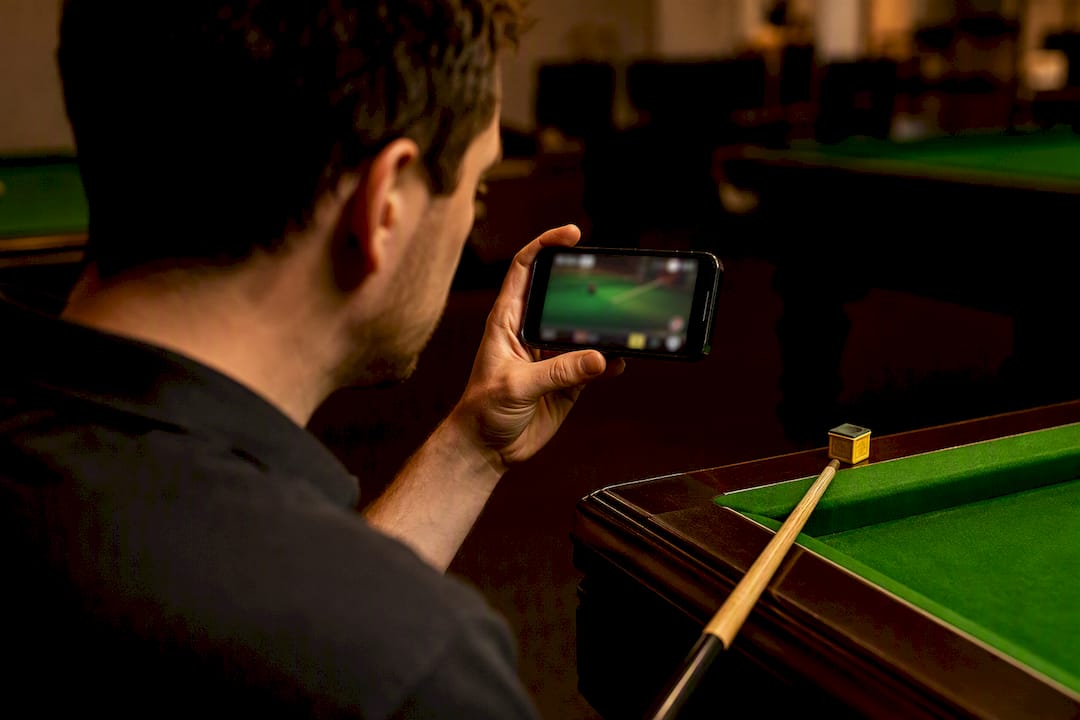
Pro Tip: Record your practice sessions on your phone. Watching your cue action back after a missed safety reveals mechanical flaws, an early head lift, a rushed bridge, that you'll never catch in the moment.
What Rules and Fouls Affect Safety Play?
Every safety shot has to respect the same foundational rule: you must strike the "ball on" first, or it's a foul regardless of what happens afterward. Missing that contact entirely, or hitting the wrong ball first, triggers a penalty under the WPBSA Snooker Official Rulebook, typically at least four points depending on the value of the balls involved.
- Failing to hit a cushion after legally contacting the ball on is not automatically a foul, but failing to hit the ball on first always is.
- A referee can call "foul and a miss" when a player fails to hit the ball on despite having a clear path to it, and the incoming player may then request the shot be replayed or the balls repositioned.
- Referees hold broad discretion, including consulting video replay in some formats, to enforce fair play when an incident isn't immediately clear.
- Repeated fouls compound quickly. Three "foul and a miss" calls in one visit can hand the frame away.
Understanding these calls before you attempt an aggressive safety prevents you from giving away easy points through a technicality rather than a tactical error.
What Advanced Safety Patterns Do Pros Use?
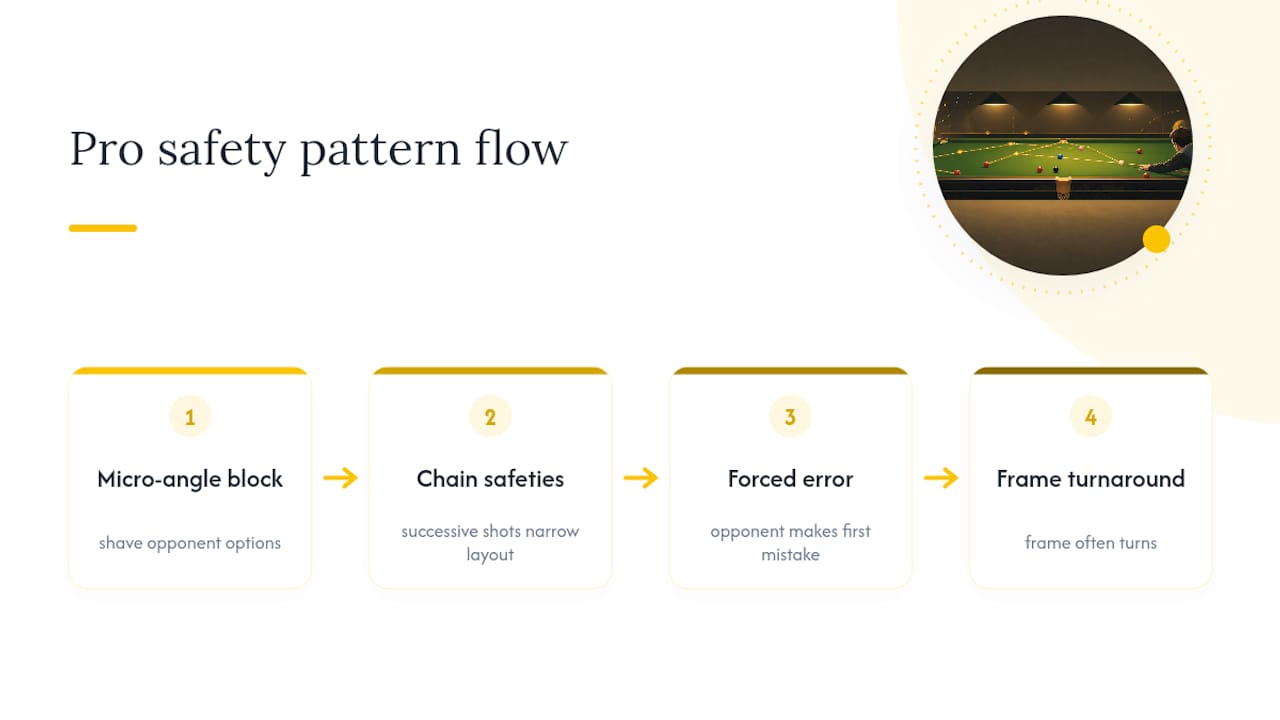
Elite players win frames with safeties that barely register on a highlight reel. John Higgins is known for a style of micro-angle blocking where each shot shaves down the opponent's options by a few degrees rather than eliminating them outright, a tactic that reportedly left fellow professional Neil Robertson visibly impressed during a televised match.
Chain safeties work the same way over several shots: each exchange narrows the layout until the opponent is finally forced into a genuine error, at which point the frame often turns. Watching professional matches with this lens, tracking how many consecutive safeties precede the first real mistake, teaches you more about tactical patience than any highlight package of pots ever will. The double-cushion and stun-block drills covered earlier are direct simulations of exactly this kind of incremental pressure.
Applying These Techniques at the Table
Practice sessions and coaching camps are offered with a progression of fundamentals, shot-specific drills, and pressure simulation under conditions close to those in matches. Watching players move from tentative safeties to confident, chained defensive sequences over a few weeks is where the real gap between theory and table performance closes. Drills only pay off once you've run them under a bit of real pressure.
— Q
Practice Safety Play at Q Billiards Arena
Reading about a screw-back safety and actually pulling it off under pressure are two different skills, and the gap closes the fastest on a real table against a real opponent. Q Billiards Arena gives you both: hourly table time to drill the routines from this guide and live tournament pressure to test them.
Book time on a Standard Snooker or Heated Snooker table to run the thin-contact and double-cushion drills at your own pace, without waiting behind a queue of casual players. If you want structured feedback rather than solo repetition, the Snooker Coaching Camp walks through cue-ball control and shot selection with actual coaching input, which is hard to replicate practicing alone. Once the fundamentals feel steady, test them where it counts: the 1-Red Snooker Tournament puts you against opponents who will punish a loose safety exactly the way this guide warns about. Reservations are available for tables and coaching spots to support practice and competitive play.
Sources
For official rulings, consult the WPBSA Snooker Official Rulebook and the SnookerHQ miss rule explainer. For drill structure, see 147 Academy's safety practice routines and CuePal's practice routine guide.
- Practice Routines – Safety – 147 Academy
- Neil Robertson left in awe by 'unbelievable' John Higgins tactic | Wales Online
- SnookerHQ — Miss rule explainer
FAQ
Is It a Foul if You Don't Hit a Cushion in Snooker?
Not automatically. The foul happens when you fail to strike the ball on first; failing to reach a cushion afterward is only a foul if the shot also breaks another rule, like leaving no ball or cushion contact at all after contact. Check the WPBSA rulebook for the exact cushion-contact conditions tied to your specific situation.
What Is "Foul and a Miss" and How Does It Work?
A referee calls "foul and a miss" when a player fails to hit the ball on despite having a clear path to it, judged to be an attempt that fell short of a genuine effort. The incoming player can then choose to replay the shot or have the balls repositioned, whichever leaves them in the stronger position.
Can You Hit Two Red Balls in a Row in Snooker?
Yes, as long as the reds are the "ball on" for that shot, since any red counts as a legal first contact while reds remain on the table.
What Is the Kiss Rule in Snooker?
The "kiss rule" isn't an official rulebook term, but it typically describes accidental contact between the cue ball and a ball it shouldn't touch during a shot, which can turn a legal pot attempt into a foul depending on contact order. Referees judge these cases individually based on which ball was struck first and whether that contact was legal under the ball-on requirement.
How Much Does Snooker Coaching Cost at Q Billiards Arena?
Pricing for the Snooker Coaching Camp isn't published online, so check current availability and cost directly through the events page. Standard Snooker table rental runs $15 per hour, and Heated Snooker runs $20 per hour, giving you a place to drill on your own between coached sessions.