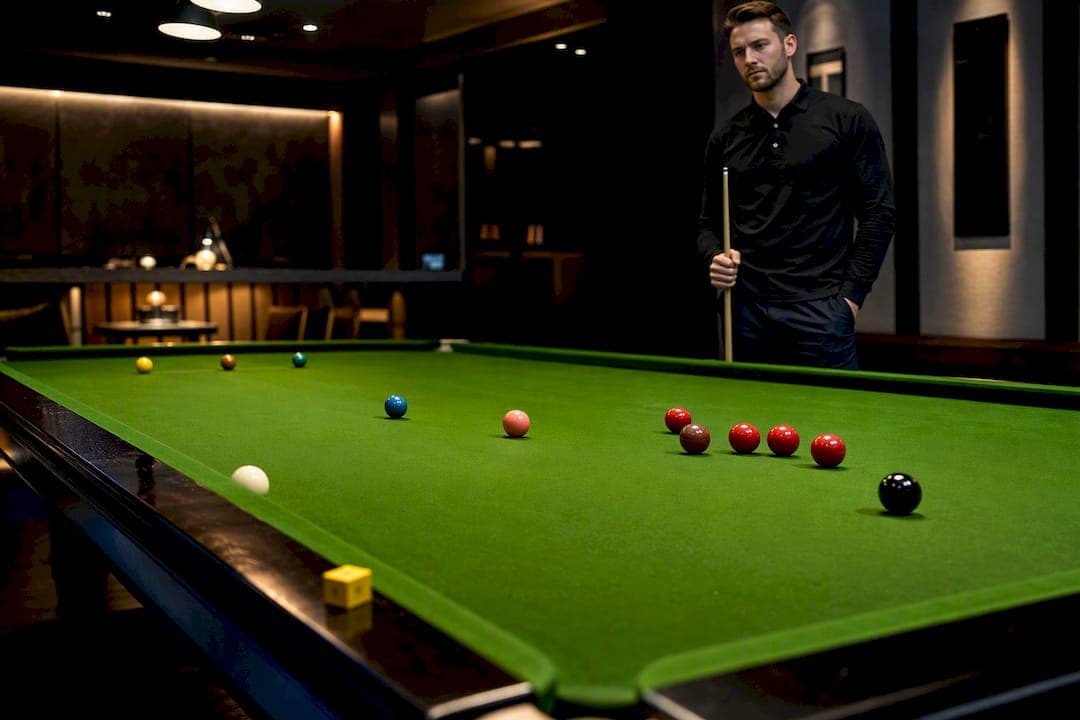
A foul in snooker is any rule infringement that ends your turn and hands your opponent at least four points, up to a maximum of seven, depending on which balls are involved. The moment a foul happens, your break is over. Your opponent then chooses how to play next, either from where the balls sit or with the cue ball placed anywhere in the "D".
TL;DR:
- Fouls involving the black ball or a serious breach automatically carry a penalty of seven points, including potting the cue ball after contact with the black.
- Higher-value fouls, such as potting the black or fouling during a black-only shot, override the minimum four-point penalty and can reach the maximum of seven points.
- The highest penalty from a single foul in a stroke is applied, even if multiple rules are broken simultaneously; penalties do not stack.
- Common foul mistakes include hitting the wrong ball first, in-offs, touch fouls, push shots, and touching the cue ball with anything other than the tip.
- Recognizing foul and miss situations requires understanding the referee’s judgment of sincere effort, which influences whether balls are replaced or the shot is replayed.
Table of Contents
- What Counts as a Snooker Foul: The Full List
- How Snooker Foul Points Are Calculated (4 to 7)
- Free Ball Rules: When You Get a Second Chance
- The Foul and a Miss Rule, Explained
- What Happens Right After a Foul
- Common Fouls and Drills to Cut Them Out
- What Q Billiards Arena Sees on the Table Every Week
- Amateur vs. Professional Snooker: How Foul Enforcement Differs
- Famous Snooker Fouls That Made Headlines
- Why Knowing the Rules Cold Changes How You Play
- Book Table Time to Put These Rules Into Practice
- Sources
What Counts as a Snooker Foul: The Full List
The WPBSA rulebook defines dozens of specific fouls, but almost every one falls into a handful of buckets: hitting the wrong ball, missing everything, moving a ball you shouldn't have, or breaking a rule about how the cue ball can be struck. Knowing the categories matters more than memorizing every clause, because most club-level fouls repeat the same five or six mistakes over and over.
Here's the list of common snooker fouls you'll actually see at the table:
- Hitting the wrong ball first. If reds are on and your cue ball strikes a colour first, that's a foul, even if you then clip a red on the rebound.
- Potting a ball not "on." Sinking a colour when you were supposed to be playing a red (or vice versa) counts as a foul regardless of how clean the shot looked.
- In-off. The cue ball follows the object ball into a pocket. This is one of the most common fouls in snooker because it usually results from too much follow-through or a misjudged angle.
- Touching ball / failing to call it. If the cue ball is touching another ball at the start of a shot, the striker must inform the referee and play away from it correctly; skipping that step is a foul.
- Double hit. The cue tip contacts the cue ball more than once on a single stroke, usually from playing too close to the object ball with excessive force.
- Push shot. The tip stays in contact with the cue ball for longer than a fair strike allows, often on tight-angle shots near a cushion.
- Jump shot. The cue ball hops over another ball rather than rolling into or around it, which is illegal even if it looks spectacular.
- Both feet off the floor. At least one foot must stay on the ground at the moment of striking. Reaching across the table for an awkward shot is a classic way to give away four points.
- Touching the cue ball with anything but the tip. Clothing, a sleeve, the rest, or a stray finger touching the cue ball is a foul, even if it doesn't affect the shot's outcome.
- Playing out of turn or before balls stop moving. Simple, but it happens more than you'd think in fast paced club play.
Two situations trip up newer players specifically. A ball forced off the table, whether jumped off a cushion or knocked clean over the rail, is always a foul, and it gets replaced or spotted depending on which ball it was. Recent WPBSA rule updates clarified exactly how a ball intentionally moved by the striker, rather than by a legitimate stroke, should be handled and put back on the table, which had previously caused confusion among referees. If your sleeve brushes a ball and it rolls two inches, that ball gets replaced as close as possible to its original spot before play continues.
How Snooker Foul Points Are Calculated (4 to 7)
Every foul carries a penalty of at least four points. The referee then checks whether a higher penalty applies, and awards whichever number is highest: the value of the ball that was "on," the value of the highest-valued ball actually involved in the foul, or four. That's the entire calculation, and the official WPBSA rulebook spells it out in Section 3.
Penalty Points at a Glance: Fouls involving a red or a low colour usually cost four points. Fouls involving the pink or the black, including an in-off on the black, jump to seven, the maximum single-foul penalty in the game.
Certain offences carry a seven-point penalty almost automatically, because they involve the black ball or a comparably serious breach:
- Potting the cue ball after contact with the black when the black was the ball on
- Committing a foul during a shot where the black is the only ball on (typically in the closing stages of a frame)
- A foul involving simultaneous contact with the black and another ball in a way that makes the black the highest-valued ball struck
Compare two real scenarios. If a player is on a red, fouls by touching a colour first, and no ball above a red's value gets struck, the penalty is four points, the baseline minimum. But if that same player is on the black (common near the end of a frame) and commits an in-off, sending the cue ball into a pocket after the black, the penalty jumps to seven points because the black's value overrides the four-point floor.
Here's the part that surprises a lot of players: if you manage to break several rules in a single stroke, say you double-hit the cue ball and it also touches the black illegally, you don't get charged for both. The official rules are explicit that penalties don't stack. Only the highest-value foul in that stroke counts, so a messy shot that breaks two rules still costs you the same as breaking just the worse one. That single fact should take the panic out of a scrambled shot. Focus on recovering position, not totaling up imaginary extra points.
Free Ball Rules: When You Get a Second Chance
A free ball gets awarded when your opponent's foul leaves you snookered, meaning you can't see any part of a legal ball on in a straight line to at least one pocket. When that happens, the referee calls it, and you're allowed to nominate any ball on the table as if it were the ball actually on.
Here's how the mechanics work in practice:
- You nominate a colour (or, if reds remain, you can effectively treat a colour as a red) and play at it as your legal target.
- If you pot the nominated free ball, it scores the same value as the ball that was actually on before the foul, not the free ball's own table value.
- After the shot, the free ball gets respotted if it wasn't legally potted as part of normal play, according to Wikipedia's rundown of the miss rule and free ball behavior), which lines up with how referees apply it at club level.
Two caveats catch people out. First, if the non-offending player instead asks the offender to play the shot again rather than accepting the free ball, the free ball is voided entirely; it only exists once you choose to take it. Second, when only the pink and black remain on the table, free ball situations get more restrictive because there's no lower-value colour left to nominate as a stand-in, so referees apply extra scrutiny to make sure the free ball genuinely reflects the snooker created.
Pro Tip: If you're snookered after your opponent's foul, don't rush the free ball decision. Check both the direct shot and any escape angles before nominating, because a poorly chosen free ball can leave you snookered again on your next shot.
The Foul and a Miss Rule, Explained
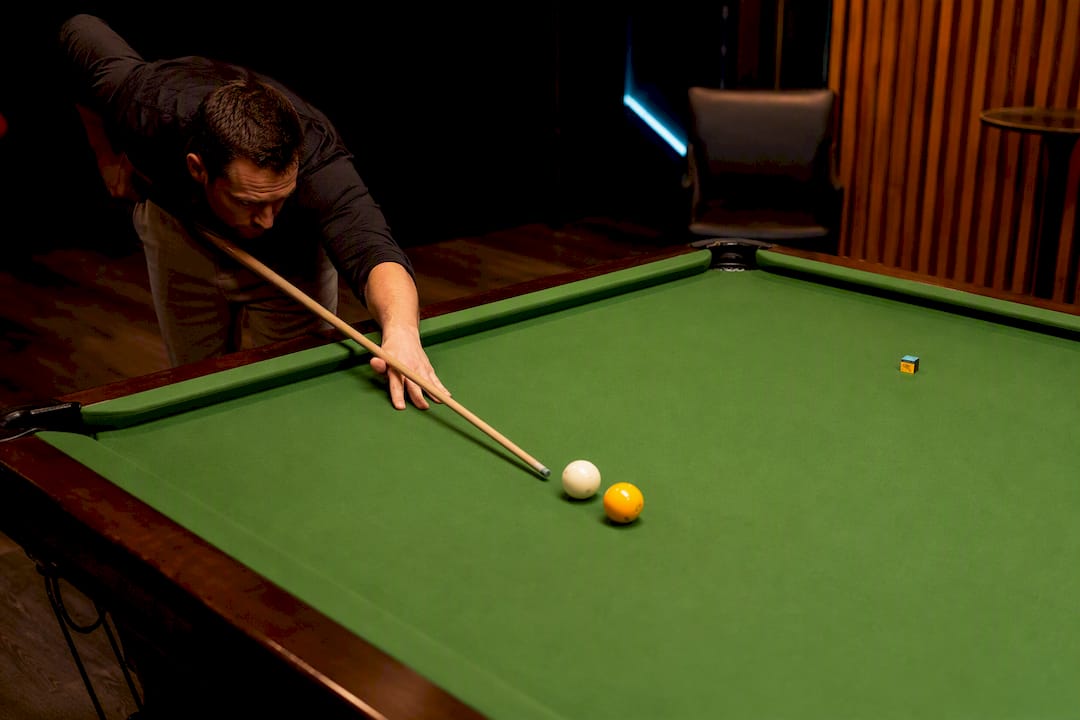
"Foul and a miss" gets called when the referee decides you didn't try hard enough to hit the ball you were supposed to hit. It's a judgment call, not a mechanical measurement, and that's exactly why it causes more arguments than any other rule in the game.
The standard the referee applies is whether the striker made a genuine attempt, "to the best of his ability," to hit the ball on, as BBC Sport's breakdown of the miss rule puts it. If a player clearly aims for a tricky positional shot but slightly misjudges the angle, that's not a miss, that's a legitimate attempt that happened to fail. If a player barely swings at the cue ball to avoid leaving their opponent an easy pot, hoping to hide behind a snooker instead, that's exactly what the rule exists to catch.
Once "miss" is called, here's what happens next:
- The non-offending player can ask for the balls to be returned to their original position and have the offender play the shot again.
- Alternatively, the non-offending player can choose to play the balls from wherever they now lie, if that position actually favors them.
- The referee can issue warnings for repeated misses, and persistent, blatant misses can eventually lead to a forfeited frame in extreme cases, though this is rare outside professional play.
One nuance often missed: the miss rule generally does not apply if playing the "safe" shot in an honest attempt still fails to hit the ball on, because genuine effort is the whole test. A poor safety shot isn't automatically a miss just because it didn't work; it's only a miss when the referee judges the attempt itself wasn't sincere. That distinction, subtle as it sounds, is why identical-looking shots get ruled differently depending on the player's evident intent.
What Happens Right After a Foul
Once a foul is called, the non-offending player gets to decide how the next shot unfolds, and the options depend entirely on where the cue ball ended up.
If the cue ball is still on the table and playable, the next shot is simply played from wherever it stopped. This is "playing from position," and it's the default outcome for most fouls, including a missed contact or a foul on a touching ball.
If the cue ball left the table entirely, whether potted or knocked off the cushion onto the floor, the next player gets it in-hand, meaning it can be placed anywhere inside the D (the semicircle at the baulk end) for the next shot, per the WPBSA's guidance on fouls and post-foul play.
Beyond those two defaults, the non-offending player has real choices:
- Play from the position left. Take the shot as the table now sits.
- Request the offender play again. Useful when the foul left the table in worse shape for you than before the shot.
- Request that balls be replaced and the shot replayed, applicable mainly when a ball was moved improperly or forced off the table in a way that disrupted a fair position.
When balls need replacing, colours go back on their designated spots. Reds present a wrinkle: since reds don't have individual marked spots on the table, a moved red typically gets placed as close as possible to its original position, judged by the referee's best estimate, rather than any fixed marker.
Common Fouls and Drills to Cut Them Out
Most recurring fouls trace back to a handful of fixable habits, and each one has a specific technical cause.
- Double hits and push shots almost always come from playing the cue ball too close to the object ball with a hard, jabbing stroke. Slow your cue speed on tight-contact shots and commit to a clean, single follow-through rather than "steering" the ball with extended tip contact.
- In-offs usually happen from over-hitting a shot or misjudging the angle of a thin cut near a pocket. Practice thin cuts specifically at low pace; speed magnifies angle errors and sends the cue ball wandering toward the pocket you're cutting into.
- Misses on safety shots often come from indecision, half-committing to a direction because you're worried about leaving something on. Pick a target and a strength before you get down on the shot, then execute it fully; a confident, deliberate miss reads very differently to a referee than a tentative one, and it also actually works as safety play.
Three drills worth running every practice session:
- In-hand placement drill. Set up a snooker scenario, place the cue ball anywhere in the D, and practice escaping toward different areas of the table without touching a colour first.
- Cue-ball control drill. Line up straightforward pots at varying distances and focus purely on stopping the cue ball dead, cutting down the follow-through habits that cause in-offs and push shots.
- Snooker escape drill. Have a practice partner snooker you deliberately, then work on legal escape shots that avoid a foul and, ideally, leave your opponent nothing.
Pro Tip: Film your cue action on your phone during practice. Push shots and double hits are almost always visible in slow motion, even when they feel invisible in real time.
What Q Billiards Arena Sees on the Table Every Week
Referees and regular players at Q Billiards Arena tend to flag the same handful of fouls night after night: in-offs from over-cut position shots, and misses called on half-hearted safety attempts. Both are avoidable with repetition, not talent.
Club practice sessions built around snooker generally mix short technical drills, like escape shots from a snookered position, with slower-paced frames where players call their own fouls before a referee has to step in. That self-officiating habit builds rules literacy faster than reading any rulebook cover to cover.
With tables running regularly and weekly league and tournament play across a full-size venue, there's no shortage of real match reps to sharpen foul awareness against actual opponents instead of an empty table.
Amateur vs. Professional Snooker: How Foul Enforcement Differs
The written rules are identical at every level; the WPBSA rulebook doesn't have a separate amateur edition. What changes is enforcement, and that gap explains a lot of confusion for players who move between casual and competitive play.
Professional matches always have a dedicated referee physically at the table, calling every foul in real time, including subtle ones like a marginal double hit or a touching ball. In club and amateur play, players frequently self-officiate, especially in casual games, which means judgment calls like "foul and a miss" get applied inconsistently or skipped entirely to keep the game moving.
Amateur league and tournament play sits in between. Organized club competitions typically bring in a referee or a designated marker for at least the closing stages of a frame, particularly once only the pink and black remain and every point matters. Casual practice games rarely bother, and players tend to call obvious fouls on themselves and let smaller judgment calls slide.
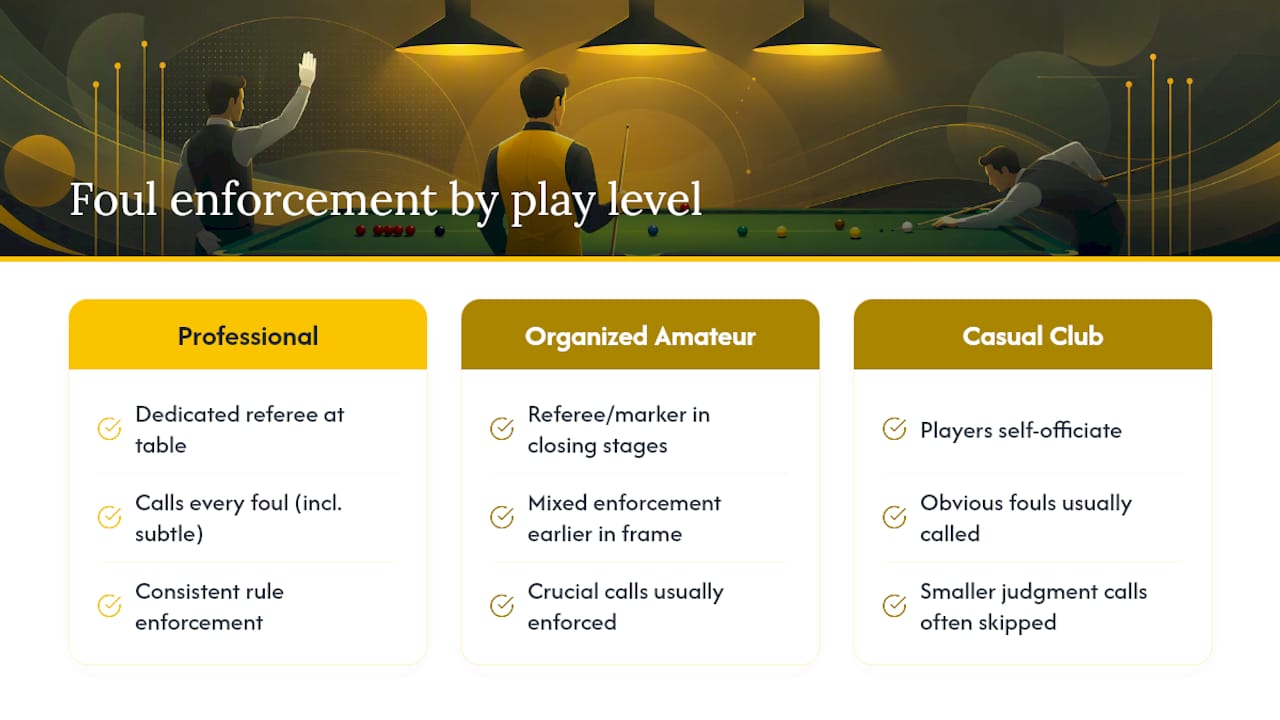
This gap is exactly why understanding the actual rules matters more for club players than for professionals. A touring pro doesn't need to memorize the seven-point offences list; a referee handles it. A club player who wants fair, low-argument games needs to know that list personally, because half the time, they're the one making the call.
Famous Snooker Fouls That Made Headlines
A handful of fouls have become part of snooker folklore, mostly because they exposed exactly how much the miss rule and penalty calculations depend on split-second judgment under pressure.
Deliberate "foul and a miss" tactics have sparked some of the sport's most heated on-air arguments, particularly in tense safety battles where a player intentionally plays a weak shot at the ball on, betting that conceding four points is cheaper than opening up the table for an opponent's big break. Commentators and referees have disagreed live on air more than once about whether a given attempt was genuine or a calculated miss, precisely because the rule asks a referee to judge intent, not just outcome.
Snookers created by fouls have also decided famous frames. A player left needing colours in a tight endgame has, on occasion, been handed a match-turning free ball after an opponent's foul left them completely snookered on the final red, converting what looked like a lost frame into a plausible comeback in a matter of two shots.
These moments stick in memory because they show the miss rule and penalty system working exactly as designed: turning a rules technicality into genuine tactical drama, rather than a dry footnote buried in a rulebook.
Why Knowing the Rules Cold Changes How You Play
Most club arguments about fouls come down to one player knowing the rule better than the other, not genuine bad faith. Learn the penalty structure and the miss rule cold, and you stop wasting shots arguing and start using fouls tactically, deliberately conceding four points on a hopeless red rather than gifting your opponent position on the black.
The players who improve fastest tend to be the ones who stop treating "foul" as a vague bad outcome and start treating it as a calculable cost, sometimes worth paying on purpose. That mental shift alone changes how you approach every close safety exchange.
Bring that same rules literacy to your next practice session. It pays off faster than another hour of pure potting practice.
— Q
Book Table Time to Put These Rules Into Practice
Reading the rules gets you halfway there. The rest comes from playing real frames against real opponents, which is exactly what Q Billiards Arena is built for.

Unlike watching clips or drilling alone on a home table, a full-size professional snooker table gives you the actual angles, cushion speed, and pocket dimensions where fouls like in-offs and push shots really show up, so the habits you build actually transfer to competitive play. The venue runs standard and heated snooker tables alongside weekly league and tournament play, giving players a steady rotation of opponents to test their foul awareness against instead of the same one or two practice partners.
Check current session rates and table availability on the games and pricing page, or look at what's coming up on the tournaments and events schedule if you're ready to put your rules knowledge to the test in competitive frames.
Sources
- OFFICIAL RULES OF THE GAMES OF SNOOKER AND ENGLISH BILLIARDS (WPBSA) — Section 3: The game / Penalties
- BBC Sport — What is the miss rule?
- WPBSA — Updates to the rules of snooker (Aug 2024)