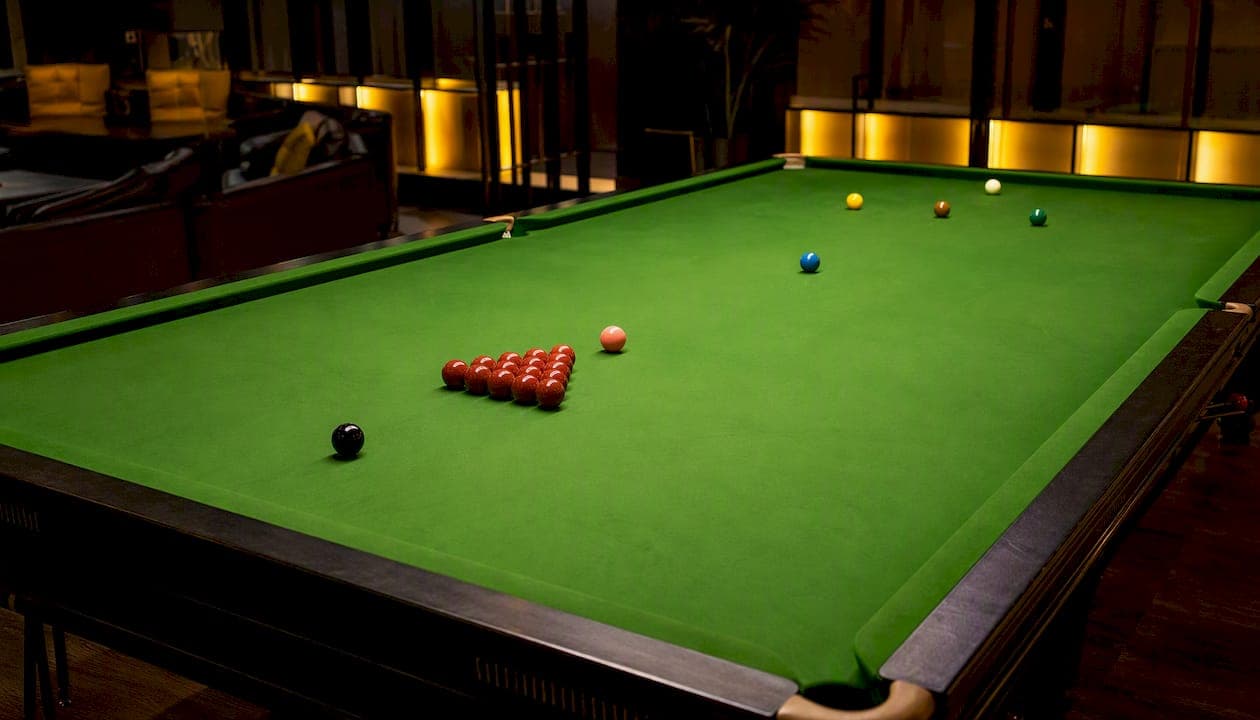
Snooker scoring is a fixed, points-based system: each ball carries a set value, points are scored by legally potting balls in a prescribed sequence, and fouls award penalty points to the opponent. According to the BBC's rules overview, a frame starts with 22 object balls — 15 reds worth 1 point each and six colors worth 2 through 7 — and the player with the higher score when all balls are cleared wins the frame.
The essentials at a glance:
- Reds are worth 1 point each; the six colors range from 2 (yellow) to 7 (black)
- While reds remain: pot a red, then nominate and pot a color; the color is respotted
- Once reds are gone: pot colors in ascending order (yellow through black); no respotting
- Fouls award a minimum of 4 penalty points to the opponent (up to 7), and end the striker's visit
- Penalty points go to the opponent's frame score but do NOT count as part of anyone's break
- Standard maximum break: the highest possible without special conditions is 147; a free ball situation can increase this maximum in rare cases.
Key Takeaways
Snooker scoring requires tracking two separate numbers at all times: a player's break total for the current visit and the cumulative frame score that decides who wins.
| Point | Details |
|---|---|
| Ball values are fixed | Reds = 1; colors range from yellow (2) to black (7); these never change. |
| Sequence determines legality | Pot red then a color while reds remain; clear colors in order once reds are gone. |
| Fouls go to frame score only | Penalty points (minimum 4, up to 7) add to the opponent's frame score, not any break. |
| Maximum breaks | Standard max is 147; a free ball before any reds are potted makes 155 possible. |
| Tied frames use the black | Respot the black, coin toss for order, and the next pot or foul decides the frame. |
Table of Contents
- How snooker scoring works: ball values at a glance
- How a frame is scored: sequence, respotting, and the endgame
- How fouls work and why they don't count toward your break
- Free-ball rule and maximum breaks: 147, 155, and why 167 isn't a thing
- How a frame ends and how the winner is decided
- How to keep score correctly at the table
- Worked examples: breaks, fouls, and a full-frame walkthrough
- When players play for snookers instead of pots
- What happens when a frame is tied
- Sources
How snooker scoring works: ball values at a glance
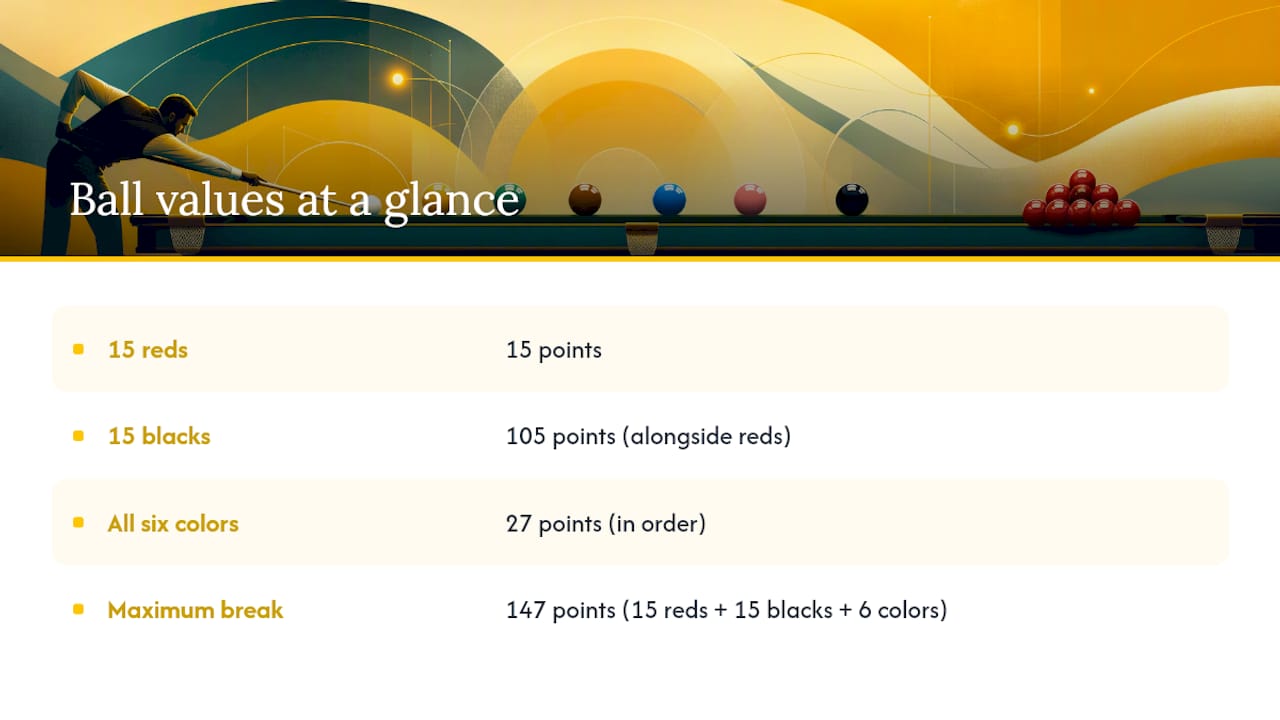
Every ball in snooker has a fixed point value that never changes. The Sporting News breakdown confirms the full set: 15 red balls at 1 point each, plus six colors with ascending values. At the start of a frame, those 15 reds sit in a triangle near the pink spot, and the six colors each occupy their own designated spot on the table.
The maximum points available from potting alone: 15 reds (15) + 15 blacks alongside them (105) + all six colors in order (27) = 147. That arithmetic matters when you get to maximum breaks.
How a frame is scored: sequence, respotting, and the endgame
The sequence of play is the single most important thing to understand about snooker scoring. While any red remains on the table, a player must pot a red first, then nominate and pot one of the six colors. The color is then respotted to its original position, and the pattern repeats. Once all 15 reds are gone, the colors are potted in strict ascending order — yellow, green, brown, blue, pink, black — and none of them are respotted.

Per the Sporting News and confirmed by the Rules of Sport guide, this two-phase structure is where most beginners get confused. Colors only stay on the table permanently once the reds are cleared.
Here is a short example sequence to show how a break accumulates:
- Pot red → +1 (running break: 1)
- Nominate and pot black → +7 (running break: 8)
- Black is respotted
- Pot red → +1 (running break: 9)
- Nominate and pot pink → +6 (running break: 15)
- Pink is respotted
- Miss next shot → visit ends; break total = 15
That 15-point break is then added to the player's frame score. The next visit starts a fresh break count from zero.
Pro Tip: A "break" is only the points scored in a single uninterrupted visit to the table. The "frame score" is the running total across all visits. These are two different numbers — knowing which one you're tracking prevents a lot of scorekeeping errors.
How fouls work and why they don't count toward your break
A foul immediately ends the striker's visit and awards penalty points to the opponent. The Wikipedia rules article is clear: the minimum penalty is 4 points, but it rises to match the value of the ball involved — or up to 7 — depending on the circumstances.
Common fouls and their typical penalties:
- Potting the cue ball (in-off): minimum 4 points, or the value of the ball on if higher
- Hitting the wrong ball first: penalty equals the value of the ball on (minimum 4)
- Failing to hit any ball: 4 points minimum
- Potting a color when a red is "on": value of the color potted or 4, whichever is greater
- Touching a ball with anything other than the cue tip: minimum 4 points
A concrete example: a player attempts a pink (worth 6) but pots the cue ball instead. The opponent receives 6 penalty points — not 4 — because the ball "on" was worth more than the minimum.
Here is the critical distinction that SnookerHQ explains clearly: those 6 penalty points go straight to the opponent's frame score, but they do not count as part of the opponent's break. The opponent didn't pot anything. Their break counter stays at zero until they actually visit the table and start potting.
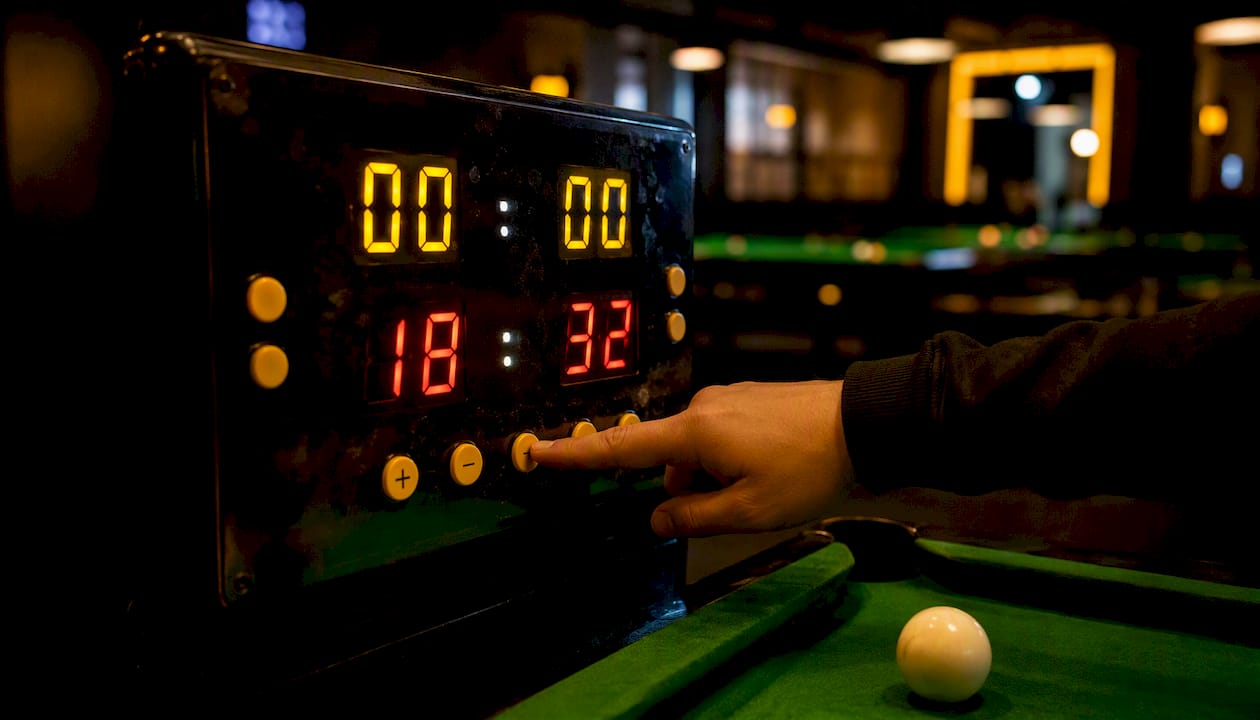
Pro Tip: When you receive penalty points from a foul, your frame score goes up — but your break total doesn't change. Track them separately on the scoreboard to avoid confusion at the end of a visit.
Free-ball rule and maximum breaks: 147, 155, and why 167 isn't a thing
The standard maximum break under normal play is 147. The Wikipedia rules article documents the arithmetic precisely: pot all 15 reds each followed by the black (15 + 105 = 120), then clear all six colors in order (2+3+4+5+6+7 = 27), and you reach exactly 147.
The free-ball situation is rarer and worth understanding. When a player is snookered after a foul, the referee may award a free ball — meaning the player can nominate any ball as a substitute for the ball "on." If this happens before any reds have been potted, the free ball can be nominated as a red. Pot it, then pot the black, and you've effectively added an extra red-black pair to the sequence. That produces a theoretical maximum of 155: one extra red (1) + one extra black (7) on top of the standard 147.
A break higher than the standard maximum requires a rare free ball situation before any reds are potted.
Numbers like 167 sometimes circulate online, but they don't represent a recognized standard maximum. They typically arise from miscounting or applying non-standard formats. The WPBSA Official Rulebook 2024-25 recognizes 147 as the maximum under normal conditions and 155 as the theoretical free-ball maximum.
Pro Tip: If a free ball is awarded early in a frame, pay attention to which ball is nominated. Nominating a color as a "red" and then potting the black immediately after changes the scoring sequence for that visit — and can shift the frame total meaningfully.
How a frame ends and how the winner is decided
A frame ends when all balls have been legally potted and the player with the higher score wins. Simple enough in most cases. The complications come when the scores are close and balls are running out.
Key frame-end scenarios:
- Normal clearance: all balls potted in sequence; higher score wins
- Concession: a player may concede a frame at any point when they judge it unwinnable
- Snookers required: if the trailing player cannot win by potting every remaining ball, they need the opponent to foul enough times to make up the gap
The "points remaining" calculation is straightforward. Add up the value of every ball still on the table — including the colors at their full values — and compare that to the points deficit. If the deficit is larger than the total remaining, the trailing player cannot win by potting alone.
When a frame is tied after all balls are potted, the black is respotted to its spot. A coin toss decides who plays first, and the next pot or foul decides the frame. That single black is worth 7 points, but the frame is awarded to whoever pots it or benefits from a foul — not necessarily whoever scores more on that shot.
How to keep score correctly at the table
Accurate scorekeeping keeps matches clean and prevents disputes. The WPBSA Rulebook notes that while the referee maintains the official record, players share responsibility for flagging errors — a point reinforced by the WPBSA Rules document hosted by NT Snooker.
Follow these steps at the scoreboard:
- Set up the scoreboard before the frame starts with both players at zero
- Record each pot as it happens — add the ball's value to the striker's running break total
- At the end of each visit, add the break total to the striker's cumulative frame score; reset the break counter to zero
- Record fouls separately — add the penalty value to the opponent's frame score only; do not add it to any break total
- Check the scoreboard after every visit and confirm both players agree on the totals before the next player takes their shot
- Call the referee immediately if there is a discrepancy; do not continue play with an unresolved score dispute
Pro Tip: Write visit totals and cumulative totals in separate columns if you're keeping a paper scoresheet. Mixing them is the most common scorekeeping mistake at club level — and it's nearly impossible to untangle mid-frame.
Worked examples: breaks, fouls, and a full-frame walkthrough
These examples show how break totals and frame totals evolve together — and how a foul mid-frame changes the picture.
Example 1: A clean visit
- Pot red (+1), pot black (+7) — break: 8
- Pot red (+1), pot black (+7) — break: 16
- Pot red (+1), pot pink (+6) — break: 23
- Miss — visit ends
Player A's frame score increases by 23. Break resets to zero.
Example 2: A foul mid-frame
Player A is at 23, Player B is at 0. Player B attempts a red but fouls (hits the blue first — blue is worth 5, which is above the 4-point minimum).
- Player A receives 5 penalty points added to their frame score: A now has 28
- Player B's frame score stays at 0
- Player B's break total stays at 0 — they haven't potted anything
Player B now visits the table and pots red (+1), black (+7), red (+1), black (+7): break = 16. Frame score: B = 16.
Running totals after these events:
| Event | Player A Frame Score | Player B Frame Score |
|---|---|---|
| After A's 23-point visit | 23 | 0 |
| After B's foul (5-point penalty to A) | 28 | 0 |
| After B's 16-point visit | 28 | 16 |
Player A leads 28–16. The 5 penalty points never appeared in any break total — only in the frame score column.
When players play for snookers instead of pots
Players play for snookers when the points remaining on the table are not enough to close the gap by potting alone. This is a rational, rules-based decision — not a desperate gamble.
According to WPBSA strategic guidance and SnookerHQ's analysis, the typical tactical goals when playing for snookers are:
- Force the opponent into a difficult position where a foul is likely
- Accumulate penalty points (minimum 4 per foul) to chip away at the deficit
- Disrupt the opponent's rhythm and change the table layout
- Buy time for the table position to improve
The math drives the decision. If 27 points remain on the table and a player trails by 35, they need at least two successful snookers — meaning the opponent must foul at least twice — just to draw level. Every shot choice from that point should prioritize making the opponent foul over attempting low-percentage pots.
What happens when a frame is tied
A tied frame after all balls are cleared is resolved by respotting the black on its spot. Both players have an equal chance: a coin toss determines who breaks off, and the frame is decided by the next scoring event — a pot or a foul. There is no sudden-death potting sequence beyond that single black.
Tie situations at the match level (not just the frame) follow the same logic scaled up. In a best-of-seven match, for example, the first player to win four frames takes the match. Individual frame ties are resolved by the respotted black before the next frame begins. The WPBSA Official Rulebook 2024-25 covers the exact procedure, including what happens if the respotted black is itself snookered.
One edge case worth knowing: if the scores are equal and the black is potted off its spot, the frame is awarded to the player who potted it — not to whoever had the higher score before the respot. That single pot is the entire tiebreaker.
A note on scorekeeping and refereeing at a local club
At a venue like Qbilliardshtx, where professional-grade snooker tables are available alongside a referee and a proper scoreboard, the scoring process runs smoothly when players treat the scoreboard as a shared responsibility. The referee keeps the official record, but experienced club players check the board at the end of every visit — not just when something feels wrong. Catching a discrepancy after three visits is manageable; catching it after ten is a headache for everyone at the table.
Club-level disputes usually come down to one of two things: a foul penalty that was added to the wrong player's total, or a break that was recorded as a frame score addition before the visit actually ended. Both are easy to prevent with a quick verbal confirmation after each visit. If you're playing at a venue with a dedicated referee, use them — that's exactly what they're there for.
Sources
The definitive reference for every rule in this article is the WPBSA Snooker Official Rulebook 2024-25, which covers scoring strokes, fouls, free-ball procedures, referee responsibilities, and frame-award conditions in full. For a readable overview of ball values and the basic sequence, the BBC Sport snooker rules page is a reliable starting point. The SnookerHQ scoring explainer is particularly useful for understanding the break-versus-frame-score distinction. The Sporting News ball-values guide and the Wikipedia rules of snooker article round out the core references, with Wikipedia covering foul penalties and maximum-break arithmetic in detail.
- WPBSA Snooker Official Rulebook 2024-25
- Rules of snooker
- Snookerhq
- Snooker ball colours points scoring explained: Black, pink, blue, green, yellow, brown, red totals | Sporting News
- Rules of snooker - Wikipedia
Ready to put these rules into practice? Qbilliardshtx at Q Billiards Arena in Houston has professional-grade snooker tables, a full scoreboard setup, and late-night hours so you can play a proper frame any time. Check games and pricing to book your table, or browse upcoming tournaments if you want to test your scoring knowledge in a competitive setting.