A straddle is a voluntary live blind bet posted before the cards are dealt, typically set at twice the big blind, that raises the effective stakes and reshuffles preflop action order. For home games, the short verdict is this: straddles are generally allowed for fun and can generate action, but they are almost never mathematically profitable for the player posting them. The two trade-offs every host and player should weigh upfront are bigger pots and livelier action on one side, and reduced effective stack depth plus a real positional cost on the other.
Table of Contents
- What straddle variants do home games typically use?
- How do straddles affect pot size, effective stacks, and EV?
- When does straddling actually make sense strategically?
- What house rules should every host announce before the first hand?
- How do straddles shift table culture and etiquette?
- Quick math: what do common straddle setups actually look like?
- Two copy/paste rule sets hosts can use tonight
- Key Takeaways
- The part most straddle guides skip
- Want a home game without the hosting headaches?
- Useful sources and further reading
What straddle variants do home games typically use?
Home-game communities use a wide range of straddle rules, and the differences between variants can create real confusion if the host has not announced them clearly.
| Variant | Who Posts | Preflop Action Starts | Positional Impact | Common In |
|---|---|---|---|---|
| UTG (standard) | Under the gun | UTG+1 | Straddler acts last preflop, but is out of position postflop | Casinos and home games |
| Button straddle | Button | Small blind | Button keeps postflop position | Home games primarily |
| Mississippi straddle | Any seat | Next player left of straddler | Varies by seat | Home games only |
| Sleeper straddle | Any seat (not yet acted) | Normal order until reached | Cancels if action raises before it | Home games only |
| Re-straddle | Player left of straddler | Continues shifting left | Compounds positional and stack costs | Home games, some casinos |
The UTG straddle is the standard you will see in most card rooms. The button straddle is a home-game staple because it feels fairer to the player posting it. Mississippi and sleeper straddles slow the game down and can confuse newer players, so most hosts either ban them or introduce them only after the group is comfortable with basic straddle rules.
Re-straddle scaling is where hosts need a clear rule. The two common methods are doubling (each re-straddle is 2× the previous: $4, $8, $16) or adding one big blind ($4, $6, $8). Doubling escalates stakes fast and can alienate casual players. Adding one BB keeps the game more stable. Pick one method and announce it before the first hand.
How do straddles affect pot size, effective stacks, and EV?
The math is straightforward and worth knowing before you post a chip.
Effective stack depth is the key concept. When you post a straddle, you are committing chips to the pot before seeing your cards, which shrinks your remaining stack relative to the pot. Poker strategy measures this as stack-to-pot ratio (SPR). A lower SPR means less room to maneuver postflop.
Consider a $1/$2 game where everyone sits with a typical stack:
- Without a straddle: the pot starts with the blinds.
- With a straddle: the effective stack depth for the straddler is significantly reduced due to the extra blind posted before cards are dealt.
That is a dramatic compression. PokerStrategy's analysis uses a similar example at $2/$5 with a $5 straddle, where a $500 stack drops to roughly 50 big blinds effective. The deeper the game, the less the straddle hurts proportionally, but at typical home-game stack sizes, the effect is significant.
The EV reality: Straddles are almost never positive expected value. You post a blind without information, often out of position, and you compress your stack. The only scenarios where straddling approaches neutral EV are when everyone at the table straddles (so the disadvantage is shared), when you are at an extremely passive table where you can steal the pot frequently, or when stacks are deep enough that the SPR compression barely registers.
When can the math shift? Very deep stacks (300+ big blinds) reduce the proportional impact of a straddle. A table full of habitual limpers who rarely three-bet can also make a straddle more profitable, since you will often take down the pot with a preflop raise. But these are exceptions, not the rule.
When does straddling actually make sense strategically?
Three scenarios where straddling can be reasonable:
Everyone straddles. If the table has adopted a mandatory or near-universal straddle culture, opting out creates a relative advantage for you but also social friction. James Sweeney of Red Chip Poker advises that participating may be the pragmatic choice when straddling becomes table culture, since the social cost of refusing can outweigh the marginal EV gain of sitting out.
Very deep stacks. At 300+ big blinds, the SPR compression from a straddle is less severe. Players with deep stacks and strong postflop skills can absorb the cost and still outplay opponents.
Button straddle at a passive table. Jonathan Little highlights that button straddles can preserve positional advantage while inflating the pot. If you are on the button against players who play fit-or-fold, a button straddle can build a pot you are well-positioned to win.
When others straddle, your adjustments are straightforward. Tighten your preflop calling range because the effective big blind is larger. Widen your three-bet range against weak straddlers who post out of habit. Postflop, remember that shorter SPR means more commitment with top pair or better.
UTG straddles are the hardest to defend strategically. You are posting blind from the worst position at the table, compressing your stack, and giving everyone else better odds to enter the pot. The home and recreational settings where social value outweighs strict profitability are the right context for UTG straddling. At a serious game, it is a leak.
What house rules should every host announce before the first hand?
Hosting guidance consistently recommends that hosts announce straddle policies and caps at the start of play. Without a clear policy, disputes arise mid-hand, and mid-hand disputes kill the mood fast.
Here is a numbered checklist of decisions every host should make before the game starts:
- Re-straddle rule — Choose one: no re-straddles, one re-straddle allowed, or unlimited re-straddles with a doubling cap. State the scaling method (double or +1BB).
Pro Tip: Write your straddle rules on a notecard and place it on the table. Players who arrive late can read it without interrupting the game.
Here are short scripts you can read aloud at game start:
Tight game: "We're playing $1/$2. No straddles tonight. If you want to run it loose, we can revisit after the first hour."
Standard home game: "Straddles are allowed from UTG only, capped at $4. No re-straddles. The straddler acts last preflop."
Action game: "UTG and button straddles are allowed. One re-straddle permitted, doubling the previous straddle. Cap is $16. Anything bigger needs a table vote."
How do straddles shift table culture and etiquette?
The social dynamics of straddling in home games are often more complicated than the rules themselves.
Peer pressure is the most common issue. One player starts straddling every hand, then nudges others to join. Before long, there is an unspoken expectation that everyone must straddle or be seen as a spoilsport. That pressure is real, and it disproportionately affects newer or more casual players who came to enjoy a friendly game, not to play $1/$2/$4 with compressed stacks.
Widespread straddling often produces the opposite of its intended effect. Rather than creating action, it tends to tighten the table. Players fold more preflop because the effective big blind is larger and marginal hands lose value. The game gets faster in terms of hands per hour but sloppier in terms of decision quality.
If you want to opt out without creating tension, a simple line works: "I'm going to sit this one out on the straddle, but I'm in for the hand." No explanation needed. If someone pushes back, "I'm just playing my game" is enough.
For hosts, the right move is to monitor whether the straddle policy is achieving what you wanted. If the table is getting quieter and players are leaving earlier, the straddle rule may be the cause. A trial approach works well: run a loose straddle night, then revert to tighter rules if the energy drops.
Quick math: what do common straddle setups actually look like?
Here are two concrete examples and a reference table for the most common home-game blind structures.
Example 1: $1/$2 game, $4 UTG straddle, $300 stacks
- Pot before cards: $7 ($1 + $2 + $4)
- Straddler's remaining stack: $296
- Effective big blind for straddler: $4
- Straddler's effective depth: 74 big blinds ($296 ÷ $4)
- If UTG+1 calls and BB calls, pot is $12 before the flop. SPR for a $296 stack vs. $12 pot is roughly 24.
Example 2: $1/$3 game, $6 button straddle, $300 stacks
- Pot before cards: $10 ($1 + $3 + $6)
- Button's remaining stack: $294
- Effective big blind for button: $6
- Button's effective depth: 49 big blinds ($294 ÷ $6)
- Button retains postflop position, which partially offsets the stack compression.
Re-straddle escalation in a $1/$2 game (doubling method):
| Straddle Level | Blind Posted | Pot Before Cards | $300 Stack Effective BBs |
|---|---|---|---|
| No straddle | — | $3 | $300 stack |
| 1st straddle ($4) | $4 | $7 | 74 BB |
| 2nd straddle ($8) | $8 | $15 | 37 BB |
| 3rd straddle ($16) | $16 | $31 | 19 BB |
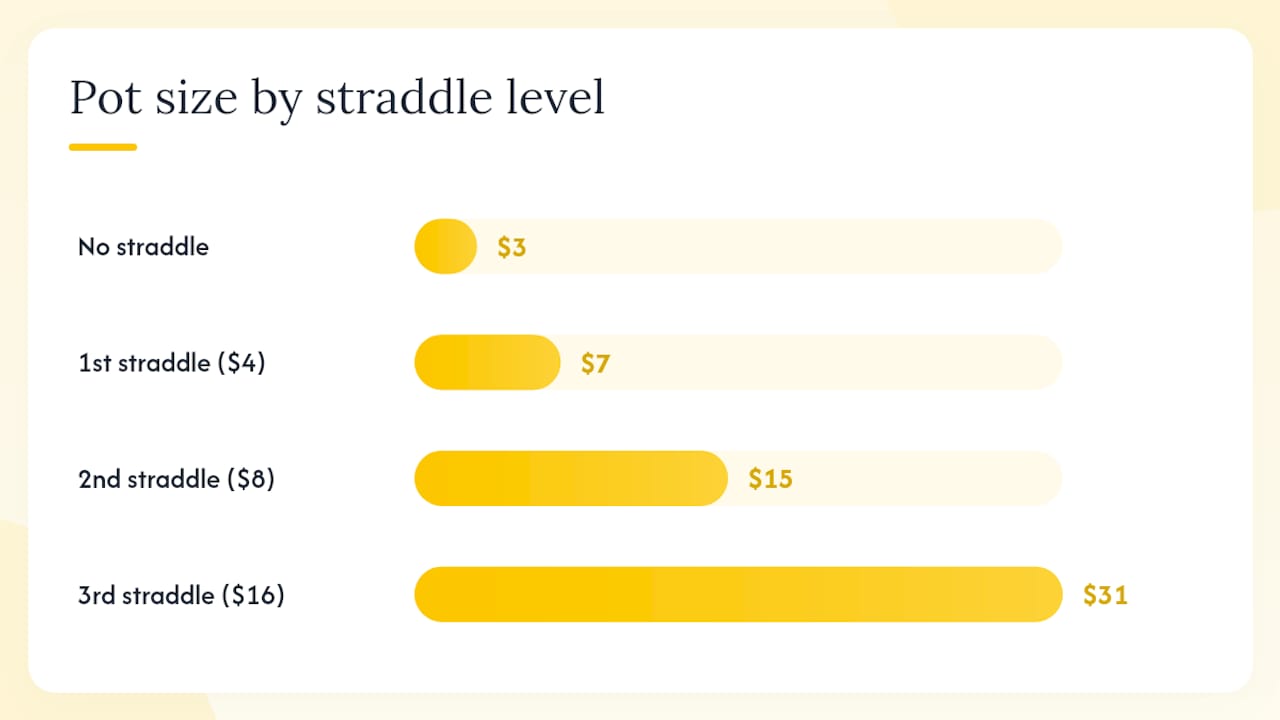
Multiple doubling re-straddles can rapidly reduce effective stack depth, turning a deep-stacked game into a short-stacked environment. That is why caps matter.
Two copy/paste rule sets hosts can use tonight
Tight default (recommended for mixed groups or newcomers):
- No straddles, or UTG-only straddle capped at 2× big blind
- No re-straddles permitted
- Straddler acts last preflop; all other action order rules remain standard
- Host decision is final on any dispute
Loose default (for action-focused groups who know the game):
- UTG and button straddles allowed
- One re-straddle permitted, doubling the previous straddle
- Cap at 5× big blind or a host-determined dollar maximum
- Mississippi or sleeper straddles only if the full table agrees before the game starts
- Host decision is final; no mid-game rule changes
When to choose tight: your group includes players newer to poker, the stakes are meaningful relative to the players' bankrolls, or you have had disputes about straddle rules before. When to choose loose: everyone at the table plays regularly, the group explicitly wants a higher-variance night, and you have a designated dealer or host who can manage rulings quickly.
For hosts who want to go deeper on blind structures and how they interact with straddles, the big blind ante mechanics guide at Shuffle Up and Deal is a useful companion read.
Key Takeaways
A straddle in home games is almost always negative EV for the player posting it, but with clear house rules and the right group, it can add genuine fun without wrecking the game.
| Point | Details |
|---|---|
| Straddles compress stacks fast | A straddle in a $1/$2 game can cut a typical $300 stack's effective big blinds roughly in half, significantly compressing stack depth. |
| UTG straddles are hardest to justify | Posting blind from the worst position is a strategic leak; button straddles are more defensible. |
| Announce rules before hand one | Hosts must state allowed positions, caps, and re-straddle scaling before the first deal to prevent disputes. |
| Re-straddle doubling escalates quickly | Multiple doubling re-straddles can rapidly reduce effective stack depth, turning a deep-stacked game into a short-stacked environment. |
| Qbilliardshtx offers a private poker room | Houston players can skip the hosting hassle and book a private poker room at Q Billiards Arena. |
The part most straddle guides skip
Most straddle guides treat the question as purely strategic: is it plus EV or minus EV? That framing misses the real issue in home games, which is game health over time.
The players most likely to straddle every hand are also the players most likely to pressure others into doing the same. That social dynamic, left unchecked, gradually prices out the casual players who make the game fun and profitable for everyone else. A table of six regulars all straddling every hand is not a looser game. It is a tighter, more expensive game where the rake equivalent is the straddle itself.
The hosts who run the best long-term home games tend to be conservative with straddle rules early, then loosen them selectively once the group has established trust and bankroll comfort. Starting loose and tightening up creates resentment. Starting tight and loosening up feels like a reward.
There is also a practical argument for the button straddle over the UTG straddle that most casual players never hear: the button straddle is the only variant where the player posting it keeps a structural advantage. Every other straddle is a pure donation to the pot. If your group insists on straddling, pushing for button-only straddles is a reasonable compromise that keeps the game moving without punishing the straddler as severely.
Want a home game without the hosting headaches?
Running a great poker night takes more than knowing the straddle rules. You need a private space, a proper table, and someone to handle the logistics so you can actually play.

Qbilliardshtx offers a private poker room rental at Q Billiards Arena in Houston, built specifically for groups who want a real game without the setup. The room comes with a dedicated poker table, food and drink service from the full menu, and late-night availability so the game runs as long as your group wants. There is no scrambling for folding chairs or arguing about whose house has enough space. The venue handles the environment; you handle the cards.
Booking is straightforward. Check availability and reserve your session at qbilliardshtx.com or visit the poker room page directly to see pricing and what is included.
Useful sources and further reading
The following sources informed this guide and are worth bookmarking for deeper research:
- Live straddle in poker | CardPlayer
- What is a straddle? | Upswing Poker
- Poker Basics - Straddling | PokerStrategy
- Poker Straddle Explained: How It Works and When to Use It | Poker Coaching
- Should I Straddle in Poker? | Red Chip Poker
- Straddle Rule in Cash Games | Poker Chip Forum
- What is a straddle? | Pokerology
- How To Host Home Poker Cash Games | GGPoker