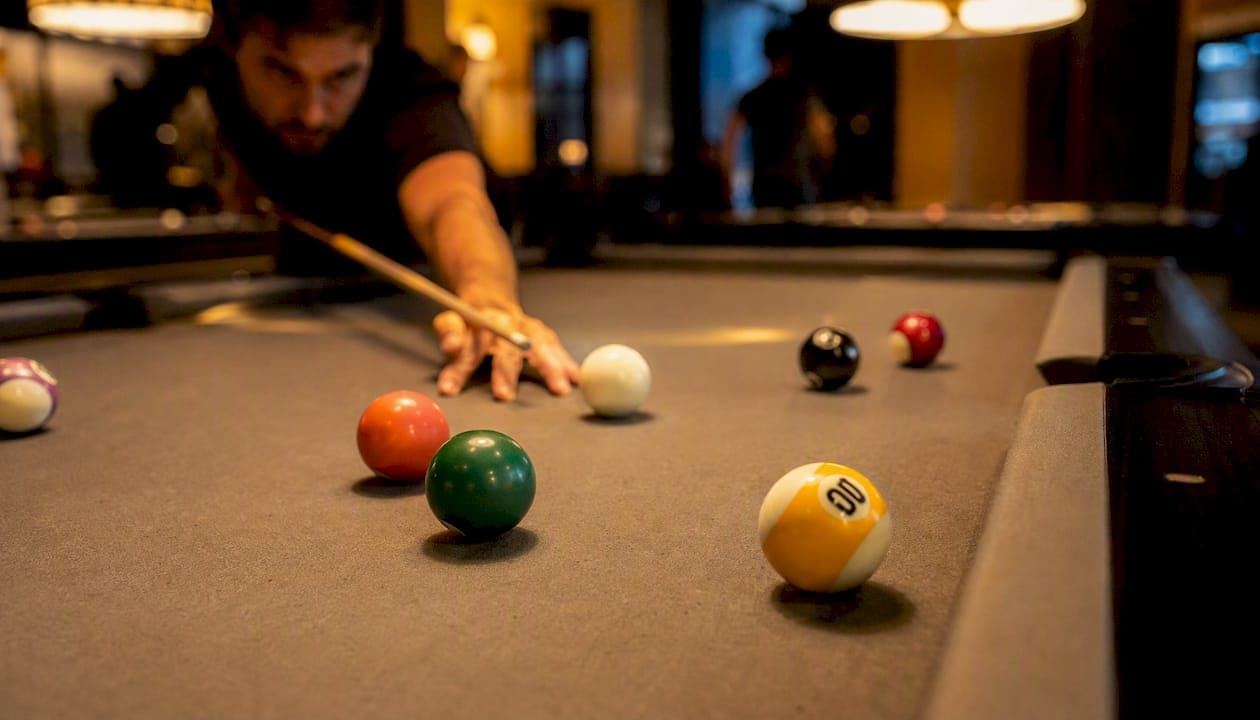
Ten-ball is a call-shot rotation game played with balls 1 through 10. You win a rack by legally pocketing the 10-ball in a called pocket. Every shot requires you to hit the lowest-numbered ball on the table first, and you must call the pocket for the 10-ball before shooting. These three facts: rotation, the call requirement, and the win condition, cover the majority of what you need to know to play or referee a game correctly.
The three rules you must have memorized before you break:
- Rotation: The cue ball must contact the lowest-numbered ball on the table first on every shot.
- Call the 10: You must call the pocket for the 10-ball. Banks, combinations, and kick shots must also be called regardless of which ball is involved.
- Spotting: If the 10-ball is pocketed illegally (foul, push-out, wrong pocket, or off the table), it is spotted on the foot spot. No other ball is spotted in standard play.
The three governing bodies whose rule texts you should consult are the WPA (World Pool-Billiard Association), the UPA (US Professional Poolplayers Association), and CueSports International (CSI). Each publishes official rule texts, and their positions on a few key situations differ enough to matter in match play.
Key Takeaways
Ten-ball is a call-shot rotation game where you must hit the lowest-numbered ball first and legally pocket the called 10-ball to win the rack.
| Point | Details |
|---|---|
| Rotation is mandatory | The cue ball must contact the lowest-numbered ball first on every shot; failure is a foul. |
| Always call the 10-ball | The 10-ball requires a called pocket every time; banks and combos must also be called for any ball. |
| Spotting the 10-ball | The 10 is spotted when pocketed illegally; no other ball is spotted in standard play. |
| Break rules vary by ruleset | UPA awards an automatic win for a 10 on the break; WPA and CSI respot the ball and continue. |
| Qbilliardshtx for live practice | Q Billiards Arena in Houston offers professional tables and tournament nights to practice under real conditions. |
Table of Contents
- Ten ball rules at a glance: the core checklist
- How to rack ten-ball correctly
- What makes a shot legal and how turns work
- Legal break requirements and the push-out rule
- Fouls, ball in hand, and spotting rules
- How to call shots and win the rack
- WPA vs. UPA vs. house rules: what actually differs
- Where to practice ten-ball in Houston
- Why ten-ball rewards players who actually know the rules
- Practice these rules at Q Billiards Arena
- Sources
Ten ball rules at a glance: the core checklist
Use this as a quick reference during play or when you are refereeing a casual match.
- Objective: Legally pocket the called 10-ball to win the rack.
- Rotation: Cue ball must contact the lowest-numbered ball first on every shot. Failure is a foul.
- Call requirement: You must call the pocket for the 10-ball. Banks, combinations, and kick shots must be called for any ball. Obvious straight-in shots on balls 1–9 do not need to be called.
- Legal break: Cue ball starts behind the head string. You must pocket a ball or drive a required number of object balls to cushions. Failure is a foul.
- 10-ball on the break: Under UPA rules, legally pocketing the 10 on the break is an automatic win. Under WPA and CSI rules, the 10 is spotted and play continues.
- Fouls: The incoming player receives ball in hand anywhere on the table.
- Three-foul rule: Not universally applied. Check the event sheet for your specific tournament or league.
Pro Tip: Print this checklist and tape it to your cue case. When a dispute comes up mid-match, a quick glance at the governing rule text (WPA, UPA, or CSI) resolves it faster than arguing from memory.
How to rack ten-ball correctly
Getting the rack right prevents disputes before the break even happens. Here is the standard setup:
- Place the 1-ball at the apex on the foot spot. This is the ball closest to the breaker.
- Place the 10-ball in the center of the triangle, the middle position of the third row.
- Place the 2-ball and 3-ball in the two back corners of the rack. Both the UPA and CSI official rules specify this placement. WPA guidance does not mandate specific corner balls, so random placement is acceptable under WPA rules.
- Fill remaining positions randomly with balls 4–9.
- Rack tightly. Every ball should be touching its neighbors. A loose rack produces unpredictable breaks and is grounds for a re-rack.
A tight rack takes priority over perfect spot placement. Under UPA guidance, a slight offset from the foot spot within roughly a dime's radius is acceptable when the table surface makes exact placement impossible. A tight rack with a minor offset beats a perfectly centered loose rack every time.
If the break is ruled illegal because fewer than the required number of balls reached a cushion, the rack is re-set and the breaker shoots again (or the opponent may take the option to break, depending on the ruleset). Check your event sheet for which option applies.
Pro Tip: When racking for someone else, ask them to inspect the rack before you lift the triangle. A quick visual check by both players eliminates re-rack disputes entirely.
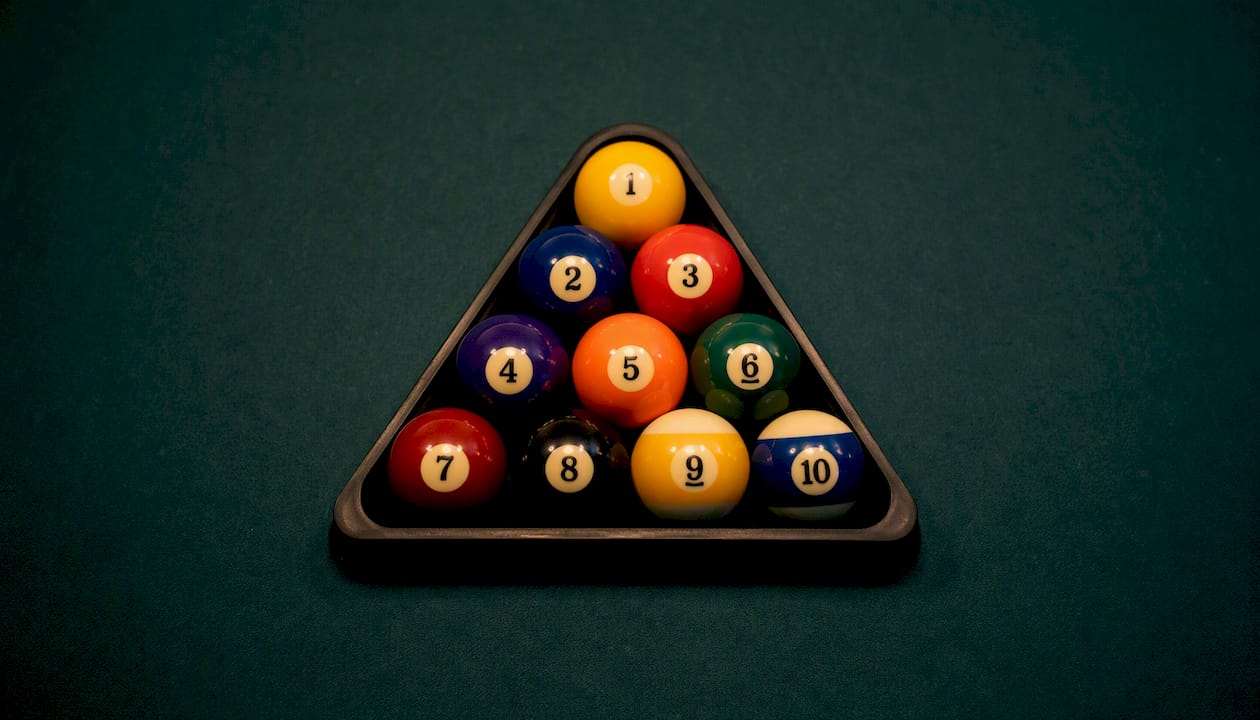
For a deeper look at racking technique that transfers directly to ten-ball, the 9-ball racking guide at Qbilliardshtx covers tight-rack mechanics that apply to both games.
What makes a shot legal and how turns work
A legal shot in ten-ball has two requirements. First, the cue ball must contact the lowest-numbered ball on the table before touching anything else. Second, after that contact, either a ball must be pocketed or the cue ball or any object ball must reach a cushion. Miss either requirement and it is a foul.
The key terms:
- Legal hit: Cue ball contacts the lowest-numbered ball first.
- Legal shot: Legal hit, plus a ball is pocketed or a ball reaches a rail after contact.
- Frozen ball exception: If the cue ball or the lowest ball is frozen to a cushion, the rail contact requirement is modified. Consult the specific rule text for the frozen-ball clause.
- Multiple balls pocketed: Pocketing additional balls on a called shot is legal and the shooter continues. The one exception is the 10-ball: if the 10 goes in before it is the last ball on the table and it was not called, it is spotted and the shooter continues their turn.
Under WPA rules, any bank shot, kick shot, or combination must be called regardless of how obvious it appears. Straight-in shots on balls 1–9 are considered obvious and do not require a call, but the moment a shot involves a non-direct path, you call it or risk a dispute.
A practical sequence: You are at the table with balls 3, 7, and 10 remaining. You must hit the 3 first. You call "3-ball, corner pocket" and pocket it. The 7 and 10 remain. You now must hit the 7 first. You call "7-ball, side pocket" and pocket it. Only the 10 remains. You call "10-ball, corner pocket" and pocket it cleanly. Rack over, you win.
If you accidentally pocket the 10 while shooting at the 7 (a combination, for example), and you did not call that combination, the 10 is spotted and your turn continues since no foul occurred. The WPA rule text is explicit on this: the call requirement exists to prevent accidental wins.
Legal break requirements and the push-out rule
The legal break
The cue ball must start behind the head string. From there, you must either pocket a ball or drive a minimum number of object balls to cushions. The exact minimum varies:
- WPA: Four object balls must reach a cushion, or a ball must be pocketed.
- UPA: Same standard in most published texts, though event sheets sometimes specify a different count.
- House rules: Often reduced to three balls, or simply "make contact and something moves."
Failing the minimum is a foul. The incoming player then has the option to accept the table as-is, re-rack and break themselves, or (under some rulesets) require the original breaker to re-break. The Billiards Republic overview notes that house rules frequently diverge from official texts on this point, which is exactly why checking the event sheet matters.
10-ball pocketed on the break
| Rule Set | 10-Ball Pocketed on a Legal Break |
|---|---|
| UPA | Automatic win for the breaker |
| WPA | 10-ball is spotted; breaker continues |
| CSI | 10-ball is spotted; breaker continues |
| Common house rules | Varies; often follows WPA/CSI respot |
The push-out
A push-out is a one-time option available only to the player who just made a legal break. It must be declared before the shot. On a push-out:
- Normal lowest-ball-first and rail requirements are suspended.
- No foul is committed regardless of where the cue ball ends up, as long as no ball is pocketed.
- After a legal push-out, the opponent chooses: shoot from the current position or pass the shot back.
- If the opponent passes it back, the original shooter plays from that position.
A short example: You break legally, no balls drop, and the cue ball is buried. You declare a push-out and nudge the cue ball to a safer position. Your opponent looks at the layout, decides it is still bad for them, and passes it back. Now you shoot from that position under full rules.
The push-out exists specifically to prevent the breaker from being stuck in an impossible position after a legal but unlucky break. It is a one-shot option only, and it disappears if the breaker takes any other shot first.
Fouls, ball in hand, and spotting rules
Standard fouls
- Cue ball scratch (into a pocket)
- Cue ball driven off the table
- Failing to hit the lowest-numbered ball first
- No ball reaching a rail or pocket after contact
- Double-hitting the cue ball
- Touching or moving any ball with anything other than the cue tip during a legal stroke
- Playing out of turn
- Slow play (exceeding the shot clock, where one is in use)
Ball in hand
Any foul gives the incoming player ball in hand anywhere on the table, not just behind the head string. That is a significant penalty. The incoming player may place the cue ball anywhere, in any orientation, before shooting. CueSight's rule summary confirms this scope: full-table ball in hand is the standard penalty for all fouls in ten-ball.
Spotting the 10-ball
The 10-ball is spotted on the foot spot when it is pocketed illegally. Situations that trigger a spot:
- Pocketed on a foul (any foul during the shot)
- Pocketed during a push-out
- Pocketed without being called
- Pocketed in the wrong pocket
- Driven off the table
No other ball is spotted in standard ten-ball play. If the foot spot is occupied, the 10 is placed as close to the foot spot as possible along the foot string toward the foot cushion.
Three-foul rule
The three-foul automatic loss rule is not part of standard WPA ten-ball. Some UPA events and league formats enforce it. If three consecutive fouls by the same player result in an automatic loss of the rack, that rule must appear on the event sheet. Never assume it applies unless you have confirmed it in writing.
Pro Tip: Before any match, ask the tournament director two questions: "Is the three-foul rule in effect?" and "What is the shot clock?" Both are common sources of mid-match disputes that a 30-second pre-match conversation eliminates.
How to call shots and win the rack
The call requirement
You call one ball and one pocket per shot. You do not need to call every ball you intend to pocket, just the one you are shooting at. For balls 1–9, obvious straight-in shots are self-evident and do not require a verbal call. The 10-ball always requires a call, no exceptions.
Banks, combinations, and kick shots must be called for any ball, including balls 1–9. The WPA rule text is clear on this, and UPA rules apply the same standard. If you are shooting a combination to pocket the 4-ball off the 3-ball, you call "4-ball, corner pocket" and indicate it is a combination if asked.
Winning the rack
You win when you legally pocket the called 10-ball. Legal means:
- No foul occurred on the shot.
- The cue ball contacted the lowest-numbered ball first (which is the 10 when it is the last ball).
- The 10 dropped in the called pocket.
Edge cases
- 10-ball pocketed before it is the last ball: Spotted. Your turn continues if no foul occurred.
- 10-ball in the wrong pocket: Spotted. Incoming player gets ball in hand if a foul also occurred; otherwise play continues from current position.
- 10-ball driven off the table: Spotted. This counts as a foul, so the incoming player gets ball in hand.
- Combination that pockets the 10 as the last ball: Legal win, provided you called the combination and the pocket.
Pro Tip: Referees: when a shot could be a combination or a kick, ask the shooter to confirm their call before they shoot. A brief "What's your call?" takes two seconds and prevents a post-shot argument. Document the call mentally or on a scoresheet if the match is formal.
WPA vs. UPA vs. house rules: what actually differs
The differences between rule sets are narrow but consequential. Here is where they diverge:
| Rule Point | WPA | UPA | Typical House/League |
|---|---|---|---|
| 10-ball on legal break | Respot, continue | Automatic win | Usually respot |
| Back corner balls in rack | Random | 2 and 3 required | Usually random |
| Call requirement | Banks/combos/kicks | Banks/combos/kicks (stricter enforcement noted) | Often lenient on obvious shots |
| Three-foul automatic loss | Not standard | May apply; check event sheet | Rarely enforced |
| Shot clock | Not universal | Event-specific | Rarely used |
| Minimum balls to cushion on break | 4 balls or pocket | 4 balls or pocket | Often 3 or "just hit them" |
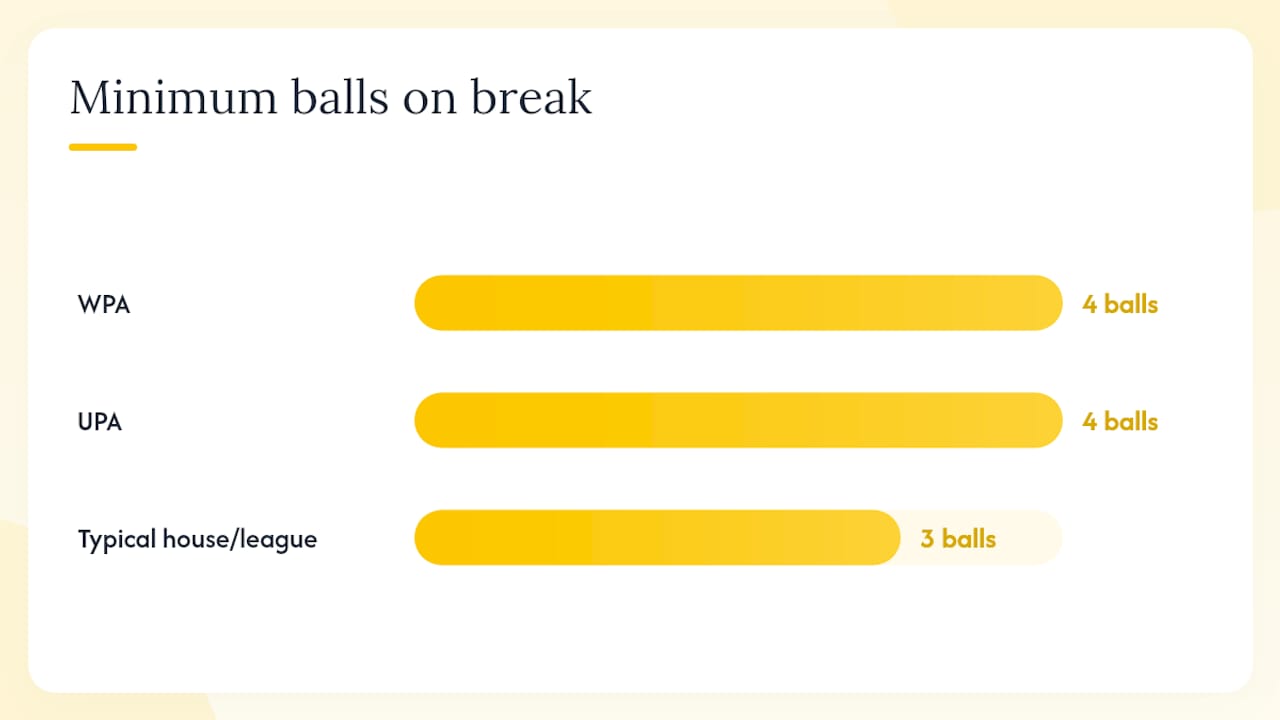
The single most impactful difference for match play is the 10-ball on the break. Under UPA rules, a legally pocketed 10 on the break ends the rack immediately. Under WPA and CSI rules, it is spotted and play continues. Getting this wrong in a tournament setting causes real disputes.
Common house variations you will encounter:
- No call requirement on any shot (pure rotation, no call-shot rule)
- Break from anywhere behind the head string with no minimum cushion count
- No push-out allowed
- Modified spotting (all balls spotted, not just the 10)
The practical recommendation: before any organized match, confirm these five items on the event sheet: break format (minimum cushion count), push-out allowed or not, 10-ball on break (win or respot), three-foul rule in effect or not, and shot clock duration. Tournament directors at organized events typically publish this information in advance, and Billiards Republic notes that most common disagreements trace back to players assuming their home-game rules apply.
Where to practice ten-ball in Houston
Reading the rules is one thing. Applying rotation under pressure, making called shots when a rack is on the line, and executing a push-out decision in real time are skills that only develop at the table.
Qbilliardshtx operates Q Billiards Arena in Houston, a 11,000-square-foot venue with 25 professional-grade tables, weekly tournaments, and late-night hours. The venue runs regular tournament nights where ten-ball and other rotation formats are played under structured conditions, which means you can practice call-shot discipline in a real competitive setting rather than a casual one.
Practical drills to build ten-ball skills:
- Rotation enforcement drill: Set up a full rack and play solo, calling every shot including obvious ones. This builds the habit before it matters in a match.
- Push-out decision drill: After a legal break, practice declaring a push-out and then evaluating whether your opponent would accept or pass. Run the scenario both ways.
- Call-shot pressure drill: Play with a partner and require calls on every single shot, including straight-ins. The added pressure of calling everything sharpens shot selection.
Bring a printed copy of the applicable rule text (WPA, UPA, or CSI) to your first few sessions. When a question comes up, resolve it by reading the rule rather than debating it. That habit alone will make you a better referee and a more disciplined player.
Pro Tip: Check the tournaments and events page at Qbilliardshtx before you go. Knowing which rule set governs the next tournament lets you practice under the exact conditions you will face.
Why ten-ball rewards players who actually know the rules
Ten-ball was developed specifically to reduce the luck-based outcomes that nine-ball sometimes produces. Adding a call-shot requirement and a tenth object ball shifts the balance toward precision and safety strategy. A player who flukes a nine-ball win on the break cannot do the same in ten-ball under WPA or CSI rules, and even under UPA rules, the automatic break win requires a genuinely legal and controlled break.
What most casual players underestimate is how much the call-shot rule changes safety play. In nine-ball, you can play a safety and leave your opponent with a difficult shot without much consequence. In ten-ball, every safety must also satisfy the rotation requirement and the rail rule. That combination forces a level of positional thinking that nine-ball simply does not demand at the same frequency.
The game's growing presence in US tournament formats reflects this. Events that want to test real cue-sport skill, not break luck, increasingly default to ten-ball. Players who have internalized the rules, not just memorized them, are the ones who compete confidently when the format changes.
The Wikipedia overview of ten-ball captures the historical context well, but the strategic depth only becomes clear once you have played a few racks under strict call-shot conditions. The rules are not complicated. The discipline they demand is.
Practice these rules at Q Billiards Arena
Knowing the rules and playing under them are two different things. Q Billiards Arena in Houston gives you 25 professional-grade tables, a tournament schedule that runs rotation formats including ten-ball, and late-night hours so you can get real reps in after work.

The venue runs weekly tournaments with structured event sheets, so you will always know which rule set is in play before you break. Fresh food and drinks are available on-site, and the space is built for players who take the game seriously without taking themselves too seriously. Check games and pricing to see table availability and current rates, or browse the tournament schedule to find the next ten-ball night. This article is published by Q Billiards Arena.
Sources
- WPA rules
- US 10-Ball Rules - US Professional Poolplayers Association
- 10-Ball Rules - CueSight
- Ten Ball - Billiards Republic
- Ten-ball - Wikipedia