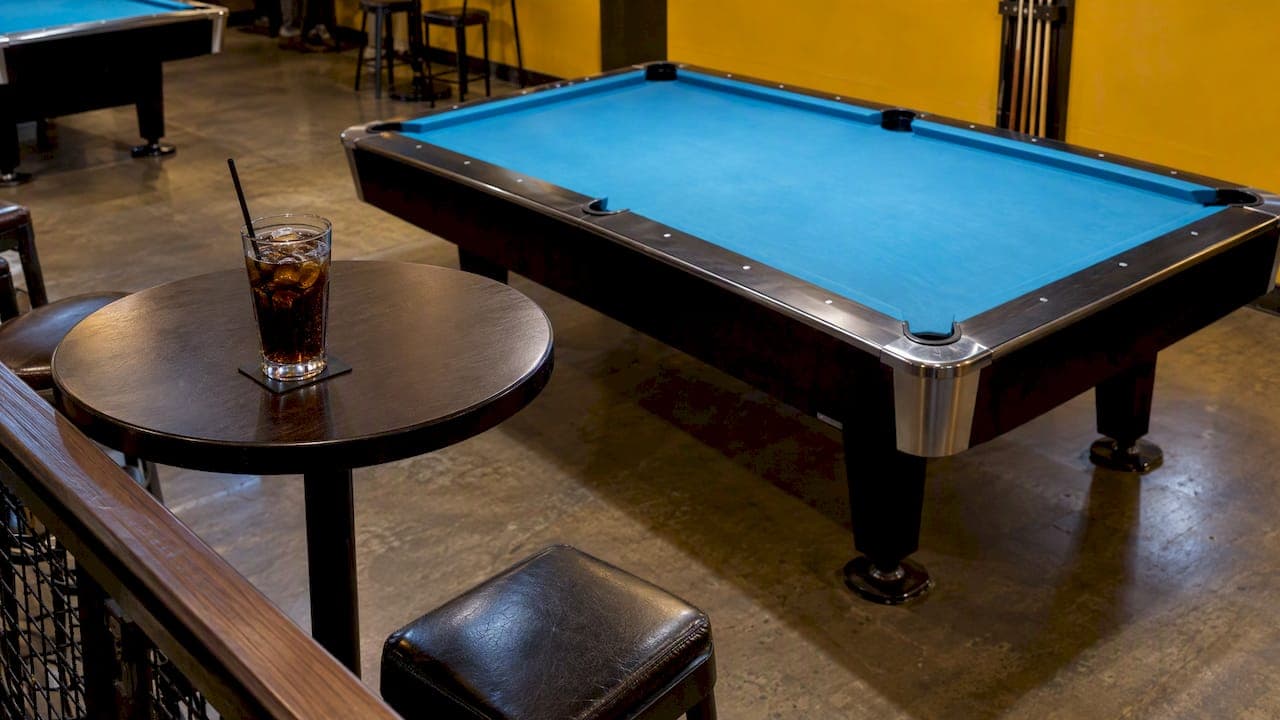
Don't put your drink on a pool table, and that includes the rails. A glass on the rail is one elbow or one bridge hand away from a spill, and cloth and wood don't forgive moisture. Set it on a nearby counter, a pub table or a stool instead, and if something does spill, lift the cup away, blot (never rub) and let the cloth dry on its own.
This guide covers the reasoning behind the rule, the best places to park a drink, what to do in the first minute after a spill, how house rules differ from hall to hall, and why drinking games need their own ground rules.
TL;DR
- Keep drinks off the playing surface and off the rails. League etiquette and facility policies agree on this.
- Use a counter, pub table, stool or spectator seating beside the table, outside your stroke area.
- If a spill happens, lift the container straight up, blot with a clean dry cloth, don't rub, and tell staff.
- Rules differ by venue, so ask at the front desk before you rack, and don't bring outside drinks unless the host allows it.
- Pool drinking games need pacing, water and a ride home planned in advance.
Table of Contents
- Why drinks don't belong on a pool table
- Where to put your drink instead
- What a spill actually does to felt
- What to do in the first minute after a spill
- House rules differ from one pool hall to the next
- Setting up a drink-friendly room without hurting the tables
- Pool drinking games: set the safety rules first
- Our perspective at Q Billiards Arena
- Play and eat in the same night at Q Billiards Arena
- Making your own table-side rule for a group
- Frequently asked questions
- Sources
Why drinks don't belong on a pool table
A pool table looks tougher than it is. The cloth is a tightly woven playing surface, the rails are finished wood with cushions underneath, and the bed beneath the cloth reacts to moisture. Table-care guidance from Billiards Digest calls moisture an enemy of the table, lists it alongside heat, chalk, jewelry and cue-tip contact as a damaging influence, and specifically advises keeping drinks off the rails.
There are three separate ways a drink causes trouble:
- Spills on the cloth. Liquid soaks in fast and can leave discoloration, residue or a tacky patch that changes how balls roll.
- Rings and dents on the wood. A Canadian table retailer's care guide notes that a drink left on the table can stamp rings and other blemishes onto the wood, and that setting a mug or glass down roughly can dent a rail.
- Interference with play. A glass on the rail sits exactly where bridge hands, cues and elbows travel. The most common cause of a spill is not carelessness about the drink but a player simply reaching for a shot.
The rule is not an old-fashioned snobbery. It protects equipment that is meant to stay level and smooth through thousands of games.
What the major rule-makers say
The American Poolplayers Association's league etiquette says plainly not to set drinks on the pool table. The same page tells players to respect the equipment and follow the host location's house rules, and to avoid outside food or beverages unless the host permits them.
Facility policies go further. One U.S. billiard-area use policy prohibits food or beverages on or near the tables, citing both personal safety and equipment protection. It also bans sitting on tables and allows additional posted house rules. The pattern is consistent: the table is for balls and cues, and everything else lives next to it.

Where to put your drink instead
The fix is simple, and it takes about two seconds of planning when you walk up to a table.
- A counter or ledge near the table. Etiquette guidance from a Pennsylvania table retailer tells players to use a nearby counter or table instead of the pool table.
- A pub table or tall corner table. These sit at a good height for a glass or a plate and keep the drink off the rail. Keep it outside your stroke area so you aren't bumping it on a backswing.
- A stool or spectator chair side table. Handy for a small group where one person is waiting on a turn.
- A drink rail or shelf. Many halls build these in so players don't have to improvise.
A useful habit is to place your drink on the side of the table where you are least likely to shoot from, and to take it with you when you move to the other end rather than leaving it at the rail "just for a second."
A quick habit checklist
- Put the drink down before you chalk, not after.
- Choose a spot at least an arm's length plus a cue's length from your shot lines.
- Use a lid or a bottle with a cap if you must walk around the table.
- Keep napkins on your side table, not on the rail.
- Don't use the table as a coaster, even for a closed bottle. Condensation is moisture too.
What a spill actually does to felt
People often ask whether the kind of drink matters. The honest answer is that it depends. The Family Game Room explains that a spill may leave discoloration or residue and affect ball movement, that different drinks can leave different marks, and that drink type alone doesn't predict permanent damage. The result depends on the cloth, the size of the spill and how quickly someone responds.
That said, sugary drinks, dark drinks and anything sticky are the ones that tend to leave residue behind, and any liquid that reaches the bed under the cloth is a bigger problem than one that stays at the surface. This is why the rule isn't "only avoid sodas." It's "avoid all of it."

What to do in the first minute after a spill
Speed and gentleness matter more than any product. Here's the sequence that table-care sources agree on.
- Lift the container away without dragging it. Dragging spreads liquid across the cloth and can tug the fibers.
- Blot, don't rub. Press a clean, dry, absorbent cloth onto the spot. The same guidance says not to rub, and to check the table or cloth manufacturer's care instructions before adding water or cleaner.
- Let it dry naturally. Skip hair dryers and heaters, and skip unapproved cleaning products. Only after drying should you judge whether there's persistent discoloration, tackiness, odor or dampness.
- Tell the staff. At a pool hall, the person who maintains the tables will know the cloth and what is safe to use. At home, the manufacturer's instructions are the authority.
One retailer's care page suggests that a liquid spill can be handled with a soft, damp absorbent towel placed over the spot, and warns that the mark may still stay visible because cloth is unforgiving. That is a good reminder that cleanup is damage control, not a guarantee. Prevention is cheaper.
For home tables where drinks are unavoidable, the Billiards Digest page mentioned above also suggests a fabric sealant such as Scotch Gard on the felt. Check with your cloth maker first, since treatments can change how a cloth plays.
House rules differ from one pool hall to the next
Pool is full of unwritten rules, and drink policy is a good example. Dr. Dave's rules FAQ points out that U.S. "bar rules" are not an official uniform rule set and can change from bar to bar and region to region, which is why players are advised to agree on rules before the game starts.
A few common patterns you'll run into:
| Setting | Typical expectation |
|---|---|
| League night | Follow APA etiquette: no drinks on the table, and respect the host location's rules |
| Casual pool hall | Drinks welcome at the venue, but kept off the table and rails |
| Bar with a coin-op table | Looser culture, but spills still end games and can cost you |
| Private event or rented room | Whatever the host posts, so ask |
Two habits keep you out of trouble anywhere. First, ask the staff what the policy is when you arrive. Second, don't carry outside food or drink in unless the venue says it's fine. If you want more on conduct beyond drinks, we cover it in our guide to pool hall etiquette for beginners and league play.
Why venues write policies down
A written policy turns an awkward moment into a simple reminder. It's easier for a staffer to point to a posted rule than to confront a customer, and it keeps every table in the room in the same condition. Even policies outside billiards follow this logic. A good example is how other entertainment venues explain their food and drink policies: they state what's allowed, where, and why, so guests aren't guessing.
Setting up a drink-friendly room without hurting the tables
If you host a pool night at home or run an event, plan the room so the drink never needs to be near the table. The principle is the same one event planners use for any gathering: put the serving point away from the action and give guests a surface within reach. A guide to golf tournament bar setup covers layout, staffing and drinks for crowds, and the idea carries over to a game room: keep the bar or cooler in one spot, keep traffic flowing, and give people somewhere to put a cup.
For a pool room specifically:
- Place tall pub tables or a shelf along one wall, a few feet from the table.
- Keep walkways wide enough that someone carrying a drink doesn't brush a player mid-stroke.
- Provide coasters on the side tables, not the rails.
- Keep a stack of clean dry cloths somewhere obvious, not in a closet.
- Put snacks that leave grease or sticky residue on plates and napkins, and wash your hands before gripping a cue.
On that last point, food matters as much as drinks. Crumbs, oil and sugar all end up on cloth. If you're picking what to eat during a session, see our notes on the best snacks for pool night and pool night drinks that keep your aim steady.
Pool drinking games: set the safety rules first
Searches for drinks on a pool table often lead to drinking games, where drinks are tied to the game itself. These games add a penalty to events such as pocketing a ball, fouling, missing or sinking the 8-ball. One roundup of variants describes setups such as Beer Pool, where a player drinks when the opponent pockets a ball, along with penalties for fouls and misses.
The same page also gives the safety advice that matters more than any rule variant: pace yourself, know your limits, offer nonalcoholic drinks, provide water, look out for others, and arrange a designated driver or rideshare.
The practical issues are the ones this article started with. Games like these multiply the number of times a drink is picked up and put down, which is exactly when spills happen. If you play them:
- Keep the drinks on a side table and have the penalized player walk over.
- Agree before the first break on what counts as a penalty, so a ruling doesn't turn into an argument.
- Make water and nonalcoholic drinks as easy to grab as anything else.
- Stop the game for anyone who wants out, no questions asked.
- Arrange the ride home before the first round, not after the last one.
If alcohol is a concern for you or someone in your group, a doctor or a local support line is the right person to talk to, not a game rulebook.
Our perspective at Q Billiards Arena
We run a large room: 25 professional-grade tables across 11,000 square feet, with American pool, snooker, Chinese 9-ball and carom billiards, a fresh food and drink menu, and late-night hours. A room like that only works if eating and drinking are part of the evening and the tables stay in good shape at the same time.
Our view is that the "no drinks on the table" rule isn't a restriction on having a good time. It's what makes a long night of pool possible. A cloth that stays clean and a rail that stays smooth mean the table plays the same at midnight as it did at six. And players who have a drink and a snack within arm's reach, but not on the rail, play better and argue less.
So our advice is simple. Order what you like, take it to a side surface, and ask a staff member if you're unsure where to put it. If something spills, don't try to fix it yourself with whatever is in your pocket. Tell us, and we'll handle it properly.
— Q
Play and eat in the same night at Q Billiards Arena
If you want a room built for playing with a drink and a plate nearby, our Houston hall has the space for it. Table rates are published: American pool is $10 per hour, standard snooker, Chinese 9-ball and carom billiards are $15 per hour, and heated snooker is $20 per hour. See the full list of pool, snooker and carom tables.
Browse the food and drink menu before you come, or look at our weekly tournaments and events if you'd like to play competitively. Our Tuesday and Friday night pool tournaments each have a $10 entry. If you're not sure which room fits your night, our guide to choosing a pool hall for your goal helps you decide, and you can always start from our homepage.
Making your own table-side rule for a group
If you play with the same friends every week, write down a three-line rule and agree on it once. For example: drinks stay on the side table; anyone who spills reports it immediately; no one chalks over the cloth edge. It sounds formal, but it spares you the "who put that there?" conversation.
Here's a small plan you can adapt:
- Before the first rack, point out where drinks go.
- During play, the player at the table moves the drink if it's in the way, instead of asking someone else to.
- After a spill, stop the game, lift, blot, and let staff or the table owner decide the next step.
- At the end of the night, wipe side surfaces and check the rails for rings.
When chalk is the issue instead of drinks, the Billiards Digest piece quotes a table professional saying chalk is abrasive and destroys cloth, and another recommending soft-bristle brushing toward the pockets or a low-powered vacuum without a brush attachment for cleaning. The point holds across the board: the cloth does best when everything foreign stays off it.
If you may be asked to pay
One etiquette guide from a billiards gear site reminds players to follow the venue's rules, avoid bringing outside food or drink unless allowed, and be aware that you may have to pay for cloth damage. Repair costs are the venue's decision, and the best way to avoid the conversation is to keep the drink off the table in the first place.
Frequently asked questions
Can I put a drink on the rail of a pool table?
No. The rail is part of the table, and moisture and rings can mark the wood. League etiquette from the APA says not to set drinks on the table at all. Use a counter, pub table or stool instead.
What should I do if I spill a drink on the felt?
Lift the container away without dragging it, blot with a clean dry cloth, and don't rub. Let the area dry naturally with no heaters or hair dryers, and tell the venue staff or check the manufacturer's care instructions before using any cleaner.
Do I have to buy food or drinks to play pool?
It depends on the hall. Some charge an hourly rate only, and some offer deals with a purchase. Ask at the front desk. At Q Billiards Arena, table time is billed by the hour, and our menu is there if you want to eat or drink while you play.
Can I bring my own drinks to a pool hall?
Only if the venue says so. APA etiquette tells players to avoid outside food or beverages unless the host permits them, and many halls have posted house rules that say the same. When in doubt, ask before you walk in with a cooler.
Is it okay to play pool drinking games?
It can be, with ground rules. Pace yourself, keep water and nonalcoholic options available, keep drinks on a side table, and arrange a designated driver or rideshare beforehand. If the venue has rules about alcohol or games, follow those first.
Sources
- Billiards Digest: pool table maintenance
- Canadian Home Leisure: mistakes that damage pool table rails
- APA league play etiquette
- Use of billiard tables facility policy
- West Penn Billiards: pool table etiquette
- The Family Game Room: spilled drink on pool table felt
- Kinney Billiards: pool table care
- Dr. Dave Pool Info: bar rules
- The Gear Sports: pool etiquette
- DrinkPlayground: pool table drinking games
- Escape room food and drink policy
- Golf tournament bar setup