Heated snooker tables keep the playing cloth slightly above the room's dew point so balls roll more consistently. Under-slate heating dries out moisture that would otherwise settle into the wool nap, which lowers surface friction and keeps spin and speed predictable frame after frame. It also extends cloth life by cutting down on the swelling and matting that damp fibers cause. One thing trips people up constantly: the 45 to 50°C reading on a thermostat is the heater or slate temperature, not how warm the cloth actually feels.
TL;DR:
- Maintaining the slate temperature between 45 and 50°C keeps the cloth dry, consistent, and less prone to dampness-related issues, especially in humid environments.
- The actual cloth surface remains only a few degrees above room temperature, making it essential to understand that the thermostat reading reflects slate or heater temperature, not surface warmth.
- Heated tables improve play by enhancing ball roll accuracy, increasing cue ball speed and spin, and reducing uneven behavior across different seasons.
- Retrofitting heating systems involves lifting the slate, installing panels or mats, and adding insulation, with operational costs mainly affected by wattage, schedule, and insulation quality.
- Heating is most justified in humid, high-traffic, or competitive settings; for casual or dry-room use, a dehumidifier and regular maintenance suffice.
Table of Contents
- How Under-Slate Heating Systems Actually Work
- What Playing on a Heated Table Actually Feels Like
- What Do the Temperature Settings Actually Mean?
- Installing or Retrofitting a Heated System
- Do You Actually Need a Heated Table?
- How Q Billiards Arena Runs Its Heated Snooker Tables
- The Real Case for Heated Tables
- Sources
How Under-Slate Heating Systems Actually Work
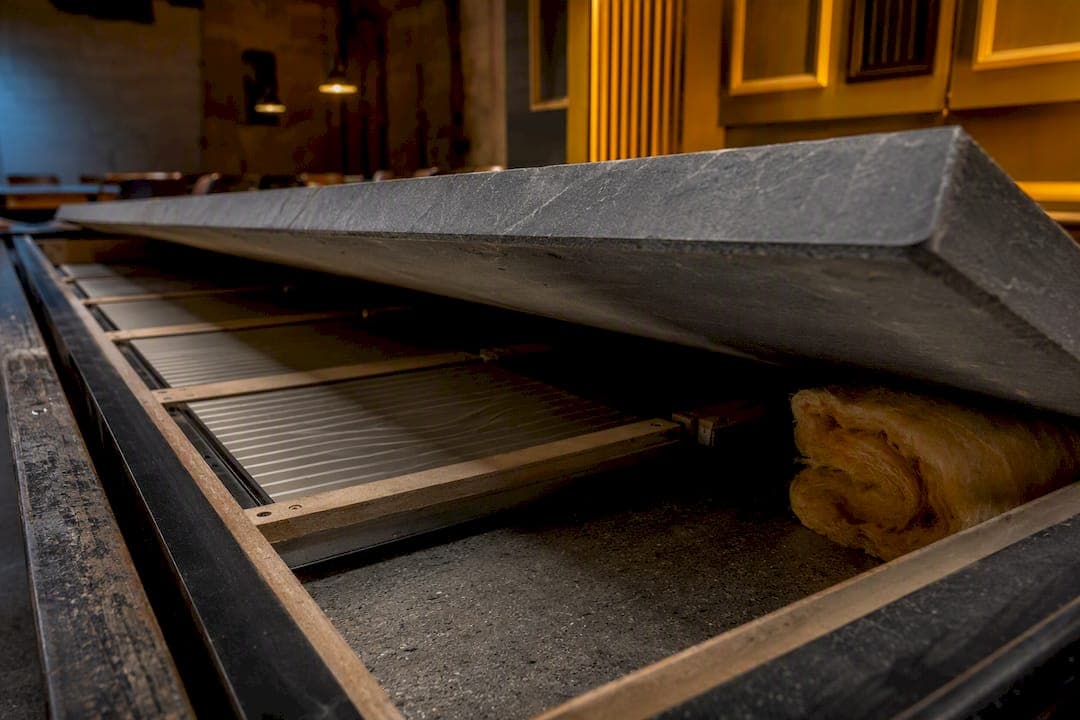
A heated snooker table gets its warmth from thin heating elements, usually panels, mats, or occasionally cables, mounted directly beneath the slate bed. The slate itself does a lot of the real work here. Because it's dense and thick, it acts as a thermal reservoir, soaking up heat from the elements and spreading it evenly across the entire bed instead of leaving hot spots under the pockets or cold zones at the rails.
That matters because wool cloth is hygroscopic, meaning it absorbs ambient moisture like a sponge absorbs water. Left cold, especially in a room with any humidity swing, the nap pulls in dampness and the fibers swell just enough to increase drag on the ball. A heated system keeps the cloth surface a few degrees above ambient, which is enough to hold the wool above the dew point and stop that moisture from ever settling in.
This is where the thermostat confusion comes from. What you see on the controller is the element or slate temperature, not what your hand feels on the baize. A few practical points worth knowing:
- The slate absorbs and diffuses heat before it ever reaches the cloth surface.
- Cloth surface temperature typically sits only a few degrees above room temperature, not near the 45 to 50°C shown on the display.
- Historical versions of this idea go back further than most players assume. Nineteenth-century tables used zinc tubes to warm the bed, long before electric elements existed.
What Playing on a Heated Table Actually Feels Like
Ask any regular league player and they'll tell you the same thing: heated tables just play more honestly. The ball goes where you send it, shot after shot, without the random drift that creeps in on a cold, damp cloth.
That consistency shows up in three specific ways. First, roll becomes repeatable. Long safety shots that skid short or drift wide on a cold table tend to hold their line on a heated one. Second, reduced surface friction lets the cue ball carry speed and spin more cleanly, which matters enormously for players working screw shots or side spin across the length of the table. Third, that predictability makes touch shots and long century breaks genuinely easier to construct, because you're not compensating for a cloth that behaves differently in November than it did in July.
Maintenance improves too. A few concrete gains club owners notice:
- Less frequent ironing, since the cloth doesn't retain the moisture that causes matting.
- Fewer full re-felts over the table's working life.
- More stable play across seasons, rather than a table that's "fast" in summer and "sticky" in winter.
Quick numbers to know: a modern under-slate heater typically draws around 600 watts, and running it on a smart schedule rather than around the clock can cut that energy use by more than half.
What Do the Temperature Settings Actually Mean?
The 45 to 50°C figure you'll see glowing on most tournament and club controllers refers to the heating element or the underside of the slate, never the cloth you're chalking your cue over. By the time that heat has passed through several inches of slate, the playing surface ends up only a few degrees warmer than the room itself, just enough to keep the wool dry.
Recommended ranges vary a bit by setting:
- Tournament tables: Run continuously during play, often set toward the higher end of that 45 to 50°C band for consistent conditions across long sessions.
- Club tables: Usually scheduled to warm up an hour or two before opening rather than run all day.
- Home tables: Lower priority unless the room is genuinely damp or cold; many owners run heaters only during active play.
Hardware varies too. Flat heating plates are common on higher-end tables, mats are a popular retrofit option, and larger installations sometimes use zoned systems that heat different sections independently. Whatever the setup, look for a controller with both a thermostat and a built-in timer.
Pro Tip: Set your heater on a timer that switches off overnight and during closed hours. The slate holds heat well enough that you won't lose playability, and you'll notice it on your energy bill.
Installing or Retrofitting a Heated System
Adding heating to an existing table isn't a weekend project. It means lifting the slate sections, laying the heating elements evenly across the underside, adding insulation to direct heat upward rather than into the floor, and reassembling with the cloth reset and stretched properly. Skipping the insulation step wastes energy and can leave the slate underheated no matter how powerful the elements are.
Retrofit realities differ by setting. A home table might justify a simpler mat-based kit if the room runs cold or damp. Club and tournament tables generally warrant a full panel system built to run daily without wearing out.
On running costs, a handful of factors do most of the work:
- Wattage and coverage of the elements you choose.
- How many hours per day the system actually runs.
- Insulation quality beneath the slate, which determines how much heat you're wasting.
- Labor and electrician costs for the retrofit itself, which usually outweigh the price of the heating kit.
The single biggest lever for ROI is scheduling. Pairing a timer with reasonable dehumidification in the room, rather than letting the heater run nonstop, is where most venues get the best return on the investment.
Do You Actually Need a Heated Table?
Not every player or venue needs one. Run through this before spending money:
- How humid is your room? High or variable humidity is the strongest case for heating.
- What size is the table? Full-size 12-foot tables show moisture effects more visibly than smaller ones, simply because there's more cloth exposed.
- How often is it played? Daily club use justifies the investment far more than occasional home games.
- Are you training for competition? Consistent conditions matter more once you're chasing repeatable break-building.
- What's your budget? Heating is genuinely optional for many home setups, especially in dry, climate-controlled rooms.
If your answers lean toward casual home play in a stable, dry room, a dehumidifier and regular ironing will get you most of the benefit without the installation cost. For anything approaching club-level frequency, heating stops being a luxury.
How Q Billiards Arena Runs Its Heated Snooker Tables
At Q Billiards Arena, heated snooker tables aren't left running around the clock. Staff bring them up to temperature ahead of tournaments and peak evening hours, then let them cool during closed hours, a schedule that mirrors the energy-saving approach most operators rely on to keep running costs sane without sacrificing table quality.
Players notice it most on long safety exchanges and screw shots. The cue ball holds its line instead of drifting off a cold, slightly damp cloth. That's the whole point of heating: not making the table feel hot, but keeping the cloth dry enough to behave the same way every time you play.
Maintenance follows the same rhythm: less ironing between sessions, and cloth that holds its pace far longer than an unheated table would in a busy Houston venue. Check current games and pricing or see the snooker club setup in person.
The Real Case for Heated Tables
The conventional pitch for heated snooker tables leans too hard on the word "premium," as if heating is a luxury feature for high-end rooms. That undersells what's actually happening. Heating solves a specific, measurable problem: wool cloth absorbing ambient moisture and dragging on the ball. It's a maintenance tool as much as a performance one.
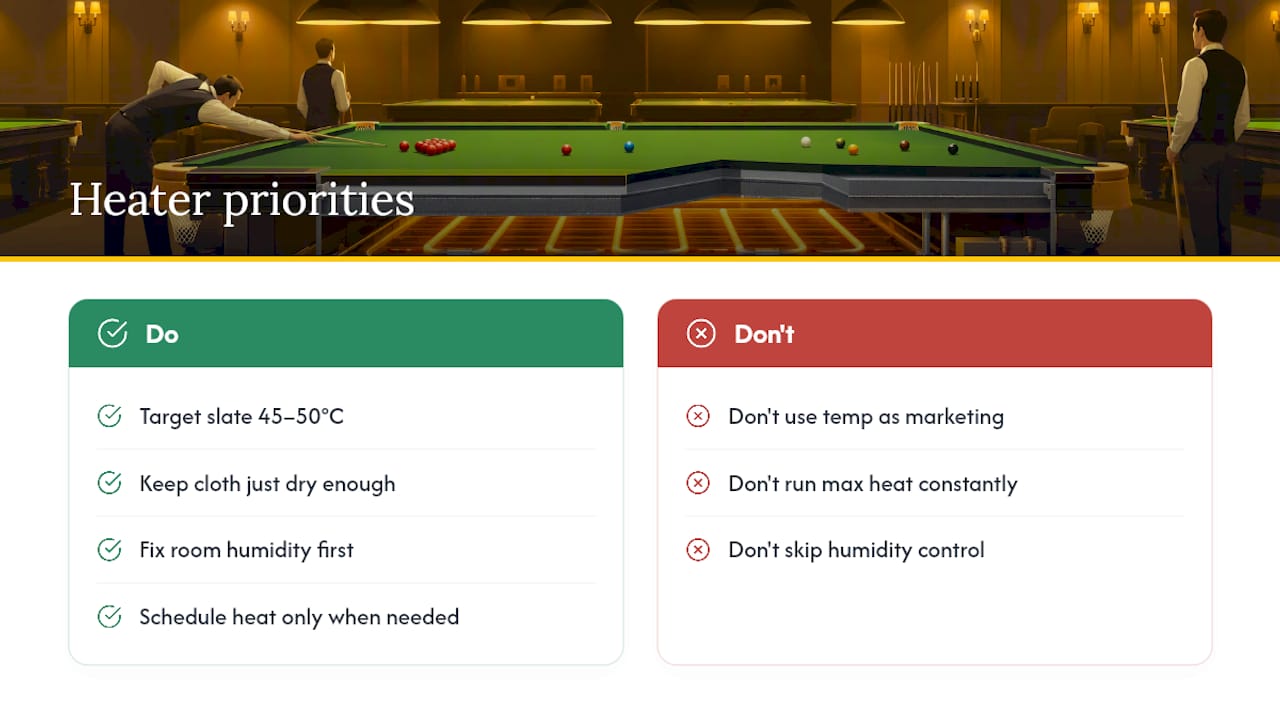
Where most advice falls short is treating the thermostat number as marketing rather than mechanics. Understanding that 45 to 50°C refers to the slate, not your palm on the baize, changes how you think about running costs and scheduling. You don't need max heat around the clock. You need the cloth just dry enough, just often enough.
If you're deciding where to start, prioritize humidity control in your room before you spend on elements and controllers. A heater fighting a genuinely damp space will run constantly and still underperform. Fix the room first, then let the heating system do the smaller job it's actually built for.
— Q
Curious what a properly heated table actually feels like under your cue? Book a table at Q Billiards Arena and judge the roll for yourself.
Sources
- Why are Snooker tables heated? — Snooker Shorts
- Why do snooker tables have heaters? - Surrey Snooker Academy
- Billiard table — Wikipedia