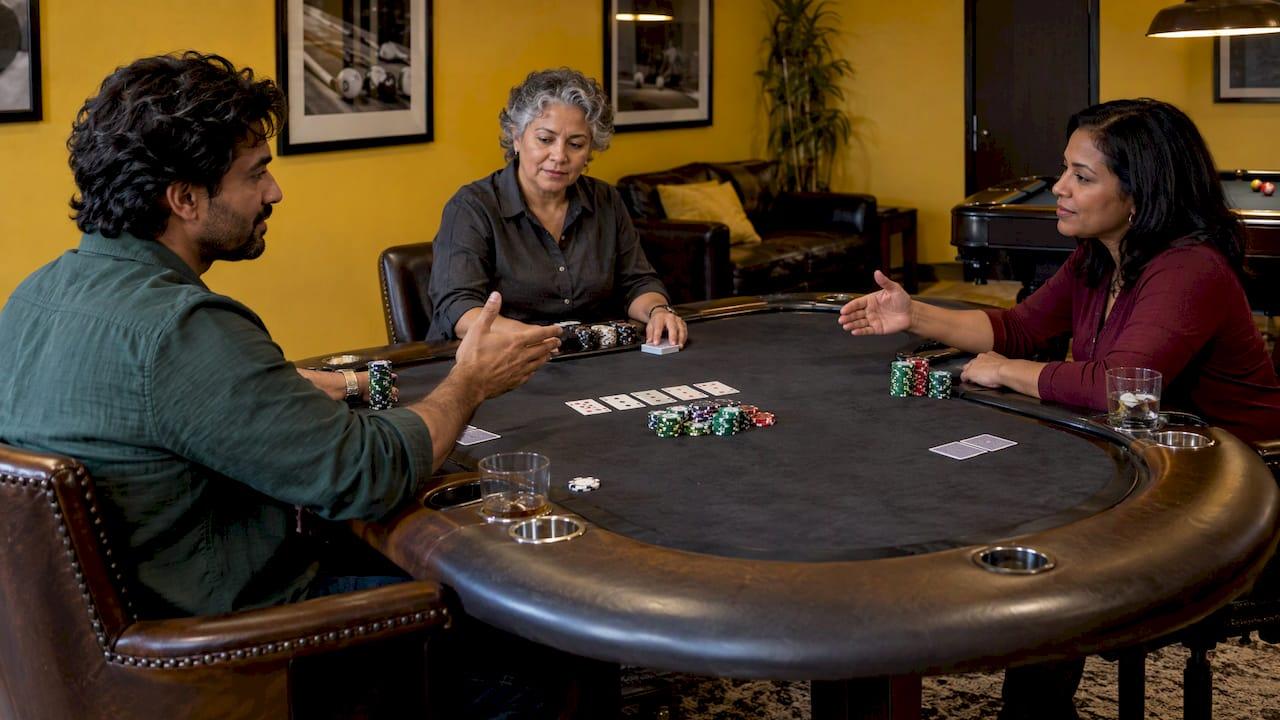
Running it twice means that when a player is all-in and no more betting can happen, the players deal the remaining community cards two separate times and each board wins half the pot. It does not change anyone's expected value. It only smooths out the swings, and it works only if every player in the pot agrees. This guide covers how it works, the math, the etiquette, and how to set the rule for your own game.
TL;DR
- Running it twice deals the unseen board cards twice after an all-in. Each run pays half the pot, and a player who wins one run and loses the other gets their money back.
- Your expected value (your long-run average result) is the same whether you run it once or twice. Only variance, the size of the swings, goes down.
- Everyone involved must agree. If one player says no, the hand runs once. Ask once and accept the answer.
- It is a cash-game practice. Do not expect it in tournaments.
- If you host a game, put the rule in your house rules before the first hand. We rent a private poker room in Houston for groups that want their own rules and their own table.
Table of Contents
- What "run it twice" means
- How the cards and the pot are handled
- Does running it twice change your odds?
- When can you run it twice, and who has to agree?
- Cash games versus tournaments
- Run it twice etiquette
- Setting the rule for your own game
- Where to play it in Houston
- Our perspective
- FAQ
- Sources
What "run it twice" means
The situation is always the same. Two or more players are all-in, or one is all-in and the other has called, and there are still community cards to come. Instead of dealing the rest of the board once, the players agree to deal it two times. PokerNews describes it as dealing the remaining streets twice and giving half the pot to the best hand on each run.
A few terms, in case you are newer to the game:
- All-in means a player has put every chip they have into the pot.
- Community cards are the shared cards: the flop (three cards), the turn (one) and the river (one).
- Runout is the set of cards still to be dealt, also called a run or a board.
- Equity is your share of the pot based on your chance of winning at that moment.
Players sometimes call it "dealing twice" or "running it two times". Some games allow three runs, and the same logic applies.
How the cards and the pot are handled
Only undealt cards are dealt again
Cards already on the table stay there. If the all-in happens on the flop, the same flop stays for both runs, and only the turn and river are dealt twice. If it happens on the turn, only the river is dealt twice. The BetMGM-style description of an extra full board only applies when the all-in happens before the flop, since then nothing has been dealt yet.

The second run comes from the same deck. The cards used in the first run are not shuffled back in. That detail matters for the math below.
The pot is split in two
The pot is divided into two equal halves. The winner of the first board takes the first half, and the winner of the second board takes the second half. A simple example, adapted from the one PokerNews uses: A♣K♦ goes all-in against Q♦Q♣. On the first board, kings win. On the second board, queens win. The two players split the pot, and each wins half. If someone wins both boards, they take the whole pot.
If a single board ends in a tie, that board's half is divided between the tied players. When the pot does not split evenly, the odd chip is awarded by house rule. The 2026 WSOP cash-game rules, as reported by Betting Tribune, give the extra chip to the main board.
Side pots and three-way hands
When more than two players are involved and stacks are different, there is a main pot and one or more side pots. Rooms handle these differently. According to the same Betting Tribune report, the WSOP and PokerStars Live cash-game rules allow the players in a side pot to run their pot twice, and they treat the main pot as a separate procedure. Because rooms differ, the safe habit is to tell the dealer you want to run it multiple times and confirm three things before any card is dealt:
- Which players have to agree.
- Which pots are being run twice.
- How many runs there will be.
The dealer then controls the cards and the pot division. Players should not touch the deck or the board.
Does running it twice change your odds?
No. This is the question that starts most arguments, so it is worth getting right. PokerNews' strategy analysis concludes that running it twice or more does not change a player's odds or expected value. It reduces variance and leaves expected value intact. Over a long run you win the same amount, with smaller swings in your bankroll.
A worked example
Say the pot is $200 and you have an 80% chance of winning if the hand is dealt once. Your expected value is 0.80 × $200 = $160.
Now run it twice. Treat each board as roughly an 80% shot for you, which is a close approximation:
| Outcome | Chance (approx.) | What you get |
|---|---|---|
| Win both boards | 64% | $200 |
| Win one, lose one | 32% | $100 |
| Lose both boards | 4% | $0 |
The expected value is 0.64 × $200 + 0.32 × $100 + 0.04 × $0 = $160. It is the same as running it once. What changed is the shape of the result. Running it once, you lose the whole pot 20% of the time. Running it twice, you lose all of it only about 4% of the time, and you get a middle outcome, a split, about a third of the time.
The favorite gives up some outright wins, and the underdog gives up some lucky scoops. Both sides keep the same long-run average. That is why the old idea that the favorite should always say no and the underdog should always ask is a myth. Neither player gains or loses expected value by agreeing.

Why the two boards are not perfectly independent
The two runs come from the same deck, with the first run's cards removed. If the first board brought two cards you needed, there are fewer of them left for the second. Mathematician Stewart Ethier, in an academic paper on variance reduction, notes that the mean return for running it n times equals that of running it once, while the variance is less than 1/n of the single-run variance. So running it twice cuts variance to a bit less than half. For a player at the table, the practical takeaway is simple: same average, smaller swings.
Why anyone asks to run it twice
If the math is neutral, why do players ask? Mostly for bankroll and nerves:
- The pot is large compared with what you comfortably risk in one hand.
- You tend to tilt after a bad beat, and a split result softens the blow.
- The game is high-variance, such as Omaha or a bomb pot (a hand where everyone antes and plays the flop together).
- Recreational players often enjoy a second chance after losing a big hand.
Reasons to decline are equally fine: the pot is small, you want the game to keep moving, or you simply prefer one board. Each run takes extra time, and a table that runs everything twice deals fewer hands per hour.
When can you run it twice, and who has to agree?
Three conditions are common to almost every room:
- The game allows it. House rules decide, not the players. Some rooms allow it only heads-up, some cap the number of runs, and some do not offer it at all.
- There is an all-in and no action is pending. All betting is finished, and the cards still to come are the only thing left.
- Everyone involved agrees. One decline and the hand is dealt once.
The 2026 WSOP live-action rules reported by Betting Tribune follow this pattern: the option is available for the cash games named in the rules, all remaining participants must agree, and at least one player must be all-in with no action pending. Online sites that offer it work the same way. PokerNews reported in April 2026 on one site launching the feature at cash tables, and noted that you are never obliged to accept when an opponent asks, and they do not have to accept when you ask.
Another common rule: you cannot agree to stop betting early or "check it down" on the first board in order to run it twice. Betting finishes the normal way, then the option comes up.
Cash games versus tournaments
Running it twice belongs to cash games. FlopTurnRiver's guide states that it is only done at cash tables and never in tournaments. It also notes that stakes below $5/$10 no-limit rarely allow it because it slows the game.
The reason is the structure of a tournament. Chips in a tournament do not equal dollars, because prizes jump at certain finishing places. An all-in decides whether a player is eliminated, and one standard result per all-in keeps every table fair. If your game is a tournament, expect one board per all-in. If you are choosing between formats for your group, our guide to cash versus tournament poker explains which one fits which night.
Run it twice etiquette
The etiquette is short, and it keeps games friendly.
- Ask once. If the answer is no, drop it. Do not push, joke about it, or needle the other player.
- Ask at the right time. Raise it after betting is complete, not while players are still deciding.
- Be consistent. If you agree only when you are behind and refuse when you are ahead, the table notices. Your expected value is the same either way, but your reputation is not.
- Decide quickly. Do not stall, especially on apps with a timer. Stalling can look like you are waiting to see who is favored.
- Do not change your mind mid-hand. Once you have agreed and the first run is dealt, you are committed to the second.
- Do not criticize the choice. Some players want one board and some want three. Both are within the rules.
- Let the dealer run the show. Confirm the number of runs out loud, then let the dealer deal and award the pots.
- Know the house rules. If you are unsure whether a game allows it, ask the dealer or host before the hand starts, not during an all-in.
Setting the rule for your own game
If you host a home game or a private event, run it twice is one of the rules to settle before play. Players who are used to casino rooms will ask about it, and disputes appear exactly when a big pot is on the table. Decide these points in advance and write them down:
- Is it allowed at all?
- Is it heads-up only, or can multiway pots run twice?
- How many runs: two only, or up to three?
- How are side pots and the odd chip handled?
- Is it banned in any tournament portion of the night?
The same habit applies to the rest of your house rules. Our guides on private poker room rules and poker game etiquette for hosts give a rulesheet you can copy and adapt. If you plan a mixed night, the guide to Texas Hold'em versus Omaha helps you choose the game, since Omaha pots tend to be the ones people want to run twice.
Where to play it in Houston
A private room helps with all of the above. At Q Billiards Arena, the poker room can be rented for events, with a minimum purchase or a paid reservation. Your group sets the rules at your table, including how all-in hands are handled, and the room sits inside our 11,000 square foot venue with a fresh food and drink menu. Late-night hours run until 2 to 4 AM, so a long cash game does not have to end early. For the reservation details, see the poker room rental page.

If part of your group would rather shoot pool between hands, our tables and hourly rates start at $10 per hour for American pool, and the menu covers food, snacks and drinks for the whole night.
Our perspective
We think the best poker nights are the ones where nobody argues about the rules at the moment a big pot is in the middle. Run it twice is the clearest example. The math is settled: the average result is the same, and only the swings change. So the real question is not whether it is correct, but whether your table has agreed on it.
That is why we like a private room for a poker night. Your group decides before the first hand whether all-in hands run once, twice or three times, writes it on the rulesheet, and everyone sits down knowing the answer. There is no room policy to work around and no stranger at the table who plays by different habits.
A good night also needs more than cards. Our venue has 25 professional-grade tables for anyone who wants to play pool or snooker between hands, a food and drink menu for the break, and late hours so the game ends when your group wants it to. We built the arena around people who like friendly competition, and a well-run poker table is part of that.
Q
FAQ
Is running it twice allowed in every poker game?
No. House rules decide. Many casino and online cash games allow it, some limit it to heads-up pots or cap the number of runs, and some do not offer it. Ask the dealer or host before the hand starts, since the all-in is a bad time to find out.
Does running it twice give the underdog an edge?
No. Each player's expected value is the same as running it once, so neither side gains. The favorite wins the whole pot a little less often, and the underdog loses the whole pot a little less often. Both end up with smaller swings and the same long-run average, as the PokerNews analysis explains.
Can I run it twice in a tournament?
Almost never. It is a cash-game practice, and tournaments use a single result per all-in because chips and prize money do not match one to one. Check the tournament rules before play, and do not assume it is available.
What happens if one player refuses?
The hand runs once, as normal. Every player involved in the all-in must agree, and nobody has to explain a no. Ask once and accept the answer.
What if the second board gives the same winner?
That player wins both halves, so they take the whole pot. If the winners differ, each takes half. If one board is a tie, that board's half is split between the tied players, and the dealer handles any odd chip under the house rule.
Sources
- Running It Twice | Poker Terms | PokerNews
- Why 'Running it Twice' Does Not Affect Your Odds | PokerNews
- 888poker Launches Run It Twice Feature In Cash Games | PokerNews
- Run it twice poker: consent, side pots and payouts | Betting Tribune
- Variance reduction in Texas hold'em and in video poker | arXiv
- Running it Twice in Poker: How, Where, & Why to Run it Twice | FlopTurnRiver