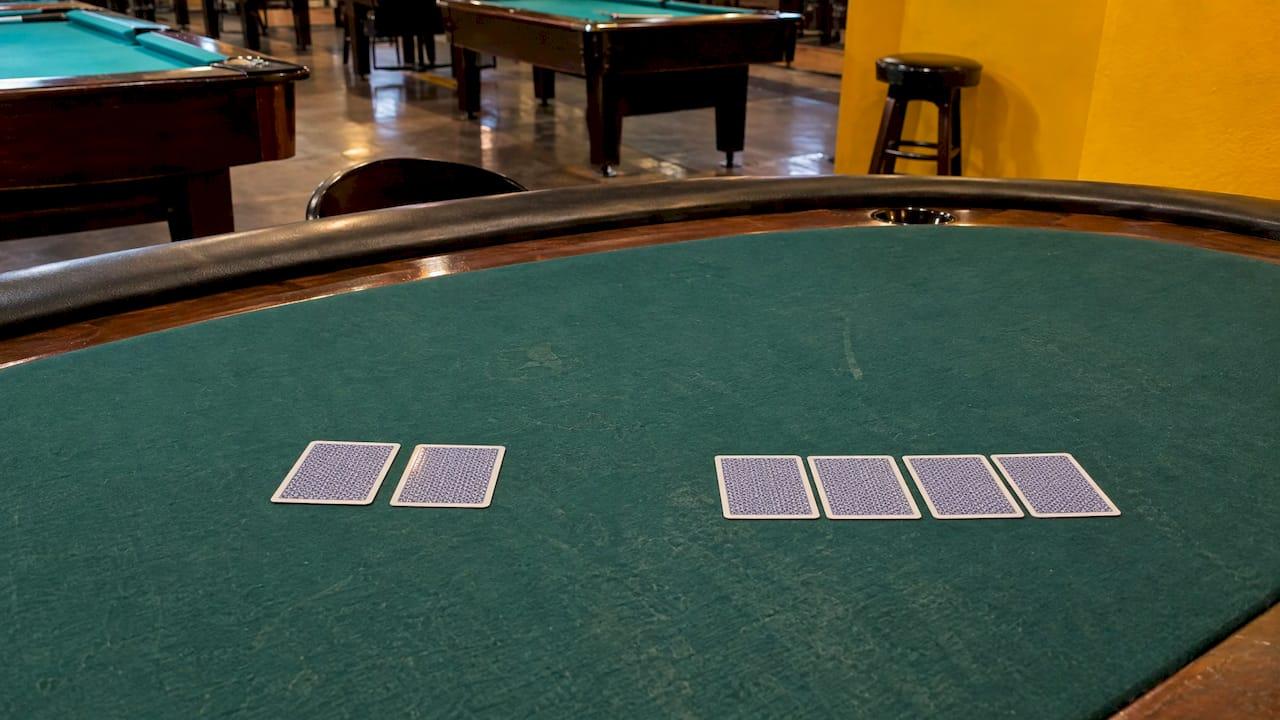
The short version: Texas Hold'em deals you two hole cards and lets you use any mix of them with the board. Omaha deals you four and forces you to use exactly two. That one rule changes hand values, betting, pace and how hard the game is to learn. Below you will find the differences side by side, a worked example on one board, and a simple way to pick the right game for your next night at the table.
TL;DR
- Hold'em: two hole cards, and you can use both, one or none of them with the five community cards. Omaha: four hole cards, and you must use exactly two plus exactly three from the board.
- Hold'em is most often played no-limit. Omaha is most often played pot-limit.
- Omaha hands run closer in equity and winning hands are usually stronger, so top pair rarely holds up.
- Hold'em is the easier game to learn first. Omaha rewards players who like drawing to the best possible hand and plenty of action.
- Hosting a home or private game in Houston? Pick the game your group already understands, then explain the exactly-two rule before the first deal.
Table of Contents
- The core difference: two hole cards or four
- How the exactly-two rule changes your hand
- Betting formats: no-limit Hold'em vs pot-limit Omaha
- Starting hands and equity: why Omaha plays closer
- Pace, bluffing and difficulty
- Omaha Hi-Lo: the split-pot version
- Which game should you play?
- Our perspective
- Host your poker night in Houston
- FAQ
- Sources
The core difference: two hole cards or four
Both games use the same skeleton. Players get private cards, then a flop, turn and river are dealt face up in the middle, with a round of betting after each deal and one before the flop. Both have four betting rounds and use the flop, turn and river, and the hand rankings are identical: royal flush down to high card.
What changes is how you build your final five-card hand:
| Texas Hold'em | Omaha | |
|---|---|---|
| Hole cards | 2 | 4 |
| Hole cards you must use | Any: both, one or none | Exactly 2 |
| Board cards you must use | Any: five, four or three | Exactly 3 |
| Playing the board | Allowed | Not allowed |
| Typical betting format | No-limit | Pot-limit |
| Usual feel | Deliberate, bluff-heavy | Faster, more aggressive, draw-heavy |
In Hold'em you can use any combination of your two cards and the five community cards. In Omaha, you must use exactly two of your four hole cards and exactly three community cards. Whenever a new player at the table says "but I have four hearts," this is the rule that answers them.
How the exactly-two rule changes your hand
Four hole cards give you six possible two-card pairings, compared with one in Hold'em. Think of an Omaha hand as six little hands competing against the board at the same time. That is why Omaha feels so much busier.
One board, two games
Here is a classic example from the Omaha hold 'em entry on Wikipedia.
Flush. The board is K♠ 9♠ Q♠ Q♥ 5♠. A player holds A♠ 2♥ 4♥ 5♣.
- In Hold'em, that player uses the A♠ with the four spades on board and makes an ace-high flush.
- In Omaha, there is only one spade in the hand, so no flush is possible. The best hand is two pair.
Straight. The board is 5♠ 6♥ 7♦ 8♥ A♠.
- A player with J♦ J♠ 4♦ 9♠ cannot make a straight in Omaha, because the straight needs a 3 or a 9 plus another connecting card from the hand, and the hand does not supply the right pair.
- A player with J♦ J♠ 4♦ 3♠ can make the 3-to-7 straight by using the 4 and the 3.
Full house. When there is three of a kind on the board, an Omaha player needs a pair in their own hand to make a full house. The trips alone cannot do the work, because playing the board is not allowed.
The same logic applies to a four-flush board. A board with four cards of one suit is not a flush for you in Omaha unless you hold two cards of that suit.
Showdown and ties
Showdown works the same way in both games. In Omaha, the pot goes to the highest-ranking five-card hand, and ties split the pot equally, with any odd chip going to the player closest to the left of the dealer button. Decide how odd chips are handled before you play, and nobody argues later.
Betting formats: no-limit Hold'em vs pot-limit Omaha
The games are not tied to a betting structure, but habits are strong. Hold'em is usually no-limit and Omaha is typically pot-limit, which is why you will see "NLHE" and "PLO" as shorthand for the two main games.
- No-limit: you can bet or raise up to all of your chips at any time, so a hand can end in an all-in on any street.
- Pot-limit: a bet or raise is capped at the size of the pot. The maximum raise is the pot after you call, plus the amount of that call.
A quick pot-limit example: the pot is $20 and your opponent bets $20. If you call, the pot becomes $60 (the $20 already there, their $20 and your $20 call). You can raise the pot size, which is $60 on top of your $20 call, so your total raise-to is $80. Pot-limit makes you build big pots over several streets rather than jumping all-in at once.
The two structures also pair well with each game's math. Hold'em hands often have a clear leader, so a big no-limit bet puts real pressure on a worse hand. Omaha hands are usually closer, so capping the bet keeps the game from becoming a coin flip with huge stacks.
Starting hands and equity: why Omaha plays closer
In Hold'em there are 1,326 possible starting hands, while four-card pot-limit Omaha has 270,725, roughly 200 times as many. More combinations mean fewer clear favorites before the flop.

In practice, Omaha equities sit near each other. One example: in Hold'em, aces against 3-4 suited are about an 80% favorite, while in Omaha most pre-flop matchups fall between 55% and 65%.
What to look for in Omaha
In Hold'em you often judge a hand by its two cards. In Omaha your four cards have to work as a team. Connectivity, suitedness and nuttiness are the three things to check. Strong starting hands include:
- Double-suited rundowns, such as J-10-9-8 with two suits.
- Double-suited aces, such as A-K-x-x or A-x-x-x with the ace suited to a second card.
- Connected, suited broadway cards.
Hands with a dangling low card or three cards of one suit often look better than they play.
Double-suited hands, with exactly two cards in each of two suits, show up in about 9.5% of unpaired PLO hands and give you two separate nut flush draws. The word "nut" matters: Omaha is often called a game of the nuts, because it often takes the best possible hand to win. A second-best flush or the low end of a straight can quickly become a losing hand.
A pro's caution about the flop
Michael Mizrachi suggests playing PLO a little tighter than NLHE when there are no antes, and says betting the pot and trying to get all-in on the flop is a common mistake because players do not fold their draws. That is worth remembering: in Omaha, a made hand that looks strong on the flop can be facing a draw with real equity. Big swings are part of the game, so it helps to decide your limits in advance and stick to them. This piece on controlling tilt after losses covers how to stop chasing when a pot goes against you.
Pace, bluffing and difficulty
Which is harder to learn?
Hold'em is easier for beginners: hand reading is simpler, bluffing is more effective, and typical showdown hands are things like top pair or bottom set. Omaha is harder to learn and play. Four hole cards produce thousands more combinations, closer equities and more multiway pots, and top pair will rarely be enough.
Omaha's inventor, Robert Turner, put it simply: Hold'em is the most elementary poker game, while Omaha takes a little more thinking and is far more action packed.
Why Omaha feels faster
Omaha is generally faster-paced and more aggressive, with more frequent betting and raising, because more hand combinations make more players think they are in the hunt. Hold'em tends to be more deliberate.
Bluffing follows the same pattern. Bluffing is harder in Omaha because more potential strong hands exist, while Hold'em puts a lot of weight on reading opponents and their betting patterns. If your group enjoys table talk and well-timed bluffs, Hold'em suits them. If they enjoy big pots and chasing the best draw, Omaha is more fun.
Omaha Hi-Lo: the split-pot version
If somebody at your table says "Omaha" and means the split-pot game, the rules change again. In Omaha Hi-Lo, also called Omaha Eight or Better, the pot is split between the best high hand and the best qualifying low hand. A low qualifies at eight-low or better, with aces counting low. If no low qualifies, the high hand takes the whole pot.
The low is built with the same restriction as the high: exactly two hole cards and three community cards, five unpaired cards ranked eight or lower. You can use different pairs of hole cards for the high and the low. The most valuable starting hand is A-A-2-3 double-suited.
Because you evaluate two separate legal hands and check whether a low qualifies, PokerNews describes Hi-Lo as more complex than standard Omaha. Save it for players who are already comfortable with regular Omaha.

Which game should you play?
Use this as a quick guide:
- You are new to poker: start with Texas Hold'em. The rules are easier to teach, and a table of beginners will not stall on hand construction.
- You like action and big pots: try pot-limit Omaha. A pro-level comparison of the two games puts it this way: NLHE gives the fastest learning curve and lowest bankroll requirement, while PLO offers softer fields at low and mid stakes and more action.
- You want to bluff and read people: Hold'em gives you more room for both.
- You want a mixed night: deal Hold'em for a few rounds, then switch to Omaha once everyone has had a short rules briefing.
Tips for running a mixed table
- Say the rule out loud before each deal: "two from your hand, three from the board."
- Choose a betting format and write it down. If you play pot-limit, have someone confirm the maximum raise on request.
- Use a lower buy-in or shorter stacks for the first Omaha session. Hands run closer, so swings come faster.
- Keep the dealer button visible, so ties and odd chips are handled the same way every hand.
If you are hosting, our guides on private poker room rules, cash vs tournament poker and straddles in home games will help you set the structure. For a night built around a theme, see these Houston poker night ideas.
Our perspective
We see a lot of groups get together for a night built around cue sports, cards and good food, and the games that go best have one thing in common: everyone understands the rules before the first hand.
That is why we lean toward Hold'em for mixed groups. It is easy to teach, easy to follow and fun to watch. Omaha is the better pick when your group already knows its way around a poker table and wants more action. Either way, the exactly-two rule is worth saying out loud at the start.
At Q Billiards Arena we have a private poker room for events, 25 professional-grade tables for the rest of the night, a food and drink menu, and late-night hours. A good poker evening is rarely only about the cards. It is also about the space, the snacks and having something to do between hands, and that is what we have built here.
Q
Host your poker night in Houston
Planning a Hold'em or Omaha night for friends, coworkers or a league? Our private poker room is available for events, with a minimum purchase or a paid reservation. Take a look at the poker room rental page for details and to book.

Before the cards come out, or when the game wraps up, you can order from our food and drink menu or head to the tables. American pool starts at $10 per hour, and our weekly tournaments let you keep the competitive feel going. You can find out more about the club on our home page.
FAQ
Is Omaha harder than Texas Hold'em?
Yes, for most people. Four hole cards create many more combinations, and you must build your hand from exactly two of them and exactly three board cards. Hold'em is easier for beginners, while Omaha takes more practice to read. Learn Hold'em first, then add Omaha when the basics feel automatic.
Can you use just one hole card in Omaha?
No. You must use exactly two hole cards and exactly three board cards, so using one hole card, three, four or none is not allowed. In Hold'em you can use both, one or none of your hole cards.
What does PLO mean, and how is it different from Hold'em?
PLO stands for pot-limit Omaha. It uses four hole cards and a bet cap equal to the size of the pot. Hold'em is usually no-limit, where you can bet all your chips at any point. Hand rankings are the same in both games.
Are the hand rankings different in Omaha?
No. The rankings run from royal flush down to high card, exactly as in Hold'em. What differs is how you assemble the five cards, not how a flush or straight ranks.
Which game is better for a home game or private event?
Pick the game your group already knows. For mixed groups, Hold'em keeps the pace simple. For experienced players who want bigger pots, pot-limit Omaha adds action. Setting the format before the first hand keeps the night smooth.
Sources
- Omaha vs Texas Hold'em: Key Differences & Strategy Guide
- How To Play Omaha Poker (PLO): Official Rules
- Omaha Poker Rules: How to Play Pot-Limit Omaha
- Omaha hold 'em, Wikipedia
- Omaha rules, California Attorney General
- Pot-Limit Omaha Poker: Rules, Strategy and How to Play
- Best Omaha Starting Hands
- Omaha v Hold'em
- Michael Mizrachi's Mixed Game Tips, Part 4
- Interview with Robert Turner, Inventor of Omaha Poker
- Difference Between Texas Hold'em and Omaha
- How to Play Omaha Hi-Lo
- PLO8 Poker Rules
- Omaha Poker: Rules & Strategy
- NLHE vs PLO: Which Poker Game Should You Play
- Texas Hold'em vs Omaha Poker
- Community card poker rules
- Tilt Control in Sports Betting