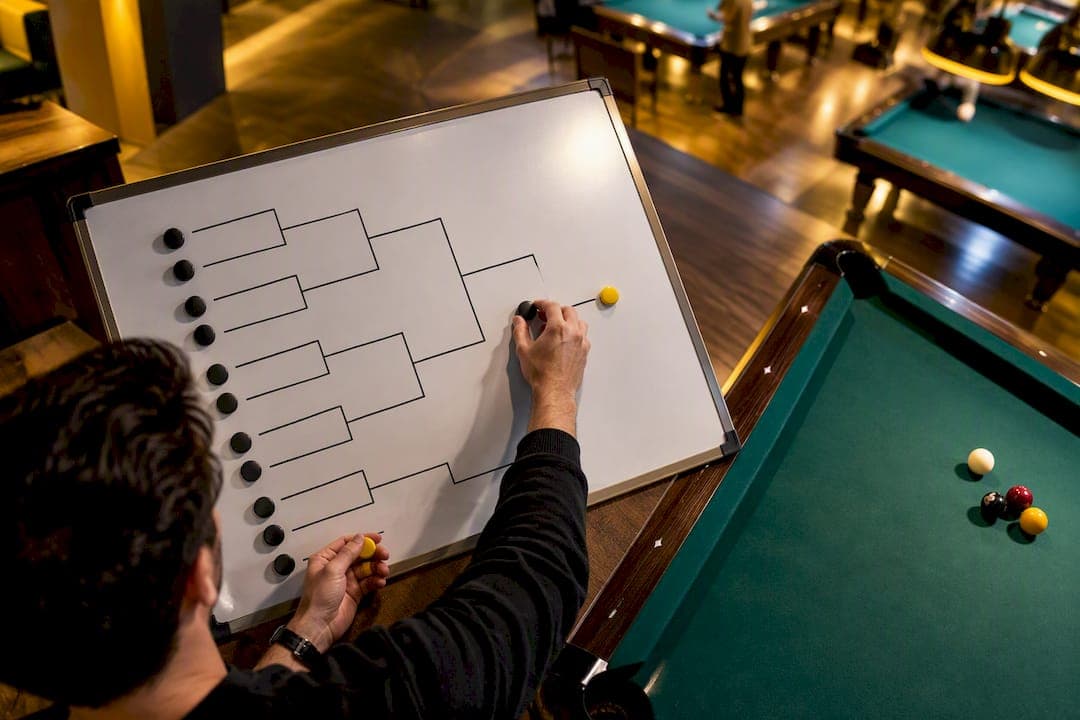
Tournament bracket seeding is the process of ranking players or teams before the draw so that the strongest competitors face the weakest ones early and stay apart until the later rounds. The standard method pairs the highest seed against the lowest, second-highest against second-lowest, and so on, which keeps the best matchups for the final rounds instead of the first. Get this right and your bracket runs itself. Get it wrong and you'll spend the whole night fielding complaints. This guide covers the methods, the layout math, byes, and the tools that make it simple.
TL;DR:
- Seeding should be based on current rankings, ratings, or committee judgment in competitive events, not random draws, to ensure fairness and defensibility.
- The mirror or fold pattern places the top seed against the lowest seed, guaranteeing the top two seeds cannot meet before the final, regardless of bracket size.
- Byes are assigned to the highest seeds when the number of players doesn't match a power of two, with their placement clearly posted to avoid confusion.
- Locking the bracket after seeding and prior to the event prevents disputes, while reseeding mid-tournament may offer fairness but complicates management.
- Publishing seeding criteria in advance and deciding on tiebreaker methods before the tournament are key to running a transparent, dispute-free bracket.
Table of Contents
- What Seeding Means and When to Use It
- How to Create the Seed List: Rankings, Ratings, Committee, or Random
- Where Seeds Sit on the Bracket: The Mirror-Fold Pattern
- How to Handle Byes When Your Field Isn't a Power of Two
- Locked Brackets, Reseeding, and Other Bracket Formats
- Tools and Templates That Make Seeding Easy
- The Organizer's Seeding Checklist
- What Weekly Pool Tournaments Teach You About Seeding
- Where This Guide's Information Comes From
- Fairness Matters, But So Does the Room You're Running
- Sources
- FAQ
What Seeding Means and When to Use It
Seeding exists to solve one problem: without it, your two best players could meet in round one, and one of them goes home in the first ten minutes. That's bad for the player, bad for the bracket, and bad for anyone who paid an entry fee expecting a full night of play. Ranking players before the draw and placing them so top seeds only meet in later rounds fixes that.
The practice traces back to lawn tennis in the late 1800s, when tournament organizers realized that random draws kept producing lopsided early rounds and boring finals. The idea stuck because it works everywhere: pool leagues, chess clubs, esports ladders.
Seeding isn't always the right call, though. Here's when it earns its keep:
- Competitive events with entry fees or prize money need seeding to protect the integrity of the results.
- Recurring leagues benefit because seeding rewards consistent performance over time.
- Casual or social nights often do better with a random draw. Nobody's ranking matters, and the unpredictability is part of the fun.
- Mixed-skill open events sometimes split the difference: seed the top eight, randomize the rest.
How to Create the Seed List: Rankings, Ratings, Committee, or Random
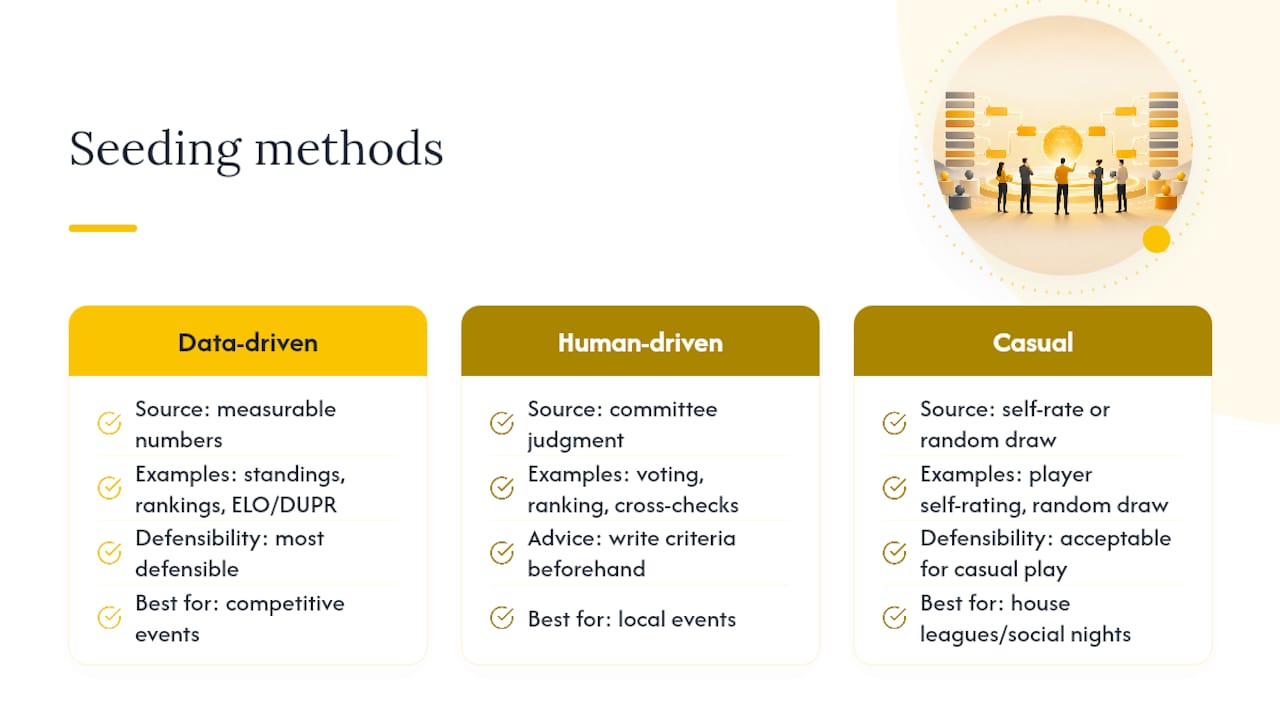
Picking a method matters more than most organizers realize, because the method you choose determines how defensible your bracket is when someone questions it. Common seeding methods fall into three buckets: data-driven, human-driven, and casual.
Data-driven options pull from something measurable: league standings from the current season, official rankings from a governing body, or rating systems like ELO or DUPR that update after every match. These are the most defensible because nobody can argue with a number that's been tracking performance for weeks or months.
Human-driven options rely on judgment. A committee reviews results and assigns seeds the way the NCAA selection committee does for its basketball tournament, through a process of voting, ranking, and cross-checking the list before it's finalized. If you go this route for a local event, write down your criteria beforehand and share it. That single step prevents most seeding disputes.
Casual options include self-rating (players estimate their own skill) or a straight random draw, which works fine for house leagues and one-off social nights.
Data point: competitive events do better with data-based seeding, while casual events hold up fine with random draws, according to PlayRez's generator documentation.
When two players tie, most leagues fall back on a fixed sequence: head-to-head record first, then points scored, then points allowed, then a coin flip as the last resort, a pattern documented in ESPN's explainer on standings tiebreakers. Decide your sequence before the season starts, not after a dispute.
Where Seeds Sit on the Bracket: The Mirror-Fold Pattern
Every standard bracket uses the same placement logic, called mirror or fold seeding. The formula is simple: Seed N faces Seed (Total + 1 minus N). In an 8-player bracket, that's 1 vs. 8, 2 vs. 7, 3 vs. 6, and 4 vs. 5.
Scale it to 16 players and the pattern holds:
- Seed 1 vs. Seed 16
- Seed 2 vs. Seed 15
- Seed 3 vs. Seed 14
- Seed 4 vs. Seed 13
- Seed 5 vs. Seed 12
- Seed 6 vs. Seed 11
- Seed 7 vs. Seed 10
- Seed 8 vs. Seed 9
That layout guarantees Seeds 1 and 2 can only meet in the final, and Seeds 1 through 4 can only meet in the semifinals, a structural rule confirmed by the Wikipedia entry on seeding in sports). The same math scales to 32, 64, or any power of two. It's the reason nearly every bracket generator on the market defaults to this exact placement.
How to Handle Byes When Your Field Isn't a Power of Two
Brackets need a number of slots that's a power of two: 8, 16, 32, 64. Real tournaments rarely show up with exactly that many players, so you round up to the nearest power of two and give the extra slots, called byes, to your top seeds.
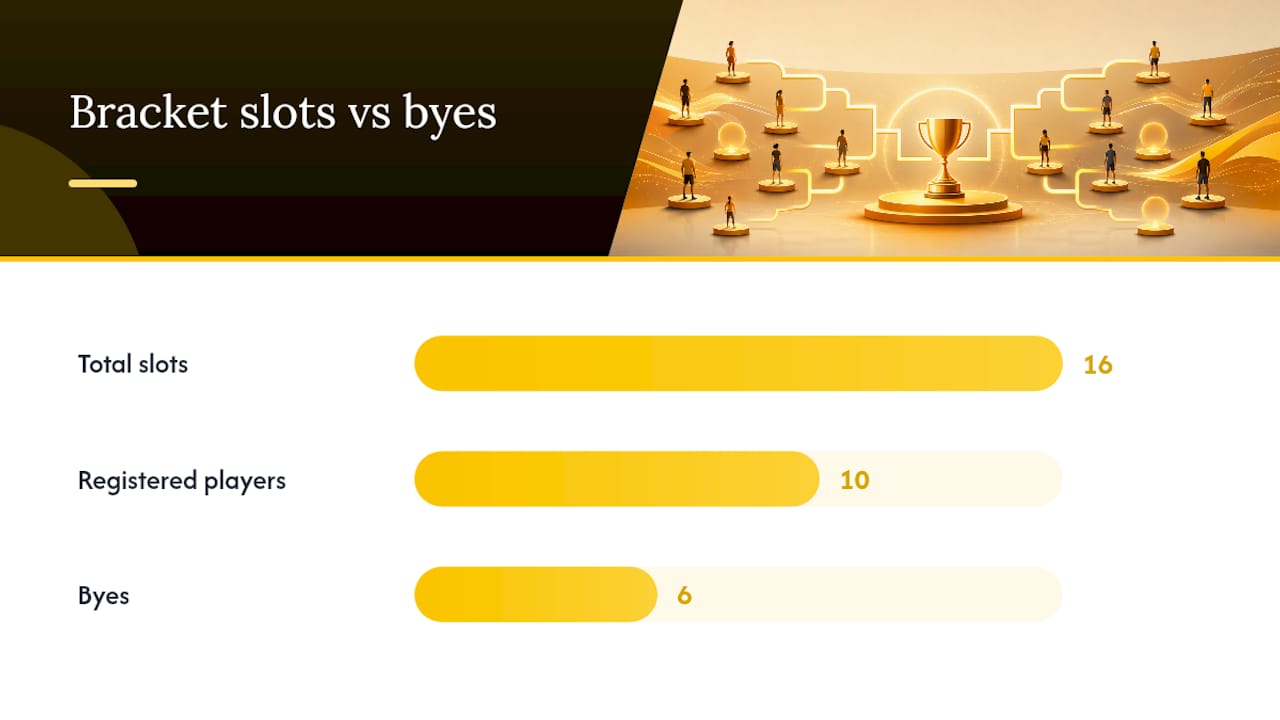
Say ten players register for a 16-slot bracket. That leaves six open slots, so the top six seeds each get a first-round bye straight into round two, a pattern laid out clearly by TournamentBracketMaker's seeding guide. Seeds 7 through 10 play it out in round one.
A few things to keep in mind when byes enter the picture:
- Byes always go to the highest seeds first, never randomly assigned.
- A player with a bye should still show up near their scheduled time. Confusion about "do I need to be here" is the number one bye-related complaint organizers hear.
- For larger fields with too many byes to feel fair, consider a play-in round or preliminary matches to shrink the gap before the main bracket starts.
Pro Tip: Post the bye list next to the bracket, not just inside it. Players scan for their name and often miss a small "BYE" label buried in a bracket line.
Locked Brackets, Reseeding, and Other Bracket Formats
Once your bracket is set, you have two choices for how it behaves as rounds progress: locked or reseeded.
A locked bracket keeps the original placement fixed from round one through the final. Nobody's position shifts based on how the bracket unfolds. This is what most single-elimination pool and snooker tournaments use because it's easy to print, easy to follow, and easy to explain to a room full of players waiting on their match.
Reseeding reshuffles the remaining field after each round so the highest remaining seed always plays the lowest remaining seed. Leagues that care deeply about preserving a top seed's advantage all the way through favor this method, but it comes at a cost: the bracket isn't fixed in advance, which confuses spectators and makes printed brackets useless.
- Locked brackets: simpler, fan-friendly, standard for most club events.
- Reseeding: fairer in theory, harder to manage live.
- Group stage or pot systems and Swiss pairings offer a middle path, useful when factors like geography or repeat-matchup avoidance matter alongside pure ranking.
Tools and Templates That Make Seeding Easy
You don't need custom software to run a clean seeded bracket. Online generators like Challonge handle auto-seeding by rank, calculate byes automatically, and export a printable PDF, which covers most of what a weekly tournament organizer needs.
Here's what to expect from a decent generator, and when a spreadsheet beats it:
- Auto-seeding by rank: you enter the seed order, the tool builds the mirror-fold matchups for you.
- Bye handling: most generators calculate and assign byes automatically once you input your player count.
- PDF or printable export: useful for posting a physical bracket at the venue.
- Spreadsheet method: if you'd rather build it yourself, list seeds in order down one column, then pair row 1 with the last row, row 2 with the second-to-last, and so on. It's the same mirror-fold math, just done by hand.
Printable seeded bracket templates work fine for quick weeknight events where you don't need live online scoring, just a clipboard and a marker.
The Organizer's Seeding Checklist
Running a clean, dispute-free bracket comes down to sequencing your decisions correctly, not to any single trick. Here's the order that works:
- Collect your seed inputs early and freeze them a day or two before the event. Standings, ratings, or committee decisions should be locked before anyone sees the bracket.
- Publish your seeding method in advance. Tell players whether you're using rankings, ratings, or a committee call, and post your tiebreaker sequence too.
- Generate and post the bracket. Once it's public, don't reseed unless your published rules explicitly allow it.
- Assign byes to the top seeds and set match times, making sure bye recipients still know when to show up.
- Communicate the dispute process before round one starts, not after someone's already upset.
Pro Tip: Finalize seeding before you generate the bracket, not after. Reseeding once a bracket has gone public is the single fastest way to make a fair process look rigged, even when it wasn't.
The most common pitfalls: changing seeds after players have seen the bracket, using stale results from three months ago instead of current standings, and running a tiebreaker scenario with no documented rule to fall back on.
What Weekly Pool Tournaments Teach You About Seeding
Running weekly cue sports events at Q Billiards Arena has taught us that seeding disputes almost always trace back to one thing: players didn't know the rule beforehand. For our recurring Tuesday and Friday night pool tournaments, we lock seeds based on recent results before the sign-in sheet even opens, and byes always go to the players who've shown up most consistently that month.
A few house rules worth borrowing for your own event:
- Post seeding criteria on a sign-in sheet or wall so nobody's guessing.
- Assign byes before the first match of the night, not mid-tournament.
- For formats beyond single elimination, our guides on double-elimination match math and round-robin scheduling walk through how seeding shifts between formats.
Where This Guide's Information Comes From
The NCAA's own breakdown of its selection and seeding process is the clearest public example of committee-style seeding at scale, worth a read if you're building a formal ranking process. The Wikipedia entry on seeding lays out the mirror-fold math cleanly, and TournamentBracketMaker's guide walks through bye assignment with real numbers.
Fairness Matters, But So Does the Room You're Running
Strict seeding math is the right default, but I'd rather bend a seed slightly to keep two friends from meeting in round one of a casual night than defend a technically perfect bracket to an empty room next week. What never bends: publishing your rules ahead of time. That's the one thing that keeps every seeding decision, strict or flexible, feeling fair.
— Q
Sources
- Building the brackets: A deep dive on the NCAA tournament selection and seeding process — NCAA
- How Bracket Seeding Works — TournamentBracketMaker
- Tournament Bracket Generator — Challonge
- Free Tournament Bracket Generator - PlayRez
FAQ
How Does Seeding Work in a Tournament Bracket?
Seeding ranks players or teams by skill or past results, then places them so the strongest competitors avoid each other until later rounds. The standard placement pairs the top seed against the bottom seed, following the mirror-fold pattern used in most bracket generators.
What Are the Seeds for the 2026 NCAA Tournament?
Specific team seedings change every year based on that season's committee rankings, so there's no fixed answer here. The NCAA's selection and seeding process explains how the committee votes, ranks, and finalizes the list each March.
How Do I Handle Byes if My Player Count Isn't a Power of Two?
Round your field up to the next power of two, then give the extra bracket slots to your highest seeds. With 10 players in a 16-slot draw, the top 6 seeds receive byes straight into round two.
Should I Reseed the Bracket After Each Round?
Most club and casual tournaments should keep a locked bracket because it's easier to print, post, and follow. Reseeding after every round preserves a slight competitive edge for top seeds, but it's harder to manage live and confuses anyone reading a posted bracket.
What Tiebreaker Should I Use When Seeds Are Equal?
A common sequence is head-to-head record first, then points scored, then points allowed, with a coin flip as the final fallback, a structure used across many league standings systems. Decide and publish your sequence before the season starts so nobody disputes it mid-event.