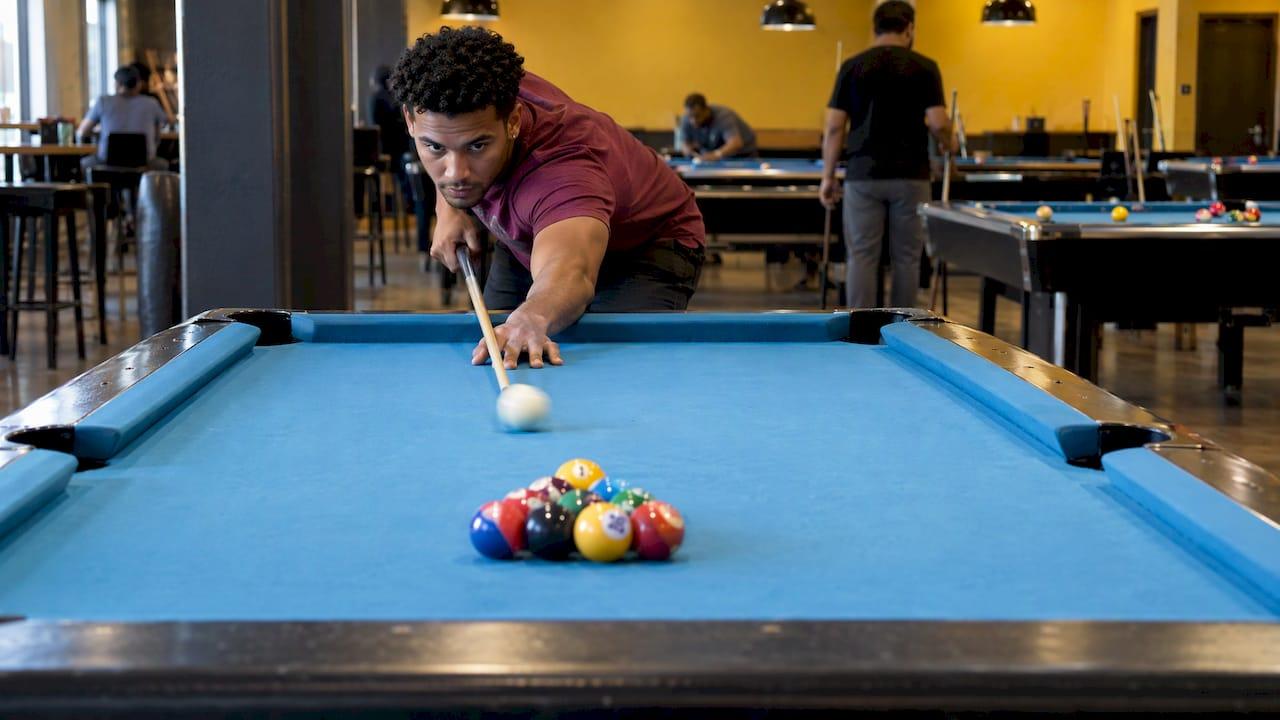
A good 9-ball break comes down to three things: a tight rack, a square hit on the 1 ball, and only as much speed as you can control. Do those three and a ball drops more often, the cue ball stops near the center of the table, and you get a playable 1 ball. Swinging harder rarely helps. At Q Billiards Arena in Houston we have 25 professional-grade tables, so players can rehearse this break until it repeats.
TL;DR
- Rack tight: the balls should touch, with the 1 at the head of the diamond and the 9 in the middle on the foot spot.
- Hit the 1 ball square, with the cue ball struck at its center. Most of your break's power comes from accuracy.
- Use controlled speed. Pros measure a break by whether a ball dropped, whether the cue ball parked near center and whether the 1 is playable.
- Know the legal-break rule in your format: usually four balls to a rail or a ball pocketed, and some formats require three balls across the head string.
- If the rack is loose or the break fails, change your position or speed instead of swinging harder.
Table of Contents
- What a good 9-ball break actually is
- Start with the rack
- Where to put the cue ball
- How to hit the 1 ball
- How hard should you break?
- Park the cue ball, then play the 1
- Golden breaks and what happens if the 9 drops
- What counts as a legal break
- When the break goes wrong
- Build a break you can repeat
- Practice your break at Q Billiards Arena
- Our view on the break
- FAQ
- Sources
What a good 9-ball break actually is
Most players treat the break as a power contest. Strong players treat it as a repeatable system. Corey Bernstein, writing about the 256-player Florida Open, describes three outcomes pros track: did a ball drop, did the cue ball park near the center of the table, and is the 1 ball playable. Raw speed ranks a distant fourth.
That changes how you practice. A break that pockets nothing but leaves the cue ball in the middle with a clear 1 ball is a good break. A thunderous break that scatters the balls and leaves you hooked behind the 9 is a bad one. Judge each break on those three outcomes and your decisions get simpler.
One caution before the details. Rules differ by league and format, so the legal-break section below matters as much as technique. A break that is fast but illegal gives your opponent the table.
Start with the rack
The best break in the world is wasted on a loose rack. Under the WPA Rules of Play, the balls are racked as tightly as possible in a diamond, with the 1 ball at the apex toward the head of the table and the 9 in the middle of the diamond on the foot spot. The other balls go in without any purposeful pattern. The APA's league rules say the same and add that the breaker can ask for the lowest available nine balls to be used.
Check for gaps before you shoot
A frozen rack passes the energy of the cue ball straight through the diamond toward the pockets. A loose rack absorbs the hit. A simple check is to roll the rack forward slightly and look for daylight between the balls, especially between the 1 and the two balls behind it. Dr. Dave Alciatore advises inspecting the rack for gaps and asking for a re-rack if there are any. If gaps are unavoidable, he suggests adjusting your break to take advantage of them.

Do not manipulate the balls to create gaps or a favorable pattern. Dr. Dave notes that this is considered illegal and unethical in tournament play, and in a league match it is the quickest way to start an argument.
Where the other balls go
The rules say the other balls are unpatterned, but many strong players still follow a habit. The APA's Lesson 1 describes the professional racking order when breaking from the right side: the 1 toward the side pocket or above, the 2 down toward the foot rail, the 3 up toward the head rail, the 4 down and the 5 up. Breaking from the left swaps the 2 and 3 with the 4 and 5. Treat this as a tendency to test, not a guarantee. For a step-by-step walk through the rack itself, see our guide to racking 9 ball right.
Where to put the cue ball
You have two common choices, and both are legal as long as the cue ball starts in hand behind the head string.
From the side, near the rail. The APA lesson notes that most pros like to break from the side rail at the line because it frequently makes the corner ball. The same lesson adds a warning: it only works if you hit the rack square. The author himself breaks closer to center because he is more accurate there, and he still makes the corner ball just as often. Accuracy beats the "correct" spot.
Slightly off center. Bernstein's 2026 guide suggests starting one to three inches from the center of the break line. That lets you hit the 1 ball just barely off full and sends the cue ball toward the middle of the table, while full-center hits tend to send the cue ball forward into the pack or straight back.
When the rack is tight and the 9 is on the spot. Dr. Dave recommends breaking from the side with the cue ball close to the long rail and hitting the 1 ball square, aiming to pocket the wing ball.
A practical way to choose: try three positions (rail, a few inches off center, and center) for ten racks each and note where the cue ball stops and how often a ball drops. Keep the one that gives the best mix, not the one that sounds most professional.
How to hit the 1 ball
Alciatore's 2016 article, How to Break Like a Pro, calls an accurate, square hit on the lead ball the most important factor for a good break. If the cue ball hits at an angle, it risks jumping off the table and does not deliver its full energy to the rack.
Johnny Archer made the same point with a golf comparison in Billiards Digest: a dead-center hit at lower speed travels as far as an off-center hit at higher speed, so a centered hit on the 1 ball needs less force to get the action.
Cue ball contact and stroke
Bernstein's guide recommends aiming at the center of the cue ball, at its equator. Vertical spin on the break is wasted energy and makes the cue ball harder to control. His other mechanical points:
- Stand slightly higher than you do for a normal shot.
- Take a longer backswing than you think you need.
- Accelerate through the cue ball, not at it.
- Keep a loose grip at contact.
Dr. Dave's break technique advice agrees on the fundamentals: a longer bridge length and stroke for more powerful shots, a stable bridge hand during the forward stroke, a relaxed grip hand, a level cue and a straight follow-through.
The cut break
Some pros use a cut break when the 9 is racked on the foot spot. Darren Appleton describes hitting the 1 slightly less than full, aiming at about 4 o'clock on the cue ball when breaking from the right side (8 o'clock from the left), and moving to 5 or 7 o'clock when the cloth and balls are older to add draw. With a tight, untouched rack, Dr. Dave explains, a cut break can send the cue ball off the side rail into the 9, which may go into any of four pockets. It is an advanced shot. Learn the square break first.
How hard should you break?
The APA's Lesson 1 gives a practical starting point: take about 50 percent of your power off at first, focus on a square hit so the cue ball stops near the table center, and add power gradually while keeping accuracy. Alciatore's rule of thumb is to use only as much power as you can control.
Charlie Williams, quoted in the same 2007 Billiards Digest issue, says experienced players break with 70 to 80 percent of their power, taking about 30 percent off maximum to control the cue ball. He adds that if you feel you need more than 70 percent, you are better off changing your position on the table.
A power ladder you can use tonight
Williams also describes a drill. Start by hitting the head ball full with a medium-speed stop shot. Then add roughly 10 percent more power on each repetition until you are at maximum power, but only keep going while you still hit the head ball accurately. The moment accuracy slips, drop back one step. That is your current break speed.

The table is where this pays off. Rack the same way every time, break, and note three things: balls pocketed, where the cue ball finished, and whether you had a shot at the 1. If you want to tighten the control side of the stroke, our speed control drills and cue ball control drills fit well into the same session.
Park the cue ball, then play the 1
Dr. Dave's goal on the break is to "squat the rock": park the cue ball near the center of the table after pocketing a ball. From the center you have the most options for the 1 ball. When the cue ball runs the length of the table or ends up on a rail, you often must play safe or take a hard shot.
If your cue ball keeps ending up in the wrong place, adjust one variable at a time:
- Cue ball flies forward into the pack or back down the table: you are probably hitting too close to full center. Move a few inches off center.
- Cue ball goes to a rail: reduce speed and check that your cue tip is at the equator.
- Wing ball never drops: check the squareness of the hit before you check your speed.
- Ball drops but you scratch: you are probably breaking too hard for your accuracy. Use the power ladder above.
Golden breaks and what happens if the 9 drops
A golden break is pocketing the 9 on the break. It is mostly luck at the amateur level, but your technique affects how often the cut-break scenario comes up. The consequences are set by the rules you play under:
- APA rules: if the 9 is pocketed on the break, it is a win unless the player scratches. On a scratch, the 9 is spotted and the turn passes to the opponent. If any ball is pocketed on the break, it is still the breaker's turn.
- VNEA rules: making the 9 on the break is an automatic win for the breaker, but if the cue ball is scratched, the 9 is respotted.
Always confirm the rule with your league captain or tournament director before play starts, especially for a bar-box league night.
What counts as a legal break
Under the WPA rules, the cue ball begins in hand above the head string. If no ball is pocketed, at least four object balls must be driven to one or more rails, or the break is a foul. The WPA also applies a three-ball break rule: if no ball is pocketed, three balls must cross the head string, or it is an illegal break. A summary of the WPA nine-ball rules adds that the lag winner chooses who breaks the first rack and that the usual format alternates the break.
The push-out matters right after your break. The APA notes that push-outs are fairly standard in pro events and the U.S. Amateur Championship, but are not allowed in APA handicapped competition. Masters Divisions follow U.S. Amateur Championship rules, so the push-out is allowed there and any balls pocketed on a push-out are spotted. If you pocket a ball but leave a hard 1, a push-out from your opponent is a real possibility in some formats, so leave a manageable shot.
When the break goes wrong
Thorsten Hohmann, quoted in Billiards Digest, argues that the only good break is one that sinks a ball, and that some players refuse to soft break out of stubbornness when they should be trying to win. Be ready to change cue ball position, speed or even use a less-than-full hit on the head ball.
If the rack is tilted, has gaps on one side, or is solid except for the back ball, Dr. Dave recommends breaking from the box with a square hit to pocket the wing ball and get shape on the 1.
If you are not pocketing balls, run this checklist in order:
- Is the rack frozen? Ask for a re-rack if not.
- Is the hit square on the 1? Mark the cue ball's departure line if you need to.
- Is the cue ball struck at the center?
- Are you swinging past the speed at which you stay accurate?
- Does a different spot on the break line give a better result?
Build a break you can repeat
Hohmann's practice advice is simple: always rack in the same order, track where each ball went, make a chart, record the results and switch positions or speed every 25 racks. Over a few sessions you learn which setup pockets a ball most often on a given table.
That last point is why practicing on the same table type matters. Cloth speed, rack quality and pocket size all change the result, and the cue ball behaves differently on older cloth, as Appleton's draw adjustment shows. Q Billiards Arena runs American pool at $10 per hour, and our tables are professional grade, so you can put in 25-rack blocks and chart them.
Practice your break at Q Billiards Arena
If you want to turn this into a routine, book a table and work through the power ladder and the 25-rack chart. American pool is $10 per hour at our Houston club, and our hours run late, until 2 to 4 AM, so you can practice after work. When you are ready to test the break under pressure, our Tuesday and Friday night pool tournaments are $10 to enter. See our games and hourly rates or the tournament schedule.

Food and drinks are on the menu while you play, so a long practice block does not have to be a hungry one. Check the menu before you come.
Our view on the break
At Q we think the 9-ball break is the most misunderstood shot in pool. Players come to the table believing it is about speed, and the research from coaches and pros says the real work is a tight rack, a square hit and a cue ball that stops where you can use it.
That is why we built a room around repetition. With 25 professional-grade tables, American pool at $10 per hour and late hours, you can rack, break, chart the result and repeat without watching the clock. The weekly tournaments then give you the pressure that practice alone cannot.
Our advice: pick one break, hit 25 racks with it, and let the chart tell you what to change. Then come test it in a Tuesday or Friday night event.
Q
FAQ
What is the best spot to break from in 9-ball?
Many pros break from the side rail because it often pockets the wing ball, but the APA lesson stresses that it only works if you hit the rack square. Bernstein suggests starting one to three inches off center. Test a few spots and keep the one where your hit is most accurate.
How hard should I break in 9-ball?
The APA suggests starting with about 50 percent less power and adding it gradually while keeping a square hit. Charlie Williams says experienced players use 70 to 80 percent of their power. Use the most speed at which you still hit the 1 ball square.
Do I have to pocket a ball on the break?
Not always. Under WPA rules, if no ball is pocketed, at least four object balls must reach a rail, and three must cross the head string. Otherwise the break is a foul or illegal. Check your league's rules, because formats differ.
What happens if I make the 9 ball on the break?
In APA and VNEA play, it is a win for the breaker unless the cue ball is scratched. On a scratch, the 9 is spotted or respotted and the opponent shoots next.
Should I ask for a re-rack?
Yes, if you see gaps between balls. A tight rack is what makes the break work, and Dr. Dave recommends asking for a re-rack when there are gaps.
Sources
- WPA Rules of Play (2025)
- Racking, Pool Rules for APA League Play
- Lesson 1: Breaking and the Rack, APA
- After The Break, Pool Rules for APA League Play
- VNEA 9-Ball Official Rules of Play (2022)
- Pool billiards rules, Nine ball
- How to Rack and Break 9-ball Like a Pro, Billiards Digest (2018)
- How to Break Like a Pro, Billiards Digest (2016)
- Break Technique Advice, Dr. Dave Pool Info
- Billiards Digest, August 2007
- Perfect Practice with Darren Appleton, Billiards Digest
- Florida Open 2026: Lessons From the 256 Player Field