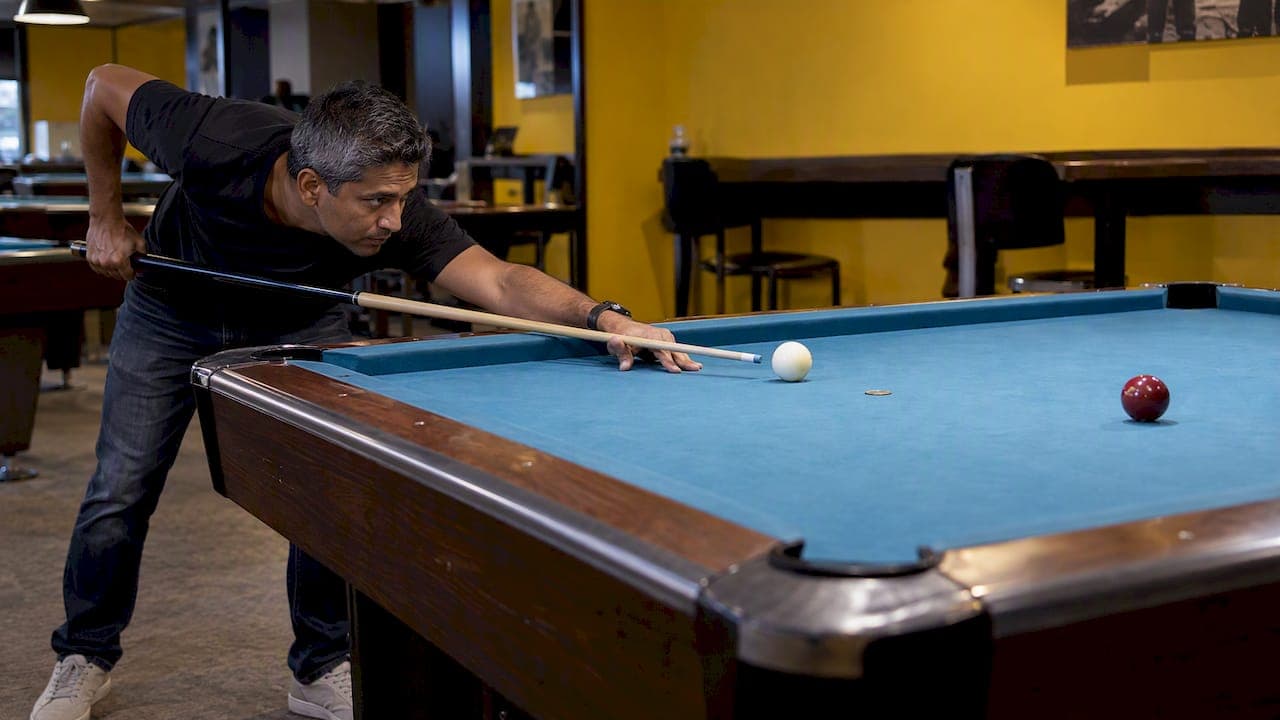
Speed control drills for pool train one skill: sending the cue ball the right distance, shot after shot, so the next ball is easy. The seven drills below start with simple distance work and build to pocketing a ball while landing the cue ball in a target zone. Each one is scored, so you can see whether you are improving or just hitting balls.
TL;DR
- Speed control means the cue ball travels the right distance, not that you hit softly or hard. Most of the shots you face need slow and medium speeds.
- Vary your stroke length with the speed you want, and accelerate smoothly through the cue ball instead of decelerating into it.
- Practice pocketing balls while hitting a target. Hitting the cue ball up and down the table only trains part of the skill.
- Score every drill and repeat it. Progress comes from tracked repetition, not from one good session.
- Run the 45-minute plan below once or twice a week and add one new drill at a time.
Table of Contents
- What speed control actually is
- The stroke habits that make every drill work
- Seven speed control drills
- A 45-minute practice plan
- Common mistakes and how to fix them
- Adapting the drills to your level and table
- Perspective: what we see on the tables
- Where to practice in Houston
- FAQ
- Sources
What speed control actually is
Speed control is sending the cue ball the right distance so the next ball is easy to pocket. That is the whole definition, and it explains why it matters. Pocketing the object ball is only half the shot. The other half is where the cue ball stops.
When speed control fails, you see the same problems again and again: an awkward angle on the next ball, a cue ball stranded far from the next target, or a cue ball stuck behind another ball. Players often blame "bad luck" for these. Usually the shot was fine and the speed was off by a foot or two.
Speed is also not the same as force. Think of it as a distance. Dr. Cue's lesson suggests defining speed in terms of table lengths, and says slow and medium speeds make up roughly 70% of the shots you need in a game. That is why the drills below spend most of their time below hard-hit speeds. Break shots and long power draws can wait.
The stroke habits that make every drill work
Drills only help if your stroke is repeatable. Three habits matter most.
Match stroke length to speed. Dr. Dave Alciatore's core principle is to vary the length of your stroke in proportion to the speed you need, with smooth acceleration that never feels rushed. Short backswing for a soft shot, longer backswing for a firmer one. Keep your tempo steady and let the length do the work. If you change both length and tempo at once, you cannot repeat the result.
Finish the stroke. The most common speed error is decelerating into the cue ball, which also hurts accuracy. The fix is to accelerate smoothly through the ball. On soft shots this feels strange, because you are trying to be gentle. Stay gentle, but still follow through.
Hit the same spot on the ball. For rolling-ball shots, Alciatore recommends striking the cue ball about 20% of its radius above center for consistent speed and distance. In practice that is a small amount of follow, just above the middle. Pick a tip position you can hit accurately and keep it constant while you learn distance. Add draw and follow once your neutral roll is predictable.
If you want a fuller routine on position play, our guide to five drills that fix position play pairs well with this one.
Seven speed control drills
Start at the top and move down only when the earlier drill feels dull. Each drill has a way to score it. Write the scores down, on paper or in your phone.
1. The one-rail lag ladder
This is the simplest distance drill. Place the cue ball on the head string, shoot to the far rail and let it return. Aim to stop it at set points: the head string, the center spot, the foot string, then the far rail.
- Shoot three attempts at each target.
- Score 2 points if the ball stops within one ball width of the target, 1 point within a diamond-length, 0 otherwise.
- Maximum score for four targets and three attempts each: 24.
Note what this drill does and does not teach. Dr. Dave points out that hitting the cue ball up and down the table is good for judging speed on long shots like lags and kicks but is not enough for the speed control you need when pocketing balls. Use it as a warm-up, then move on.
2. Three identical strokes
Set the cue ball and shoot it the same distance three times in a row, with the same stroke length and the same tempo. Then see how close the three stopping points are.
The goal is not a particular distance. It is repeatability. If three "identical" strokes give you three different results, your stroke is changing, and no amount of feel will fix that. Slow down, shorten your backswing, and check that your grip pressure and tempo match each time.
Run it at three speeds: soft (about a table length), medium (about two), and firm (about three). Score by measuring the spread between the closest and farthest of the three stops. Smaller spread means better control.
3. Stop-shot target square
Place the cue ball and an object ball about a foot and a half apart, straight in line with a corner pocket. Shoot a stop shot, then a slow roll, then a medium roll. Place a coin or a small piece of paper where you want the cue ball to finish each time.
This drill ties the stroke to pocketing. Because the object ball must go in, you cannot ignore accuracy to hit your speed. Score 1 point for pocketing the ball and 1 more if the cue ball stops within a ball width of the marker.
4. The distance-after-contact drill
This is the pocketing version of the target practice that Dr. Dave recommends. Target drills are very helpful for developing cue-ball speed and position control. Here is a simple setup you can build in a minute:
- Place an object ball a foot or so from a side pocket, with a cut angle of about 20 degrees.
- Mark a target circle, roughly the size of a drink coaster, for the cue ball to land in after contact.
- Shoot ten times. Score 1 point for each shot that pockets the ball and leaves the cue ball inside the circle.
- Move the target farther away, then closer, and repeat.
To make it harder, change the cut angle. Cue-ball speed behaves differently on thin cuts than on near-straight shots, and your position results will reflect that. This is the reason to practice over a range of angles rather than a single favorite shot.
5. Slow-speed progression
Slow speeds are where most games are won, so train them on purpose. Place the cue ball on the head string and an object ball in a position that gives you a simple shot. Begin at a very slow speed and stroke the cue ball so it stops close to a marked position. Repeat until you succeed twice in a row, then raise the speed a notch. A published version of this progression uses a small tolerance around the marked position and asks for two successes in a row before moving on, which is a good way to avoid advancing on a lucky shot.

Keep the tolerance tight at first and loosen it only if you are stuck. A target a few inches wide teaches more than one the size of a dinner plate.
6. Follow and draw matrix
Once neutral roll is reliable, add tip position. Dr. Dave's site offers scoring sheets for follow and draw matrix drills from Bob Jewett, which ask you to pocket a ball and land the cue ball in marked zones with each type of shot. If you do not want to print a sheet, a homemade version works: choose a target zone, shoot five follow shots and five draw shots, and score how many land inside.
Expect your draw results to be wider than your follow results. That is normal. The point is to find the gap and shrink it.
7. Three-ball position run
This is the drill that tests whether the others carried over. Place three object balls in a loose pattern, cue ball in hand. Pocket each in order, with the cue ball landing in a good zone for the next shot. Count how many full runs you complete out of ten. Dr. Dave also points to the Billiard University exam drills, F2 to F5 and F8 in Exam I and S5 in Exam II, as strong tests with many shot types, along with scored speed-control drills in his Video Encyclopedia of Pool Practice.
If you play snooker, the same logic applies at a bigger scale. Our 90 minute snooker practice plan builds break-making from the same distance-control foundation.
A 45-minute practice plan
Here is how the drills fit into one session.
| Minutes | Drill | Goal |
|---|---|---|
| 0 to 5 | One-rail lag ladder | Warm up your feel for table speed |
| 5 to 15 | Three identical strokes at three speeds | Check stroke repeatability |
| 15 to 30 | Distance-after-contact drill, two cut angles | Pocket and position together |
| 30 to 40 | Slow-speed progression | Own the soft shots |
| 40 to 45 | Three-ball position run, ten attempts | Test the whole skill |
Write down your scores in the same order each time. After three or four sessions, look back. A rising score in the distance-after-contact drill is the clearest sign your speed control is transferring to real games.
Common mistakes and how to fix them
Decelerating into the ball. You aim for a soft shot and let the cue stick slow down before contact. The result is a cue ball that dies short and a shot that misses on the thin side. Keep accelerating through contact, and shorten the backswing to keep the speed low.
Using power instead of roll. One practical guide warns that relying on excessive speed buys distance at the expense of control, and recommends a relaxed stroke that builds the ball's roll. If your cue ball keeps running too far, try a longer, smoother stroke at lower speed and see if it settles.
Changing too many things at once. If you change tip position, stroke length and tempo between shots, you cannot learn from the result. Change one variable at a time.
Practicing only your favorite shot. Straight-in shots are comfortable and teach little. Rotate cut angles and distances, and put the target in different places.
Never keeping score. Without numbers, a good day and a lucky day look the same. Even a rough tally helps.
There is no shortcut here. Dr. Dave puts it plainly: the only real recipe for speed-control success is extensive practice to develop a feel for it. The drills above make that practice efficient.

Adapting the drills to your level and table
Beginners. Do drills 1, 2 and 3 for the first few weeks. Use big targets and focus on a smooth stroke. Do not worry about draw yet.
Intermediate players. Add drills 4 and 5 and track scores weekly. Start varying cut angles and distances. Pay attention to which angles make your cue ball run long.
Advanced players. Use drills 6 and 7 as the core, shrink the targets, and set a pass mark you must hit before moving on.
Table conditions. Cloth speed changes how far the ball travels. A new, fast cloth or a clean table rolls farther than a worn one, and humidity and ball condition play a part too. Spend your first few shots calibrating with the lag ladder, then adjust. This matters at a new venue or when you move between table types. On a snooker table, the larger bed and heated-table conditions change distances again, so recalibrate rather than trusting your usual feel.
Perspective: what we see on the tables
At Q Billiards Arena we have 25 professional-grade tables and a mix of players: casual groups, league regulars and tournament competitors. The same pattern shows up across all of them. People who miss position usually are not failing at aim. They are hitting too hard because it feels safer, then compensating with a rushed stroke.
Our advice is to practice slower than feels natural. Pick one drill, keep score, and come back to it the next week. When you play across several games in one session, you also learn how distance differs between American pool, Chinese 9-ball, carom and snooker tables, which sharpens your sense of speed faster than staying on one table. Speed control is a feel skill, and feel grows from repetition on varied tables with honest scoring.
And if you want to keep going after your drills, play a few frames. Drills build the skill, but real games show you where it breaks.
— Q
Where to practice in Houston
Practice time is cheaper than most people expect. At Q Billiards Arena, American pool tables are $10 per hour, standard snooker, Chinese 9-ball and carom billiards are $15 per hour, and heated snooker is $20 per hour. We keep late hours, up to 2 to 4 AM, so you can fit a drill session after work, and there is a food and drink menu when you want a break between sets.
When you are ready to test your speed under pressure, our weekly events are a good next step. The Tuesday and Friday night pool tournaments are $10 each to enter, and the 1-Red Snooker tournament is $20. Check the pages for the current schedule.
Position play also depends on knowing the rules around the cue ball. Our guide to cue ball fouls and ball in hand covers what happens when your speed goes wrong, and the one on side spin drills is the natural next step once your neutral speed is dependable.
FAQ
How long does it take to improve speed control?
Most players notice better consistency within a few weeks of scored practice, but the feel keeps developing for years. Short sessions two or three times a week beat one long session. Track your scores so you can see the trend rather than guessing.
Should I practice speed control with or without pocketing balls?
Do both, but spend more time pocketing balls. Hitting the cue ball up and down the table builds a feel for long distances, while pocketing drills train the speed you use in real shots over many cut angles.
What is the best distance to leave the cue ball from the next shot?
There is no single answer, because it depends on the shot and the angle you want. One beginner reference suggests that a gap of one to two feet between the cue ball and the next object ball is a useful target for many shots. Treat it as a starting point and adjust to the pattern.
Do I need to hit the cue ball softly to get good speed control?
No. Speed control means sending the ball the right distance, whether that is soft, medium or firm. Slow and medium speeds are used most often, so train them first, but keep the stroke smooth at every speed.
How many drills should I do in one session?
Three or four is plenty. Pick one warm-up, one pocketing drill, and one test drill. Adding a new one each week keeps practice fresh without losing the scores you are tracking.
Sources
- Speed Control, Illustrated Principles, Dr. Dave Alciatore (2020)
- Speed Control Drills, Dr. Dave Pool Info
- Dr. Cue Lesson 12: Speed Defined with Controlled Practice
- Speed control practice drill, Dr. Dave Pool Info
- Illustrated Principles, Dr. Dave Alciatore (2009)
- Control the Cue Ball e-book
- Speed Control, Basic Billiards