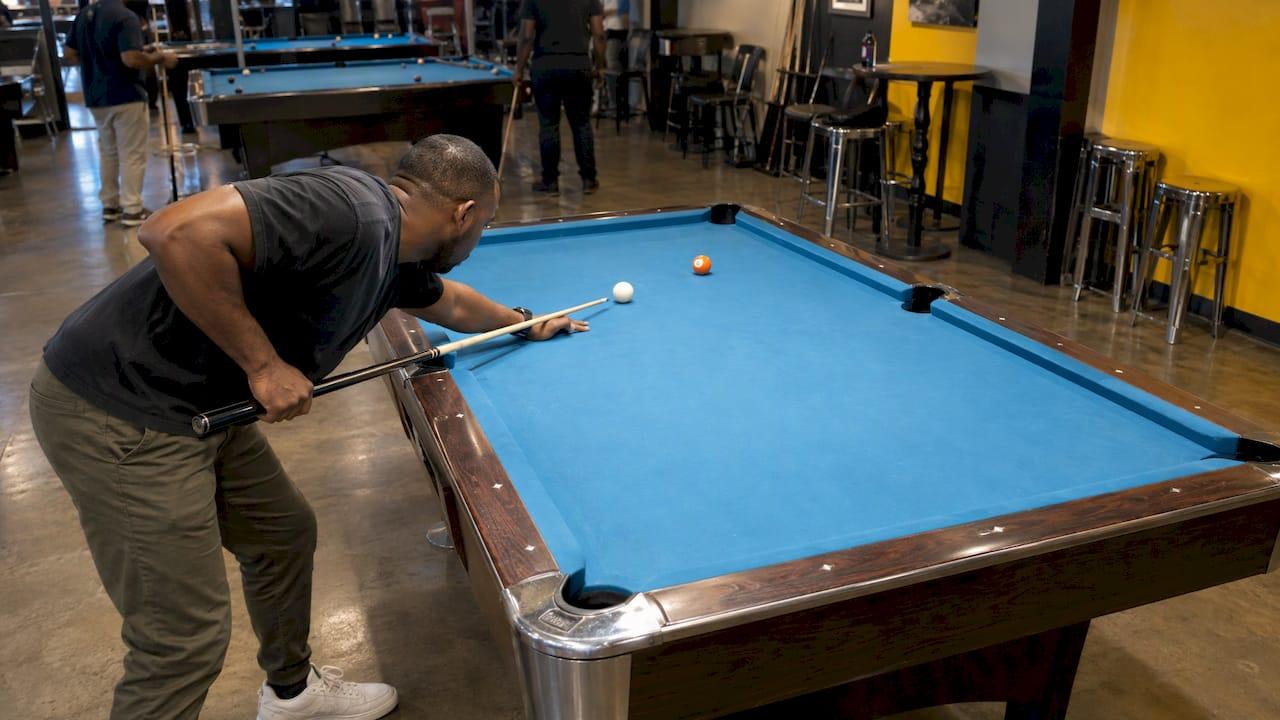
An aiming system is a repeatable way to turn the picture you see over the table into the line your cue must travel. The most useful one to learn first is the ghost ball method, because it shows you what you are actually trying to do: send the cue ball to the spot where it will touch the object ball at the right angle. Contact-point, fractional and pivot systems are shortcuts built on the same idea. Below, we explain each one, show where it works and where it breaks down, and give you drills you can run on a real table, such as the ones on our floor at Q Billiards Arena in Houston.
TL;DR
- Ghost ball: imagine a cue ball touching the object ball on the line to the pocket, then send your real cue ball to the center of that imaginary ball.
- Contact point: pick the one spot on the object ball that faces away from the pocket, and aim so the cue ball arrives there. It uses the same math as ghost ball with one dot instead of a whole ball.
- Fractional aiming: memorize three cut angles, ¾ ball (about 14.5°), ½ ball (30°) and ¼ ball (about 48.6°), and adjust between them.
- No system replaces a straight stroke, a steady routine and lots of practice. Pick one, drill it, and add a second for shots where the first struggles.
Table of Contents
- What a pool aiming system actually does
- The three families of aiming methods
- The ghost ball method, step by step
- Contact point aiming: the same math, one dot
- Fractional aiming: cut angles you can memorize
- Pivot systems such as CTE
- How to choose: a simple pairing
- Fix your aim before you change your system
- Putting it into practice at the table
- Room to practice in Houston
- Our view: pick one picture and own it
- FAQ
- Sources
What a pool aiming system actually does
Every cut shot has two parts. First you decide where the cue ball must go, and then you deliver it there. Dr. Dave Alciatore, the engineering professor behind the well-known Dr. Dave pool site, defines aiming as finding the cue line that sends the cue ball to the ghost-ball position, which cuts the object ball the required amount. He treats alignment (how your body and head sit) and sighting (where your eyes focus) as separate skills.
That split matters. An aiming system only answers the first question: where should the cue point? It cannot fix a wobbly stroke or a head that pops up at contact. His own FAQ puts it plainly: good shooting needs precise alignment, consistent sighting, a consistent stroke and, above all, practice. It adds that there are no quick fixes, though systems can help some players.
So think of a system as a map. It gives you a repeatable starting point, so the same shot looks and feels the same each time you meet it.
The three families of aiming methods
Most systems fall into three groups:
- Contact-point systems (ghost ball, parallel lines, double the distance). You find where the balls must touch, then work back to the cue line.
- Fractional systems. You reduce every shot to a set of standard overlaps between the cue ball and object ball.
- Pivoting systems. You line the cue up on a reference point, then shift or pivot it to the final line.
You will hear many brand names, but they all land in one of these buckets. Knowing the family tells you what the method asks of your eyes and hands.
The ghost ball method, step by step
Ghost ball is the starting point for most players. It is also what most people mean when they search for ghost ball aiming. Here is how it works.
- Find the line to the pocket. Picture a line from the center of the pocket through the center of the object ball and out the back of it.
- Place the ghost. Imagine a second ball, the same size as the cue ball, pressed against the object ball on that line, on the side away from the pocket. This is the ghost ball.
- Aim at the ghost's center. Your real cue ball must arrive exactly where the ghost sits. Sight along the line from the cue ball's center to the ghost's center.
- Get down on that line. Keep your eyes and cue on it, and deliver a smooth stroke.
Dr. Dave's October 2008 column describes the same sequence: sight the object ball and target to find the contact point and impact line, then sight the cue ball and the center of the ghost ball along the aiming line. The cue ball's aiming line does not pass through the contact point on the object ball.
The classic beginner error
The most common mistake is aiming the center of the cue ball at the contact point on the object ball. According to the same column, that sends the cue ball to the wrong spot, produces too small a cut and leaves the object ball hit too full. The cue ball's center must go to the ghost's center. The contact point is where the balls touch, not where you aim.
A pool ball is 2.25 inches across, so the contact point sits one ball radius, 1.125 inches, from the center of the ghost. That is a handy reminder that the ghost is simply one ball width behind the contact spot.
Where ghost ball struggles
The ghost is invisible, so your brain has to build it. That gets harder on long shots and thin cuts, where small errors in depth perception move the ghost by an inch or two. It also ignores throw, the slight sideways push friction gives the object ball at contact. Dr. Dave's June 2011 column notes that players must compensate for cut-induced throw, which is greatest on slow stun shots near a 30° cut, and for squirt, swerve and spin-induced throw when using English.
In practice, use ghost ball as your base for short and medium shots, and nudge your aim for spin and speed as your experience grows.
Contact point aiming: the same math, one dot
Contact-point aiming asks a simpler question: where on the object ball must the cue ball touch? Dr. Dave's May 2026 article on aim visualization describes it this way. Draw a line from the pocket center through the object ball. The spot where that line leaves the ball is the contact point, the spot farthest from the pocket. Then send the cue ball to the place that creates that contact. You never aim at the dot itself.
Two useful variations come from the same article:
- Parallel lines. Find the contact point on the object ball and the matching contact point on the cue ball, join them with an imaginary line, then shift that line sideways until it passes through the cue ball's center. That shifted line is your aim line.
- Double the distance. Measure the gap from the object ball's center to the contact point, then aim the same distance on the other side of the contact point. For thinner cuts, you double the smaller distance from the contact point to the object ball's outside edge instead. This is a good tool for thin cuts.
He also points out that the contact point should always sit in the middle of the overlap lens, the lens-shaped area where the two balls appear to overlap from your standing view. That overlap picture should look the same all the way down into your stance. If it changes when you get down, your alignment has shifted.
Contact-point aiming is quick once you know it. Many advanced players use it even when they describe their method as ghost ball, because with enough table time the brain can see the dot directly.
Fractional aiming: cut angles you can memorize
Fractional systems shrink a thousand possible cuts into a few standard ones. You judge how much of the object ball the cue ball will cover, then aim for that overlap. Dr. Dave's June 2011 column gives the standard references:
| Overlap | Name | Cut angle |
|---|---|---|
| 75% | ¾-ball hit | about 14.5° |
| 50% | ½-ball hit | 30° |
| 25% | ¼-ball hit | about 48.6° |
Those figures come from the same June 2011 article, which shows quarter-division markings on the balls. A full-ball hit is a straight shot, 0°. The half-ball hit is the anchor most players learn first.
A popular version is sometimes called the three-angle system, which claims that three aims of about 15°, 30° and 45° cover all cuts. Dr. Dave's fractional aiming FAQ shows those equal ¾-, ½- and ¼-ball hits, with the 15° and 45° aims not exact. For cuts between the references, you adjust by feel.

That is the real lesson of fractional aiming. The three fractions are landmarks, not a full solution. Cloth speed, stroke pace and spin all shift the angle a little, so you learn to lean on a reference and then correct.
Pivot systems such as CTE
Pivoting systems start with an easy visual alignment, such as sighting from the center of the cue ball to the edge of the object ball, then offset or pivot the cue to the final line. You will see them called CTE (center to edge), Pro One and 90/90. They are popular and also debated: fans say they remove guesswork, skeptics say the pivot itself dials you onto the line.
What both camps agree on is that pivoting needs good fundamentals. A PoolDawg Academy article by Tom Simpson explains that pivoting works by routinizing where you look and how you set your body, and that you must be able to stroke straight along the stick's line even when your eyes are not on it. If your stroke wanders, no pivot will rescue it.
How to choose: a simple pairing
There is no universal winner. Use this as a starting plan:
| If you are... | Start with | Add later |
|---|---|---|
| New to cut shots | Ghost ball | Contact point |
| A visual thinker | Ghost ball up to medium range | Contact point for precision shots |
| Someone who likes numbers | Fractional (¾, ½, ¼) | Double the distance for thin cuts |
| Struggling on long cuts | Your base system | A pivot method, once your stroke is straight |
The logic: choose a base system you can picture clearly, learn the cut angles as a check, and keep a second method for the shots where the first feels shaky. Snooker players face the same trade-off with more severity. On a 12-foot table with smaller balls and tighter pockets, a small cue error becomes a large miss at the pocket, so precision matters more. If you play both games, our 90-minute snooker practice routine is a good way to test your aim under pressure.
Fix your aim before you change your system
Players often blame the system when the real problem is the setup or stroke. Check these first.
Build a routine
Billiards Digest's instruction column says that consistency matters more than the exact gaze or head position: do it the same way every time, pause in the set position, and move smoothly into the forward swing. For shots without English, the contact point on the cue ball should be on its vertical centerline, and the elbow should stay up while your bridge, head and body stay still. Many intermediate players lose accuracy by rushing or jerking the cue forward.
That is the first fix for a miss that feels mysterious. If your pause is rushed, your aim will drift whatever system you use.
Check the stroke with a center-strike drill
A drill from World of Pool and Billiards tests whether you can hit the cue ball exactly where you intend. Hit it dead center, bounce it off the second diamond on the short rail, and see whether it returns to your tip. Keep going until you score at least 9 out of 10. If you can't, no aiming system will be reliable.

Watch your English
Spin is a leading cause of misses even among experienced players, because throw, deflection and swerve must all be compensated for, according to Basic Billiards. Its drill: pocket an object ball one diamond from the rail while drawing the cue ball back at least one diamond, then move the cue ball one diamond farther each time you succeed. It builds a straighter stroke.
A ghost ball practice plan
Here is a simple progression to run in one session:
- Ten straight-in shots, picturing the ghost directly behind the object ball.
- Ten shots at roughly a half-ball cut (30°), tracing the line from the pocket through the object ball and placing the ghost on it.
- The same cut, this time using only the contact point.
- A 45° cut with no visual aids, judging only how much of the ball you cover.
When you miss, ask first whether the cue ball arrived at the right spot. If it did not, your stroke or alignment is the issue, not the angle. A common pattern is cutting the ball too thick, because aim drifts toward the pocket instead of the ghost. The fix is to deliberately exaggerate the cut until your eye recalibrates.
Once your aim is steady, position play is the next step. Our guides on cue-ball control drills and speed control drills pick up where aiming leaves off.
Putting it into practice at the table
Aiming is something you learn by repetition on a real table, with real cloth and different distances. A few habits help:
- Practice shots from short, medium and long distances. A system that works at three feet may need adjusting at six.
- Change tables. Pocket size, cloth speed and ball condition all alter what you see.
- Use pressure. A league night or tournament shows whether your routine holds up when the shot matters.
If you prefer game-based practice, our guides to bank pool rules and two-player pool games make good drills with an opponent.
Room to practice in Houston
Q Billiards Arena has 25 professional-grade tables across 11,000 square feet, so you can work on a single shot without waiting for a table. Tables are rented by the hour: American pool is $10 per hour, standard snooker and Chinese 9-ball are $15 per hour, carom billiards is $15 per hour and heated snooker is $20 per hour. You can find the full list on our games and pricing page. We stay open late, with hours running until 2 to 4 AM, which suits players who prefer a quiet table after a day's work.
When you are ready to test your aim against other people, our Tuesday and Friday night pool tournaments have a $10 entry, and the 1-Red Snooker Tournament is $20.

Order from the menu while you play. We serve food, snacks and hot, cold and house special drinks, so a long practice session does not mean leaving the table.
Our view: pick one picture and own it
At Q Billiards Arena we watch players change systems every few weeks, hoping the next one will fix their misses. Most of the time the fix is simpler: choose a single way of seeing the shot and give it a full month of honest table time.
Ghost ball is a fine place to begin. Once it feels natural, you will notice yourself reading contact points without thinking about it. That is the sign the system is working, because the goal is a picture so familiar that you stop calculating.
That takes tables and time. With 25 professional-grade tables, snooker and Chinese 9-ball alongside American pool, and late hours, we built a place where you can repeat one shot fifty times, then try it again in a league night or a Friday tournament. Different games ask different things of your eyes, and playing them sharpens your aim in all of them.
Bring a friend, order something from the kitchen, and set up the same cut over and over. That is how aim gets built.
Q
FAQ
What is the best aiming system in pool?
There is no single best system. Ghost ball is the usual starting point because it is intuitive and teaches you to see the aim line. Fractional aiming works well as a check, and pivot systems suit players who struggle to visualize. Choose one, drill it, and add another only when you find shots it cannot handle.
What is the ghost ball method in pool?
You imagine a second ball touching the object ball on the line from the pocket through its center. Your real cue ball must travel to the center of that imaginary ball. Dr. Dave's column notes the cue ball's aim line does not pass through the contact point itself.
What is contact point aiming?
It is the same geometry as ghost ball, using a single dot instead of a ghost ball. You find the spot on the object ball facing directly away from the pocket, then send the cue ball so it touches there. You aim the cue ball's center at the ghost position, not at the dot, as Dr. Dave's 2026 article explains.
What angles do ¼, ½ and ¾ ball hits create?
A ¼-ball hit creates about a 48.6° cut, a ½-ball hit creates a 30° cut and a ¾-ball hit creates about a 14.5° cut. These come from Dr. Dave's June 2011 article. Use them as landmarks and adjust for angles in between.
Why do I keep missing even with a system?
The cause is usually the stroke, alignment or spin, not the system. Check your pre-shot routine, your pause at the set position and whether your head stays down through contact. Then run a center-strike drill and confirm the cue ball goes where you intend.
Sources
- Dr. Dave, Billiards Digest column, June 2011
- Dr. Dave, Billiards Digest column, October 2008
- Dr. Dave, Aim Visualization Techniques, May 2026
- Dr. Dave, Aiming Systems FAQ
- Dr. Dave, Fractional-Ball Aiming FAQ
- PoolDawg Academy, Aiming Systems
- Billiards Digest, tune-up instruction
- World of Pool and Billiards, Shot Routine
- Basic Billiards, Straight in Shots are Easy