
The best two-player pool games are 8-ball, 9-ball and 10-ball for a standard match, and straight pool, one-pocket and bank pool when you want a slower, tactical contest. If you want something looser, try cutthroat variants, three-ball games or a timed pocketing challenge. Each game below comes with how it works, who it suits and what to agree on before the break. Near the end you will also find what an hour of table time costs at our Houston club.
TL;DR
- For a first game, play 8-ball. It is the standard bar and league game, and most people already know it.
- For something faster, play 9-ball. Balls go in numerical order, and legally pocketing the 9 wins the rack.
- For a real chess match, try one-pocket or straight pool. Both reward patience and shot-making over speed.
- Settle the rules before the break. Agree on the game, the race length, the break and what a foul costs.
- At Q Billiards Arena, American Pool is $10 per hour. That is for a table, so two players can split it.
Table of Contents
- Quick comparison of two-player pool games
- 8-ball: the default game for two
- 9-ball and 10-ball: faster racks
- Straight pool: the long, patient game
- One-pocket: chess on a pool table
- Bank pool: a game for sharper angles
- Casual formats for a night out
- What to agree on before the break
- What about online pool games?
- Our perspective on playing pool for two
- Playing two-player pool at Q Billiards Arena
- How to choose your game in a minute
- FAQ
- Sources
Quick comparison of two-player pool games
| Game | Balls used | How you win | Pace | Best for |
|---|---|---|---|---|
| 8-ball | 15 plus cue ball | Clear your group (solids or stripes), then pocket the 8 | Medium | Beginners, casual nights, leagues |
| 9-ball | 1 to 9 | Legally pocket the 9-ball | Fast | Quick races, tournament-style play |
| 10-ball | 1 to 10 | Call every shot, pocket the 10 legally | Medium | Players who want 9-ball with more precision |
| Straight pool (14.1) | 15 plus cue ball | Reach an agreed point total | Slow | Serious practice and long sessions |
| One-pocket | 15 plus cue ball | Pocket your agreed number of balls in your one pocket | Slow | Strategy lovers |
| Bank pool | Any ball | Bank balls into pockets | Medium | Sharpening bank shots |
| Cowboy / bootlegger | 3 balls | Pocket the balls under simple rules | Fast | Casual, bar-style play |
| Scotch doubles | Any game | Two-person teams alternate shots | Medium | Social nights, first-timers |
| Timed challenge | Varies | Beat the clock or your opponent's count | Fast | Low-pressure practice |
8-ball: the default game for two
If nobody has a preference, play 8-ball. You and your opponent share one rack of fifteen object balls. One of you ends up with solids (1 to 7) and the other with stripes (9 to 15). The first legally pocketed ball after the break usually decides who gets which group. The winner is the player who clears their group and then legally pockets the 8-ball in a called pocket, according to USA Today's illustrated rules guide.
The details matter more than most casual players think:
- The break. Players typically lag for it. Under the WPA Rules of Play, the cue ball starts in hand behind the head string. If no ball is pocketed, at least four object balls must be driven to a rail, or the break is illegal.
- Calling the 8. Once your group is gone, you must name the pocket for the 8-ball. If it drops somewhere else, you lose the game.
- Fouls. Scratching, hitting the wrong ball first, or failing to send a ball to a rail after contact are all fouls. The usual penalty is ball-in-hand anywhere on the table for your opponent.
- Losing on the 8. Under the BCA rules posted by the University of Colorado, you lose if you foul while pocketing the 8-ball. You also lose if you pocket it on the same stroke as your last group ball, or if you jump it off the table.
Racking matters too, because a sloppy rack changes the break. Our guide to racking 8-ball the official way walks through the steps for casual and league play.
A rule most beginners miss: the stalemate
Sometimes both players keep tiptoeing around a cluster, because moving it would lose them the game. The BCA rules include a fix. After three consecutive turns by each player, six in total, the referee can judge that no one can safely move an object ball. The balls are then reracked, and the original breaker breaks again. Without a referee, agree on something similar before you start.
9-ball and 10-ball: faster racks
Nine-ball is the rotation game most players reach for when they want pace. You play balls 1 to 9 in ascending order, with the 9 racked in the middle of the diamond on the foot spot. Whoever legally pockets the 9-ball wins the rack, as laid out in the WPA's current Rules of Play. You do not need to pocket the other balls to win. A lucky combination on the 9 ends the rack on the spot, which is part of the game's appeal.
Ten-ball is the stricter cousin. The WPA defines it as a call-shot game played in ascending order, won by legally pocketing the 10-ball when it is the only object ball left. Because every shot is called, luck matters less and precision matters more. We have a quick reference on ten-ball rules for players who want to try it.
For 9-ball, two guides will tighten your game:
- Racking 9-ball right, because a tight rack makes the break fair.
- 9-ball rules on breaks and push-outs, which matter once the match turns competitive.
A good casual format here is a short race. PoolHost suggests a race to 2 as a sensible default for a quick match.
Straight pool: the long, patient game
Straight pool, also called 14.1 continuous, is a call-pocket game. On every shot you name both the ball and the pocket. A typical game goes to 100 points, and professional matches are usually played to 125, according to the cue sports overview on Wikipedia. Each legally pocketed ball earns a point, and you keep shooting until you miss. The structure rewards runs, position play and controlled breaks of the last rack.
Two players with a free evening, who want to practice position play, will get a lot from it. Our straight pool rules and break-ball drill explain the 15-point penalty and how to set up the key shot.
If you like numbers more than rack-clearing, rotation pool is another option. It is also played to 61 points, and our guide covers rules and club tips.

One-pocket: chess on a pool table
One-pocket is made for two. Each player owns one of the two corner pockets at the foot end of the table. Per the official One Pocket rules, you score only in your pocket. A standard game ends when someone pockets eight balls there, and a ball dropped in your opponent's pocket counts for them. Nearly every shot is a defensive decision: where do you leave the cue ball, which balls do you protect, and when do you bank?
One-pocket is the game to choose when both of you already feel comfortable with 8-ball and want a deeper contest. It is not a quick game, and it is not the best first choice for a beginner. Give it an hour, and plan on a few arguments about whether a bank was smart or just lucky.
Bank pool: a game for sharper angles
In bank pool, every legally pocketed ball has to be banked into the pocket off at least one rail. Any object ball can be chosen, and the game works for two individuals or two teams, according to the Billiards Forum rules page. It trains the shot that most players neglect, and it levels out an uneven match because the stronger player's usual cut-shot skill does not help as much.

Casual formats for a night out
Not every game has to be a pure duel. Two people on a first date, or a pair of coworkers after a long day, probably want a friendly game more than a serious one.
- Cowboy pool (bootlegger). It uses just three balls, so it is quick and less punishing. Pool Hall Pros calls it a simple, fast-paced, social game that suits bar-style settings.
- Scotch doubles. Strictly, this is two teams of two, but it works for a four-person night. Two-person teams alternate shots. Pool Hall Pros recommends it for first-timers because it is social and fun.
- A timed or position challenge. Ariakon's guidance on choosing casual games notes that a timed position or pocketing challenge works well when you want low waiting time. Head-to-head 8-ball or 9-ball suits a more competitive pairing.
The same source offers a good rule of thumb: the best casual game is one you can both explain, finish and enjoy in the table time you have.
If pool is just one stop in a longer evening, co-op games for two are a good way to extend the night once you leave the table.
What to agree on before the break
Most arguments at a pool table come from rules nobody said out loud. Spend thirty seconds on these before the first shot:
- The game. 8-ball, 9-ball or something else.
- The race. How many racks wins the match.
- The break. A lag or a coin toss, and whether the winner alternates or keeps the break.
- Fouls. Ball-in-hand anywhere, or only behind the head string. PoolHost lists both options among the house rules to settle before the first break.
- Calling shots. American bar rules vary a great deal. According to Billiards Forum, some places require calling every shot and others call none. Win conditions such as bank-the-8 and last-pocket also vary.
Ariakon's advice is to start from a published ruleset when you can, and to label any simplification as a house rule. That way a disagreement becomes a check of the rule rather than an argument about who is right.
Keeping an uneven match fair
When one of you plays much better, a fair match needs a handicap. Two easy options:
- Break every game for the weaker player. LeaguePool suggests this, or a race where the stronger player needs more wins.
- A race handicap. PoolHost describes a system where, in a standard race of 5, a stronger player races to 6 and a weaker one to 4 or 3. The idea is that a beginner can still play a regular and have a real chance.
What about online pool games?
Browser games are a handy way to learn the rules and to practice reading angles. LeaguePool points out that none of them train your actual stroke. The physical table does that work. If you are going to be playing a friend in person anyway, a short session on a real table teaches you more in an hour than a month of screens, because you feel the speed of the cloth, the rails and the pockets.
Our perspective on playing pool for two
We built Q Billiards Arena around one idea: two people with one table should be able to find the right game for the night, whether it is a first date, a rivalry or a serious practice session.
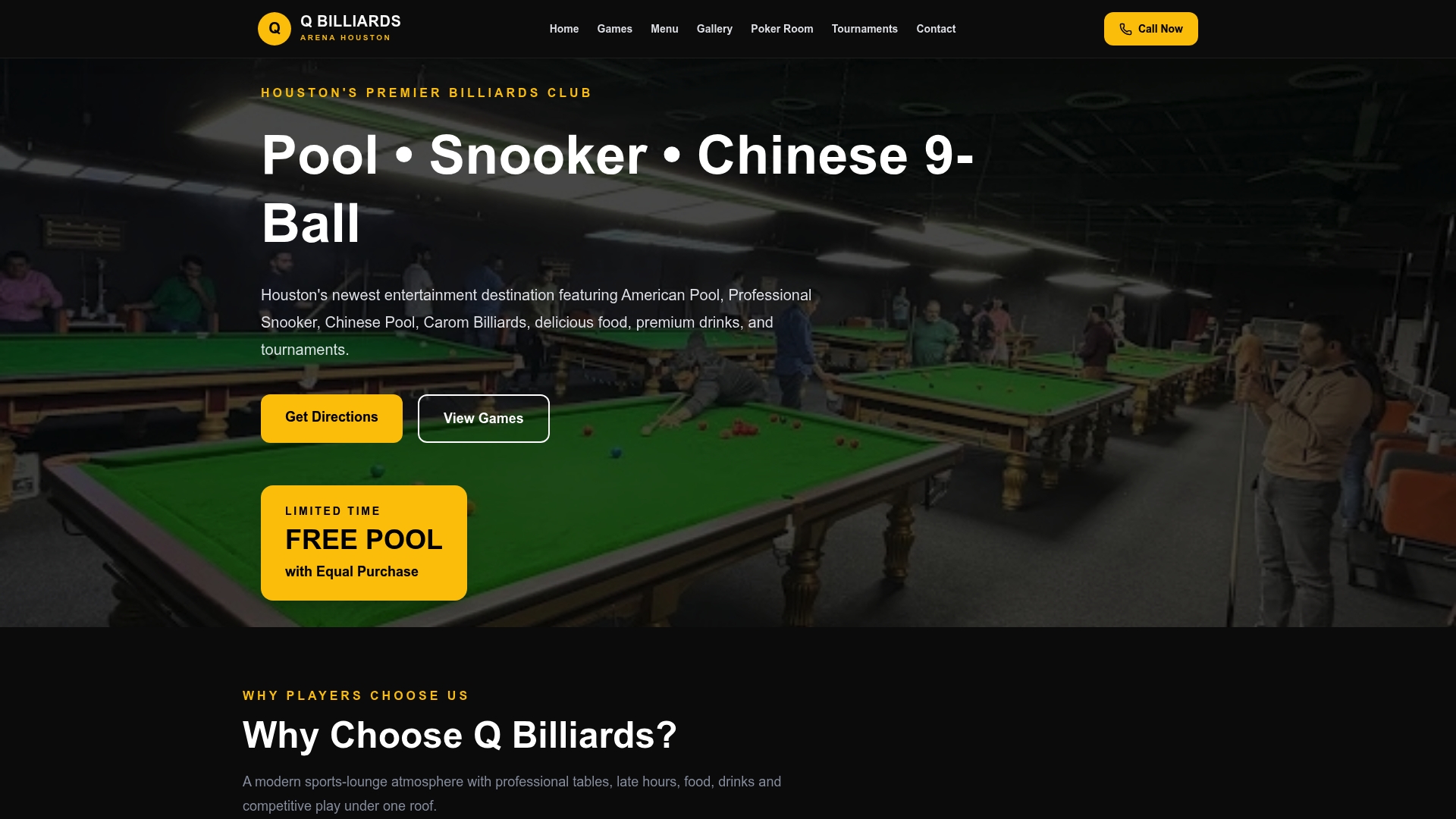
That is why we run 25 professional-grade tables across 11,000 square feet, with American Pool, standard and heated snooker, Chinese 9-ball and carom billiards all under one roof. A pair of players does not have to stick to 8-ball. You can start there, move to 9-ball when you want pace, and try something new when you are ready.
We also think the atmosphere is half the game. Fresh food and drinks come to the table, our hours run late (we aim for 2 to 4 AM), and our weekly tournaments give any pair of friends somewhere to test what they learned. Our promotional offers, such as free pool with an equal purchase, are there so that the game stays about the play, not the bill.
Q
Playing two-player pool at Q Billiards Arena
Our Houston club is built for exactly this kind of night. Table time is hourly. American Pool is $10 per hour, which is easy to split between two players. If you want to try something different, standard snooker, Chinese 9-ball and carom billiards are each $15 per hour, and heated snooker is $20 per hour. You can see the full list on our games and pricing page.
Hungry? Our menu covers food, snacks, and hot, cold and house special drinks. For something more competitive, our Tuesday and Friday night pool tournaments are $10 each to enter. Our guide to pool hall etiquette will help you feel at home in a league night or a first tournament. Ask us about our current offers when you arrive. For everything else, start at qbilliardshtx.com.
How to choose your game in a minute
- Never played together? 8-ball. Everyone knows it, and the rules above cover the edge cases.
- Short on time? 9-ball, with a race to 2 or 3.
- Evenly matched and want depth? One-pocket or straight pool.
- Mismatched skill? Bank pool, plus a race handicap or a break-every-game rule for the weaker player.
- Just here for the evening? Cowboy pool, scotch doubles or a timed challenge, plus a plate of snacks.
FAQ
What is the easiest pool game for two players?
Eight-ball is the easiest to learn and the most widely played. One player takes solids and the other takes stripes, and the winner is whoever pockets their group and then the 8-ball. If you want something even looser, three-ball cowboy pool is quick and forgiving.
How do you play pool with two people?
Lag for the break, agree on a game, then alternate turns. In 8-ball, you keep shooting until you miss or foul. The first legal pocketed ball after the break determines solids or stripes. After a foul, your opponent usually gets ball-in-hand anywhere on the table.
Which game is better for two players, 8-ball or 9-ball?
It depends on the pace you want. Eight-ball is slower and gives you more time to plan around your group. Nine-ball is faster because you can win the rack from a single legal shot on the 9. Many pairs play both, switching after a set number of racks.
Can two players of different skill levels play fairly?
Yes. The weaker player can break every game, or the stronger player can race to more wins. A race handicap is common in leagues, for example racing to 6 against a player racing to 4. Agree on it before you start so it feels like part of the game.
Sources
- How to play pool: Illustrated guide to 8-ball rules (USA Today)
- WPA Rules of Play, September 2025
- WPA Rules of Play, October 2026
- 8-Ball Rules (BCA, University of Colorado)
- Pool (cue sports), Wikipedia
- Official One Pocket Rules
- Bank Pool Rules, Billiards Forum
- Regional Variations on 8 Ball Pool Rules, Billiards Forum
- Pool Variations: Different Ways to Play Pool, Pool Hall Pros
- Your First Pool Tournament: What to Expect, Pool Hall Pros
- Choose a Pool Game for Two, Three or Four Casual Players, Ariakon
- Billiards Games for 2, 3, 4 or More Players, LeaguePool
- How to Run a Pool Tournament, PoolHost
- Pool Handicap System, PoolHost
- Couple Games to Play Together: Co-op Picks for Two