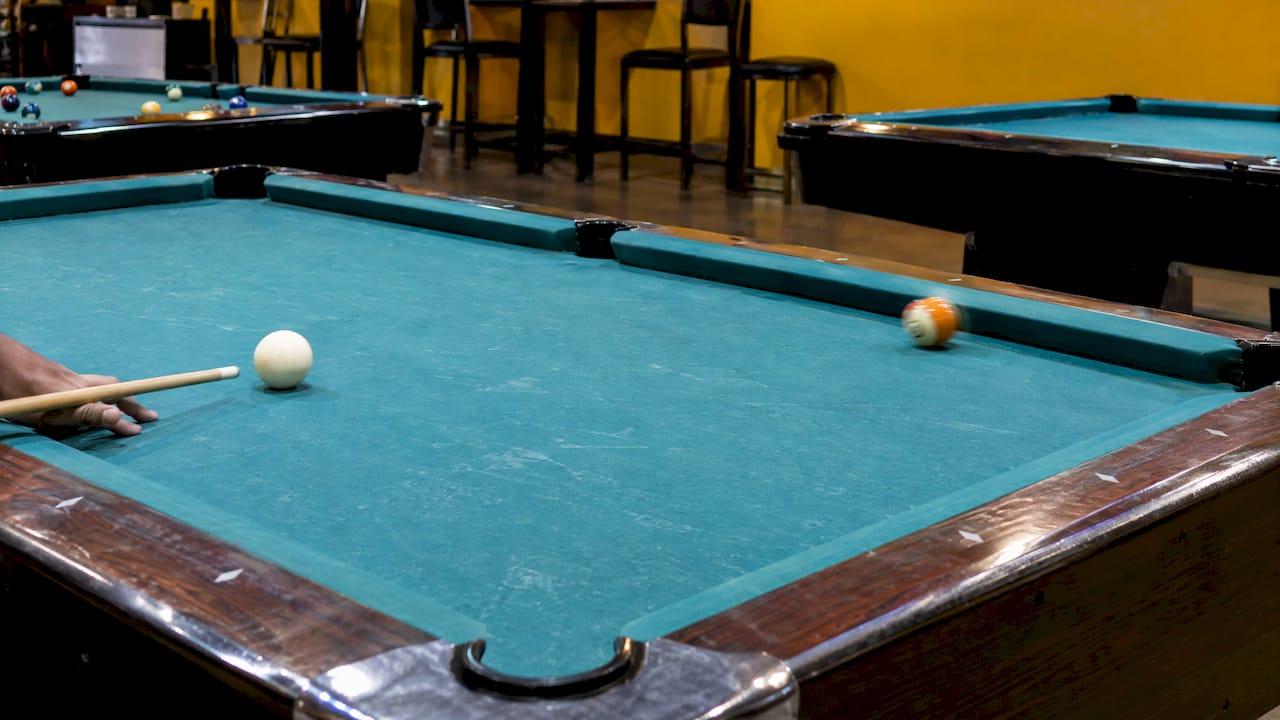
Bank pool is a call-shot game where every ball you score must go off at least one cushion before it drops. You name the ball, the cushion or cushions, and the pocket. The first player to reach five banks (nine-ball version) or eight banks (fifteen-ball version) wins the rack. Kicks, combinations and straight-in shots never count. Below you get the full rules, the fouls, a worked example and the strategy that decides most games.
TL;DR
- Bank pool uses either nine balls (race to five) or fifteen balls (race to eight), per the WPA Rules of Play.
- Every shot is called: object ball, cushion(s), pocket. The cue ball must hit the called ball first.
- No kicks, combos, carom or kiss shots score. A straight-in shot with no rail does not score either.
- A miss on a legal shot just ends your turn. A foul costs you a point.
- You can practice on any regulation pool table. Our American pool tables run $10 per hour in Houston.
Table of Contents
- What bank pool is
- The two versions: short rack and full rack
- How to play bank pool, step by step
- What makes a bank legal: the five tests
- Which shots score and which do not
- Fouls and penalties
- A worked example
- How to aim a bank shot
- Strategy: every bank is also a position shot
- Our perspective on learning bank pool
- Practice bank pool in Houston
- Common mistakes to avoid
- Variations and house rules
- FAQ
- Sources
What bank pool is
Bank pool strips pool down to one idea. The most basic requirement is that all scoring shots are made by bank shot: a called ball goes off a cushion and into a called pocket, as Wikipedia's overview of the game puts it. There is no running a rack of straight-in shots. You win by out-banking your opponent, and by leaving them nothing easy when you miss.
According to the WPA Rules of Play (effective September 15, 2025), the game uses either nine or fifteen object balls plus the cue ball. The player who scores the required number of banks wins the rack.
The game has a long history in pool rooms, and the nine-ball version has become a spectator format. Wikipedia notes that the shortened game, often called nine-ball banks, gained popularity in the 1990s and 2000s and is now played in international professional competition and on television.

The two versions: short rack and full rack
The WPA calls them short rack and full rack. The difference is the number of balls and the target score.
| Short rack (nine balls) | Full rack (fifteen balls) | |
|---|---|---|
| Balls on the table | 9 | 15 |
| Rack shape | Diamond, as for nine-ball | Triangle, as for 8-ball |
| Banks needed to win the rack | 5 | 8 |
| Pace | Faster, more offensive | Slower, more safety play |
The racking details come from WPA rule 13.2. If you need a refresher on how to build each rack tightly, see our guides to racking 9 ball and racking 8 ball.
Professional Nick Varner described the contrast in an interview with Legends of the Cue. He said he was bored with the fifteen-ball game because of how many safeties get played, and that nine-ball banks felt like a far more offensive game. If you want action, start with the nine-ball version. If you like a long tactical grind, the fifteen-ball game is for you.
How to play bank pool, step by step
- Rack and break. Rack nine balls in a diamond or fifteen in a triangle. Agree on the break order before you start, such as a lag or a coin toss.
- Call your shot. Before you shoot, indicate the object ball, the cushion or cushions it will hit, and the pocket it will go into. This is an exception to normal call-shot habits. The World Confederation of Billiards Sports glossary notes that most games never require you to name cushions, but bank pool is the exception.
- Shoot. The cue ball must strike your called ball first, before any other ball or any rail.
- Score or pass the turn. If the ball goes in exactly as called with no foul, you score a point and shoot again. If you miss on an otherwise legal shot, your turn ends with no penalty.
- Keep going to the target. The first to five (nine balls) or eight (fifteen balls) wins the rack.
If you want to sharpen your habits on naming shots in general, our piece on call shot rules in pool covers what to call and what happens when you miss.
What makes a bank legal: the five tests
A bank has to pass every one of these checks to score. The WPA rule (13.5) and the Pool Table Portfolio guide point to the same list:
- You called it. Object ball, cushion(s) in order, and pocket.
- The cue ball reached the called ball first. No rail first, which means no kick.
- The called ball ran clean. It must not touch any other object ball, or the cue ball a second time.
- It touched only the called rails. Incidental contact does not count against you.
- There was no foul on the shot.
What counts as a cushion contact
The incidental contact rule trips up many new players. Under the WPA rules, contact with the two rail sections next to the target pocket, as the ball enters that pocket, is not counted for or against the shooter. The BCA Pool Leagues take the same line in their rulebook: a bank requires a cushion on a rail that is not adjacent to the called pocket, and brushing the cushion next to the pocket does not make a bank.
In practice, a ball that rolls along the rail beside the pocket and drops is not a bank. It needs a real contact on a rail away from the pocket.
Which shots score and which do not
The LeaguePool guide sorts the common situations clearly. Here is the same logic in a quick table:
| Situation | Scores? |
|---|---|
| Called one-rail cross-side or cross-corner bank, goes in as called | Yes |
| Called two-rail bank, goes in off two rails as called | Yes |
| Called one rail, but the ball hits two rails and drops | No, ball is spotted |
| Straight in with no rail | No, ball is spotted |
| Cue ball hits a rail first (a kick), then the bank | No |
| Called bank kisses another ball on the way | No |
| Combination or carom into the pocket | No |
The key point is that extra balls that drop do not count for you. They are spotted back on the table.
Bank versus kick
People mix these up all the time. In a bank shot, the object ball hits a cushion and bounces into a pocket. In a kick shot, the cue ball hits the cushion first and then contacts the object ball, as AimGeometry explains. Kicks are useful in safeties and for escaping snookers in other games, but in bank pool a kick never scores.
Fouls and penalties
The penalty structure is simple. Under the WPA rules, a standard foul costs you one point, balls are spotted as needed, and play passes to your opponent. The cue ball stays where it stopped, except where the rules say otherwise.
The standard fouls listed by the WPA include:
- Cue ball scratch or off the table (cue ball in hand above the head string)
- No rail after contact
- No foot on the floor
- Ball driven off the table
- Touched ball
- Double hit or frozen balls
- Push shot
- Balls still moving
Three consecutive fouls by the same player cost the current rack. Unsportsmanlike conduct is handled by the referee, who picks a penalty that fits the offense.
As LeaguePool describes it, each foul takes away one of your scored balls, or you owe one if you have none yet. A scratch gives your opponent ball in hand behind the head string. For a deeper look at avoiding cue ball mistakes, read our guide on cue ball fouls.
One rule that prevents many arguments: if the cue ball appears to hit the called ball and a cushion, or another ball, at the same instant and nobody can tell which came first, the WPA gives the call to the shooter.
For another view on how penalties compare across games, Wikipedia's pool overview notes that bank pool fouls resemble one pocket, where the player who fouls spots a ball before the incoming player shoots.
A worked example
Say you are playing nine-ball banks, and the 3 ball sits about halfway between the two long rails, a few feet from the side pocket. You say, "Three ball, one rail, corner pocket." You hit the 3 first with the cue ball, it bounces off the long rail and drops in the corner. That is one point and you shoot again.
Now the same shot, but the cue ball clips the 6 on the way to the 3. The 3 still drops. No score: you did not hit the called ball first without contacting another. The ball is spotted, your turn ends, and if it also counts as a foul under the rules, you lose a point.
If the 3 hits the rail and rattles in the jaws without dropping, you simply miss. There is no penalty, but your opponent plays from where everything stopped.

How to aim a bank shot
Most players learn banking with the mirror system. Picture the target pocket reflected on the far side of the cushion you want to hit, then aim the object ball at that mirror pocket. Pool Table Portfolio gives a concrete starting point: for a cross-side bank with the ball halfway between the two long rails, the contact point falls one-third of the way along the rail from the ball toward the pocket.
The physics behind it is the same as light off a mirror. With no sidespin and moderate speed, the ball rebounds at the same angle it arrived, according to AimGeometry. The same lesson warns that sidespin, forward roll on the cue ball and hard speed all change that angle.
Three habits help beginners:
- Use medium speed. Hard shots deviate from the mirror rule, and soft shots die early.
- Keep the cue ball free of spin. Center-ball contact keeps the geometry predictable.
- Learn your table. Cloth speed and cushion rubber change how a ball comes off the rail. Warm up on a few banks before the game counts.
Strategy: every bank is also a position shot
Because your opponent plays from wherever the balls stop, each attempt is also a defensive decision. Pool Table Portfolio gives a rule of thumb: choose the speed and the bank that still leave nothing easy if you miss. When no bank is worth trying, play a legal shot that puts a ball on a rail and hides the cue ball.
Quarter King Billiards makes a similar point in its bank pool lessons for league players: once combinations and caroms are out, the game comes down to two skills, pocketing through banks and locking your opponent into a position where they cannot answer.
The safety ideas carry over from other games. Our breakdown of 9-ball safeties shows repeatable ways to hide the cue ball, and they work just as well when you decline a low-percentage bank.
Our perspective on learning bank pool
We see the same pattern at our tables: players who learn to bank well become better at every other pool game. Banking forces you to read angles, control speed and think about where the cue ball will stop.
Our view is simple. Learn the rules first, because the call is the whole game. Then spend table time on it. An hour on a regulation table is the cheapest way to find out how a cushion really plays, and our American pool tables are built for exactly that kind of practice.
We designed Q Billiards Arena around a lively room with 25 professional-grade tables, so you can find open space to practice banks and still have a game going nearby when you want one. Bring a friend, agree on nine balls and race to five.
Q
Practice bank pool in Houston
If you want to try the game, you need a regulation table and a few uninterrupted hours. At Q Billiards Arena in Houston, American pool is $10 per hour, and our games page lists every table type and rate. We offer 25 professional-grade tables across 11,000 square feet, with late-night hours that we describe as running until 2 to 4 AM, so you can practice after your shift.
When you want to put your skills against others, our pool tournament nights are $10 per entry on Tuesday and Friday. Order a snack or a drink from our menu while you play. Before you come, check the website for the current schedule and format.
Common mistakes to avoid
- Forgetting to call the cushion. Unlike most pool games, bank pool requires you to name it. If you say only the ball and pocket, you invite a dispute.
- Letting a ball touch a second rail uncalled. A called one-rail shot that hits two rails does not score.
- Hitting a rail with the cue ball first. That is a kick, and kicks never score.
- Playing every shot at full speed. Hard banks are random banks.
- Ignoring the opponent's next shot. A miss that leaves an open bank gives away a point.
Variations and house rules
Bank pool is often played under house rules in bars and pool halls. Common variations include different call requirements for cushions or different target scores. Agree on the format before the first shot. If you play in a league, read the official rulebook, because the BCA Pool Leagues and the WPA share the same core idea but are written for their own events. Agree on how to handle simultaneous contact, how many fouls end a rack, and whether you play short or full rack.
FAQ
Can the cue ball hit a rail before the object ball in bank pool?
No. The cue ball must contact the called ball before any other ball or any rail. A shot where the cue ball hits the rail first is a kick, and kicks never score in bank pool.
How many balls do you need to win at bank pool?
In the nine-ball game, you need five valid banks. In the fifteen-ball game, you need eight. These targets come from the WPA Rules of Play.
Do I have to call the cushion?
Yes. In bank pool you must indicate the object ball, the cushion or cushions in order, and the pocket. Most other pool games do not require you to name the rails, but bank pool is the exception.
What happens if I miss a bank?
Nothing, as long as the shot was legal. Your turn ends and your opponent plays from where the balls stop. A foul is different: you lose a point, and a scratch gives your opponent ball in hand behind the head string.
Can I play bank pool on a regular pool table?
Yes. Bank pool needs only a standard pool table, a cue ball and either nine or fifteen object balls. Our American pool tables at Q Billiards Arena work well for it.
Sources
- WPA Rules of Play (effective September 15, 2025)
- BCA Pool Leagues official rulebook, 2023
- World Confederation of Billiards Sports glossary
- LeaguePool: Bank Pool Rules
- Pool Table Portfolio: How to Play Bank Pool
- AimGeometry: Bank Shot Practice
- Quarter King Billiards: bank pool lessons
- Legends of the Cue: Nick Varner interview
- Wikipedia: Bank pool
- Wikipedia: Pool (cue sports)