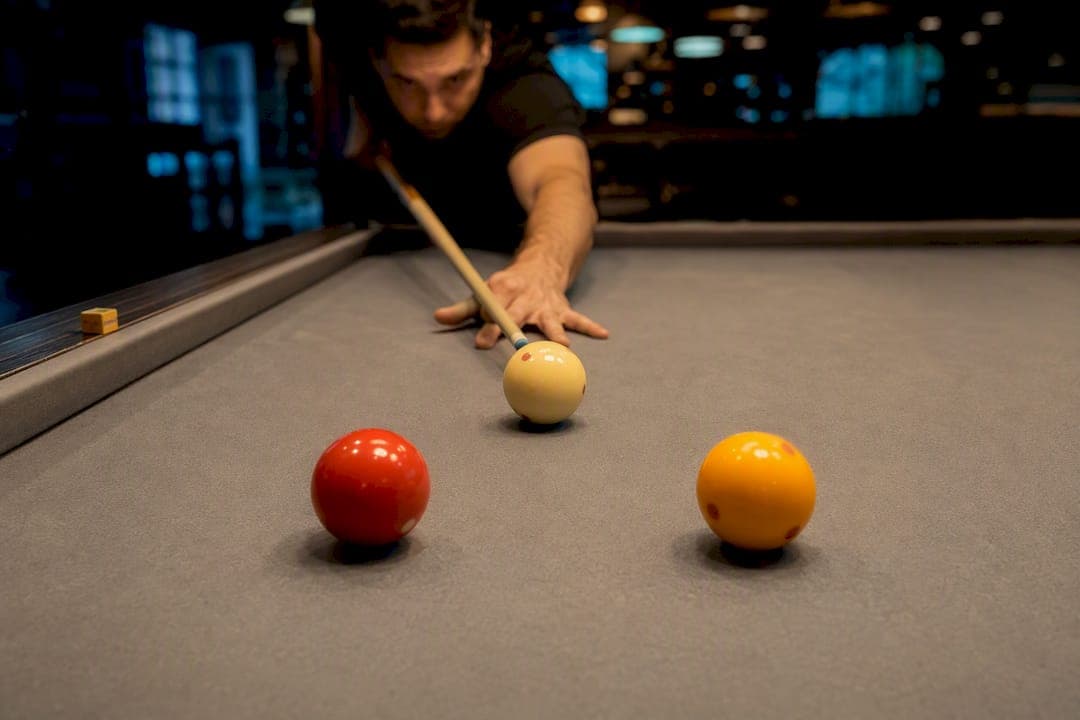
In carom billiards, you score a point the moment your cue ball contacts both other balls on the table in one stroke. That single contact is called a carom, and matches are usually won by being the first player to reach a set number of points. Most disciplines award one point per valid carom, though variants like three-cushion and five-pins layer on extra requirements before a hit counts.
TL;DR:
- Players must use the same cue ball throughout the match, and it is crucial to correctly identify your cue ball to avoid fouls.
- A point is scored only when the cue ball contacts both the red object ball and the opponent's cue ball in one shot, with all balls coming to rest afterward.
- Three-cushion and balkline require hitting specific cushion contact or zones before contacting the second ball, significantly increasing difficulty.
- Fouls such as touching balls, double hits, or knocking balls off the table usually end a turn and may incur additional penalties or re-spotting.
- Practicing geometry-focused drills like two-ball caroms and short positioning accelerates skill development in cushion angles and cue-ball control.
Table of Contents
- What Are the Carom Billiards Rules for Equipment and Setup?
- What Counts as a Point in Carom Billiards Scoring?
- How Does a Carom Billiards Match Start?
- What Fouls and Penalties Show Up Most in Carom Billiards?
- What Are the Main Variations of Carom Billiards?
- How Do You Practice Carom Billiards Strategy and Technique?
- How Are Carom Billiards Matches Timed and Scored to a Finish?
- Carom Billiards Quick Reference Cheat Sheet
- Why Rules Alone Won't Make You a Better Carom Player
- Practice Carom Rules on a Real Table at Q Billiards Arena
- Where to Read the Official Carom Billiards Rules
- Sources
What Are the Carom Billiards Rules for Equipment and Setup?
Carom is played on a pocketless table, which trips up a lot of players coming from pocket pool. There's nowhere for the balls to hide, and nowhere for a mistake to disappear. Tables typically run larger than standard pool tables, which changes how much power and spin you actually need to travel the same relative distance.
The ball set is simple: two cue balls and one red object ball, three balls total. One cue ball is usually marked with small dots so players and referees can tell it apart from the opponent's cue ball at a glance.
- Head, center, and foot spots mark fixed reference points used for setup and re-spotting balls after certain fouls.
- Starting line is where both cue balls sit before the first shot, positioned according to the referee's placement.
- Cues for carom tend to favor stiffer shafts than pool cues, since precise cushion contact matters more than soft touch on a pocket.
- Tip maintenance matters here just as much as in pool. A dead or glazed tip kills the spin control that carom depends on.
What Counts as a Point in Carom Billiards Scoring?
A carom is only valid when your cue ball strikes both the red object ball and the opponent's cue ball during a single stroke, and every ball involved must come to a complete rest before the shot is judged final. Miss that condition and nothing counts, no matter how good the shot looked.
Scoring in carom billiards runs one point per valid carom in most disciplines, including free rail, one-cushion, three-cushion, and balkline. Five-pins is the exception. It uses a separate scoring system tied to knocking down small pins positioned on the table, so point values there don't map directly onto the "one carom, one point" standard.
Matches are usually structured in one of two formats:
- Distance format, where the first player to reach a predetermined point total wins outright.
- Set format, where players compete across multiple sets, similar to how tennis stacks games into sets.
A player keeps shooting as long as they keep scoring. The inning ends the moment a shot fails to produce a valid carom. If the match ends level, a shoot-out decides the winner, and referees are the ones who make the final call on whether a carom was legitimately completed under UMB's official rules.
How Does a Carom Billiards Match Start?
Before a single point is scored, someone has to earn the right to shoot first. That's handled through a cushion draw, sometimes called a lag: both players strike a ball toward the far cushion and back, and whoever lands closest to the near rail chooses whether to break or let the opponent break. A player who repeatedly fumbles the cushion draw can actually lose the right to choose, according to UMB's tournament rules.
Once that's settled, here's how the opening unfolds:
- The referee places the red ball on the foot spot and both cue balls on the head spots, following standard starting positions.
- The breaking player must strike the red ball first. Hitting your opponent's cue ball first on the break is a foul.
- Each player must consistently use their assigned cue ball for the entire match. Striking the shot with the wrong cue ball is a foul.
- Play continues in innings. Each player keeps their turn until they fail to complete a valid carom, at which point the turn passes.
Getting comfortable with cue-ball fouls early saves you from bleeding points on mistakes that have nothing to do with your actual shot-making.
What Fouls and Penalties Show Up Most in Carom Billiards?
Most carom fouls fall into a handful of predictable categories, and once you know them, they're easy to avoid.
- Wrong cue ball. Shooting with your opponent's ball instead of your own. This is one of the most common beginner mistakes, especially on tables where the marking isn't obvious at a glance.
- Touching balls or double hits. Any contact with a ball other than through a legal stroke, including nudging a resting ball with your hand, cue, or clothing.
- Pushing or double-tapping the cue ball, where the tip stays in contact too long instead of a clean strike.
- Skipping a required cushion, relevant in cushion-dependent disciplines like one-cushion and three-cushion.
- Knocking a ball off the table, which is always a foul regardless of discipline.
The standard penalty for most fouls is loss of the inning, meaning your turn ends immediately with no point awarded. Some fouls carry an additional penalty. A wrong-cue-ball foul, for instance, often costs a point on top of ending the turn under official UMB rules. When balls end up touching after a shot, referees re-spot them according to fixed procedure rather than leaving position to guesswork. Tournament play leans heavily on referees making these calls in real time, which is exactly why casual games benefit from someone at the table who actually knows the rulebook.
What Are the Main Variations of Carom Billiards?
Carom isn't one game. It's a family of disciplines that all share the same core carom requirement but stack different constraints on top of it, and those constraints change how the game feels to play.
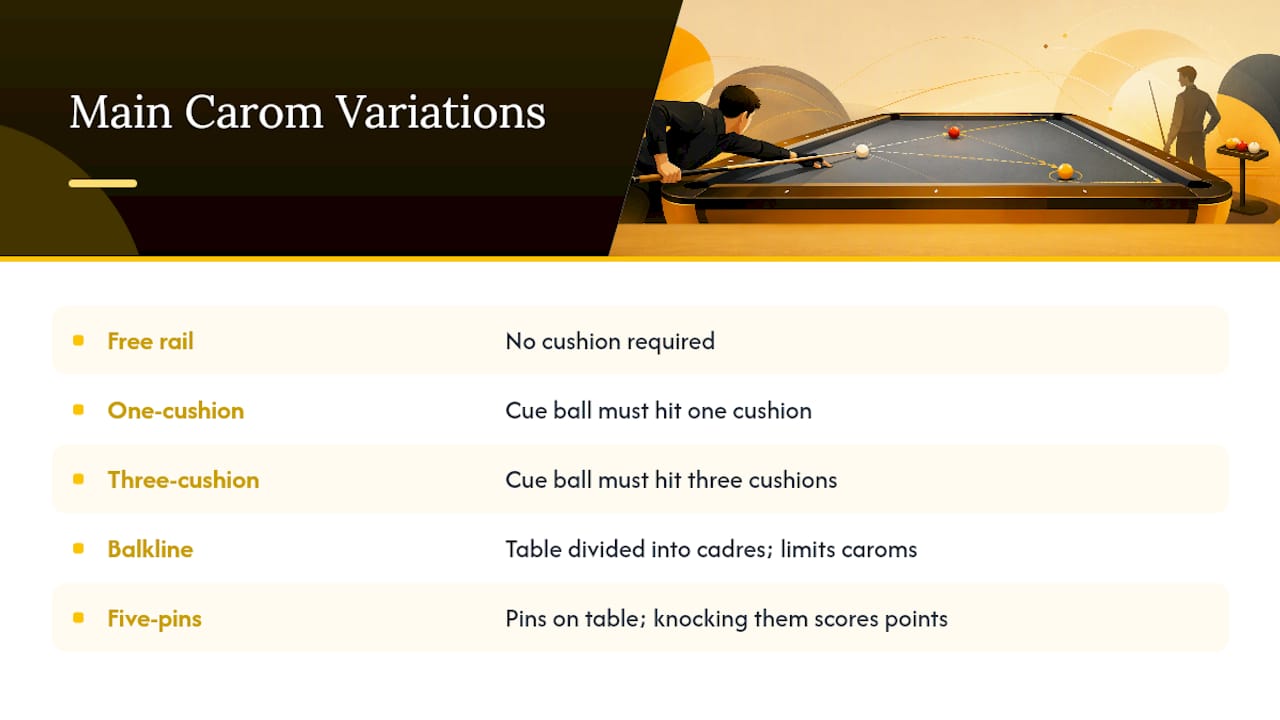
Free rail (straight rail) is the simplest version: no cushion requirement at all. You just need your cue ball to touch both other balls. That simplicity is exactly why it fell out of favor at the elite level. Skilled players could rack up absurd, nearly uninterrupted scoring runs by nesting balls in a corner and tapping out point after point.
One-cushion adds a single rule: the cue ball must touch at least one cushion before, between, or after contacting the two object balls (depending on the specific ruleset). It's a modest step up in difficulty from free rail but still approachable for newer players.
Three-cushion is the discipline most serious tournaments run today, and for good reason. Your cue ball has to contact at least three cushions before it touches the second object ball. That single requirement transforms the game into something closer to applied geometry. The WPA's coaching guidance treats every shot as a math problem involving angle, spin, and speed, and that framing is not an exaggeration. You can read more on what actually counts as a point under three-cushion rules if you want the scoring mechanics broken down further.
Balkline was invented specifically to stop free rail's runaway scoring problem. The table gets divided into rectangular zones called cadres, using set distances like 47 centimeters, and once a certain number of caroms happen inside one cadre, the next shot has to send at least one ball outside that zone. Notations like "47/1" reference the cadre size and scoring limit for that specific format.
Five-pins is the outlier. Small pins sit on the table, and knocking them down alongside completing a carom generates different point values entirely, making it more of a specialty variant than a mainstream competitive format.
How Do You Practice Carom Billiards Strategy and Technique?
The single biggest mental shift for anyone coming from pocket pool is this: stop thinking about potting and start thinking about rebound angles. Every cushion is a geometry tool, not a wall you're avoiding. Picture the path as a "V," where the angle you send the ball in determines the angle it comes back out, and suddenly cushion shots stop feeling random.
Three drills build that skill fast:
- Two-ball carom repetition. Set up simple, short-distance caroms and repeat them until contact feels automatic rather than lucky.
- Short positioning drills. Focus purely on where your cue ball stops after contact, not on making the carom itself. Position is half the game.
- Incremental three-cushion attempts. Start with two-cushion combinations at short range, then gradually add distance and cushion count as your spin control improves.
Keep your stroke length short and controlled, and use the minimum power needed to reach the target. Overhitting is the most common beginner error, and it's almost always fixable by slowing down. Pairing these drills with dedicated cue-ball control practice speeds up the learning curve considerably.
Pro Tip: Coaches watch your aim line before anything else. If your rebound angle is consistently off by the same margin every time, the fix usually isn't your stroke. It's where you're standing relative to the shot.
How Are Carom Billiards Matches Timed and Scored to a Finish?
Formal matches run to a set point distance or across multiple sets, and both formats include structural pauses that casual players often don't expect. Under official UMB rules, a short break is scheduled once a player reaches half the target distance, provided the match has lasted long enough.
- Distance matches end the moment one player reaches the target point count first.
- Set matches require winning a set number of individual sets, not just total points.
- Ties get resolved through a shoot-out rather than sudden-death continuation.
- For casual play, pick a shorter distance (20 to 30 points) so games move quickly while you're still learning positioning.
Carom Billiards Quick Reference Cheat Sheet
Keep this nearby for your next session, or just memorize the short version: one carom equals one point, your inning continues until you miss, and the fine print lives in the fouls.
- Do use the same cue ball all match, and confirm which one is yours before you shoot.
- Don't assume a touching ball is automatically a foul. Check whether it moved before calling it.
- Do hit the red ball first on the break, every time, no exceptions.
- Beginner distance suggestions: 20 points for free rail, 15 for one-cushion, 10 to 15 for three-cushion.
Why Rules Alone Won't Make You a Better Carom Player
Reading the rulebook cover to cover won't put a single ball in motion correctly. Rules tell you what's legal. They don't tell you how to actually judge an angle under pressure, and that gap is where most self-taught players stall out for months.
Some billiards venues offer beginner sessions and supervised practice specifically so newcomers apply these rules against real feedback instead of guessing. Try the drills here, but try them with someone watching who can catch the habit before it sets.
— Q
Practice Carom Rules on a Real Table at Q Billiards Arena
Reading about cushion geometry only gets you so far. Some billiards arenas provide carom-capable tables where you can run the drills from this guide, correct your stroke in real time, and experience how a three-cushion angle behaves differently on felt than it does in your head.

Beyond open table time, our tournaments and league nights put you in front of players who already know these rules cold, which is honestly the fastest way to stop making the same fouls over and over. Check games and pricing to see current table rates and league schedules, then book a session and bring this guide with you. Reading the rules is step one. Playing them out on a real table is what actually sticks.
Where to Read the Official Carom Billiards Rules
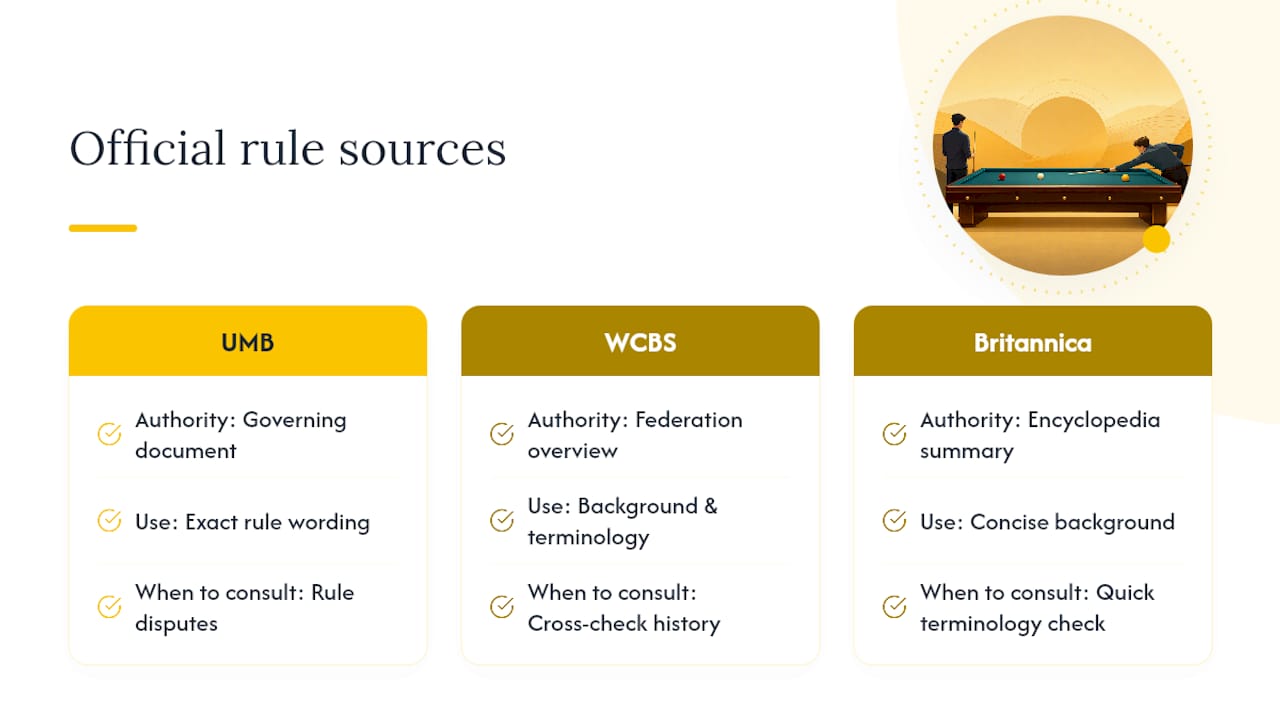
For exact rule wording, start with the UMB world rules, the governing document behind everything covered here. The WCBS carom overview and Britannica's summary both offer useful background for cross-checking terminology and history.
Sources
- WORLD RULES OF CAROM BILLIARD (UMB rulebook)
- How to Play Carom | World Confederation of Billiards Sports (WCBS)
- Carom billiards | Britannica
- How to play three-cushion billiards | WPA (how-to)