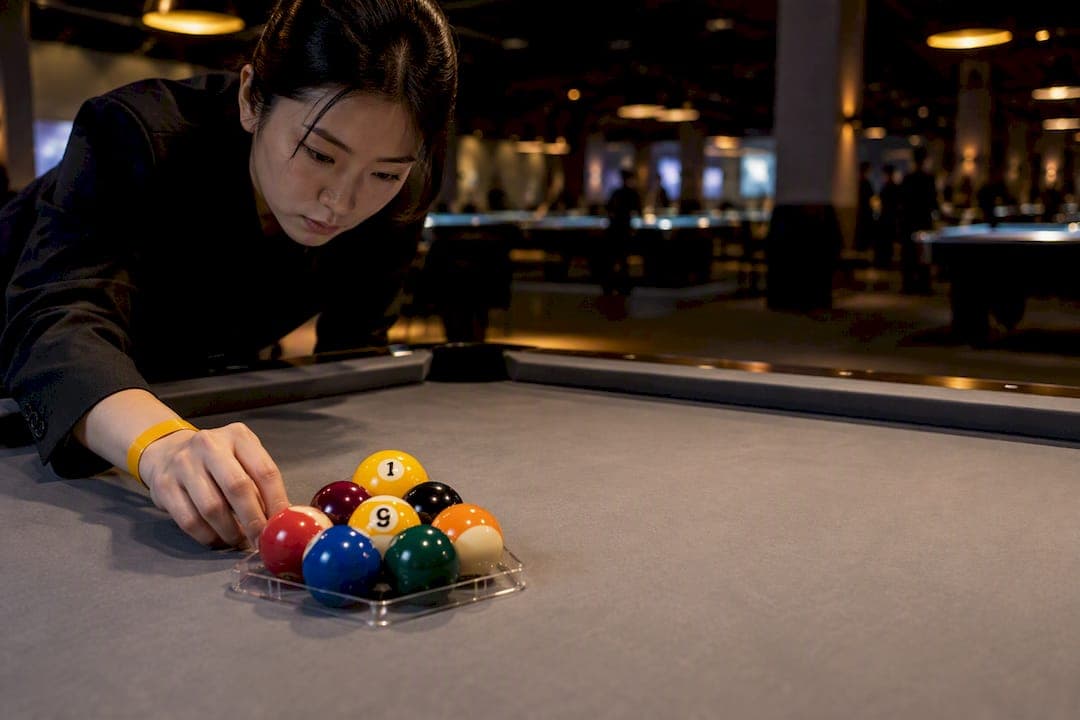
To win a rack of Chinese 9-ball, legally pocket the 9-ball after a legal break that requires the cue ball behind the head string and first contact on the 1-ball, with either four object balls hitting a cushion or one ball pocketed. Miss any of those conditions and the break is illegal. Chinese 9-ball also scores cumulatively across a match, awarding points for break-and-runs, table-runs, standard rack wins, and fouls, with fouls giving points to your opponent.
TL;DR:
- A legal break requires the cue ball behind the head string, first contact with the 1-ball, and at least four balls hitting cushions or one ball pocketed; failing any of these makes the break a foul.
- The 9-ball must be re-spotted on the foot spot after any foul pocketing it illegally, and play continues; other balls removed from play entirely if driven off the table.
- Scoring in Chinese 9-ball awards six points for a break-and-run, four for a table-run, and two for a standard rack win, with fouls giving opponents one point each.
- After a legal break, players can execute a push-out, which allows almost any shot location without contact rules, but must be declared before the shot; subsequent shots follow standard rules.
- Foul penalties depend on severity: standard fouls cost ball-in-hand and one point for opponents, while serious fouls can cost the entire rack or disqualification, with three consecutive fouls ending the match instantly.
Table of Contents
- What Are the Chinese 9-Ball Rules for Racking and Equipment?
- What Counts as a Legal Break in Chinese 9-Ball?
- How Does Play Continue After the Break?
- What Fouls and Penalties Apply in Chinese 9-Ball?
- What Happens When the 9-Ball Gets Pocketed on a Foul?
- How Does Chinese 9-Ball Scoring and Handicapping Work?
- What Should You Know Before Walking Into a Chinese 9-Ball Tournament?
- Why Cumulative Scoring Changes How You Should Play
- Where to Find the Official Chinese 9-Ball Rulebooks
- Sources
- FAQ
What Are the Chinese 9-Ball Rules for Racking and Equipment?
The rack itself decides half your outcome before a cue ever touches a ball. Chinese 9-ball uses the same diamond shape as standard 9-ball: nine balls arranged tightly with the 1-ball on the foot spot at the apex, the 9-ball dead center, and the rest filled in randomly behind them. Every ball is placed closely against its neighbors. A rack with visible gaps can be challenged by a referee or opposing player before the break.
Referees (or, in casual league play, the opposing player) are responsible for verifying the rack before the break shot. Most venues, including tournament rooms, use a template rack (sometimes called a "magic rack") rather than a wooden triangle, since templates lock ball spacing and remove the guesswork that comes with hand-racking. If you're serving as your own racker between matches, racking 9-ball tightly is a skill worth drilling on its own, because a loose rack changes how far balls scatter and directly affects whether the break satisfies the four-contact rule.
Table geometry matters here too. The head string and foot spot aren't decorative, they're the two reference lines that govern where you can place the cue ball and where the 1-ball must sit. Standard tournament tables used for Chinese 9-ball typically run 9-foot professional dimensions with pockets cut to modern specifications, though exact pocket dimensions and cloth type are set by the hosting association or venue rather than a single universal number.
Before the first rack of any match, confirm these setup points:
- The cue ball is in hand behind the head string for the break, never in front of it.
- The 1-ball sits on the foot spot at the apex of the diamond.
- The 9-ball sits in the exact center of the rack, not shifted toward any side.
- All nine balls are frozen together with no visible daylight between them.
- The rack has been checked by a referee or the opposing player, not just the breaker.
Equipment tolerances (ball weight, cloth speed, cue tip specifications) fall under venue responsibility, and most competitive rooms use match-grade equipment that meets whatever standard the tournament organizer specifies in the event's rule sheet. If you're unsure what a specific venue requires, ask before the match starts. Cleared-up equipment questions on rack day save arguments during rack ten.
What Counts as a Legal Break in Chinese 9-Ball?
A legal break has three non-negotiable conditions, and missing any one of them turns your break into a foul. First, the cue ball has to start behind the head string, in hand, before you strike. Second, your cue ball's first contact has to be the 1-ball, no exceptions, no matter how the rack has shifted. Third, if you don't pocket a ball on the break, at least four numbered balls must contact a cushion or the break is ruled illegal.
That four-cushion clause is where most disputes happen. A soft break that pockets nothing and sends only two or three balls to the rails gets challenged constantly in league play, because it's genuinely hard to count contacts in real time from across the table. Referees at serious events will often ask the breaker to slow the break down or will position themselves specifically to track cushion contacts, since disagreements over "did that ball touch the rail or not" cause more delays than almost any other rule in the book.
Here's how enforcement typically plays out when a break is challenged:
- The referee (or opposing player, in unofficiated matches) calls the break illegal if the four-contact minimum isn't met and no ball was pocketed.
- The incoming player is given a choice: accept the table as it lies, take ball-in-hand behind the head string, request a re-rack, or in some tournament formats, allow the original breaker to break again.
- If a re-rack is chosen, the table is reset from scratch and the same player breaks under the same legal-break requirements.
- Any dispute over cushion count that a referee can't resolve visually is typically settled in the referee's favor, since Chinese 9-ball tournament rules give the official final authority on the table.
The exact menu of options after an illegal break varies slightly by tournament regulation, so it's worth confirming which version your event uses at the pre-match meeting rather than assuming the last tournament's format carries over.
Then there's the golden break, which is the moment every 9-ball player secretly hopes for. If you legally pocket the 9-ball on the break itself, you win the rack outright, no continuation needed. That's true whether it drops on its own or gets pocketed off a combination of contacts during the break shot. The complication comes when a golden break happens alongside a foul, like a scratch on the same shot. In that case, most rulesets treat the foul as controlling: the 9-ball gets re-spotted on the foot spot, and the incoming player takes ball-in-hand rather than being denied a shot at a rack their opponent should have lost fairly.
Pro Tip: Practice your break at three different speeds before a tournament, not just your hardest shot. A break that reliably sends four balls to the rails at medium pace is more valuable in a cumulative-scoring format than a break that occasionally pockets the 9 but leaves you scratching or fouling half the time.
How Does Play Continue After the Break?
Legally pocketing any numbered ball keeps you at the table. Miss, foul, or fail to pocket anything, and the turn passes to your opponent, who takes the table exactly as it sits, unless a foul entitles them to ball-in-hand. This is standard rotation-game logic, but Chinese 9-ball layers a specific wrinkle onto it: the push-out.
A push-out is only available immediately after a legal break, and only to the player who was left to shoot next, meaning the same player who just broke if nothing was pocketed, or the incoming player if the break was legal but nothing dropped. On that shot, and only that shot, the normal requirement to hit the lowest numbered ball first (or drive a ball to a rail) is suspended. You can push the cue ball almost anywhere on the table without it counting as a foul, as long as you declare your intention to push out before shooting.
That declaration matters. If you push out and stay silent about it, most referees and opponents will treat the shot as a normal attempt, meaning any contact violation becomes a foul instead of a legal push. Once the push-out shot is taken, your opponent gets to choose: shoot from where the balls now sit, or pass the table back to you. Either way, the shot after a push-out is a normal shot again, full rules apply.
A few things worth locking into memory about turn changes:
- A legal pocket on any numbered ball earns you another shot, in any order, as long as the 9-ball isn't the last ball on the table out of sequence.
- A miss with no foul leaves the table exactly as it lies for your opponent, no ball-in-hand.
- A foul hands your opponent ball-in-hand anywhere on the table, a significant advantage compared to a clean miss.
- Push-outs can only happen once per rack, immediately after the break, and must be declared before the shot.
- If your opponent accepts a push-out table, the game resumes under standard shot rules from that position.
This is where matches are actually won or lost. Players who understand exactly when ball-in-hand applies, and how a push-out shifts risk from one player to the other, consistently outscore players who are just trying to remember which ball is next. If you want to see how these same continuation principles play out in a different rotation format, the push-out and turn-change rules in standard 9-ball follow nearly identical logic.
What Fouls and Penalties Apply in Chinese 9-Ball?
Fouls fall into two tiers, and the gap between them matters more than most casual players realize. Standard fouls cost you the table and hand your opponent ball-in-hand. Serious fouls can cost you the entire rack, or worse, depending on how a referee judges intent.
Standard fouls include:
- Scratching the cue ball into a pocket or knocking it off the table entirely.
- Contacting a ball other than the lowest numbered ball first (wrong-ball-first).
- Failing to drive any ball to a rail after legal contact, when no ball is pocketed.
- Double-hitting the cue ball with the tip on a single stroke.
- Pushing the cue ball forward with prolonged tip contact instead of a clean strike.
- Touching or moving object balls with your hand, cue, clothing, or chalk.
- Shooting out of turn.
- Violating a shot clock, in venues that enforce timed play.
Serious fouls sit in a different category entirely. These cover deliberate unsportsmanlike conduct, like intentionally driving a ball off the table to avoid a bad position, disturbing balls to disguise their position, or behavior a referee judges as intentionally disruptive. Where standard fouls carry an automatic, fixed penalty, serious fouls are judged at referee discretion, and the consequence can escalate all the way to loss of the rack or, in repeated cases, disqualification from the match.
Then there's the three-foul rule, which trips up more players than any other clause in the book. Commit three fouls in a row, without a legal shot in between, and you lose the rack outright, not just the turn. Most rulesets require the referee to give a clear warning after the second consecutive foul, so nobody loses a rack without knowing it was coming. The count resets the moment you make a legal shot, so it's specifically about consecutive fouls, not fouls total across a rack.
One statistic worth internalizing: under the scoring system used in Chinese 9-ball, every single foul hands your opponent one point outright, separate from whatever happens with the rack itself. In a cumulative-scoring match, a handful of careless fouls can hand your opponent a two or three-point lead before you've lost a single rack outright.
After any standard foul, your opponent gets ball-in-hand anywhere on the table, including the ability to attempt a direct shot or combination on the 9-ball itself if it's legally reachable given the current lowest ball. This means ball-in-hand not only improves position but may also create an opportunity for a run at the 9-ball. If you're prone to habitual fouls like double hits or slow releases, working on cue ball control fundamentals does more for your scoreboard than almost any other single adjustment.
What Happens When the 9-Ball Gets Pocketed on a Foul?
The 9-ball occupies a special place in the rules because it's the only ball that gets a second chance after leaving the table under the wrong circumstances. If the 9-ball is pocketed or driven off the table as the result of a foul, it doesn't stay pocketed and it doesn't end the rack. It gets re-spotted on the foot spot, and play continues from there.
Every other numbered ball works differently. If a 2-ball or 7-ball flies off the table during a shot, it's simply gone from that rack. It doesn't get respotted, and it's not treated as pocketed either, it's removed from play entirely and the game continues without it. That asymmetry exists because the 9-ball is the game's win condition, so the rules protect it from ending a rack on a technicality.
Referees handle the mechanics of respotting with a specific procedure:
- The 9-ball goes on the foot spot, the same reference point used when racking the balls at the start of the game.
- If another ball is already occupying the foot spot, the 9-ball is placed on the closest available point along the imaginary line running from the foot spot toward the foot rail.
- The respot happens regardless of whether the foul was a scratch, an off-table shot, or another rule violation involving the 9-ball.
- Play resumes with the incoming player receiving ball-in-hand, as with any standard foul.
The practical upshot is that pocketing the 9-ball illegally almost never ends the rack in your favor, and it rarely ends it in your opponent's favor either, it just resets the game's final target and hands over table control. Players sometimes misjudge this and think knocking the 9-ball off the table on a bad shot ends the rack against them permanently. It doesn't. It just costs you the turn and gives your opponent a very makeable ball sitting dead center on the table.
How Does Chinese 9-Ball Scoring and Handicapping Work?
This is the single biggest structural difference between Chinese 9-ball and the American version most players learn first. American 9-ball is almost always race-to-a-number, you win racks until someone hits the target and the match ends. Chinese 9-ball layers a point system on top of rack outcomes, which changes how every shot on the table gets weighed.
The scoring categories work like this: a break-and-run, meaning you legally pocket the 9-ball on the break itself or run the entire rack starting from your break shot without missing, earns six points. A table-run, running every ball in a rack after your opponent left you an opening (not your own break), earns four points. A standard victory, winning the rack through normal back-and-forth play, earns two points. And every foul you commit hands your opponent one point, independent of who wins the rack.
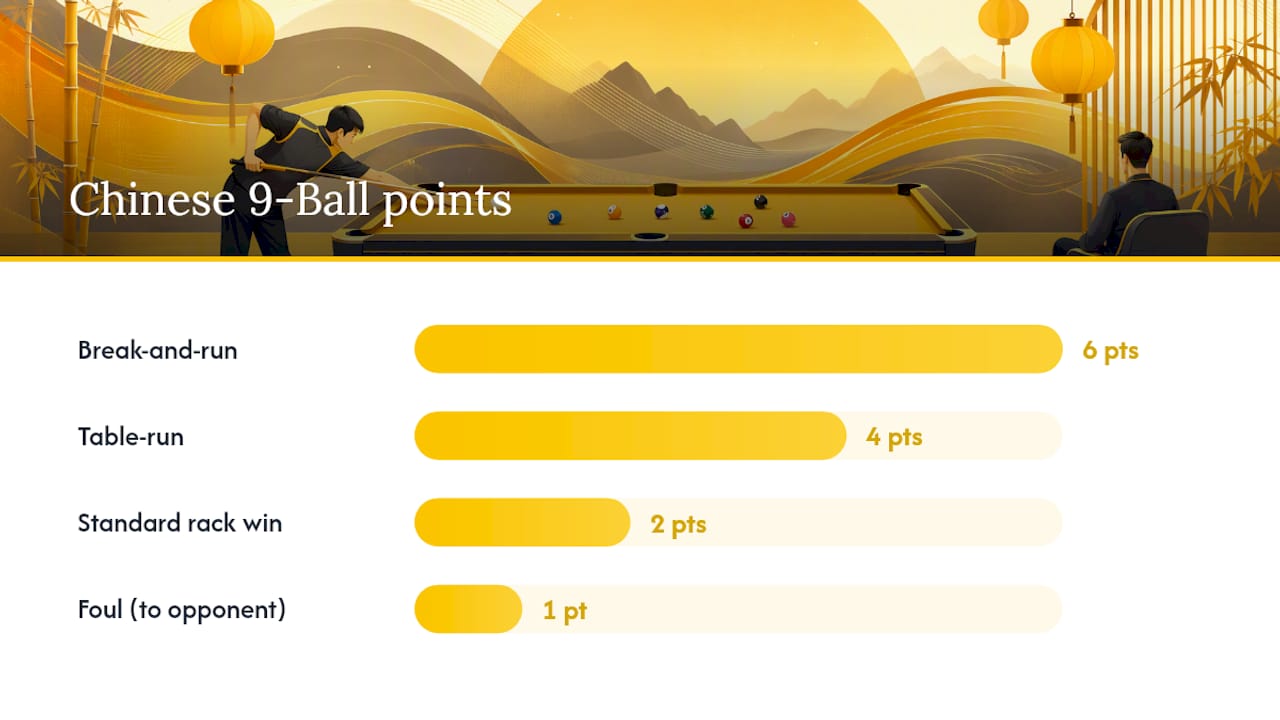
That last detail is what separates Chinese 9-ball's scoring psychology from a straight race format. A sloppy win where you fouled twice on the way to victory nets you two points for the rack but has already handed your opponent two points from those fouls, nearly canceling out your advantage. Clean, foul-free play is worth more in the final tally than it is in a simple race-to-seven structure.
Match formats vary by organizer. Some events run cumulative-point matches where the winner is whoever has the higher point total after a fixed number of racks. Others run traditional rack races where points are tracked as a secondary statistic but the match winner is still decided by total racks won. Tournament organizers set the number of racks, the break order (winner breaks versus alternating breaks), and whether cumulative scoring or a straight race decides the match, and those decisions get announced before the match begins.
Handicapping shows up most commonly as a one-ball allowance in mixed-gender events, where a female competitor may need one fewer ball pocketed to win a rack, or a comparable adjustment depending on the organizer's specific format. These handicaps aren't universal, they're event-specific and get spelled out in the pre-match rule announcement, so never assume a handicap from a previous tournament automatically applies to the one you're playing in now.
What Should You Know Before Walking Into a Chinese 9-Ball Tournament?
Referees at competitive events aren't watching passively, they're checking specific things in a specific order, and knowing what they're looking for changes how you prepare. Rack tightness gets checked before every single break, not just the first one of the match. Legal-break verification, especially that four-cushion count on breaks that don't pocket a ball, is where most referee attention goes during the opening shot of a rack. Spotting calls on the 9-ball after a foul get handled immediately, and shot clocks, where a venue uses them, get enforced strictly rather than loosely.
That last point catches players off guard more than any rule in the book. A player used to casual, untimed play at a bar table will often take twenty or thirty seconds longer per shot than a shot clock allows, and that habit alone can cost a rack through a time-violation foul before the player even realizes the clock is running against them.
Preparation for tournament-level Chinese 9-ball comes down to a handful of specific habits:
- Drill your break at a pace where you can consistently confirm four rail contacts, not just your hardest, most powerful break.
- Practice recognizing push-out situations before match day, since hesitating over whether to push costs shot-clock time you may not have.
- Work on eliminating your most common foul, whether that's a double hit, a scratch on break shots, or shooting out of turn during doubles formats.
- Show up for check-in early enough to hear the pre-match meeting in full, since that's where organizers announce any temporary rule changes or format specifics.
- Ask about rule addenda specific to the event rather than assuming the last tournament's rules carry over automatically.
Most venues that run regular league nights, Chinese 9-Ball sessions included, follow a similar rhythm: check-in, a short players' meeting covering any format specifics, then racks run under a referee or peer-officiated system depending on the size of the event. Players who treat that pre-match meeting as optional are the ones who end up arguing about a rule an organizer already explained five minutes earlier.
Pro Tip: If you're new to competitive play, spend one practice session specifically drilling ball-in-hand recovery after fouls. Being handed the table with the cue ball anywhere you want it is an advantage most players waste by not having a plan for it.
Why Cumulative Scoring Changes How You Should Play
Chinese 9-ball's point system rewards a different kind of player than American 9-ball does. In a straight race format, one spectacular rack and one disastrous rack cancel out, you're back to even. Under cumulative scoring, that's not true. A break-and-run at six points is worth three standard victories, but a rack full of fouls quietly bleeds points to your opponent even when you win it.
That reshapes what a smart break looks like. Competitive players often benefit more from mastering a medium-pace break that reliably meets the cushion contact requirement than chasing occasional golden breaks that risk fouls or scratches that cost points. Consistency compounds across a scored match in a way it simply doesn't in a race-to-seven.
The same logic applies to push-outs. Players who treat the push-out as an afterthought are leaving value on the table, since a well-timed push can flip a bad position into a table your opponent doesn't want to accept. And because every foul costs a point outright, the highest-leverage skill in Chinese 9-ball tournament play isn't a flashy shot, it's simply not fouling. None of this replaces reading the actual rule sheet for your event. Organizers have real authority to adjust formats, and the only rules that matter on match day are the ones announced at the players' meeting.
— Q
Where to Find the Official Chinese 9-Ball Rulebooks
The full, exact wording on legal breaks, fouls, and scoring lives in a handful of governing documents worth bookmarking if you play competitively.
- The Rules of Chinese 9-Ball from IHPA covers the legal-break requirements, spotting procedures for the 9-ball, and foul definitions in full detail.
- The WPA rules excerpt covers push-outs, continuing play, and the standard-versus-serious foul distinction that Chinese 9-ball tournaments largely mirror.
- The General Rules of Chinese Billiards Competition from XingPai Billiards explains scoring categories and organizer authority over match formats.
Local venues and leagues frequently add their own time controls, shot-clock policies, or format tweaks on top of these baseline documents. Always check the specific rule addenda for the event you're entering rather than assuming one tournament's format applies everywhere.
Ready to put these rules into practice? Book a table for Chinese 9-Ball at $15 per hour, or check the schedule for Tuesday and Friday night tournaments where you can test your break and push-out strategy against real competition.
Sources
- Rules of Chinese 9-Ball
- WPA rules (9-Ball sections excerpt)
- General Rules of Chinese Billiards Competition (Revised in January 2017) | XingPai Billiards
FAQ
What are the basic rules of 9-ball for beginners?
Nine-ball is a rotation game where you must contact the lowest numbered ball on the table first on every shot, though you can pocket any ball on the table as long as that contact happens. The rack winner is whoever legally pockets the 9-ball, either through a combination shot or after clearing the lower balls in order.
What are the key differences between American pool and Chinese pool tables?
Chinese 9-ball is played on standard-format pool tables similar to those used for American 9-ball, but the rules layer a cumulative scoring system on top of rack outcomes rather than just tracking rack wins. American 9-ball typically decides a match by race format alone, while Chinese 9-ball awards points for break-and-runs, table-runs, victories, and fouls that accumulate across an entire match.
What happens if you hit out of order in 9-ball?
Hitting a ball other than the lowest numbered ball first is a standard foul, and your opponent receives ball-in-hand anywhere on the table. In Chinese 9-ball, that foul also awards your opponent one point on the scoreboard, separate from whoever eventually wins the rack.
Is Chinese 8-ball harder than Chinese 9-ball?
Difficulty depends on the player's strengths rather than one format being objectively harder, since Chinese 8-ball requires grouping and clearing a full suit of balls while Chinese 9-ball rewards precise position play across a shorter, faster rotation. Players who prefer pattern planning over multiple balls often find 8-ball more demanding, while players who prefer sharp shot-making under pressure tend to find 9-ball's shorter racks more punishing of small mistakes.
What happens when the 9-ball is pocketed on a foul?
The 9-ball gets re-spotted on the foot spot rather than staying pocketed, and the rack continues. The incoming player also receives ball-in-hand as the standard penalty for the foul that caused it.