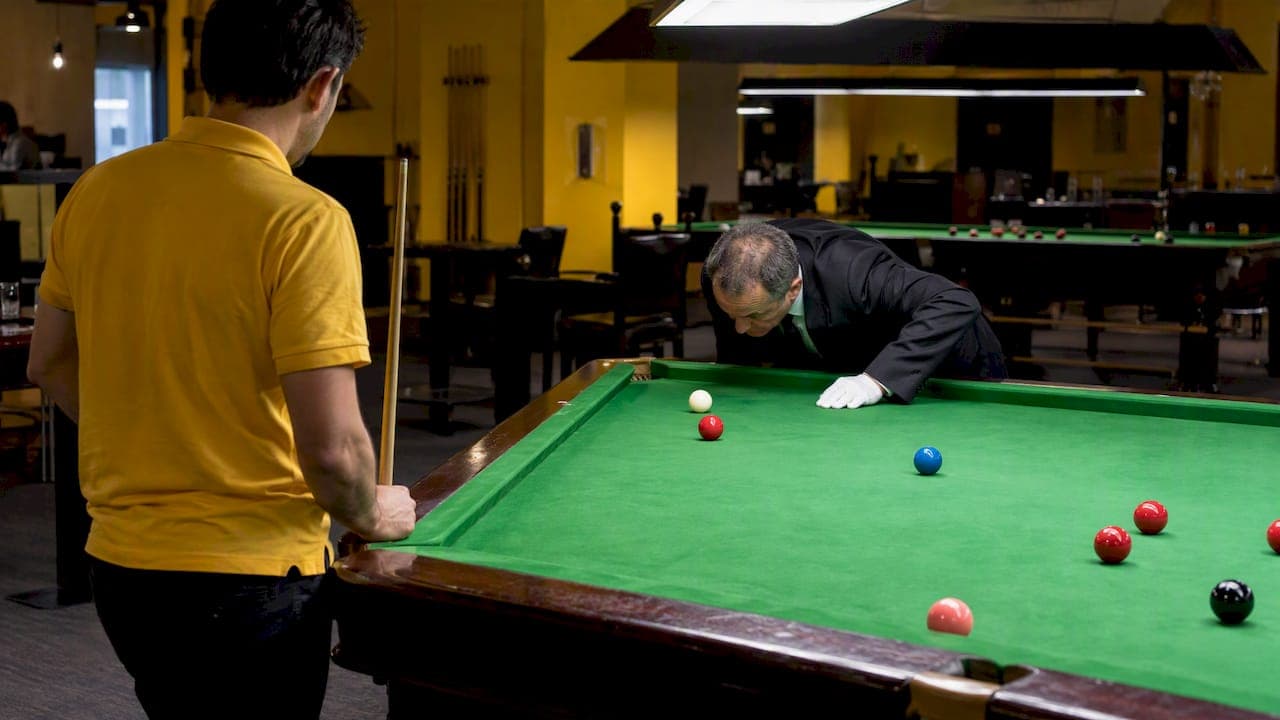
A free ball is a scoring opportunity awarded when the incoming player is snookered on every ball "on" as a direct result of an opponent's foul, letting the player nominate any other ball as a substitute target. If that nominated ball is potted, it takes on the value of the ball actually on and gets respotted when it was a colour. It is a chance to keep a break alive, not a bonus point handed out automatically.
TL;DR:
- A referee awards a free ball only when an opponent’s foul leaves every ball on blocked under the extreme edges test; cushions do not count.
- The nomination applies for one stroke only, and a player who fails to strike the nominated ball first incurs the usual miss penalty.
- A free ball scores the value of the ball on: one point with reds or a colour’s value, and the colour is respotted.
- Potting a free ball as a red can add one point beyond a standard 147 clearance; documented professional breaks have reached 153.
- Standard 8 ball and 9 ball pool do not use snooker’s free ball rule, though local league variants may differ.
Table of Contents
- How the free ball rule works under official snooker rules
- Scoring details: respotting, combined pots, and record-breaking examples
- Common mistakes, fouls, and penalties around free balls
- Referee judgment and tricky free ball situations
- Practical coaching tips and drills from our instructors
- Why learning the free ball rule actually pays off
- Play Smarter and Practice These Situations at Q Billiards Arena
- FAQ
- Sources
How the free ball rule works under official snooker rules
The WPBSA Official Rulebook defines a free ball as a ball, other than the ball on, that the striker nominates as the ball on after being snookered by a foul. The key test is whether the snooker happened because of the opponent's foul, not because of ordinary play. A referee checks this using the "extreme edges" test: a straight line from any part of the cue ball's surface to any part of a ball on must be blocked by an object ball for a snooker to count. Cushions are ignored entirely in this test, even though they might seem to block the shot in a practical sense.
Once a referee confirms a free ball situation, the incoming player has choices. According to SnookerHQ's explainer, the nomination applies only to that single stroke and never permanently replaces the ball on for the rest of the frame.
Before playing the shot, the player generally has three options:
- Play the free ball as nominated, treating it as the ball on for that stroke only.
- Ask the referee to have the offending player replay the shot instead, which can be smarter when the position after a free ball looks worse than the current lie.
- Request ball replacement if the positions of balls were disturbed in a way that voids a fair shot.
The nominee must be declared before the stroke is played, and it can be any ball other than the ball on. Once declared, failing to strike that nominated ball first is treated the same as missing the actual ball on, which brings its own set of penalties.
Scoring details: respotting, combined pots, and record-breaking examples

When a free ball is potted, it inherits the value of whatever is actually on at that point in the frame. If reds are on, a potted free ball scores exactly 1 point, same as potting a red. If a colour is on, the free ball takes that colour's value instead, and because colours always get respotted after being potted during a red-colour sequence, a free ball taken as a colour is respotted just like a normal colour pot would be.
Combined pots follow a specific logic:
- When reds are on and the player pots both the free ball and an actual red in the same stroke, both scores count.
- When a colour is on and the player pots both the free ball and the colour in the same stroke, generally only the ball on counts, since the free ball and the colour can be the same object in some configurations.
- Any colour taken as a free ball gets respotted immediately after potting, keeping the normal break-building sequence intact.
A free ball can push a maximum break past the usual 147 ceiling. Documented professional breaks have exceeded 147, including a 153 compiled after a free ball was awarded and converted during a red-and-colours sequence, as the BBC's coverage of the World Snooker Championship also explains. The extra point comes from potting the free ball as a red before the colours phase even begins, adding one point beyond what a standard clearance allows. For a fuller breakdown of how breaks are built point by point, our guide to snooker scoring walks through the sequence in detail.
Common mistakes, fouls, and penalties around free balls
Free ball situations trip up even experienced players, usually because the rule asks for a decision under pressure. A few errors show up again and again at club level.
- Forgetting to nominate before shooting. The nomination has to happen before the cue ball is struck; playing first and declaring after the shot is a foul.
- Missing the nominated ball first. If the cue ball fails to strike the nominated free ball before touching anything else, it is scored the same as missing the actual ball on, with penalty values matching whichever ball carries the higher value.
- Using a free ball to deliberately snooker the opponent. This is usually a foul, with one notable exception: if the free ball is taken as the final red and the next colour on the table happens to be pink or black, certain additional snooker allowances apply around that specific pink or black situation.
- Confusing snooker rules with pool rules. Free ball concepts do not exist in standard pool games like 8-ball or 9-ball, so league players who switch between formats should confirm which rule set their local league actually uses.
Getting the nomination and contact wrong can cost several points in a single visit to the table, which is exactly the kind of mistake we break down further in our piece on snooker fouls that cost club players the most frames.
Pro Tip: Practice calling your nominated ball out loud before every free ball attempt during solo sessions, so the habit sticks when a referee or opponent is watching during a match.
Referee judgment and tricky free ball situations
Most free ball disputes come down to how a referee applies the extreme-edges test, and cushions never factor into that judgment no matter how tight the actual angle looks. When several balls sit between the cue ball and the ball on, the referee works out which one is the effective snookering ball, since only that ball determines whether the snooker genuinely resulted from the foul.
A few situations call for extra care:
- Multiple obstructing balls: the referee identifies the specific ball causing the block, not just the nearest one.
- Angled-in or jaw positions: a ball sitting in a pocket jaw can still count as a legitimate path to the ball on, meaning no free ball is awarded even though the shot looks awkward.
- Voided free ball options: if the offending player is asked to play again instead, or if ball replacement is granted, the free ball option disappears for that stroke.
When the position is genuinely unclear, asking the referee for a ruling before playing is always the safer move than guessing.
Practical coaching tips and drills from our instructors
Free ball situations reward players who have already rehearsed the shot shape, not players figuring it out live. A simple drill: set up a nominated-ball scenario where the free ball sits near a plant combination, then practice striking it cleanly before moving to a real red. This builds the habit of checking contact first, position second.

Coaches at our tables often advise weighing the free ball against asking the offender to replay the shot, since a weak free ball position can be worse than a fresh start. The most common club-level mistake is rushing the decision under the shot clock instead of reading the full table. For players who want to try these situations on a flexible setup, our guide to setting up snooker on a pool table covers a quick way to practice at home or between sessions, and our games page lists every table type available for drilling these exact positions.
Why learning the free ball rule actually pays off
A free ball is both an escape route and a scoring chance, and most club players only ever see it as the former. Knowing the respotting rule, the combined-pot scoring, and the nomination timing removes the hesitation that turns a good position into a wasted visit. The players who gain the most from this rule are the ones who drilled it before they needed it in a match.
— Q
Play Smarter and Practice These Situations at Q Billiards Arena
We built our Houston tables around exactly this kind of hands-on rule practice, with standard and heated snooker tables rented by the hour so you can set up free ball positions as often as you need. Our Snooker Coaching Camp walks through scoring edge cases like this one with an instructor watching your technique, and our 1-Red Snooker Tournament gives you a live setting to apply the rule under real match pressure. Snooker tables run $15 per hour for standard play and $20 per hour for heated tables, and tournament entry for the 1-Red event is $20. Book a table or reserve a coaching session to turn this rule from something you read about into something you play with confidence.
FAQ
What is a free ball in snooker?
A free ball is a rule that lets the incoming player nominate any ball other than the ball on as a substitute target, awarded only when the player is snookered on every ball on as a direct result of an opponent's foul. If potted, it scores as whatever ball was actually on for that stroke.
When can you call a free ball in pool?
Standard pool games such as 8-ball and 9-ball do not include a free ball rule; it is specific to snooker and English billiards. League variants of pool sometimes borrow similar concepts after a foul, so checking local league rules is worth doing before assuming the snooker version applies.
How much is a free ball worth in snooker?
A potted free ball takes on the value of the ball actually on at that point, so it scores 1 point when reds are on, or the value of whichever colour is on during the colours sequence. Colours taken as free balls get respotted immediately after potting.
Can you snooker your opponent behind a free ball?
Using a free ball specifically to snooker the opponent is usually ruled a foul, since the free ball is meant to resolve a snooker rather than create a new one. One exception involves situations where the free ball is taken as the final red and the next colour on the table is pink or black, which carries its own additional allowance under the rules.
Why can a snooker break exceed the usual maximum of 147?
A free ball potted as a red before the colours phase adds one extra point beyond a standard maximum clearance, which is how professional breaks have reached 153 in documented matches. The extra point comes purely from the free ball counting as an additional red in the sequence.
Sources
- WPBSA Official Rulebook (2024-25 / WPBSA)
- World Snooker Championship 2026: What is a free ball and why are they awarded? - BBC Sport
- Free Ball Rule Explained – SnookerHQ
- Free ball — Wikipedia