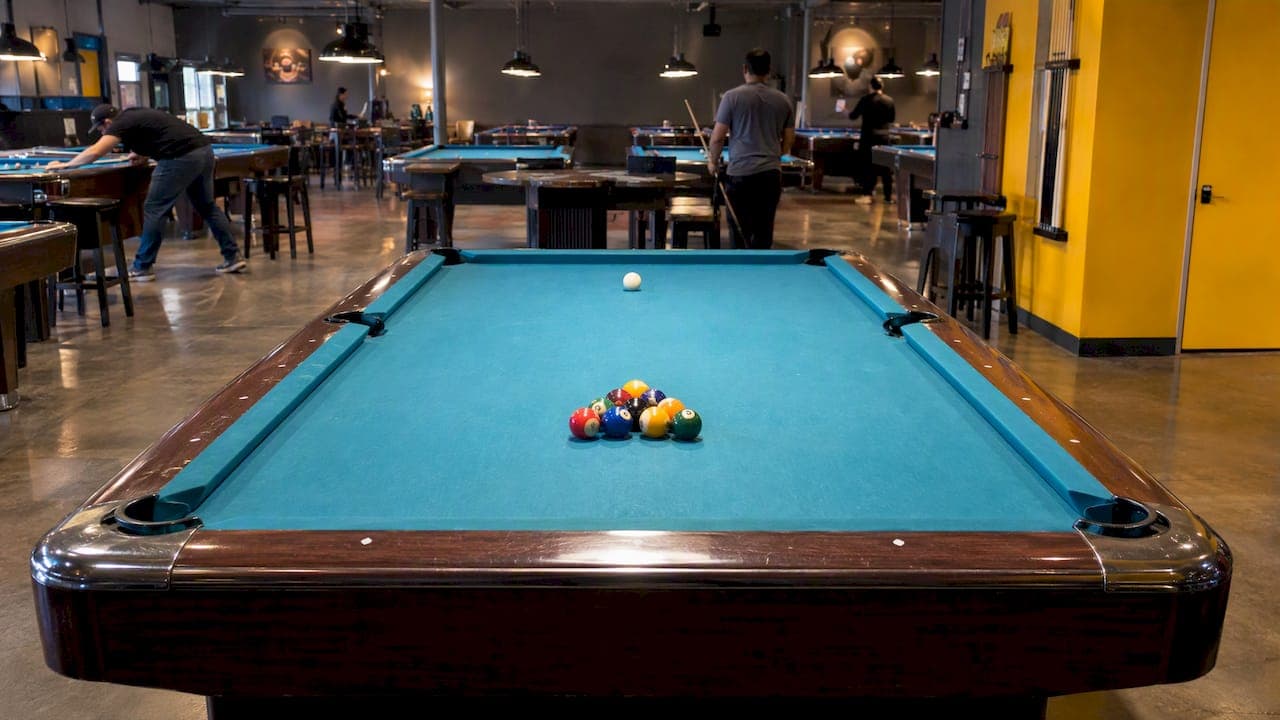
The main advantage of a nine-foot pool table is that it is the professional tournament size. It has a 50 by 100 inch playing surface, longer shots and usually tighter pockets, so it rewards a clean stroke, real cue-ball control and patient planning. The same traits make it harder on beginners, and they decide whether a nine-footer is right for you, your league night or your game room.
Below we cover what the size actually changes at the table, who benefits most, what it takes to fit one in a house, and how to get time on one before you commit.
TL;DR
- A nine-foot table is the standard for professional tournaments, so practice on it carries straight over to serious competition.
- Longer shots and more open space expose weak speed control and sloppy aim, which is exactly why they build fundamentals.
- Experienced and competitive players tend to get the most from it. Beginners often enjoy smaller tables more at first.
- Owning one needs a room of about 14 feet 6 inches by 18 feet 4 inches for a standard 58-inch cue.
- You can test the size at a club before you spend money on a table of your own.
Table of Contents
- What a nine-foot table actually is
- Advantage 1: It is the professional tournament size
- Advantage 2: Longer shots build a better stroke
- Advantage 3: Cue-ball control becomes the whole game
- Advantage 4: Tighter pockets sharpen your shot-making
- Advantage 5: Cloth and playing conditions are closer to the real thing
- Nine-foot versus smaller tables: how play changes
- Who benefits most, and who should wait
- Our view at Q Billiards Arena
- Can you fit a nine-foot table at home?
- A practice plan for your first nine-foot sessions
- Play on big tables in Houston
- FAQ
- Sources
What a nine-foot table actually is
A nine-foot table is defined by its playing surface. The World Pool-Billiard Association specifies a 9-foot playing surface of 100 by 50 inches, measured without the cushions, in specifications effective since November 2001. A current WPA-hosted dimensions guide lists the same 50 by 100 inch surface and notes that the longer playing area makes shots longer and exposes errors faster than on smaller tables.
That is the whole story in one line: the table is not a different game, it is the same game with less forgiveness and more room. Everything below follows from that.
Advantage 1: It is the professional tournament size
If you want to compete, nine feet is the size to know. One buyer's guide describes it as a professional tournament size suited to skilled and competitive players. At the top of the sport, the event guide for the 2024 WPA World 10-Ball Women's Championship lists a Predator Apex 9ft Pro Table as official equipment.
The practical meaning for you: the speeds, angles and distances you practice on a nine-footer are the ones you will meet in a sanctioned event. Table makers say the same about their top models. The nine-foot Gold Crown VII, for example, is described as the full tournament footprint of its platform, giving the geometry and response associated with tournament billiards.
If you play 9-ball or 10-ball in tournaments, it also helps to know the rules that decide racks. Our guide to 9-ball rules on breaks and push outs is a good companion once you are on the bigger table.
Advantage 2: Longer shots build a better stroke
On a nine-footer, a miss by a hair at one end of the table becomes a miss by a mile at the other. One league-focused guide published in June 2026 says a nine-foot table demands a cleaner stroke, more precise cue-ball control and better planning, and that distance misses are more visible.
Another source makes the aiming point plainly: on tournament tables, small aiming errors are magnified over distance. A tiny pivot in your bridge hand that you get away with on a short shot can send a long shot well wide of the pocket.
What this does for your game:
- Straighter stroke. Long shots punish a cue that drifts, so you learn to deliver the tip on the line you aimed.
- Smoother tempo. Rushing shows up fast. The same guide stresses smooth tempo and sound fundamentals.
- Honest feedback. The table does not hide problems with a short, lucky pocket.
The flip side is that it is humbling. If you are used to a smaller table, expect an adjustment period. The same guide notes that players coming from seven-foot tables may need time to adjust.
Advantage 3: Cue-ball control becomes the whole game
On a big table, pocketing the ball is only half the job. Where the cue ball ends up decides whether your next shot is a gift or a gamble. One veteran player's explanation of the large table is that you must control cue-ball speed to get close to the next ball, because otherwise you may leave a shot more than seven feet long, which even professionals can miss.
That pressure trains the skills that separate good players from great ones: speed control, follow, draw, stun and sidespin, plus safety and position play. Dr. Dave's published shot encyclopedia covers all of these, and a nine-foot table is where they matter most.
Position play gets more room to work
The extra space also rewards thoughtful patterns. The June 2026 league guide points to multiple safety lanes and patterns on the bigger table. You can plan one or two shots ahead and route the cue ball around trouble rather than simply hoping for a clear look.
If position play is your weak spot, our five drills for cue-ball control are built for exactly this kind of work, and they scale up well when you move to a larger table.
Advantage 4: Tighter pockets sharpen your shot-making
Most tournament-grade nine-footers have tighter pockets than the typical bar table. One guide on stepping up from a bar box says pockets on tournament nine-foot tables are often 4.5 inches or less, compared with 5 inches or wider on a bar box. That half inch sounds small. On a long shot it is the difference between a ball that rattles in and one that rattles out.
A separate buyer's guide says nine-foot tables are larger and often have tighter pockets, creating longer shots that need more accuracy and speed control.
There is a useful practice point here from a well-known instructor's site: time on a nine-foot table can sharpen fundamentals and pocketing skills, especially if the pockets are tight. The same page adds a caution worth taking seriously: if you compete only on bar boxes, you may do best practicing on a bar box. Train on the equipment you will be tested on.
Advantage 5: Cloth and playing conditions are closer to the real thing
Table size is not the only thing that changes when you move up. The same bar-box-to-big-table guide notes that tournament tables typically use faster worsted cloth rather than the napped cloth found on many coin-operated tables, so you have to recalibrate your speed control.
In plain terms, the ball rolls farther on less effort. Soft touches get easier, and big hits get dangerous. Learning that feel on a well-kept nine-footer is part of the advantage: you are practicing under conditions that look like a serious match, not a bar-night approximation of one.
Nine-foot versus smaller tables: how play changes
Here is a side-by-side look at how the sizes tend to play, based on the sources above.
| Factor | Smaller bar table | Nine-foot table |
|---|---|---|
| Typical shot length | Shorter, more traffic and clusters | Longer, more open table |
| Style | More finesse, less power | Cleaner stroke, precise speed control |
| Pockets | Often 5 inches or wider | Often 4.5 inches or less on tournament tables |
| Cloth | Often napped on coin-op tables | Typically faster worsted cloth |
| Best suited to | Beginners, casual and social play | Competitive and experienced players |
| Needs | Modest room | A large room, with cue clearance |
Bar-box play, according to Dr. Dave's strategy page, involves more traffic and clusters, fewer long shots, and more finesse than power compared with a full-size table. Neither is better in the abstract. They test different skills.
Who benefits most, and who should wait
The honest answer is that a nine-footer is not for everyone on day one. One buyer's guide says competitive and experienced players generally benefit from the largest table their space can fit, while beginners and casual players usually find more success and enjoyment on smaller tables, where shots are shorter and easier to pocket.
In practice:
- League and tournament players: the nine-foot table is your training ground. Everything you rehearse transfers.
- Improving intermediates: you gain the most. The table punishes the habits that cap your progress.
- Beginners and social players: a smaller table is more forgiving and more fun while the basics settle. You can still step up later.
- Players who split time: expect a switch cost. Give yourself a few racks to find your distance and speed before judging your game.
There is a fair counterpoint too. Not every pro plays on nine feet only, and a pro-sized table is not the only legitimate size. A buyer's guide notes that professional players also compete on tables of other sizes. Pick the size that matches the game you want to play.
Our view at Q Billiards Arena

We run a Houston club with 25 professional-grade tables across American pool, snooker, Chinese 9-ball and carom billiards, and we watch the same pattern play out every week. The player who wants to get better is rarely held back by talent. They are held back by never having practiced under conditions that expose their weak spots.
Our advice is simple:
- Practice where the test is. If your league or tournament uses a big table, spend your hourly time on one.
- Slow down your speed first. Before you chase tricky shots, make position routine. A ball left within a short roll of the next shot is worth more than a spectacular pocket.
- Do not skip the smaller table. Short, crowded racks teach you to handle clusters and finesse. Both skills matter.
- Test before you buy. A table at home is a big commitment. A few sessions at a club will tell you if the nine-foot size suits you.
Our weekly tournaments are an easy way to see how your practice holds up. Tuesday and Friday night pool tournaments each carry a $10 entry, and the 1-Red Snooker Tournament is $20. Entry means real match pressure for less than the price of a night out.
— Q
Can you fit a nine-foot table at home?
This is where many people stop. A nine-foot table needs a lot of room, because you have to stand and swing a cue on every side. A manufacturer's listing recommends a room of at least 14 feet 6 inches by 18 feet 4 inches for standard 58-inch cues.
Shorter cues reduce the footprint. The same maker's listing gives minimum room sizes of 14 feet by 17 feet 10 inches with a 52-inch cue, and 13 feet 8 inches by 17 feet 6 inches with a 48-inch cue. Those short cues are a compromise, though. You will run into awkward shots near walls more often.
The general rule is the one the manufacturer's FAQ states: you need enough room to shoot from all sides without your cue hitting a wall. Measure the room, not just the table. For a deeper breakdown of sizes and clearances, see our pool table sizes and room requirements guide.
A common question is whether a 12 by 15 room works. By the figures above, a nine-footer needs a good deal more than that, so a smaller table is the realistic choice for rooms that size.

A practice plan for your first nine-foot sessions
If you are stepping up from a smaller table, try this over a few visits. You will need about an hour per session.
- Warm up with long straight-in shots (10 minutes). Find your stroke line and tempo. Do not worry about position yet.
- Speed-control ladders (15 minutes). Shoot the cue ball down the table and stop it at set distances. This recalibrates your sense of the cloth.
- Stop-shot and follow drills (15 minutes). Pocket a ball, then land the cue ball in a small target zone. Note how often a long miss costs you the shot.
- Play a full rack with a rule (20 minutes). Make every shot leave you within a short distance of the next ball. If you leave a long shot, count it against yourself.
You will likely miss more than you expect in the first session. That is the table doing its job. Keep notes on where you miss, and the pattern will tell you what to fix.
Play on big tables in Houston
If you want to find out how your game handles a bigger, tougher table before buying one, come to Q Billiards Arena. American pool is $10 per hour, Standard Snooker, Chinese 9-Ball and Carom Billiards are $15 per hour each, and Heated Snooker is $20 per hour. You can see the full lineup on our games page.
We are open late, we serve fresh food and drinks at the tables, and our tournaments and events give you a competitive test whenever you want one. Ask our staff about the table sizes available when you arrive.
FAQ
How much space do you need for a nine-foot pool table?
A manufacturer's listing recommends at least 14 feet 6 inches by 18 feet 4 inches for a standard 58-inch cue. With a 52-inch cue the listed minimum is 14 feet by 17 feet 10 inches, and with a 48-inch cue it is 13 feet 8 inches by 17 feet 6 inches. Measure from the table's rails, not the room's center, so you can swing on every side.
Is a nine-foot table harder than a seven-foot table?
Generally yes. The longer shots, tighter pockets on tournament models and faster cloth all demand cleaner aim and better speed control. Many players who are used to seven-foot tables need time to adjust, and some find their kicks and banks feel more precise on the smaller table. The difficulty is also the training benefit.
Is a nine-foot table good for beginners?
It can be, but a smaller table is usually friendlier at first. Shots are shorter and easier to pocket, which helps early confidence. If you want to learn on a nine-footer anyway, keep sessions short, focus on straight shots and expect more misses at the start.
Why do pros and tournaments use nine-foot tables?
It is the recognized professional tournament size, and it tests skills that smaller tables cannot: long-range accuracy, speed control and planning. Events such as the 2024 WPA World 10-Ball Women's Championship listed a nine-foot table as official equipment. Playing on the same size lets you train under the conditions you will compete in.
What is the official size of a nine-foot table?
The WPA specifies a playing surface of 100 by 50 inches, excluding cushions. Allowed tolerance is a small fraction of an inch, so a true nine-footer is a very consistent size from table to table.
Sources
- WPA recommended equipment specifications (effective November 2001)
- Pool Table Dimensions & Regulation Size Explained (WPA)
- Buyer's Guide, Blatt Billiards
- WPA World 10-Ball Women's Championship event guide
- Gold Crown VII 9' Pool Table
- Gold Crown VII 8' Pool Table room sizes
- Billiards.com FAQs
- 7 Foot vs 9 Foot Pool Table: League Play Explained
- Bar Table vs. Tournament Table: Key Differences
- Myth of Playing on a Large Table
- Video Encyclopedia of Pool Shots, Dr. Dave
- Size Does Matter: Your Guide to Pool Tables
- Bar Box to Big Table: What Actually Changes on a 9-Foot
- Bar Box vs. 9-Foot Table Strategy, Dr. Dave Pool Info
- Questions to Ask When Buying a Pool Table