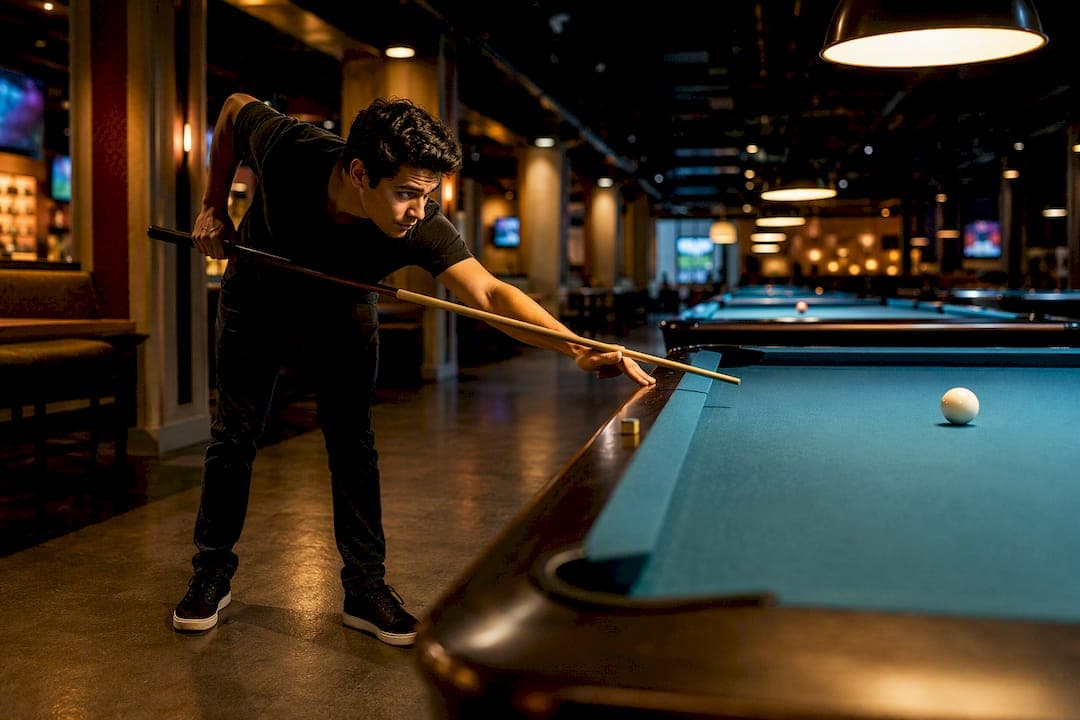
Pool hall essentials are the amenities, rules, and services a venue must provide, plus the handful of items patrons should bring to play or attend events. That means tournament-ready tables, proper lighting, a clear house rulebook, common game offerings like 8-ball and snooker, food and drink service, and straightforward booking for leagues or private events. Competitive nights add a few more expectations, mainly around dress code and equipment. A well-run venue shows what this looks like when it's done right, with many tables and a full events calendar under one roof.
TL;DR:
- Most halls require a clear understanding of rules for both casual and competitive play, with strict conduct and fouling standards enforced during tournaments.
- Table sizes range from 7 to 9 feet, with larger tables demanding more precise cueing and extra space for unobstructed strokes.
- Venue amenities such as cue racks, proper lighting, and food service elevate a hall from decent to top-tier, while equipment maintenance directly impacts gameplay quality.
- Players should bring their own cues, chalk, and accessories, but most venues provide essential equipment like cues and balls, with policies varying on personal gear.
- Booking for leagues, tournaments, or private events usually requires advance confirmation of rules, costs, and capacity, with clear communication avoiding misunderstandings.
Table of Contents
- Pool Hall Essentials: Amenities and Game Types to Expect
- House Rules, Tournament Conduct, and What Patrons Should Know
- Pool Hall Bag Checklist: What to Bring vs. What the Venue Covers
- How Leagues, Tournaments, and Private Bookings Work
- Space, Accessibility, and Table Clearance Standards
- Safety Measures and First Aid at Pool Halls
- Pricing Structures and How to Pay for Table Time
- How Pool Halls Maintain Cloth, Cues, and Balls
- Why the Real Test of a Pool Hall Isn't the Table Count
- Book a Table or Tournament Spot at Q Billiards Arena
- Sources
- FAQ
Pool Hall Essentials: Amenities and Game Types to Expect
A serious venue is built around its tables, and table size isn't just a detail. Bar boxes run around 7 feet, mid-size tables run 8 feet, and tournament setups typically run 9 feet. The bigger the table, the more precise your positional play needs to be, since longer rails punish sloppy cue angles that a 7-footer might forgive.
Beyond the table itself, a handful of amenities separate a decent hall from a great one:
- Cue racks and seating near each table so groups aren't hovering over players mid-shot
- Overhead lighting positioned directly above the playing surface, since the WPA's equipment specifications call for consistent lighting levels to keep the cloth glare free and shots readable
- Chalk stations at or near each table, not buried behind a counter
- Food and drink service you can order without leaving the floor
Game variety matters just as much as table count. Most halls rotate through 8-ball, 9-ball, and 10-ball, with snooker and Chinese 9-ball showing up at venues that cater to a broader crowd, and carom tables appearing where European-style play has a following. Before you book, ask how many tables are dedicated to each game type. A hall listing 25 tables across multiple game formats can usually handle a bigger tournament field or a group night without a two-hour wait for a table to open up.
House Rules, Tournament Conduct, and What Patrons Should Know
Casual play and competitive play run on different rulebooks, and knowing the difference before league night saves you an argument. Most halls handle everyday walk-in games loosely: call your shots, rack fair, don't hover. Tournaments and league nights are stricter, and they borrow heavily from two established rule sets.
- Conduct and fouls. UPA guidance treats distracting behavior, often called "sharking," as grounds for a warning or a ball-in-hand foul against the offender. In matches without a referee, you're calling your own fouls, which means honesty is part of the game, not an afterthought.
- Racking and breaking. UPA's 8-ball rules standardize racking format and legal-break requirements, and players are usually responsible for racking correctly when no official is on hand.
- Equipment swaps. WPA rules allow switching between break, jump, and playing cues mid-match, and gloves or mechanical bridges are fine as long as they're not functioning as aiming aids. Chalk should be applied away from the table, never used as a alignment marker on the rail.
- Dress code. Competitive events can enforce strict attire rules, and the WPA's playing regulations give the tournament director final say on what counts as compliant. If you're unsure, ask before you're standing at the table in the wrong shoes.
Statistic Callout: UPA rules specifically flag ball-in-hand penalties as the standard consequence for interference fouls in singles play, one of the more consistently enforced rules across league formats.
If a table's cloth looks worn or a rail seems dead, raise it with staff before your match starts. Once play begins, your ability to protest table condition drops fast.
Pool Hall Bag Checklist: What to Bring vs. What the Venue Covers
You don't need a full kit to walk into a pool hall, but a few personal items make the night smoother. Here's the honest breakdown.
Bring these:
- Your own cue, if you have a preferred weight or tip
- Chalk, if the house brand isn't your favorite (confirm it's allowed first)
- A glove for your bridge hand, if you use one
- A small towel for sweaty grips
- ID and a payment method for table time or tournament entry
The venue usually provides: house cues, balls, racks, chalk, seating, and the full food and drink menu. If a house cue feels warped or a rack is missing pieces, ask staff for a swap rather than working around it.
Bringing your own balls is possible at some venues, but never assume. House policies vary, and shared tables often require house equipment for consistency and hygiene.
Pro Tip: Keep a compact cue case and stick a small tag or engraving on personal gear. Busy league nights mean a dozen similar-looking cases stacked near the same rack, and yours will not stand out unless you mark it.

How Leagues, Tournaments, and Private Bookings Work
Most halls run a mix of formats: open walk-in play, weekly league nights, structured tournaments, coaching sessions, and private room rentals for parties or corporate events. Knowing which one you're walking into changes what you should ask at the counter.
- Pick your format. Open play is first-come, first-served on hourly rates. League nights and tournaments run on entry fees and set brackets. Coaching camps are scheduled sessions, usually booked ahead.
- Confirm the booking method. Some slots are walk-in only, others need a reservation, and private events almost always require a deposit or minimum spend.
- Ask the right questions before you commit: table capacity, any food or drink minimums, whether equipment is included, dress code for the event, and the cancellation policy if plans change.
For birthday parties or group bookings, get the rules in writing, especially around minimum spend and how many tables are reserved for your group. A verbal confirmation over the phone is fine for a casual Tuesday, but a 20-person party deserves a paper trail.
Space, Accessibility, and Table Clearance Standards
Room size around a table isn't a minor detail. It determines whether you can actually take a full stroke without jamming your cue into a wall or another player's shoulder. An 8-foot table typically needs clear floor space sized to allow comfortable cue strokes with standard cues, while a 9-foot tournament table often requires additional space to permit unrestricted cue extension on every rail.
For accessibility, don't assume. Ask directly about:
- Wheelchair clearance between tables and around seating areas
- Ramp access at entrances if the venue has any elevation change
- Staff availability to help with rack setup or equipment adjustments
Cleanliness expectations are simple but frequently ignored: no food or drinks resting on the rail or cloth, and a hall that brushes and irons its cloths regularly will play noticeably truer than one that doesn't. If a table feels sticky, uneven, or visibly worn, mention it to staff before you rack, not after you've lost three games to a bad roll.
Safety Measures and First Aid at Pool Halls
Cue sports carry lower injury risk than most competitive activities, but a well-run hall still treats basic safety as part of the job. Most venues keep a stocked first aid kit behind the counter or bar for minor cuts, chalk dust irritation, or the occasional pinched finger from rack setup.
Staff should know where that kit is without hunting for it, and larger venues running late hours or hosting tournaments typically have at least one team member trained in basic first response during peak shifts. Ask at the counter if you're ever unsure. It's a fair question, and any hall worth your time will answer it without hesitation.
Floor safety matters more than people expect. Spilled drinks near table legs, loose extension cords for scoring displays, and poorly lit walkways between tables are the more common hazards, not cue-related injuries. A hall with clear sightlines, dry floors, and enough space between tables to move without bumping a shooter mid-stroke is doing the basic safety work right. Late-night hours raise the stakes slightly, since fatigue and a fuller bar can make minor mishaps more likely toward closing. If you notice a hazard, whether it's a wet floor or a frayed cord, flag it to staff immediately rather than working around it. A responsive team fixes it fast; a slow one is a sign to keep your guard up for the rest of the night.
Pricing Structures and How to Pay for Table Time
Most halls charge by the hour per table, with rates varying by game type since equipment and table upkeep differ. American pool typically runs cheaper per hour than snooker, since snooker tables are larger and require tighter cloth tolerances. Heated snooker tables, which keep the cloth at a consistent temperature to reduce cloth swelling from humidity, usually carry a small premium over standard snooker.
Tournament entry works differently from hourly rental. Instead of paying by the hour, you pay a flat one-time entry fee that covers your spot in the bracket, regardless of how many games you end up playing that night.
Payment methods have modernized across most venues: expect card readers at the counter, and increasingly at the table itself for larger halls. Cash is still accepted almost everywhere, but don't assume it's the only option, especially at venues with digital reservation systems tied to online booking.
One thing worth confirming before you sit down: whether the clock starts at reservation time or when you actually rack the first game. Some halls round to the nearest quarter hour, others bill by the exact minute. It's a small detail that adds up over a long night of play.
How Pool Halls Maintain Cloth, Cues, and Balls
Table condition degrades faster than most casual players realize, and the difference between a hall that maintains its equipment and one that doesn't shows up in how a ball rolls. Cloth needs regular brushing to lift chalk dust and debris out of the weave, followed by ironing to keep the nap flat and consistent. Skip that routine for a few weeks and shots that should roll true start drifting, especially on longer rail-to-rail shots.
House cues take a beating from constant use, and a well-run hall checks tips regularly for flattening or mushrooming, since a worn tip changes how the cue ball reacts on contact. Warped shafts get pulled from rotation rather than left in the rack for an unsuspecting player to grab.
Balls need less attention but aren't maintenance free. Chalk residue builds up on the surface over a busy night, and a dirty cue ball can throw off spin and speed in ways that are hard to diagnose mid-game. Venues that clean sets regularly, or at least keep spares in rotation, tend to have a noticeably more consistent playing feel than ones that don't.
None of this maintenance is visible to a casual walk-in, but you'll feel it in how the table plays. If shots keep behaving unpredictably in ways that aren't your fault, it's worth asking staff when the cloth was last serviced.
Why the Real Test of a Pool Hall Isn't the Table Count
Most players judge a hall by the number on the door, how many tables it lists, how big the space is. That's the easy metric, and it's also the least useful one. A venue can have two dozen tables and still feel disorganized if the cloth is neglected, the rules aren't posted anywhere, and staff can't answer a basic question about dress code before a tournament.

What actually separates a good hall from a great one is consistency between what's promised and what's enforced. Does the venue actually apply UPA conduct rules on league night, or does it let sharking slide because confrontation is awkward? Does staff know the WPA dress code well enough to explain it before someone shows up in the wrong shoes, or does that conversation happen for the first time at the check-in table? Q Billiards Arena's approach, running structured formats across American pool, snooker, and Chinese 9-ball inside an 11,000 square foot space with 25 tables, suggests the operational discipline matters as much as the square footage. Late hours and a full tournament calendar only work if the rules behind them are consistent night after night.
If there's one piece of conventional wisdom worth pushing back on, it's the idea that more tables automatically means a better night out. A smaller hall with clean cloth, clear rules, and staff who actually enforce them will beat a bigger one running on autopilot, every time.
— Q
Book a Table or Tournament Spot at Q Billiards Arena
This venue covers the essentials this guide just walked through: tournament-grade tables, posted house rules, food and drink service, and a full events calendar, all under one roof instead of scattered across venues that only handle part of what you need.
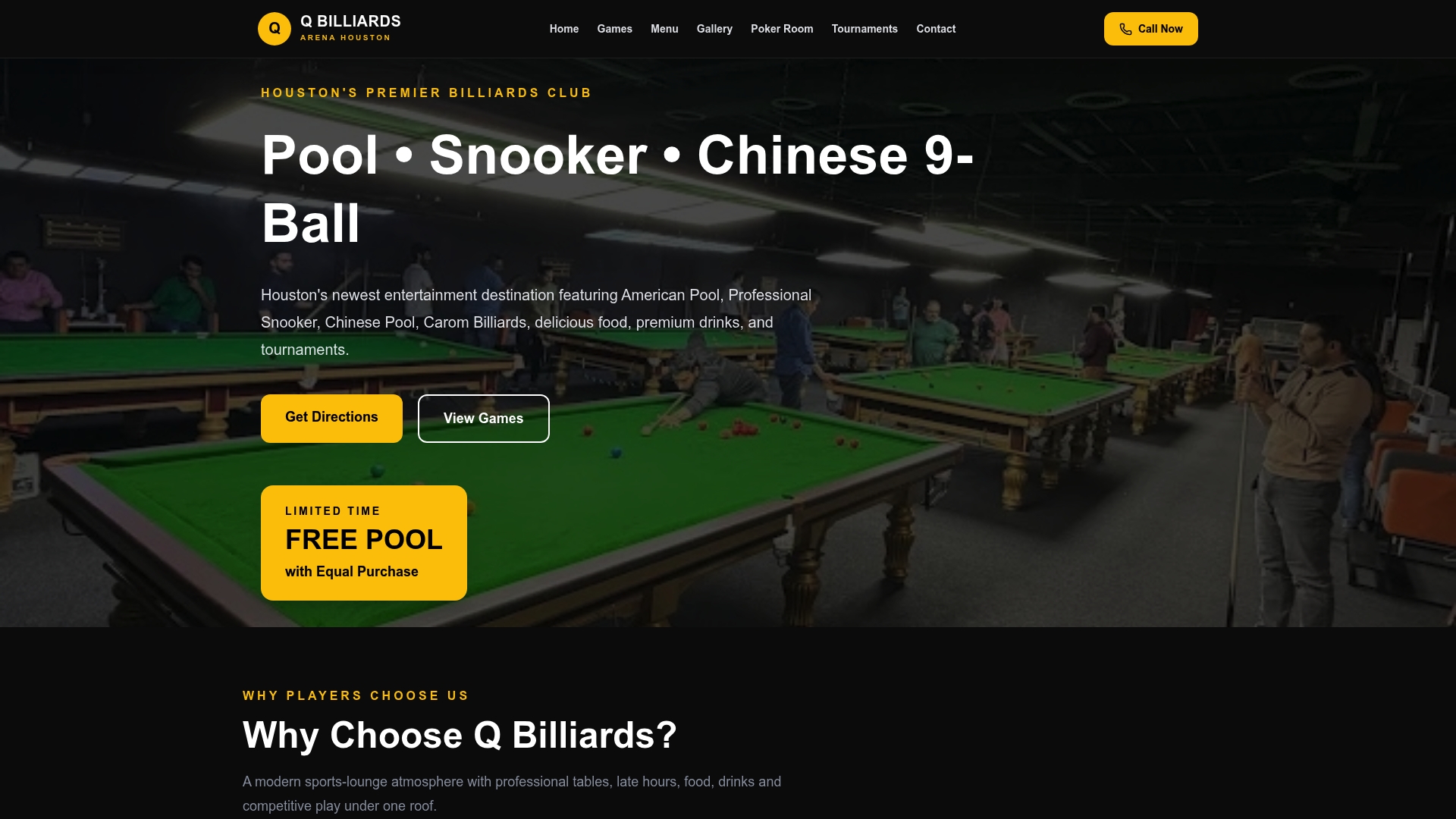
Check the games and hourly rates before you head over, since pricing varies by game type, from American pool to heated snooker, with prices listed on the venue’s site. If you're aiming for league night or a bracket, the tournament schedule lists entry fees and upcoming dates. Before any competitive event, confirm the dress code and reservation details directly with the venue, since tournament directors have final say on what's allowed at the table. Planning a private party or group outing? Reach out ahead of time to ask about accommodations or group pricing so your night runs smooth from the first rack.
Sources
- UPA Official Singles Guidelines
- WPA Playing Regulations (2025)
- UPA 8-ball rules
- WPA Recommended Equipment Specifications
FAQ
Do I Need to Bring My Own Cue?
No, most halls provide house cues at no extra charge beyond your table rate. Bringing your own is common among regular players who prefer a specific weight or tip, but it's never required for casual or league play.
What Should I Wear for League Night?
Casual league nights rarely enforce a strict dress code, but tournaments often do, and the WPA's playing regulations give the tournament director final authority over what counts as acceptable attire. When in doubt, ask the venue ahead of time rather than guessing.
Can I Reserve a Table for a Party or Private Event?
Yes, most halls including Q Billiards Arena offer private bookings for parties, group outings, and events, usually through a poker room or private area rental. Confirm deposit requirements, minimum spend, and capacity before you finalize the date.
How Much Does It Cost to Play Pool at a Venue Like This?
Rates vary by game type. At Q Billiards Arena, American pool runs $10 per hour, standard snooker $15 per hour, and heated snooker $20 per hour. Tournament entry fees are typically a flat one-time cost separate from hourly table rates.
What Happens if I Break a House Rule During a Match?
Consequences depend on the severity and whether a referee is present. UPA guidance treats interference or unsportsmanlike conduct as grounds for a warning or a ball-in-hand foul, and repeated violations can affect your standing in a tournament bracket.