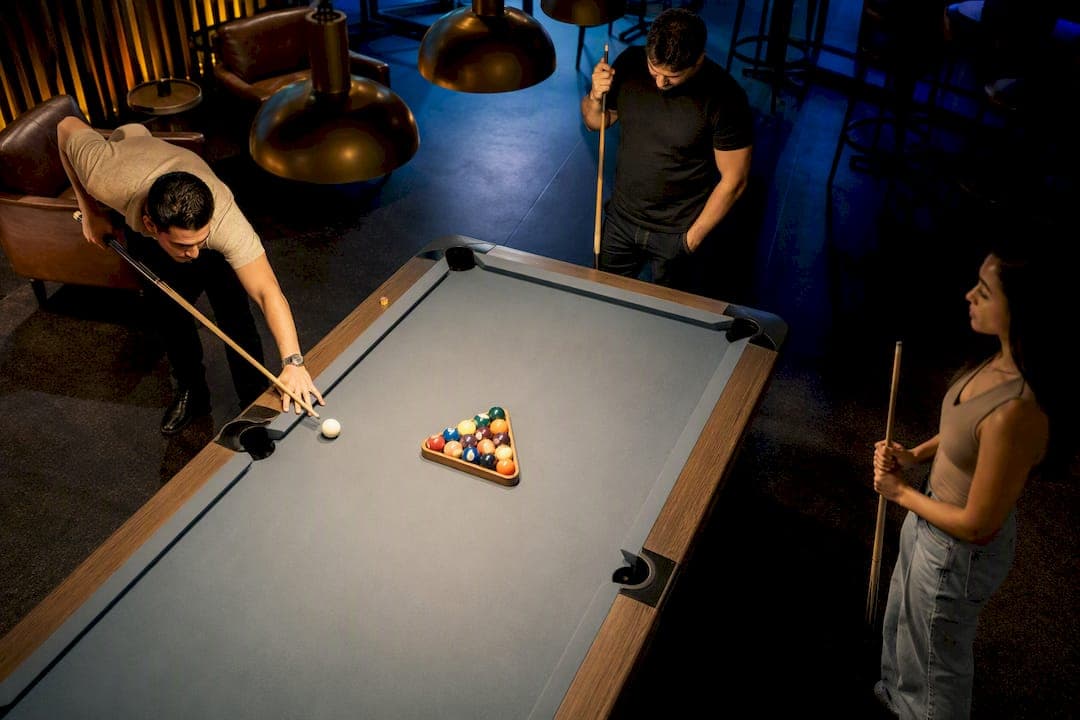
The last player with at least one of their assigned balls still on the table wins. Everything else in cutthroat pool builds on one requirement: your cue ball has to hit an opponent's ball before it touches anything else, every single shot. Agree on call-shot or slop before the first break, and you'll skip the argument that ends more casual cutthroat games than any rule confusion ever does.
TL;DR:
- Most fouls in cutthroat involve failing to contact an opponent’s ball first or scratching, with penalties including spotting opponents’ balls back onto the table.
- A legal shot requires the cue ball to hit an opponent’s ball first and then pocket a ball or contact a cushion; failing either results in a foul.
- Spotting rules and how fouls are managed are critical points, especially since a foul can reintroduce a previously pocketed player’s ball, affecting game dynamics.
- Call-shot rules are standard for tournaments, while casual games tend to use slop, with pre-agreed rules on foul penalties and spotting to prevent disputes.
- The game’s equipment is standard, with no special balls or tables needed, but rules on spotting and fouling can vary depending on player group size and house rules.
Table of Contents
- Cutthroat Pool Rules for Setup: Balls, Rack, and Groups
- What Makes a Legal Shot in Cutthroat Billiards
- Breaking and Claiming Groups Without a Fight
- Fouls, Scratches, and Spotting Rules Explained
- Winning, Elimination, and Tricky Endgame Calls
- Cutthroat Pool Variations: Call-Shot vs. Slop and Player Adjustments
- Playing Smarter: Defensive Strategy That Actually Wins Games
- Turn Order and Rotation: Who Shoots When
- Handling Simultaneous Fouls and Disputed Calls
- Scoring and Penalties Across Different Player Counts
- Do You Need a Shot Clock for Cutthroat?
- Equipment That Fits the Game: Tables and Balls
- How Q Billiards Arena Runs Cutthroat Night
- Where These Cutthroat Pool Rules Come From
- A Straight Take on Cutthroat's Most Argued Rules
- Sources
Cutthroat Pool Rules for Setup: Balls, Rack, and Groups
Cutthroat runs on a standard set: 15 numbered object balls, one cue ball, and a triangle rack. No special equipment required, which is part of why it's such a popular three-player option at pool halls and home tables alike.
The classic rack places the 1 ball on the foot spot, with the 6 and 11 balls anchored in the two back corners of the triangle. That placement isn't random. It spreads the three ball groups evenly through the rack, so no single player's set clusters together where one good break shot could wipe them out early.
Three ways to split the groups:
- Pre-assigned: Balls 1 through 5 belong to Player 1, 6 through 10 to Player 2, and 11 through 15 to Player 3, decided before the break.
- Claim after break: Everyone breaks first, then claims whichever group they pocketed from or feel the strongest defending.
- Random draw: Groups get assigned by lot, which keeps things fair when nobody wants to "guess" their way into a weak set.
Claim-after-break rewards a strong break shot, while pre-assigned and random draw keep the game simpler for beginners.
What Makes a Legal Shot in Cutthroat Billiards
Every turn hinges on the same two-part test, and it's worth memorizing before your first rack:
- The cue ball must contact an opponent's object ball first. Hit your own ball first, even by accident, and it's a foul, regardless of what happens after.
- After that first contact, something has to happen. Either a numbered ball drops into a pocket, or a ball (any ball, including the cue ball) touches a cushion. A shot that satisfies neither is a foul, even if the first-contact rule was followed correctly.
Legally pocketing an opponent's ball keeps your turn alive. Miss, foul, or fail to meet the shot requirements, and the table passes to the next player in rotation, per the WPA's cutthroat pool guidelines.
There's a wrinkle worth flagging early: pocketing your own ball isn't itself a foul, but it does remove that ball from your own group, edging you closer to elimination. Hitting your own ball first is the actual violation. New players often confuse the two, thinking any contact with their own balls is illegal. It isn't. The cue ball just can't touch one of your own balls before it touches an opponent's.
Breaking and Claiming Groups Without a Fight
An open break in cutthroat means anyone can be shooting on any group once the balls scatter, at least until groups get locked in. A legal break generally requires either pocketing a ball or driving at least four numbered balls into the cushions, a standard drawn from BCA cut-throat rules.
If you're using claim-after-break assignment, whatever the breaker pockets often determines which group they claim, or at minimum gives them first pick. That's part of why a strong break carries more weight in cutthroat than in games like 8-ball.
When the break comes up short of legal, groups usually pick from three remedies:
- Re-rack and break again, typically by the same player.
- Accept the table as it sits and continue play from wherever the balls landed.
- Pass the break to the next player, giving someone else the chance at a clean start.
Decide which remedy your group prefers before you rack, not after a disputed break.
Fouls, Scratches, and Spotting Rules Explained
Fouls in cutthroat cost you more than a lost turn. They can hand your opponents a second life. Here are the ones that come up most:
- Hitting your own ball first before contacting an opponent's ball.
- Scratching (sinking the cue ball).
- Failing to satisfy the contact requirement (no rail, no pocket after first contact).
- Jumping a ball off the table, which is treated as a foul in most rule sets.
The standard penalty, per BCA cutthroat rules, is spotting: each surviving opponent gets to return one of their previously pocketed balls to the table. That single mechanic is what separates cutthroat from most other pool games.
Spotting can bring eliminated players back into the game. If you've lost your last ball and get eliminated, a foul by either remaining opponent can put one of your balls back on the table, and you're back in it. Groups should decide upfront whether they're using this full spotting rule or a coin-op variant, where balls can't be freely returned and the fouling player instead loses one of their own remaining balls, a common workaround noted in cutthroat's rule history).
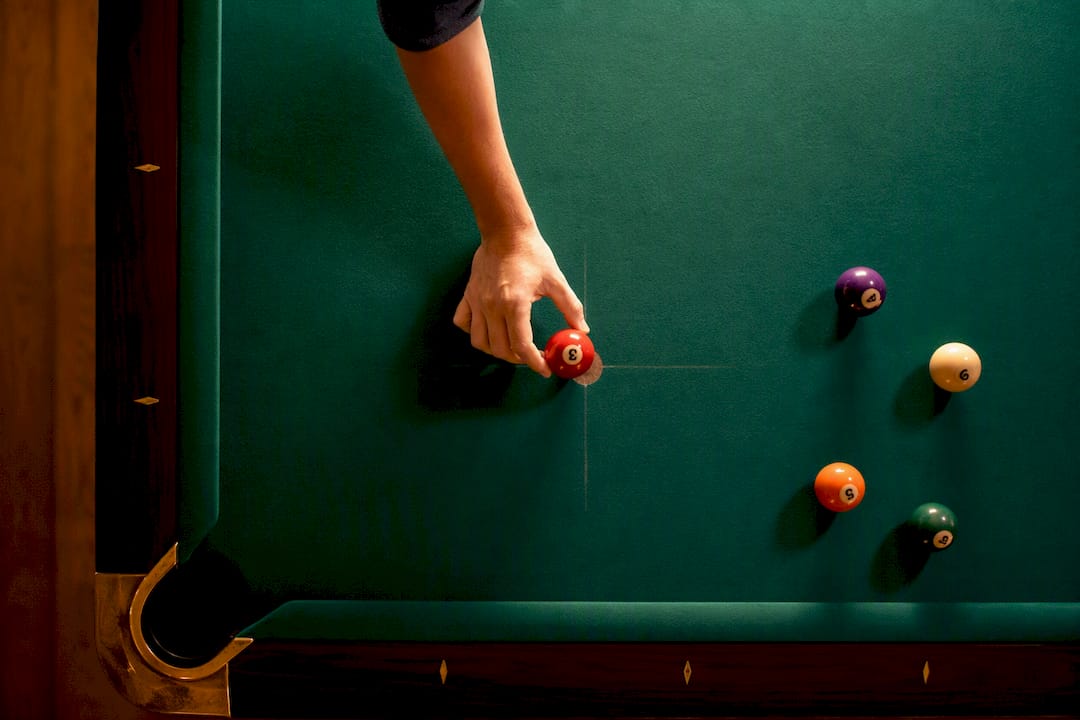
Cue-ball-in-hand after a foul also varies by house rule: some groups restrict placement to behind the head string, others allow anywhere on the table. And if a foul happens on the same shot as a legal pocket (say, a combination shot that also scratches), the foul typically overrides the pocket for scoring purposes, though the opponent's ball still stays off the table.
Winning, Elimination, and Tricky Endgame Calls
You win by being the last player with any ball from your original group still on the table. That's the whole objective, restated simply because it drives every decision late in the game.
Elimination happens the moment your last ball disappears, whether pocketed by you or an opponent. But elimination isn't always permanent:
- Opponent fouls after you're eliminated can spot one of your balls back, putting you back in contention.
- Scratching on your own last ball is usually treated as elimination just like any other loss, unless a house rule says otherwise.
- When only one ball remains between two players, spotting order (who gets the ball back first) should be settled before it becomes an argument.
Write your group's edge-case answers down before they matter, not during the tense moment when they do.
Cutthroat Pool Variations: Call-Shot vs. Slop and Player Adjustments
The single biggest source of arguments in cutthroat isn't a foul, it's whether a lucky shot counts. Call-shot requires you to declare which ball and pocket before you shoot; anything else is a miss even if a ball drops. Slop counts any legally pocketed ball, planned or not. Tournament and league play defaults to call-shot; casual home-table nights usually run on slop because it keeps the pace up, a distinction confirmed across most cutthroat how-to guides.
| Rule style | Best for | Trade-off |
|---|---|---|
| Call-shot | Competitive or tournament play | Slower, but eliminates disputed "lucky" pockets |
| Slop | Casual, social games | Faster pace, but invites arguments over accidental shots |
| more than 3 player adjustment | Larger groups | Groups shrink to smaller balls each, or players share a rotating group |
| Coin-op default | Bar tables without free spotting | Fouling player removes one of their own balls instead |
For four or five players, most groups shrink the standard 5-ball groups down or have players share a rotating group, since 15 balls don't divide evenly beyond three players. If you're playing on a coin-operated table, decide beforehand whether you're using the standard spot penalty or the coin-op substitute, since ball-jumping and coin-op fouls get handled differently depending on the table.
Playing Smarter: Defensive Strategy That Actually Wins Games
Cutthroat rewards patience over aggression more than almost any other pool variant. With three players gunning for your balls instead of one, potting recklessly just paints a target on whatever you leave behind. Leaving your opponent with no legal shot, a snooker, often does more damage than sinking a tough ball ever could, a point emphasized in WPA's strategy notes on the game.
Clustering is your best defensive tool. If two of your balls end up frozen together near a rail, they're harder for either opponent to separate cleanly, which buys you time and reduces how often you're the one under attack.
Three drills worth running before your next game night:
- Behind-the-string safety returns. Practice leaving the cue ball behind the head string while two object balls sit frozen together, rehearsing the shape you'd need after a foul.
- Cluster creation. Deliberately bank a ball into a rail near one of your own, then measure how much harder it becomes for a training partner to separate them.
- Two-rail position drills. Focus purely on cue-ball control, sending it two rails away to land near a specific spot rather than pocketing anything.
Pro Tip: Before your turn, scan for the shot that hurts your opponents most, not just the one that looks easiest. A tough safety that blocks two players beats an easy pot that only threatens one.
Turn Order and Rotation: Who Shoots When
Turn order in cutthroat follows strict rotation, same as most pocket billiards games: Player 1, then Player 2, then Player 3, repeating in that fixed sequence for the entire game regardless of who's ahead or behind on balls remaining.
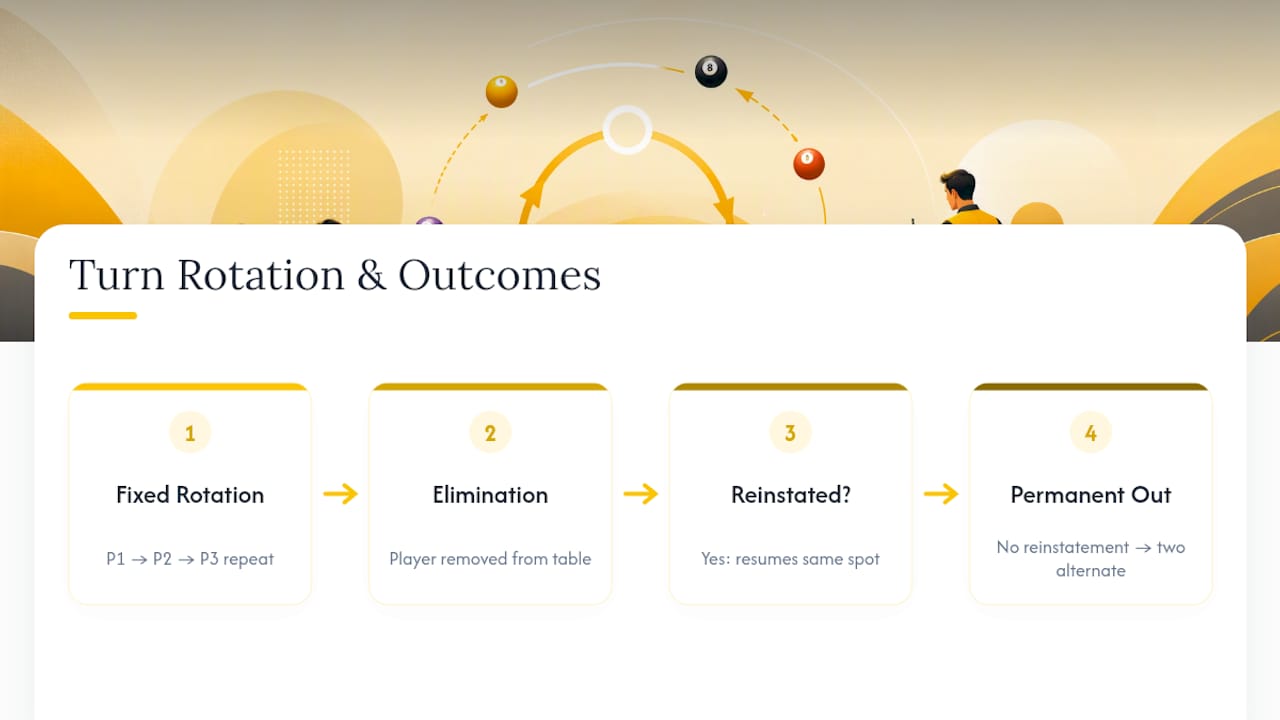
The order established before the break stays locked for the whole game. You don't get to skip a struggling opponent or reorder players based on how the table looks. This matters more in cutthroat than in two-player games because a bad rotation position, shooting right after someone who left the table wide open, can swing the whole match.
One quirk specific to cutthroat: elimination doesn't remove a player from the rotation entirely if spotting rules are in play. An eliminated player who gets reinstated through an opponent's foul simply resumes their spot in the normal turn order when it comes back around, rather than being skipped or added to the end. That keeps the game from turning into a shifting mess of special cases mid-rack.
If a player is eliminated permanently (no reinstatement rule in use, or no fouls left to trigger one), the remaining two players simply continue alternating turns until one of them clears the table of the other's group. At that stage, cutthroat effectively becomes a two-player endgame, and many groups shift their expectations toward tighter safety play once it's down to a straight duel.
Decide before the game whether a reinstated player rejoins mid-rotation or waits until the next full cycle. Most house rules use the former, but it's worth confirming with your group.
Handling Simultaneous Fouls and Disputed Calls
Two situations cause more arguments than anything else in cutthroat: a shot that might be a foul and might not, and a shot where two things seem to happen at once, like a scratch on the same stroke as a legal pocket.
For genuinely disputed calls (did the cue ball touch the rail before or after contact, was that first hit really an opponent's ball), the cleanest fix is agreeing on an arbiter before play starts. In casual games, that's usually the player not currently shooting, or a rotating "neutral" caller if you're four or more deep. In league or tournament settings, BCA and WPA rule frameworks both point toward a designated referee or the most senior player present handling contested calls.
When a shot involves a foul and a legal pocket on the same stroke, the standard resolution treats the foul as controlling: the shooter's turn ends, spotting penalties apply as usual, and the pocketed ball stays off the table regardless of whether the pot itself would have been legal on its own. This trips people up constantly. A player sinks an opponent's ball beautifully, then scratches on the same shot, and assumes the pot cancels out the penalty. It doesn't. Both things happened. The foul still costs them their turn and triggers spotting.
For simultaneous fouls, rare but they happen when a ball jumps the table on the same shot as a scratch, apply the more severe standard penalty rather than stacking both. Most groups spot one ball per opponent regardless of how many separate fouls occurred on a single stroke, unless your house rules explicitly say otherwise.
Write your dispute-resolution method into your pre-game agreement, right alongside call-shot versus slop. It takes ten seconds and saves entire evenings.
Scoring and Penalties Across Different Player Counts
Cutthroat's scoring stays simple no matter the group size: you're not counting points, you're counting survival. The player with a ball left standing wins. But the penalty structure shifts depending on how many people are at the table, because spotting only works cleanly when there are opponents with pocketed balls to spot from.
In a standard three-player game, a foul lets each of the two remaining opponents spot one ball. That's straightforward. With four or five players, spotting gets trickier since more people are eligible to reinstate a ball, and groups need to agree whether every remaining opponent spots one ball on every foul (which slows the game considerably) or whether spotting is capped, say, to one ball total per foul, distributed by whoever's turn is next.
Smaller groups sharing five-ball sets across four or five players also means each foul carries more relative weight. Losing one ball out of five hurts more than losing one out of five when there are only three players splitting 15 balls evenly. Some groups compensate by reducing the spotting penalty for larger games, spotting a ball only every other foul, or requiring two fouls before a spot is triggered, to keep games from dragging into constant back-and-forth reinstatement.
Coin-operated tables add another layer, since balls dropped into the return mechanism usually can't be pulled back out for spotting. That's why the coin-op substitute penalty (removing one of the fouling player's own balls instead of returning an opponent's) shows up so often on bar tables regardless of player count. It's a workaround forced by the equipment, not a strategic choice.
Whatever variant you use, the fix for confusion is the same: settle penalty scaling for your specific player count before the balls are racked, not mid-game when someone's already arguing about it.
Do You Need a Shot Clock for Cutthroat?
Most casual and even league-level cutthroat games run without any formal shot clock. Pool, generally, has been slower than other cue sports to adopt timing rules outside of top-tier professional competition, and cutthroat, being a social, three-player game by nature, tends to lean even further toward relaxed pacing.
That said, larger groups or busy pool halls sometimes introduce an informal time guideline, often nothing more official than "shoot within a reasonable amount of time" enforced by social pressure rather than an actual clock. If you're running a house tournament or league night and want more structure, a simple shot clock (commonly somewhere in the 30 to 60 second range per shot in competitive formats generally) can keep four or five simultaneous games moving without any single match eating the whole night.
The bigger practical issue in cutthroat isn't individual shot speed. It's decision time on safety shots, since defensive play (discussed earlier) requires reading the table for multiple opponents at once, not just one. A player weighing three different safety options against two separate opponents legitimately needs more thinking time than someone deciding between two shots in a straight one-on-one game.
If your group wants pacing rules without the rigidity of a strict clock, a reasonable middle ground is capping deliberation on safety shots specifically, since those are where games tend to stall, while leaving straightforward pot attempts unrestricted. Whatever you choose, treat it as a house rule you agree on for the night, not a universal law of the game, since most authoritative rule sets don't mandate one at all.
Equipment That Fits the Game: Tables and Balls
Cutthroat doesn't require anything beyond what a standard pool hall or home setup already has. It runs on the same tables used for 8-ball, 9-ball, and most rotation games, meaning any regulation table works fine, whether that's a bar-sized table around 7 feet or a full-size 9-foot table more common in leagues and tournaments.
The ball set is identical to straight pool and most rotation games: 15 numbered object balls (1 through 15) plus one cue ball, all standard 2.25-inch regulation pool balls. There's no special coloring, numbering, or sizing unique to cutthroat. What makes the equipment "cutthroat-specific" isn't the gear itself, it's how the 15 balls get divided conceptually into three ownership groups of five, a distinction that exists in the rules, not on the balls themselves.
One practical equipment note worth knowing: because cutthroat depends heavily on spotting balls back onto the table after fouls, tables with old-style gravity return systems (common on some coin-op setups) can make spotting awkward if pocketed balls aren't easily retrievable mid-game. That's part of why the coin-op foul substitute exists in the first place. If you're playing at a hall with modern individual ball return trays, standard spotting works exactly as written in the rules with no workaround needed.

Cue selection doesn't differ from any other pool game either. Whatever cue you'd normally play 8-ball or 9-ball with works fine for cutthroat, since the skills that matter most, cue-ball control and safety positioning, depend far more on practice than on equipment specs.
How Q Billiards Arena Runs Cutthroat Night
We default to slop for casual cutthroat nights and switch to call-shot for anything tournament-adjacent, since our regulars would rather keep the pace up on a Tuesday night than argue about a bank shot. Before racking, we announce three things: which shot-calling rule is in effect, whether ball-in-hand after a foul is restricted to behind the head string, and how we're handling scratches on a player's last ball.
If you want to run these rules on a real table instead of a kitchen setup, our games and pricing page covers open-play hours, and our tournament schedule lists upcoming cutthroat and rotation events for anyone ready to test these rules under real pressure.
Where These Cutthroat Pool Rules Come From
These rules draw on the BCA's cut-throat rule set and the WPA's official playing guide, the two most cited references for competitive play. For related house-rule guidance, see our notes on running pool night group games.
A Straight Take on Cutthroat's Most Argued Rules
Most disputes in cutthroat trace back to groups skipping the five-minute conversation that prevents them: call-shot or slop, and how spotting works after a scratch. Every rulebook covers the mechanics fine. What they don't fix is the human tendency to assume everyone's playing the same version you learned as a kid.
Here's the uncomfortable part: cutthroat's spotting rule, the thing that lets an eliminated player claw back into the game, is also the rule most people misremember or misapply. It's not optional flavor. It's the mechanic that makes cutthroat fundamentally different from straight elimination games, and skipping it (or applying it inconsistently) changes the entire strategic character of the match. A player who thinks they're safely out of contention plays looser. A player who knows a single opponent scratch could put them back in the game plays every safety shot differently.
The call-shot versus slop debate gets more attention, but it's honestly the easier fix. Slop for casual nights, call-shot for anything with stakes, decided once before the break. Spotting deserves the same upfront clarity, because it's the rule most likely to blindside someone three racks into a game they thought they'd already lost.
— Q
</br>