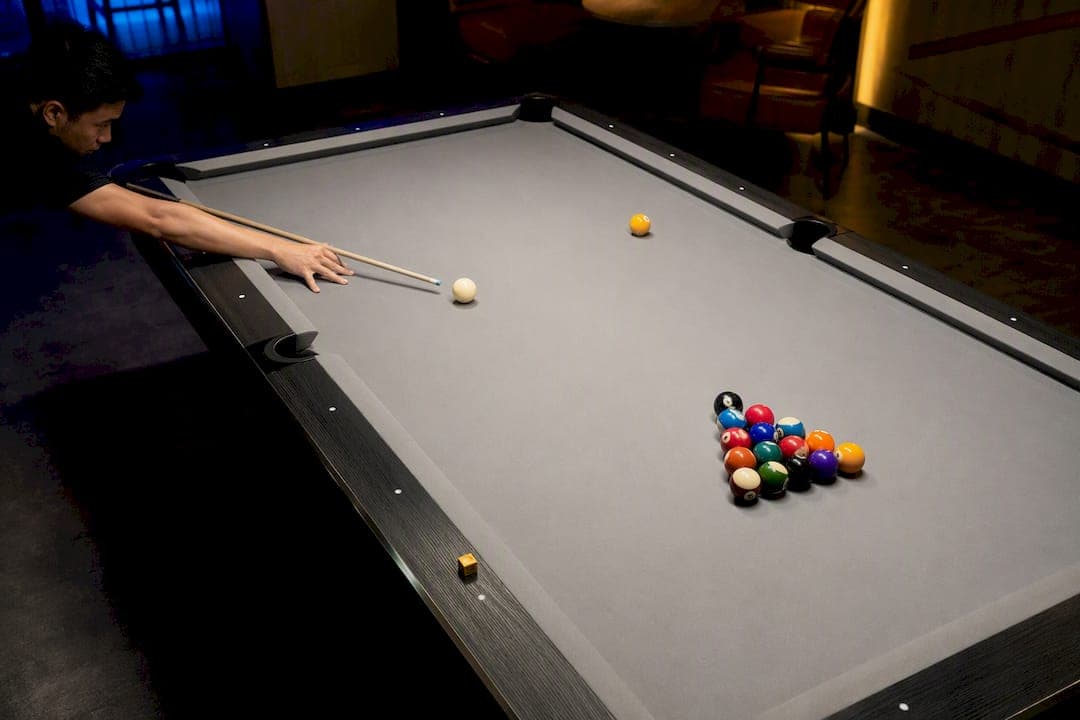
Straight pool, officially called 14.1 continuous, awards one point for every legally pocketed ball you call before the shot, and the game runs in a continuous string of racks rather than resetting each time. Fifteen balls go into play; once fourteen are pocketed, they get re-racked while the last ball stays on the table, and the shooter keeps their turn going until they miss, foul, or reach the agreed target score. Miss the call, foul on the break, or rack up three fouls in a row, and you lose points accordingly: the penalties for these fouls are defined in official rules and can be several points each.
TL;DR:
- The opening break must contact the balls legally with the cue ball in hand behind the head string, or a foul deducts two points.
- Re-racking after 14 balls are pocketed involves placing only 14 balls back into the triangle, with the remaining ball staying on the table and verification by a referee at tournament level.
- Fouls like scratches or no-rail contact cost one point, but three consecutive standard fouls trigger a 15-point penalty and a full re-rack.
- Players must call both the ball and the pocket before each shot, and illegal push or double hits are treated as fouls ending the inning.
- During the match, the table remains as is after fouls, except for the opening break and three-foul re-rack, which require specific reshoots or re-racks per rules.
Table of Contents
- What Are the Basic Rules of Straight Pool?
- Lagging and the Opening Break: Who Shoots First?
- How Racking and Re-Racking Work in Straight Pool
- Calling Your Shots: What You Must Announce
- Scoring, Standard Fouls, and the Three-Foul Penalty
- Spotting Balls and Handling Rack Interference
- Innings, Match Length, and How Ties Get Broken
- Break-Ball Strategy and a Drill Worth Running
- Fouls Beyond the Scoresheet: What Else Changes
- Scratches and What Happens When the Cue Ball Drops
- Push Shots and Other Moves That Aren't Allowed
- Whose Turn Is It, and What Happens on a Bad Hit?
- Do Fouls Reset the Break Shot or Just End the Turn?
- Why Rules Fluency Makes Straight Pool More Fun
- Where to Verify These Rules Yourself
- Sources
What Are the Basic Rules of Straight Pool?
The objective is simple to state and hard to execute: reach an agreed target score before your opponent does. Most casual matches at a club run to a commonly agreed target score, while tournament play often uses higher target scores that reward patient, methodical shot selection over flashy pocketing.
The equipment is standard American pool gear with one wrinkle. You need all fifteen numbered object balls, a cue ball, and a triangle rack, played on a standard 9 foot table with 2 1/4 inch balls in most club and tournament settings.
Here's what makes the game "continuous":
- Players shoot in innings, taking as many shots as they can legally string together in one visit to the table.
- Once 14 of the 15 object balls are pocketed, the table gets re-racked, and the remaining ball stays in play as a bridge into the next rack.
- A single inning can span multiple racks. Elite players have run well over a hundred balls without missing.
- The "14.1" name comes directly from this mechanic: 14 balls racked, 1 left on the table to link the runs together.
That continuity is the entire identity of the game, and it's why straight pool rewards positional play more than any other pool variant.
Lagging and the Opening Break: Who Shoots First?
Before anyone racks a single ball, two players lag for the break. Each shoots a ball from behind the head string down to the foot rail and back, trying to leave it closest to the head rail without touching a rail cushion behind it. Whoever gets closer chooses to break or defer.
The opening break comes with strict legal requirements under WPA tournament rules, and skipping them costs you points immediately.
- The cue ball starts in hand anywhere behind the head string for the opening shot.
- A legal break either pockets a called ball or drives the cue ball plus two object balls to contact a rail after the cue ball hits the rack.
- Falling short of either condition is a breaking foul, which subtracts two points from the offender's score.
- The non-offending player then chooses: accept the table as it sits, or require the offender to break again from scratch.
That last option matters more than it sounds. A weak, unintentional break can leave balls scattered in a way that's actually favorable to the opponent, so forcing a re-break is sometimes the smarter call than playing the mess in front of you.
How Racking and Re-Racking Work in Straight Pool
The opening rack goes down with the apex ball centered on the foot spot, exactly like a standard 8-ball or 9-ball rack. Traditional club racking places the 1-ball at the apex and the other numbered balls scattered without pattern, since calling shots makes ball placement irrelevant beyond looking tidy for a photo.
The re-rack, used every time 14 balls have been pocketed, works differently:
- Only 14 balls go back into the triangle. The apex position stays empty since the 15th ball remains live on the table.
- Referees use a marked triangle outline on the cloth to verify the rack sits correctly, since there's no apex ball to anchor the shape visually.
- If the remaining ball or the cue ball sits inside or too close to the rack's footprint, the rack can't be formed as-is and a special placement rule kicks in (covered in the spotting section below).
- At tournament level, a referee handles all racking and confirms marginal ball positions before play resumes, removing any dispute over a half-inch discrepancy.
Club play often skips a formal referee, so both players should eyeball the rack together before the next shot. That thirty seconds of mutual verification prevents almost every racking argument before it starts.
Calling Your Shots: What You Must Announce
Straight pool requires you to call both the ball and the pocket before contact, and this isn't optional flavor. It's how every point gets validated.
- The obvious-shot exception lets you skip the announcement when the shot is unmistakable to any reasonable observer, like a ball sitting directly over the pocket.
- Combinations, banks, kisses, and caroms all need a call naming the intended ball and pocket, even though the path to get there is complicated.
- The legal-shot standard says that after the cue ball contacts an object ball, either a ball must drop into a pocket or some ball must reach a rail cushion.
- If you're playing a safety instead of trying to score, you declare it before shooting, which changes how fouls and incidental pocketed balls get handled afterward.
Pocket an uncalled ball on a called shot and it doesn't count for score, though it usually stays down and gets spotted back if it interferes with the next shot's setup.
Scoring, Standard Fouls, and the Three-Foul Penalty
Every legally pocketed called ball is worth exactly one point, and that number never changes regardless of difficulty. A dead-simple tap-in and a three-rail bank shot both pay the same.
Fouls work against you in the opposite direction. A standard foul, like a scratch or failing to make a legal shot, costs one point. A breaking foul on the opening shot costs two. And the rule that catches players off guard: three standard fouls in a row triggers an additional 15-point penalty, forces a full re-rack, and the offender has to break again.
| Foul type | Point penalty | What happens next |
|---|---|---|
| Standard foul (scratch, no rail contact, wrong ball) | -1 point | Turn passes to opponent |
| Opening break foul | -2 points | Opponent accepts table or demands re-break |
| Three consecutive standard fouls | -15 points | Full re-rack; offender breaks again |
Pro Tip: Track your fouls out loud during casual matches. Saying "that's one" after a foul keeps both players honest and stops the three-foul penalty from sneaking up unnoticed, which happens constantly when nobody's counting.
The three-foul rule exists specifically to punish stalling. Without it, a player losing badly could intentionally foul over and over to avoid giving up a runnable rack, so tournament rules make that strategy catastrophically expensive.
Spotting Balls and Handling Rack Interference
Spotting means returning a ball to a fixed position on the table, and it comes up more often than newer players expect. Balls pocketed on a foul, on a declared safety, or without being called all get spotted rather than counted as a legal pocket.
- The foot spot is the default location for a single spotted ball, sitting at the same point where the apex ball normally rests.
- If the 15th ball needs spotting and the other 14 haven't been disturbed yet, WPA rules place it on the apex spot rather than the foot spot.
- When the cue ball or the last object ball physically sits inside the area the new rack needs to occupy, the rules specify exact alternate placements rather than leaving it to guesswork.
- Referees use the marked triangle outline to judge these marginal cases, since a ball resting an inch outside the footprint changes the ruling entirely.
Club-level games without a referee benefit from simply pausing and measuring together when a ball lands anywhere near the rack zone.
Innings, Match Length, and How Ties Get Broken
Play continues within an inning until the shooter misses, fouls, or the balls run out and get re-racked. There's no shot clock forcing a switch. A skilled player can hold the table across a dozen racks in one uninterrupted run.
Matches to a typical target score at a reasonable pace often last an extended session of about an hour or more, though a single dominant inning can end things more quickly.
- Stalemates, where neither player can find a legal shot and safeties pile up without progress, get resolved by re-lagging and restarting the rack.
- Multi-table events often assign dedicated area referees, while club and casual matches usually rely on the non-shooting player to call fouls in real time.
- Referee rulings are final once made, which is why tournament format events lean on trained officials for close calls near pockets or rack lines.
Break-Ball Strategy and a Drill Worth Running
Good straight pool players think two shots ahead of the rack ending, not just one. The real skill isn't running fourteen balls cleanly. It's leaving the fifteenth ball, the "break ball," in a spot that sets up an easy shot into the fresh rack.
- Play your opening break as a controlled safety rather than a scatter, tucking the cue ball where your opponent has no clean look rather than trying to pocket something immediately.
- With three or four balls left in the current rack, start planning which one you'll leave near the foot spot as your break ball for the next rack.
- Run the 14.1 break-ball drill: rack 14 balls, leave one near the foot spot, and practice running the rack while landing the cue ball in position to break the next one cleanly.
- Track how many consecutive racks you can link this way. Multiple clean transitions in a row are a strong benchmark for a club-level player working on this specific skill.
Pro Tip: Set up the break-ball drill on a slow night and run it for twenty minutes before you play a real set. It rewires how you read the table two shots ahead instead of one.
Club etiquette matters here too. Most casual games skip a dedicated referee, so agree beforehand on how you'll handle marginal calls, and practicing under real event conditions at organized league nights sharpens both your rules knowledge and your break-ball instincts far faster than solo practice ever will.
Fouls Beyond the Scoresheet: What Else Changes
Losing a point is only half the consequence of a foul in straight pool. Every foul also ends your inning immediately, handing the table to your opponent regardless of how well positioned you were mid-run.
Some fouls carry extra procedural weight beyond the point deduction. A foul that leaves the balls in a genuinely unfair position, say a ball frozen against another in a way that makes any shot nearly impossible, can prompt the incoming player to request the balls be left exactly as they lie rather than disturbed further. That's a strategic choice, not an automatic rule, and it only matters because the foul already happened.
Fouls also reset any safety declaration in progress. If you announced a safety and then fouled while executing it, the foul penalty applies on top of whatever happened with ball position, and your opponent inherits the table with full freedom to shoot however they see fit.
Repeated fouls carry a cumulative threat that single fouls don't. Two consecutive standard fouls put you one mistake away from the 15-point penalty, so a player already down two fouls should treat every subsequent shot with far more caution than the point value of a single foul might suggest. This is where match psychology and rules knowledge intersect: players who track their foul count in real time make dramatically more conservative shot choices under pressure, and that discipline is often the difference between a controlled loss and a collapse.
Scratches and What Happens When the Cue Ball Drops
A scratch, meaning the cue ball itself falls into a pocket, is always a standard foul in straight pool, carrying the same one-point deduction as any other foul. There's no separate, harsher penalty specifically for scratching versus other foul types, which surprises players coming from 8-ball or 9-ball where a scratch can sometimes end the game outright.
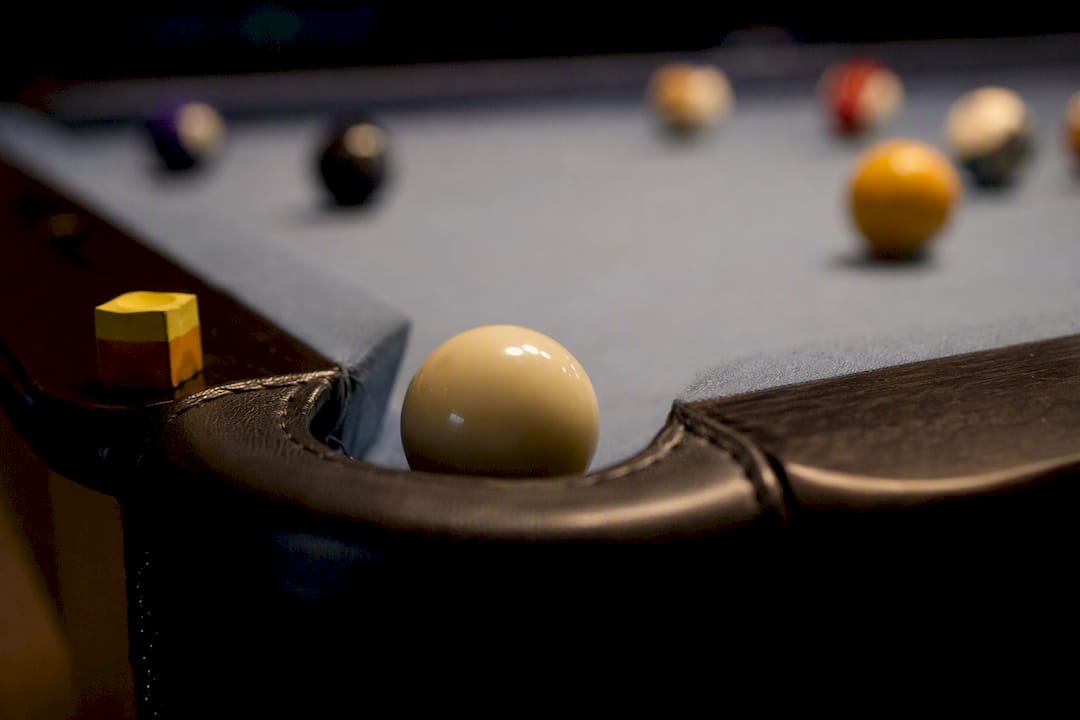
After a scratch, the incoming player gets the cue ball in hand anywhere on the table, not just behind the head string. That's a meaningful difference from the opening break, where cue-ball-in-hand is restricted to the head string area. Mid-game scratches give the next shooter full positional freedom, which is often enough to erase whatever advantage the previous player had built.
If the scratch happens on a shot where a called ball was also pocketed, the called ball doesn't count. The foul supersedes the score, the point is lost, and the object ball typically gets spotted if its position would otherwise interfere with continued play. This combination, pocketing your called ball while also scratching, is one of the more frustrating ways to lose a point, because the shot itself was technically executed correctly right up until the cue ball followed the object ball into the pocket.
Scratches also count toward the three-consecutive-fouls threshold exactly like any other standard foul. Three scratches in a row trigger the same 15-point penalty as three missed rail contacts.
Push Shots and Other Moves That Aren't Allowed
A push shot happens when the cue tip stays in extended contact with the cue ball rather than delivering a clean strike, essentially shoving the ball toward its target instead of hitting it. Straight pool rules class this as an illegal shot because it removes the skill element from position play, letting a player steer the cue ball with unnatural precision.
Double hits fall into the same category. If the cue tip contacts the cue ball twice on a single stroke, usually because the cue ball was very close to the object ball and the follow-through caught it again, the shot is illegal regardless of where the balls end up afterward.
Jump shots and other legitimate techniques remain legal as long as the stroke itself is a single, clean strike. The distinction the rules care about isn't how unusual the shot looks. It's whether the cue tip behaved like a normal stroke or lingered against the ball in a way that let the player guide it.
Any of these illegal-shot situations get treated as a standard foul, carrying the usual one-point deduction and ending the shooter's inning immediately. A referee at a sanctioned event will typically call a push shot in real time, often based on the sound and visual cue of the stroke rather than any measurable standard, which is part of why tournament referees tend to be experienced players themselves rather than neutral officials with no cue sports background.
Whose Turn Is It, and What Happens on a Bad Hit?
Turns in straight pool alternate strictly on misses and fouls. A player keeps shooting through an unlimited number of successful, legally called shots, and the turn only passes when they fail to pocket a called ball, foul, or run out of legal options entirely.
Failing to hit any ball at all with the cue ball, sometimes called a total miss or an air shot in casual conversation, is treated as a standard foul under the same legal-shot standard that governs every other shot. Remember the requirement: after cue ball contact, something must either drop into a pocket or reach a rail. Whiffing the cue ball entirely obviously satisfies neither condition, so it's an automatic one-point deduction and the turn passes immediately.
The same standard applies to a cue ball that clips an object ball so lightly that neither a pocket nor a rail results afterward. Contact alone doesn't satisfy the legal-shot rule. Something has to happen as a consequence of that contact, and a shooter who nudges a ball an inch without any rail contact anywhere on the table has committed a foul just as surely as if they'd missed everything completely.
This is one of the more commonly misunderstood rules at the club level, where players sometimes assume any contact at all counts as a legal shot. It doesn't. The rail-or-pocket requirement exists specifically to prevent players from tapping balls around indefinitely without any real risk, and enforcing it consistently is part of what keeps casual games fair between players of different skill levels.
Do Fouls Reset the Break Shot or Just End the Turn?
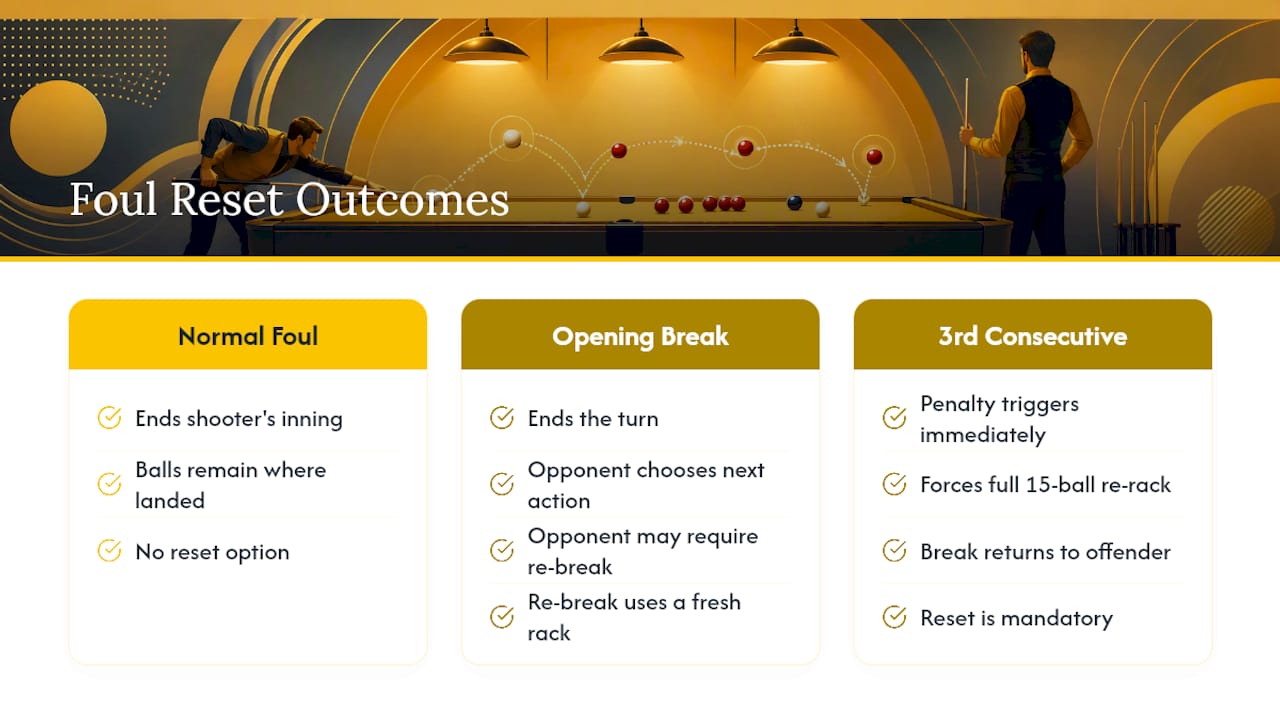
This distinction trips up a lot of players moving from casual play into more formal rule sets. A foul during regular play simply ends the shooter's inning and passes the table to the opponent, with the balls generally staying exactly where they landed. Nothing resets. The next player just picks up from wherever the table sits.
The opening break foul works completely differently, and conflating the two is where most confusion starts. A breaking foul doesn't just end the turn. It gives the opponent an actual choice: play the table as it lies, or require the offending player to re-break from scratch with a fresh rack. That option to demand a full re-break simply doesn't exist anywhere else in the game. Once the opening break is legally completed, every subsequent foul through the rest of the match follows the standard one-point, turn-ends-here pattern with no reset mechanic attached.
The three-consecutive-fouls penalty sits in its own separate category again. It doesn't just end a turn or dock a point. It actually forces a full re-rack of all 15 balls and hands the break back to the offending player, functionally recreating the opening-break scenario mid-match as a penalty. So there are really three distinct "reset" behaviors in straight pool: no reset for a normal foul, an optional reset for a breaking foul, and a mandatory reset for the third consecutive foul. Keeping those three separate is the single most useful mental model for understanding foul consequences in this game.
Why Rules Fluency Makes Straight Pool More Fun
Most disputes at the pool table trace back to one player not knowing a rule the other player does, and straight pool has more of these nuanced calls than almost any other cue sport. Knowing exactly why a breaking foul costs two points instead of one, or why the third foul in a row triggers a re-rack, ends arguments before they start instead of turning into a five-minute debate that kills the flow of a match.
There's a competitive angle too. Players who understand the official rulings hold themselves to the same standard they'd face at a sanctioned event, which makes casual practice actually transferable to tournament play instead of building habits that fall apart under a real referee.
If you want to test this rules knowledge against real competition, Q Billiards Arena runs regular tournament nights where these exact calls come up under real pressure. Book a table, run the drills, and see how the rules hold up when something is actually on the line.
— Q
Where to Verify These Rules Yourself
For the exact legal wording behind every ruling in this article, consult the WPA Rules of Play PDF and the 2025 International Open 14.1 rule document. For a plain-language walkthrough, see My Pool Cue's straight pool explainer. Tournament organizers sometimes adjust marginal rulings, so check event-specific rule sheets before competing.
Sources
- WPA Rules of Play — 14.1 Straight Pool (2025)
- 2025 International Open 14.1 Straight Pool Rules
- Straight Pool Rules: How to Play 14.1 Continuous | My Pool Cue