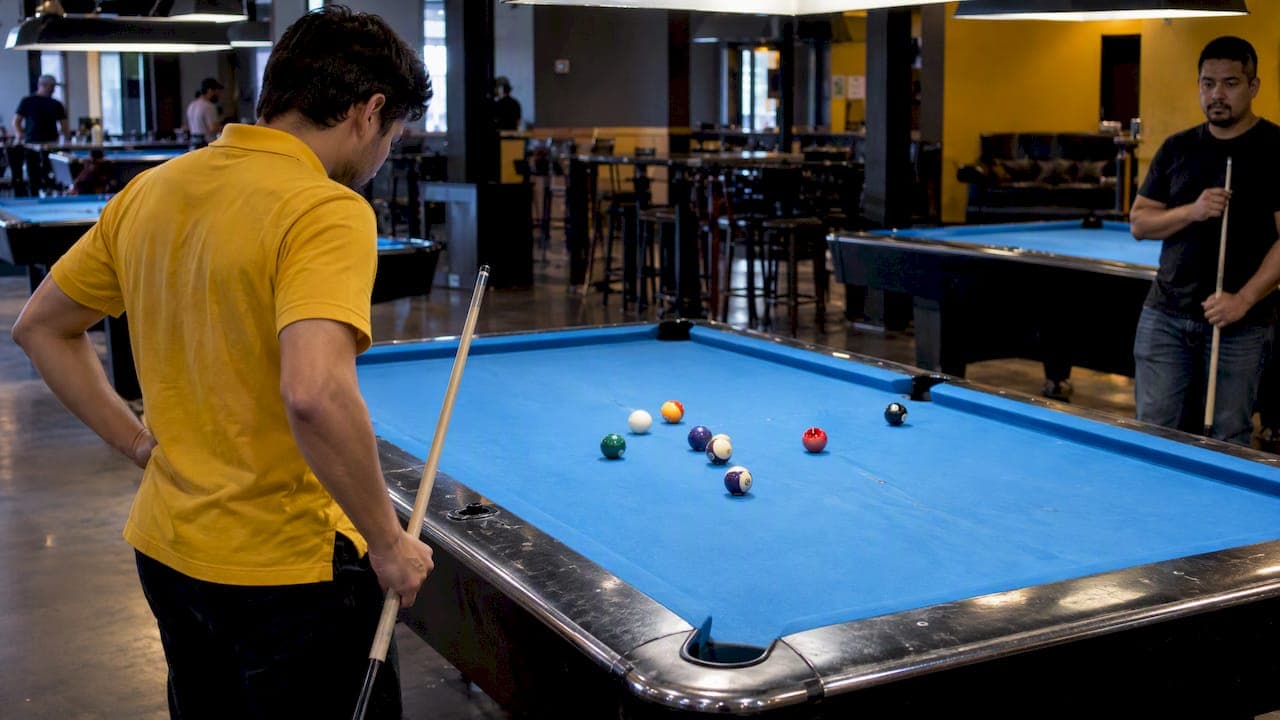
A push out is a one-time shot available only on the stroke immediately after a legal break, letting the shooter reposition the cue ball anywhere on the table without hitting the lowest-numbered ball first or touching a rail, as long as the shooter announces it before stroking. Standard fouls, like scratching or driving a ball off the table, still apply. Once the push out ends, the opponent chooses whether to shoot from the new position or pass the shot back.
TL;DR:
- A push out is only allowed immediately after a legal break, with the shot declared beforehand, and the fouls like scratching still count during it.
- The opponent decides whether to shoot or pass after a push out, with non-9 balls typically remaining down if pocketed during the shot.
- Most leagues, including WPA and UPA, follow similar rules, but some divisions like APA handicapped prohibit push outs entirely.
- To execute a legal push out, confirm the break was clean, announce "push," and avoid fouls such as scratches or ball jumps during the stroke.
- Practicing push outs with control drills enhances touch and decision-making, making it a reliable tool in competitive play.
Table of Contents
- What a push out looks like at the table
- Official rules and rule-set differences across WPA, UPA, BCA, and APA
- How to execute a legal push out step by step
- When to use a push out: a decision checklist
- Common mistakes and tournament rulings to avoid
- Practice drills to build reliable push-out control
- Why every serious player should add the push out to their toolkit
- Practice your push outs at Q Billiards Arena
- FAQ
- Sources
What a push out looks like at the table
Picture this: you break, nothing drops, and the cue ball lands frozen behind a cluster with no clean path to the lowest ball. Instead of forcing a low-percentage shot, you announce "push" and softly roll the cue ball to a safer spot, no need to tag a rail or hit any particular ball first.
A few things define this moment:
- Only the player at the table immediately after a legal break may use it, whether that's the breaker or the incoming shooter if nothing was pocketed on the break.
- The stroke can be a gentle roll, a soft nudge, or even a firm hit, as long as it's declared beforehand.
- Common scenarios include a dead-straight but risky thin cut on the 1-ball, or the cue ball trapped behind a tight cluster near the rack area.
Official rules and rule-set differences across WPA, UPA, BCA, and APA
The WPA rules spell out the push out clearly: it's allowed exactly once, only on the shot right after a legal break, and only when the shooter announces it before the stroke. During that shot, the lowest-ball-first requirement and the rail-contact rule are both suspended, but every other foul (scratching, jumping an object ball off the table, or a double hit) still counts against the shooter.
A few procedural notes matter for competitive play:
- Opponent's choice: after a legal push out, the incoming player decides whether to shoot from the resulting position or hand the shot back to the original shooter.
- Pocketed balls: non-9 balls that drop on a push out typically stay down, while the 9-ball itself gets spotted rather than counted as a win.
- UPA and BCA texts largely mirror the WPA language, so checking the WPA rulebook covers most tournament formats you'll encounter.
Not every league plays by the same book. APA's handicapped divisions generally prohibit push outs entirely, while APA Masters divisions follow U.S. Amateur Championship rules and do allow them. Before any match, ask directly: "Are push outs allowed here?"
How to execute a legal push out step by step
Getting a push out right isn't complicated, but skipping a step turns it into a foul or a wasted opportunity. Follow this sequence:
- Confirm the break was legal. If the break itself fouled, no push out is available, the rules only grant it after a clean break.
- Declare "push" or "push out" clearly before you address the cue ball. Wait for a referee or opponent nod if one is present.
- Shoot with suspended restrictions. You don't need to hit the lowest ball first or make contact with a rail.
- Watch for standing fouls. Scratching, knocking a ball off the table, or an illegal jump still counts against you even during a push out.
- Let the opponent decide. After the stroke, the incoming player chooses to shoot from where the balls lie or pass the shot back to you.
Pro Tip: Say the word "push" loudly enough that both your opponent and any nearby referee hear it clearly, mumbling it under your breath is how disputes start.
When to use a push out: a decision checklist
A push out is a tool, not a reflex. Overusing it hands your opponent easy outs; underusing it means eating bad positions you didn't have to accept. Use this checklist before deciding:
- If you have a shot you'd make 60% of the time or better, most coaching guides suggest just shooting it rather than pushing.
- If both your shot and your best safety option are weak, pushing out is usually the stronger play.
- Think about your opponent's skill level: a strong runner who accepts a mediocre position might still clear the table, so weigh that risk before pushing.
- Aim to leave a position that's roughly equally difficult for both players, not just safe for you; the goal is forcing a tough decision, not gifting a layup.
Good push targets include tucking the cue ball tight behind a cluster, leaving a long, thin cut with no clear angle, or putting the 1-ball at an awkward distance where position play becomes guesswork. The logic behind this: if the resulting shot is bad enough, your opponent either accepts a risky position or passes it back to you, and either way you haven't lost ground.
Pro Tip: When you're unsure whether to push or shoot, ask yourself if missing the shot outright would leave your opponent an easy runout, if yes, push instead.
The real risk shows up when a push out leaves a position that only looks hard. A skilled opponent accepting your push and running the table is the worst outcome, so the symmetry of difficulty matters more than simply "getting the cue ball somewhere safe."

Common mistakes and tournament rulings to avoid
Most push out disputes come down to communication, not rule complexity. The usual errors:
- Forgetting to announce. Without a clear declaration before the stroke, referees and opponents treat the shot as a normal attempt, meaning lowest-ball-first and rail rules apply and a violation becomes a foul.
- Mishandling pocketed balls. Players sometimes assume all pocketed balls count or that none do; in practice, non-9 balls commonly stay down while the 9-ball gets spotted.
- Assuming fouls don't apply. A scratch or a ball jumped off the table during a push out is still a foul, the suspended rules only cover lowest-ball-first and rail contact.
- Skipping the referee check. In any event with officials, call one over if there's doubt rather than arguing after the fact; document the sequence of events if a disagreement arises.
Practice drills to build reliable push-out control
Push outs reward touch and foresight more than power, so practice should focus on control rather than pocketing. Try these:
- Head-rail distance drill: pick three target distances along the head rail, roll the cue ball to each from a fixed starting spot, and repeat 20 times per distance to build feel for soft rolls.
- Blocked 1-ball drill: rack a cluster around the lowest ball, then practice pushing the cue ball into a spot that leaves an equally tough shot for an imaginary opponent, not just a "safe" one for you.
- Partner referee drill: have a practice partner act as referee, calling out whether your announcement, stroke, and resulting foul calls were handled correctly, then switch roles. This builds the habit of clear communication that coaching resources consistently point to as the fastest way to cut down push-out errors.
Why every serious player should add the push out to their toolkit
Most amateurs avoid the push out because handing the opponent a choice feels like giving something away. That hesitation fades once you've practiced it enough to trust your touch, a well-placed push out can flip a losing position into a coin-flip, and sometimes better. I've watched matches turn on a single push that left both players staring at a nearly impossible cut, with the eventual miss deciding the rack. Practicing it in tournament-style conditions, not just casually, is what makes the rule second nature when it matters.
— Q
Practice your push outs at Q Billiards Arena
If you want to get comfortable with push outs before you need one in a real match, table time under game-like pressure beats drilling alone at home. We offer American Pool, Standard Snooker, Heated Snooker, Chinese 9-Ball, and Carom Billiards on 25 professional-grade tables, giving you plenty of room to work through the scenarios covered here.

For players who want refereed, competitive reps, our Tuesday and Friday night pool tournaments put push-out decisions in front of real opponents and real stakes. If you'd rather sharpen fundamentals first, our Snooker Coaching Camp covers cue-ball control that carries directly into push-out touch.
- Rent a table and run the drills from this guide on regulation equipment.
- Enter a weekly tournament to practice push-out decisions under real pressure.
- Book coaching if you want faster, guided improvement.
Come practice with us and bring your push out game into match shape.
FAQ
What is a push-out shot in 9-ball?
A push out is a single shot, available only right after a legal break, where the shooter can move the cue ball anywhere without needing to hit the lowest ball first or touch a rail. It must be announced before the stroke, and standard fouls like scratching still apply.
Can you push out after any shot, or only after the break?
A push out is only available on the shot immediately following a legal break, according to WPA rules. If the break itself was a foul, the push-out option isn't available at all.
What happens if I forget to announce my push out?
If you don't declare "push" before stroking, the shot is treated as a normal attempt, meaning the lowest-ball-first and rail-contact rules apply as usual. This is one of the most common reasons push outs get ruled as fouls in casual and league play.
Are push outs allowed in every pool league?
No, rules vary by league and division. APA handicapped divisions generally disallow push outs, while APA Masters divisions permit them under U.S. Amateur Championship rules, so it's worth confirming your event's rules beforehand.
What happens to balls pocketed during a push out?
Non-9 balls pocketed on a push out typically remain down, while the 9-ball itself is spotted rather than counted as a legal win. Standard fouls, like scratches or balls driven off the table, still result in penalties even during a push out.