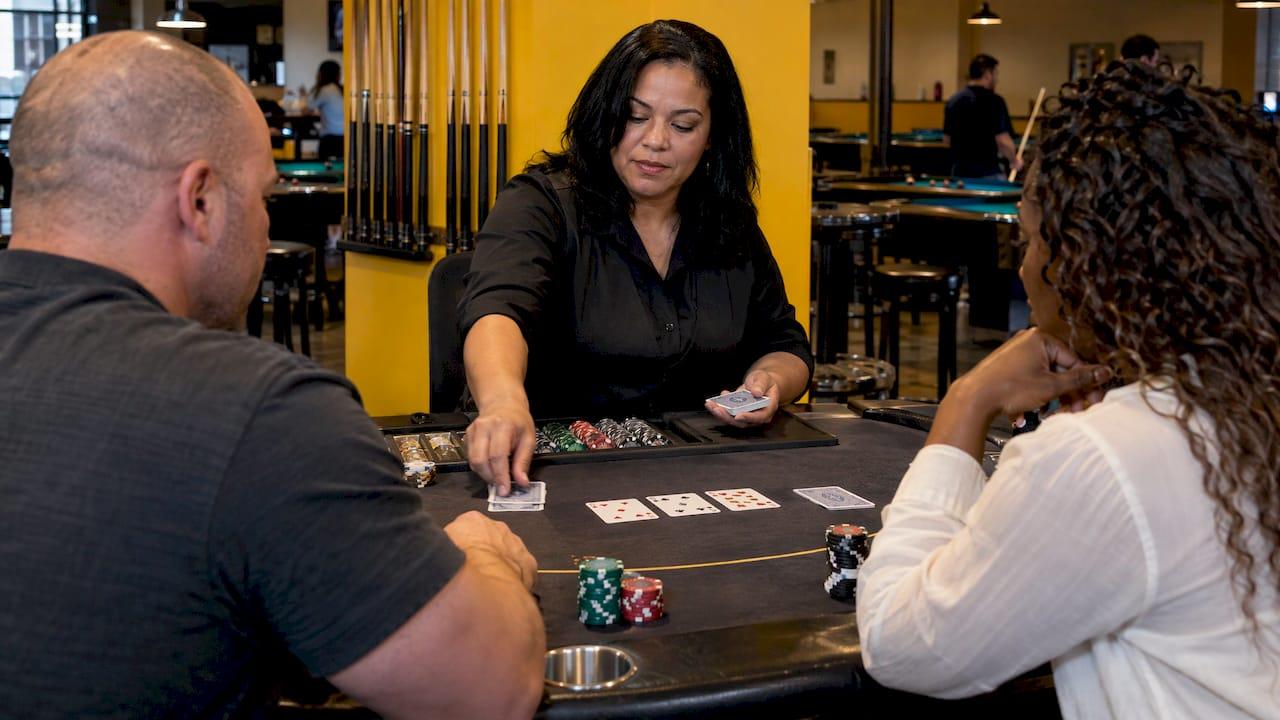
Short deck poker (also called six-plus hold'em) is Texas Hold'em played with a 36-card deck. All twos, threes, fours and fives are removed, everyone posts an ante instead of blinds, and a flush beats a full house. Everything else, two hole cards, five community cards, four betting rounds, works the way you already know. Below are the full rules, the hand rankings in order, the variations that cause arguments at the table, and how to set up a game for your group.
TL;DR
- The deck is 36 cards: sixes through aces in all four suits. Two to six players is the sweet spot.
- Everyone posts an ante, the button posts a larger one, and there are no small or big blinds.
- Ranking changes: a flush beats a full house, and the lowest straight is A-6-7-8-9.
- Some tables rank three-of-a-kind above a straight. Agree on this before the first hand.
- Planning a game night with friends? A private poker room gives you space and time to set the rules your way.
Table of Contents
- The 36-card deck and who can play
- How a hand of short deck is played
- Short deck hand rankings, highest to lowest
- The rule that changes from table to table: trips vs. straight
- Why the ante structure shapes strategy
- A popular variation: the third hole card
- Setting up a short deck game for your group
- Common mistakes
- Play it at Q Billiards Arena
- Our view: short deck suits a social night
- FAQ
- Sources
The 36-card deck and who can play
Short deck is a Hold'em variant played with a 36-card deck: take out every two, three, four and five, and what remains is six, seven, eight, nine, ten, jack, queen, king and ace in each suit. That is nine cards per suit, which is the reason the hand rankings shift (more on that below).
The smaller deck also limits table size. Short deck tables are typically capped at six players, seven at the very most, because with nine or ten players the deck runs out before the river. The minimum is two. For a home game or a private room, that makes short deck a good fit for a small group, and if you are only three, it sits alongside other games for three players as an easy way to fill an evening.
How a hand of short deck is played
If you can play Texas Hold'em, you already know 90% of this. The difference is how money goes into the pot before the cards come out.
1. Antes instead of blinds
In the most common structure, every player posts the same ante and the button posts a larger one. The button's ante is usually double the regular ante. There is no small blind and no big blind. Blinds show up mostly in casual home games that borrow regular Hold'em structure.
Example: with a $1 ante at a six-player table, five players put in $1 and the button puts in $2, so the pot starts at $7 before anyone sees a card. That dead money is why short deck rewards players who raise and take pots early.
2. The deal
Each player gets two cards face down. The dealer button moves clockwise after every hand, as in regular Hold'em.
3. Preflop betting
Action starts with the player to the left of the button and moves clockwise. Each player can fold, call or raise. To stay in, a player must at least match the button's ante. Games are normally no-limit, so you can bet any amount up to your whole stack.
4. Flop, turn and river
Three community cards come on the flop, then one on the turn, then one on the river, with a betting round after each. In short deck the player to the left of the button also acts first after the flop, unlike Hold'em, where the small blind leads off.

5. Showdown
If two or more players are still in after the final bet, they show their cards. Each player makes the best five-card hand from their two hole cards and the five community cards, in any combination. The best hand wins the pot. If one player raises and everyone else folds, that player takes the pot without showing.
Short deck hand rankings, highest to lowest
The order, according to PokerNews, is:
| Rank | Hand | Example |
|---|---|---|
| 1 | Royal flush | A♠ K♠ Q♠ J♠ 10♠ |
| 2 | Straight flush | 9♥ 8♥ 7♥ 6♥ A♥ |
| 3 | Four of a kind | K K K K 7 |
| 4 | Flush | Five cards of one suit |
| 5 | Full house | Q Q Q 8 8 |
| 6 | Straight | 10 9 8 7 6 |
| 7 | Three of a kind | 9 9 9 A 6 |
| 8 | Two pair | J J 7 7 A |
| 9 | One pair | 8 8 A K 6 |
| 10 | High card | A K J 9 7 |
There are two things to memorize from this table.
A flush beats a full house. This is the single change from regular Hold'em, and it is the question people search most. With only nine cards in each suit, flushes are scarcer than full houses, so they rank higher. In regular Hold'em the order is the reverse. The most common mistake in short deck is calling with a full house into a board with a flush showing, because habit says the full house is bigger.
The ace plays low in one straight. The lowest straight is A-6-7-8-9 (the "short deck wheel"), and the highest is 10-J-Q-K-A. Since there are no twos through fives, the ace can only complete a low straight with the 6, 7, 8 and 9. Straights cannot wrap around, so Q-K-A-6-7 is not a straight.
Why straights are more common here
Card counts change the odds. According to Cardquant's five-card probabilities for the 36-card deck, a flush occurs about 2.12% of the time, a full house 7.59%, a straight 14.14% and three of a kind 7.25%. That is why a straight is worth more than trips in the standard version: it is the more frequent hand. A flush is the rarest of those four, which justifies its rank above the full house.
The smaller deck makes draws stronger too. An open-ended straight draw completes about 45% of the time by the river, against roughly 31% in regular Hold'em. And pocket pairs are about twice as likely than with 52 cards, with a flopped set coming around 18% of the time with a pocket pair rather than 11.8%.

The rule that changes from table to table: trips vs. straight
The standard, used in most online games and in high-stakes live broadcasts, ranks a straight above three of a kind. Some house games reverse that, putting three of a kind above a straight. The flush-over-full-house rule stays in both versions.
This matters in a real hand. If three of a kind beats a straight, drawing to a straight against a possible set is a much worse bet. Players who learned one version and sit down to the other will misjudge hands all night.
A quick check before the first deal avoids any argument:
- Does a flush beat a full house? (It should.)
- Does a straight beat three of a kind, or the reverse?
- Is the ace low in A-6-7-8-9?
- What is the ante, and what does the button post?
- Is the button's extra ante live, meaning it counts toward the button's preflop bet?
Write the answers on a card and leave it on the table. Hosts who put house rules on paper have fewer disputes, and the same logic applies to home-game etiquette in general.
Why the ante structure shapes strategy
Antes make a big difference to how the game feels. In a six-handed game, the first player to act is offered 7-to-1 on a preflop call, versus 3-to-2 in a blind-structure game. Calling to see a flop is cheap, so you see many multiway pots. The player to the left of the button also acts first on every street, which pushes raisers out of position and gives the button extra power.
A few practical takeaways for a new player:
- Hands run closer in value. Aces against K-Q suited are roughly 63-37 in short deck compared with about 66-34 in regular Hold'em, per Deuces Cracked. Big pairs are less safe, so do not expect them to hold up unimproved.
- Top pair is weaker. Sets and straights come more often, so a single pair needs caution on coordinated boards.
- Pay attention to suits. Flushes are rare but rank high, and a flush draw on a four-suited board deserves respect.
- Rely on position. Because the button pays extra, aggressive play from late position is common.
A popular variation: the third hole card
One six-plus game deals each player a third hole card in place of the river card. You must use exactly two of your three hole cards plus three of the four community cards, similar to Omaha's construction. It is rare and should be announced before the deal. If your group likes it, our comparison of Texas Hold'em and Omaha explains how the two-plus-three rule works.
Setting up a short deck game for your group
Short deck is easy to host because it needs nothing special: a standard deck with the low cards pulled out, chips, and a button. Some practical advice:
- Count the cards. You need exactly 36. Pull the 2s, 3s, 4s and 5s, and check that none are left in.
- Keep the table to six or fewer. If more friends turn up, run two tables or rotate players in.
- Choose an ante you can afford. Because every player pays every hand, stacks move faster than in a blind game. A deep stack of 100 antes lasts longer than you might expect.
- Decide the rankings first. Use the five questions in the checklist above.
- Consider a limit on session length. With constant antes, play is quick. If you want a fixed finish, a clock-based blind or ante schedule keeps things on time, and our guide to tournament structure shows how to set one.
If you would rather play for stacks than cash, our comparison of cash games and tournaments covers the trade-offs.
Common mistakes
- Counting a full house as the better hand against a flush.
- Forgetting the ace plays low only in A-6-7-8-9.
- Over-valuing one pair, since sets and straights are more frequent.
- Arguing about trips versus a straight in the middle of a hand rather than before the deal.
- Seating seven or more players, then running out of cards.
Play it at Q Billiards Arena
We built Q Billiards Arena in Houston for groups who want more than a table to sit at. The venue spans 11,000 square feet, and we stay open late, until 2 to 4 AM. Our menu of food, snacks and drinks means nobody leaves the game to find dinner, and our poker room is available for rental for private events with a minimum purchase or a paid reservation. The rental price is not published, so ask us when you book.
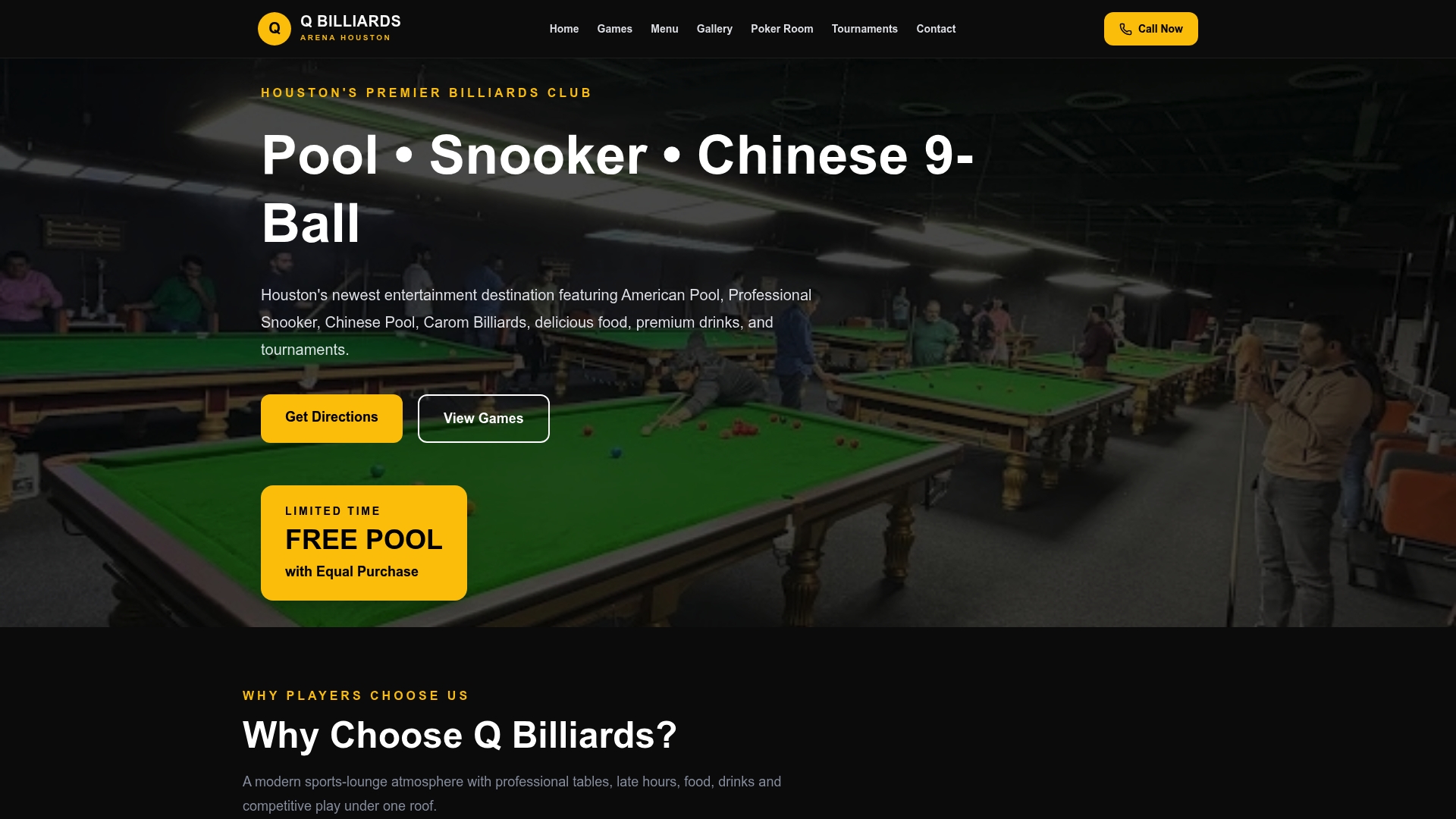
If the group gets restless between hands, the pool tables are close by. American pool starts at $10 per hour, and our Tuesday and Friday night pool tournaments have a $10 entry. Check out the Q Billiards Arena homepage for the full picture.
Our view: short deck suits a social night
Short deck is a game for people who like action. Antes keep everyone involved, draws hit often, and hands rarely sit quiet. That is exactly the energy we want in a room.
At Q Billiards Arena we have 25 professional-grade tables across American pool, snooker, Chinese 9-ball and carom, plus weekly tournaments. The poker room gives a group its own space for the same kind of night, and the kitchen and bar keep it going late. A good game night mixes a bit of everything: a few hands, a frame of pool, a plate of food.
Our advice to any host is simple. Agree on the rankings before the first hand, keep the table to six, and pick a format that suits the evening. The rest is conversation and good cards.
Q
FAQ
Does a flush beat a full house in short deck poker?
Yes. With only nine cards in each suit, a flush is harder to make than a full house, so it ranks higher. This holds in all common short deck variations. Only the order of a straight and three of a kind differs between tables.
Does a straight beat three of a kind in short deck?
In the mainstream version, yes, because straights occur more often than trips with 36 cards. Some house games reverse it. Confirm the rule with your table before the first hand, since the BARGE rulebook notes both versions exist.
What is the lowest straight in short deck?
The lowest straight is A-6-7-8-9, where the ace plays low. The highest is 10-J-Q-K-A. Wrap-around sequences such as Q-K-A-6-7 do not count.
How many players can play short deck?
Two is the minimum. Six is the usual cap, and seven is the most that works, because with more players the 36-card deck runs out before the river.
Does short deck use blinds?
Usually not. Every player posts an ante and the button posts a larger one, often double. Casual home games sometimes use blinds, so state your structure before you deal.
Sources
- Short-Deck Poker: How to Play 6+ Hold'em, PokerNews
- Short Deck Poker Hand Rankings, PokerNews
- Short Deck Texas Hold'em, BARGE Rulebook
- How to Play Short Deck Poker, Card Player
- Short Deck Poker Explained, Card Player
- Short Deck Poker Strategy: The Fundamentals, Cardquant
- How Many Players Can Play Poker, BC Poker guides
- Short Deck Hold'em Rules, Deuces Cracked
- Games for 3 Players