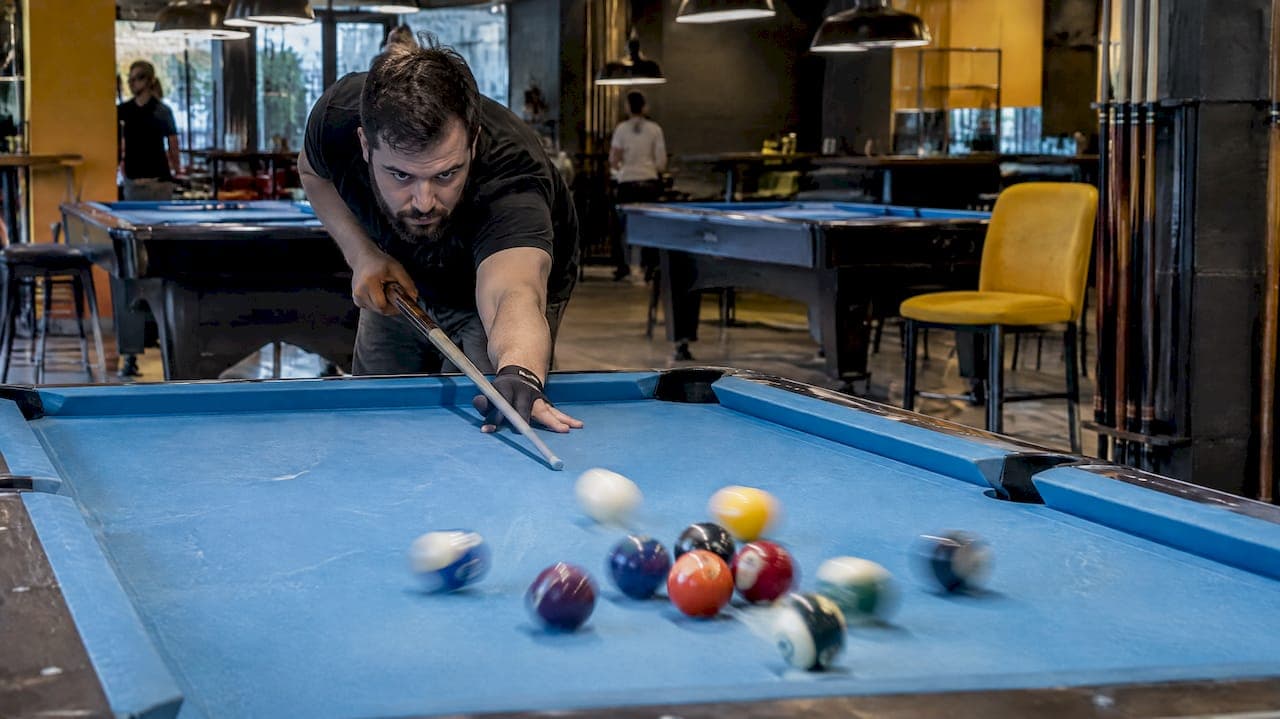
The most reliable 8-ball break is a square head-ball hit from just behind the head string, struck with controlled power in the 21 to 24 mph range so the cue ball stays near center instead of flying off the table. Before you swing, remember the legal-break rule: the cue ball must start behind the head string, and you need to pocket a ball or send at least four object balls to the rails, or the rack goes back up.
TL;DR:
- Maintaining a tight, fully-racked set of balls and practicing consistent warm-up strokes significantly improves break reliability and scatter quality.
- Striking the cue ball with controlled speed between 21 and 24 mph from behind the head string maximizes energy transfer and spread while minimizing miscues.
- A square head-ball hit with a relaxed grip, a closed bridge, and proper stance ensures consistent power and accuracy during the break.
- The most effective break targets the center of the first ball in the rack, with minor side adjustments for better spread, or using the second ball for specific table conditions.
- Pocketing the 8-ball on a legal break is usually allowed and not automatically a foul; always verify tournament rules beforehand to avoid penalties.
Table of Contents
- Pre-shot checklist for a repeatable break
- Stance, bridge, and grip mechanics for a powerful break
- Where to aim: head-ball versus second-ball breaks
- Speed bands and when to trade power for control
- Racking tightly and warming up before you break
- Choosing the right break for the table and ruleset
- Legal breaks, fouls, and what happens if you pocket the 8-ball
- Drills that build a repeatable break
- A coach's note on building a better break
- Practice your break on professional-grade tables in Houston
- FAQ
- Sources
Pre-shot checklist for a repeatable break
A good break starts before you even chalk up. Running through the same short checklist every time removes the guesswork that causes inconsistent results.
- Check the rack for visible gaps between balls and ask for a re-rack if any ball isn't touching its neighbors, since a loose rack bleeds energy on contact, a point Dr. Dave Alciatore emphasizes as the top non-mechanical factor in a weak break.
- Take 3 to 5 warm-up strokes and slow your final backswing instead of rushing it.
- Place the cue ball behind the head string, centered or offset by one ball-width depending on your aim point.
- Use a closed bridge with 8 to 10 inches of bridge length and a relaxed grip hand.
- Aim for 21 to 24 mph of cue speed and keep the stroke square to avoid unintended english.
Stance, bridge, and grip mechanics for a powerful break
Power without control is just a faster miss. A wider, lower stance gives you a stable base: feet roughly shoulder-width apart, back foot slightly dropped at the hip to lower your center of gravity through the shot. That drop lets your upper body drive forward through the cue ball rather than just swinging your arm.
The forward motion works like a controlled lunge. Your weight shifts from back foot to front foot as the tip contacts the ball, adding momentum without sacrificing aim. A closed bridge hand, thumb wrapped over the index finger, gives more stability than an open bridge when you're generating this much speed, which matters more on a break than on any other shot in the game.
Your grip hand should stay loose through the backswing and only firm up in the final few inches before contact. Keep the backswing controlled rather than exaggerated, commit to the acceleration once you start forward, and let your follow-through continue naturally past the cue ball instead of stopping short.
Pro Tip: Practice your break stroke without a cue ball first, just to feel where your grip naturally tightens, then try to delay that tightening until the last possible moment.
- Lower your stance and drop your back hip for a stable base.
- Keep the bridge closed and firm for better cue control at speed.
- Let your grip stay relaxed until the final inches of the stroke.
Where to aim: head-ball versus second-ball breaks
Where you aim the cue ball changes everything about how the rack scatters. For a classic head-ball break, aim dead center on the first ball of the rack. A perfectly square hit transfers the most energy into the pack, which Dr. Dave Alciatore's break analysis identifies as the difference between a clean spread and a mushy one where the balls barely separate.
Small adjustments change your results without changing your fundamentals.
- Offset the cue ball by one ball-width left or right of center to favor the wing balls or steer away from a cluster forming on one side.
- Try a second-ball (side) break, hitting the second ball in the rack instead of the head ball, which can open corner-pocket opportunities on smaller tables.
- Use top spin for a standard follow-through contact, a stun hit to stop the cue ball near center, or a touch of draw to manage bounce-back off the rack.
Speed bands and when to trade power for control
Not every break needs maximum force, and chasing raw speed often works against you. Moderate speeds around 21 to 24 mph tend to produce the best balance of scatter and control, according to CueBallPath's break technique guide, which found that extreme speeds increase erratic cue-ball behavior without improving pocket rates.
- 21 to 24 mph: the sweet spot most players should aim for in practice and match play.
- 18 to 21 mph: a control band that trades some scatter for far more predictable cue-ball position.
- 27 mph and above: higher scratch and jump risk, with no reliable gain in balls pocketed.
If the table's cloth is fast and the cue ball keeps sliding past center, add a touch of draw. On slower cloth, a slight follow helps the cue ball "squat" near the head string instead of drifting forward into the pack, an adjustment Dr. Dave Alciatore recommends pairing with a near-square hit.
Racking tightly and warming up before you break
A perfect stroke can't fix a bad rack. Before every game, check that every ball is touching its neighbors, since even one small gap absorbs energy that should be transferring through the pack. If you see daylight between balls, ask for a re-rack; most house and league rules allow it before the break shot is taken, and the racking guide covers the exact steps for a tight setup.
- Press the rack firmly and lift it straight up and off without disturbing the balls.
- Run a finger along the rack's edges to confirm no gaps remain.
- Check that the balls and cloth aren't excessively worn, since dead balls and slow cloth both cut your effective break speed.
- Take your warm-up strokes every time, even in casual games, to build a consistent mental routine.
Choosing the right break for the table and ruleset
The best break depends on the table you're playing on and how consistently you can execute each variation.
- Head-ball break: your default choice for most tables and rulesets, offering the most reliable spread when struck square.
- Second-ball or side break: better suited to smaller bar-box tables where the rack geometry gives the second ball a cleaner shot at the corner pockets.
- Control break: a lower-speed, more deliberate break when you need predictable cue-ball position over maximum scatter, often the smarter choice in safety-first match play.
Whichever variation you choose, confirm the house or tournament rules first. Some leagues restrict break variations or have specific rules on pattern racking, and sportsmanship expects you to follow whatever format the room or event has set, something the one-pocket rules breakdown touches on for tournament settings.
Legal breaks, fouls, and what happens if you pocket the 8-ball
A legal break under most rule sets requires the cue ball to start behind the head string, plus either a pocketed ball or at least four object balls driven to the rails, as outlined in common BCA rule extracts. Miss both conditions and the rack typically gets re-racked or your turn ends, depending on the ruleset.
- Pocketing the 8-ball on a legal break is not automatically a foul under WPA, UPA, and BCA rules; you may accept the table with the 8 spotted or choose to re-break, per common campus rule guidance.
- Under APA rules, legally pocketing the 8 on the break is commonly treated as an outright win unless a foul happens at the same time, according to In Play! magazine's APA rules summary.
- Pocketing the 8 along with a scratch is typically a loss under most rule sets.
- Always confirm the house or tournament rules before you play, since penalties for soft breaks and re-rack options vary by league.
Scratches and other cue-ball fouls carry their own penalties worth knowing before you ever chalk up; the cue-ball fouls guide walks through ball-in-hand situations in more depth.
Drills that build a repeatable break
Technique only sticks with repetition. Two drills turn the mechanics above into muscle memory.
- Square-hit consistency drill: rack and break 50 times at a controlled, moderate speed, focusing only on hitting your aim point square on the head ball every time.
- Speed progression drill: run 5 sets of 10 reps, increasing your break speed slightly each set while tracking pocket rate and where the cue ball lands.
Pro Tip: Keep a simple tally of pocket rate and cue-ball position across sessions. The pattern tells you more than any single great break ever will.
Booking table time to run these drills regularly beats occasional practice, and pairing them with broader position-play work from the cue-ball control drills rounds out your overall game.

A coach's note on building a better break
Progress on the break comes in small increments, not overnight fixes. Regular practice sessions, tracked honestly, beat sporadic bursts of effort every time.
— Q
Practice your break on professional-grade tables in Houston
We offer professional-grade tables, weekly tournaments, and a Snooker Coaching Camp for players who want hands-on guidance tightening up their break.

Book time on our pool tables and tournament nights to put these drills into practice under real match conditions.
FAQ
What happens if you break the 8-ball?
Pocketing the 8-ball on a legal break is not a foul under most rule sets, and you can choose to accept the table with the 8 spotted or re-break, per common rule guidance. Under APA rules specifically, a legally pocketed 8 on the break is commonly scored as a win unless a foul happens at the same time, according to In Play! magazine.
What is an illegal break in 8-ball pool?
An illegal break happens when the cue ball doesn't start behind the head string, or when you fail to pocket a ball and don't drive at least four object balls to the rails. Most rulesets respond with a re-rack or loss of turn, as detailed in common BCA rule extracts.
What is the best way to break in 8-ball pool?
The most consistent approach is a square head-ball hit from behind the head string at a controlled 21 to 24 mph, which research on break technique ties to the best balance of scatter and cue-ball control. A closed bridge and a relaxed grip that firms up only in the final inches of the stroke help you repeat that same hit every time.
What is the best position to break in pool?
Position the cue ball behind the head string, either centered on the head ball or offset by one ball-width to favor the wing balls. The exact spot depends on whether you're using a standard head-ball break or a second-ball break suited to smaller tables.
Sources
These references cover the rule questions and technique points discussed above, drawn from league rule documents and expert break analysis.
- In Play! — APA eight-ball rules
- CueBallPath — How to break in pool
- Dr. Dave Alciatore — VEEB break instruction