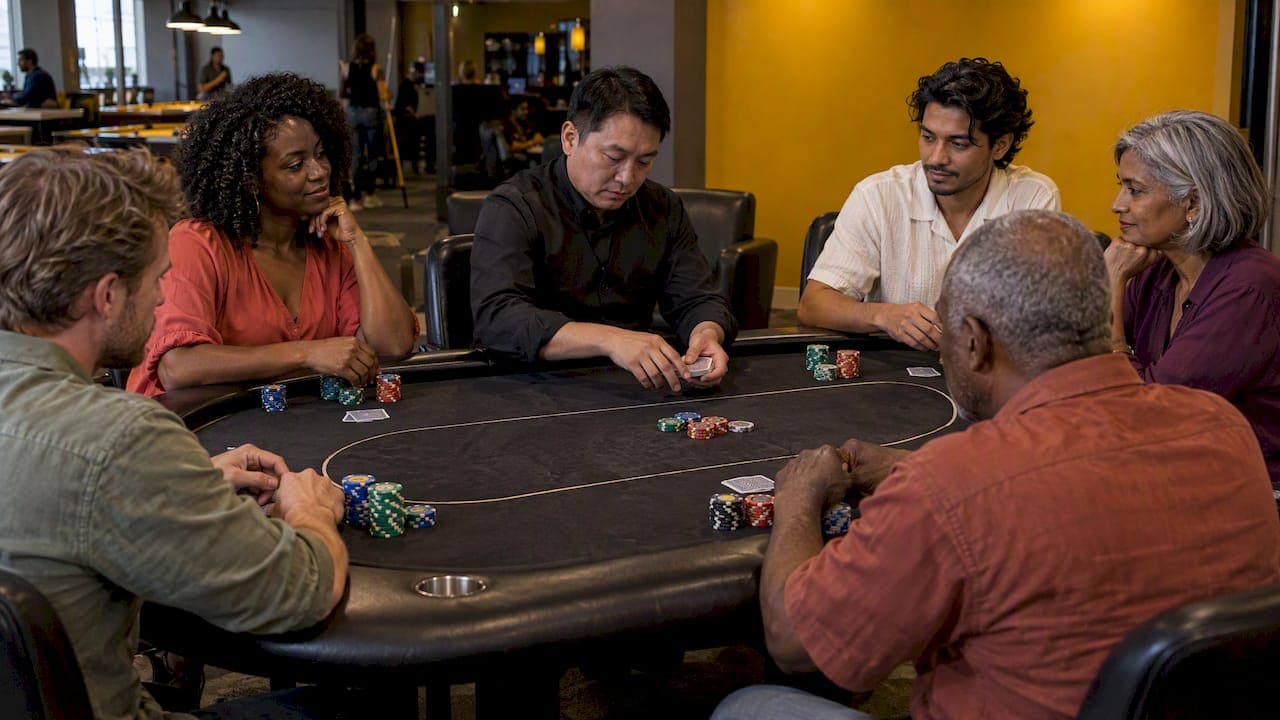
A sit and go (SNG) is a poker tournament with no set start time. It begins as soon as the required number of players has registered, everyone gets the same starting stack, blinds rise on a timer, and the last player with chips wins. Below you will find how the format starts, what a sensible structure looks like (stacks, blind levels, payouts), how strategy shifts at the bubble, and how to run a live one with friends in a private room.
TL;DR
- A sit and go starts when its seats fill, not at a scheduled time, so you can play a full tournament in about an hour or less.
- Chips are tournament chips, not cash. You pay a fixed buy-in, and only the top finishers are paid from the prize pool.
- Payouts depend on table size: a 10-handed game commonly pays three spots (50%, 30%, 20%), a 6-handed game two (60%, 40%).
- Blind speed is the biggest structural choice. Slower levels reward skill, turbo and hyper-turbo levels reward quick decisions.
- You can run a live sit and go at home or in a rented room with a simple blind sheet, a payout table and a clock.
Table of Contents
- What a sit and go actually is
- Sit and go tournament structure
- Bubble play and how strategy shifts
- Running a live sit and go in Houston
- Host your sit and go at Q Billiards Arena
- Our perspective
- FAQ
- Sources
What a sit and go actually is
The name says it: you sit down, and the game goes once the table is full. A sit and go has no set start time and begins immediately once the pre-determined number of players have registered. That is the single biggest difference from a scheduled tournament, where everybody has to be there at 7:00 p.m. on the dot.
The format can be a single table or several. PokerNews notes that SNGs may be single-table events or larger multi-table tournaments, and one US online poker room lists formats from 2 to 27 players. In live play, the one-table, six-to-ten-player version is by far the most practical, because you only need one table and one dealer or a rotating button.
Sit and go versus a cash game
If you have only played cash games, three things change.
- Chips have no cash value. In a cash game, chips are equivalent to money and blinds remain fixed. In a tournament, chips are just a way to survive and reach a paid finishing position.
- Blinds go up. Tournament blinds rise while cash-game blinds stay the same for the session, which forces action and guarantees the game ends.
- Busting means leaving. In a standard freezeout, re-entry is not permitted and a player who loses the starting stack is out. Your maximum loss is the buy-in, which is why many new players like the format.
The fee side differs too. A tournament entry is a fixed amount, typically with one portion going to the prize pool and a separate house fee, whereas a cash game takes a rake from qualifying pots. Online, tournament fees can range from 0% to 25% of the buy-in, so always read the buy-in as "prize contribution plus fee."
Sit and go tournament structure
Structure is four decisions: how many players, what each starts with, how fast blinds rise, and how the prize pool is split. Get those right and the game finishes on time and feels fair.
Starting stacks and blind levels

Every player starts with the same stack. Online, the speed is labeled: regular, turbo and hyper-turbo levels last 8, 4 and 2 minutes respectively. Online games with these speeds usually last under 60 minutes, and turbo games finish faster because blinds increase rapidly.
Live play is slower, because dealing, counting and chatting take time. That is why live hosts usually run 15 to 20 minute levels. Here is an illustrative schedule for a six to ten player live game with a 1,500-chip starting stack (our own example, not a standard):
| Level | Small / big blind | Length |
|---|---|---|
| 1 | 25 / 50 | 20 min |
| 2 | 50 / 100 | 20 min |
| 3 | 75 / 150 | 20 min |
| 4 | 100 / 200 | 20 min |
| 5 | 150 / 300 | 20 min |
| 6 | 200 / 400 | 20 min |
| 7 | 300 / 600 | 20 min |
| 8 | 400 / 800 | 20 min |
With 1,500 chips and a 50-chip big blind, you start with 30 big blinds, which leaves room to play real poker for the first hour. If you want a deeper walkthrough of building a schedule that ends when you need it to, our guide on poker tournament structure and blind schedules covers the math, and the 20-minute blind structure checklist gives you a day-of list.
Payout structures
Payouts depend on how many players you seat. As one published example, a major US online poker room pays 50%, 30% and 20% to the top three in its 10-handed tournaments, and 60% and 40% to the top two in its 6-handed ones. Here is what that looks like in a live game with a $20 buy-in and no house fee taken (a worked example):
| Format | Players | Prize pool | Payouts |
|---|---|---|---|
| 6-handed | 6 | $120 | 1st $72, 2nd $48 |
| 10-handed | 10 | $200 | 1st $100, 2nd $60, 3rd $40 |
The principle is the same everywhere: the prize pool is generally paid to the top finishers, and the more entries, the more places pay. Paying about the top 30% of the field is a common rule of thumb in larger events, but for a single table, two or three spots is plenty.
Single-table, multi-table and speed
A single-table sit and go is the simplest: one table, one winner's bracket of decisions, done in an evening hour or two. A multi-table one needs table balancing and more staff, and rewards stamina. Speed matters more than table count for most hosts. Slow structures reward patient, postflop skill. Turbo structures turn the game into a short-stack shoving contest much sooner. One online operator's own blog even admits that sit and gos can get repetitive, which is another reason to play them live with friends, where the table talk varies the experience.

Bubble play and how strategy shifts
The bubble is one spot from the money. Everyone at the table knows that finishing there pays nothing, and behavior changes. PokerNews describes bubble play as polarized: some players tighten up to avoid busting, while others attack because surviving unlocks the prize pool.
The concept behind this is the Independent Chip Model, or ICM. In short, tournament strategy has to account for rising blinds, limited ability to reload and ICM, the principle that survival and proximity to payouts can give folding positive value. Chips you win are worth less than chips you lose, so you do not simply chase the highest chip count.
A few practical habits follow:
- Know your big blinds. Count your stack in big blinds, not chips. Below roughly 15 big blinds, decisions tend to narrow to shoving or folding.
- Pressure the right opponents. On the money bubble, small stacks are generally the most pressured, so a comfortable stack can raise more against them. At a final-table bubble, medium and large stacks can feel the squeeze too.
- Do not wait too long. Because blinds keep rising, passivity costs you. A stack that sits still shrinks relative to the blinds.
- Adjust to your crowd. A friendly home game often has loose callers early and tight players near the money. Observe before you adapt.
Running a live sit and go in Houston
A good live sit and go needs five things: a table that seats your player count comfortably, a blind clock, tournament chips, a payout sheet shared before the first hand, and a room where nobody is squeezed for space. Our hosting guides go into each part: poker home game etiquette stops most disputes before they start, and Houston poker night ideas has formats for groups that want more than a single table.
A simple run-of-show:
- Announce the rules before seating. Buy-in, starting stack, blind levels, rebuys (none in a freezeout), payouts.
- Draw seats randomly. It avoids any argument about position.
- Start the clock when the first hand is dealt. Ring a bell or use a phone alert at each level change.
- Handle late arrivals up front. Online, absent players may have their blinds and antes posted automatically. Live, set a simple rule: seat starts when the first hand is dealt, and late players sit out blinds.
- Consolidate and pay out. Once you hit the paying spots, confirm the split in front of everyone.
If your group is bigger than a kitchen table allows, a dedicated space helps. Our posts on how to rent a poker room and private poker room rules walk through what to plan, from seating clearance to a rulesheet you can copy. For events with pool or snooker play too, see how pool tournament payouts and snooker tournament formats work, since many groups mix cue sports and cards in one night.
Host your sit and go at Q Billiards Arena
We offer private poker room rental at our Houston arena, so your group can run its own tournament without clearing a dining room. The rental is arranged with a minimum purchase or a paid reservation, and our kitchen and bar keep the table fed. Contact us through the poker room page for current pricing and availability.

If your night is more about pool, our hourly tables and games start at $10 per hour for American pool, and you can browse the food and drink menu before you book.
Our perspective
We see the same thing every week: groups love a tournament night when the logistics disappear. Nobody wants to be the person moving furniture, hunting for a timer or arguing about who gets paid.
That is why a single-table sit and go suits a private room so well. It has a clear start, a fixed buy-in, an end you can predict and a payout everyone agrees on up front. Add late hours, a full kitchen and space to spread out, and the poker becomes the easy part.
We run a tournament culture across our 25 tables, with weekly pool and snooker events, so we know what makes players come back: a fair structure, a smooth start and a room that treats the game seriously. Bring your blind sheet or ask for ideas, and we will help you plan around it.
Q
FAQ
How many players do you need for a sit and go?
It depends on the format. A sit and go starts once its seats are full, and online formats range from 2 to 27 players. For a live home or private-room game, six to ten players at one table is the usual sweet spot.
How long does a sit and go take?
Online games usually last less than 60 minutes. Live games run longer because of dealing and chip handling, so with 20-minute levels plan on roughly two to three hours for a six to ten player table.
Can you rebuy in a sit and go?
Not in a standard freezeout. Once a player loses their starting stack, they are out of the event. Some formats allow re-entry or rebuys, but you should announce that before the first hand.
What is a good payout structure for a sit and go?
For a small table, pay two or three places. One published online example pays 60% and 40% in a 6-handed game and 50%, 30% and 20% in a 10-handed game. Adjust the split if your group prefers a flatter or more top-heavy payout, but agree on it before play starts.
What does the bubble mean in a sit and go?
It is the position one spot short of the money. Short stacks often fold to survive, while big stacks can attack them, because busting on the bubble pays nothing.
Sources
- Sit-and-Go definition (PokerNews)
- Sit & Go tournament formats and length (online poker room)
- Texas Hold'em rules: cash vs tournament chips (World Poker Tour)
- Poker games: blinds in cash and tournament play (PokerNews)
- House rules: tournament entry fees (Nevada online poker)
- Poker rake and tournament fees explained
- Sit & Go payouts and blind levels (US online poker guide)
- What are Sit & Go tournaments (ClubWPT Gold support)
- Multi-table tournament vs sit-and-go poker
- Strategy on the bubble: 10 multi-table tournament tips (PokerNews)
- Poker strategies: tournaments vs. cash games (GTO Wizard)
- Money bubble vs final table bubble (GTO Wizard)
- What is a Sit and Go? Rules, payouts and strategy