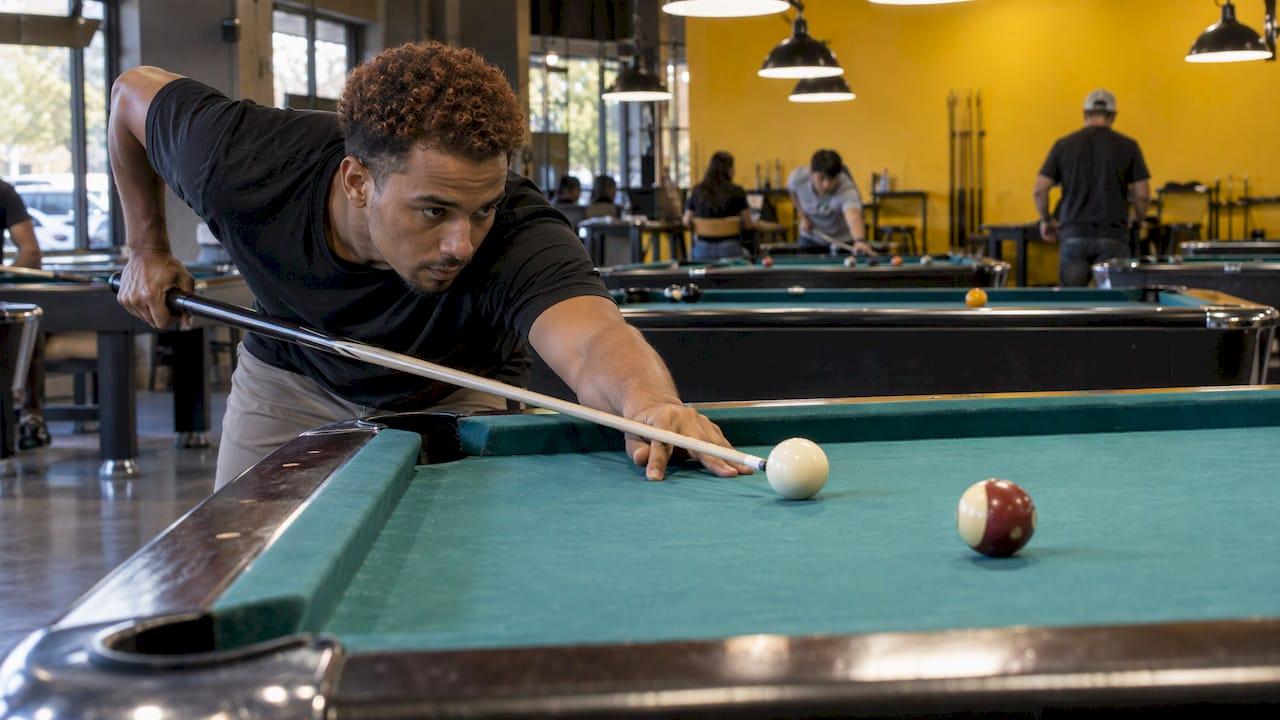
In pool, backspin means you hit the cue ball below center so it spins backward. Players call it draw. Topspin means you hit above center so the ball spins forward. Players call it follow. Topspin sends the cue ball on past the object ball, while backspin stops it or pulls it back. Knowing which one to use is how you stop leaving yourself out of position. You learn it fastest with a lot of table time, and at Q Billiards Arena in Houston, American pool is $10 per hour.
TL;DR
- Topspin (follow) comes from hitting above center. The cue ball keeps rolling forward after it hits the object ball.
- Backspin (draw) comes from hitting below center. The cue ball stops, or comes back toward you, after contact.
- For draw, aim low, keep the cue level, and accelerate smoothly through the ball. A slow, low stroke is more accurate than a hard, wild one.
- Hitting too low causes a miscue. About half the ball's radius from center is the usual limit.
- Practice with simple distance drills: change only one variable at a time, and the feel arrives quickly.
Table of Contents
- What backspin and topspin do to the cue ball
- Topspin (follow): keep the cue ball moving forward
- Backspin (draw): the cue ball that comes back
- The stun shot: the line between the two
- Backspin vs. topspin at a glance
- How to draw the cue ball: step by step
- What decides how far the cue ball draws
- Drills that build both spins
- Topspin and backspin in other sports
- Practice where the tables are plenty
- Perspective
- FAQ
- Sources
What backspin and topspin do to the cue ball
Every shot in pool is a conversation between where you strike the cue ball and what the ball does after it meets the object ball. Think of the cue ball as a clock face or a target. Hit the center and the ball slides, then settles into a roll. Hit above and it rolls harder. Hit below and it spins against its own direction.
According to TableSkills, hitting below center puts backspin on the cue ball. After it hits the object ball it can stop quickly, reverse direction, or roll forward, depending on distance. Hitting above center puts topspin on it, so the cue ball keeps rolling forward after contact.
The terms differ from the ones you may know from tennis or table tennis. In those sports, topspin dips the ball and backspin makes it float. In pool, the ball stays on the cloth, so what matters is what the spin does once the cue ball hits something: another ball or a rail.
Topspin (follow): keep the cue ball moving forward
Follow is the easiest spin to learn, and it is what most players use without thinking. When you hit a little above center and send the cue ball into an object ball, the object ball takes the forward energy. The cue ball still has forward rolling spin, so it creeps on after contact.
Follow is the shot you reach for when:
- You need the cue ball to travel up the table for the next ball.
- You are shooting a cut shot and want the cue ball to curve forward off the angle.
- You want a bit more control over speed, since a rolling ball is stable.
On angled shots, a rolling cue ball goes along a predictable path. In his January 2020 CB Control column, Dr. Dave Alciatore describes the natural angle: on cut shots, a rolling cue ball deflects at a fairly consistent angle close to 30°. You can picture it as the spread of a peace sign held at the table. Learn that angle and you can guess where the cue ball ends up without calculating anything.
The straight-in case is different. A follow shot hit straight at the object ball drives the cue ball forward behind it, so you must keep an eye on scratching in a pocket you are shooting toward.
Backspin (draw): the cue ball that comes back
Draw is the more dramatic shot, and it is the one people search for. The cue ball travels toward the object ball with backward spin. Pool Hall Pros explains what happens next: on contact, forward momentum transfers to the object ball, and the backspin that remains grabs the cloth and pulls the cue ball backward.
A physics explanation from Sandbox Physics makes the same point: a collision can pass most of the forward motion to the object ball while leaving the rotation behind. Cloth friction then turns that leftover backspin into backward travel.
A Physics Stack Exchange answer describes the straight-on case this way: the backspinning cue ball first stops, then reverses. How far below center you strike depends on how far the cue ball has to travel to the target.
Use draw when:
- You need the cue ball to stop at the spot where the object ball was (a stop shot) or come back for the next ball.
- You want to avoid scratching on a straight shot into a corner pocket.
- You are controlling the angle on a cut shot and want a sharper path than the natural one.
Here is a number worth knowing. In the same January 2020 column, Alciatore notes that for cut angles from 0° to 40°, a good draw shot sends the cue ball back at about three times the cut angle. He defines a good draw action by a half-ball (30°) cut that draws the cue ball back at 90° to its original direction.
The stun shot: the line between the two
Between follow and draw is a shot with neither: the stun shot. The cue ball is sliding, with no top or backspin, at the moment it hits the object ball. Per Alciatore's column, a stun shot sends the cue ball along the tangent line, which is perpendicular to the direction the object ball travels. Changing shot speed does not change that tangent line.
That is the 90° rule, and it is the reference for the other two shots. Topspin bends the cue ball's path forward of the tangent line. Backspin bends it back. Learn the stun shot first and you have a baseline for both.
Backspin vs. topspin at a glance
| Topspin (follow) | Backspin (draw) | |
|---|---|---|
| Where the tip hits | Above center | Below center |
| After a straight hit | Cue ball rolls on forward | Cue ball stops, then may come back |
| On a cut shot | Path bends forward of the 90° line | Path bends back of the 90° line |
| Typical use | Move up the table, keep the ball rolling | Stop the cue ball, return it for the next shot |
| Main risk | Scratching into the pocket after contact | Miscue from hitting too low |
| How easy to learn | Easier | Needs a smooth, level stroke |
How to draw the cue ball: step by step
Most people struggle with draw because they try to hit harder. The better approach is a controlled stroke. Dr. Dave Alciatore's May 2024 draw column boils it down to a clear routine.
- Chalk up. A tip without chalk skids off the ball when you aim low.
- Aim low on the cue ball. You want to hit below center without drifting off the line.
- Keep the cue level. A raised butt adds a downward angle that makes the miscue more likely.
- Pull back slowly, then accelerate smoothly. The speed comes from the acceleration, not from a hard jab.
- Keep your grip relaxed and your body still. Do not drop the elbow.
- Finish through the ball. Do not decelerate. Hold the finish position after the hit.
The column's motto is "Low and Slow is the Way to Go". A very low tip with moderate speed is more accurate than a faster stroke, because small errors in aim or tip position matter less at slower speeds.
Basic Billiards makes a related point: it is the smooth accelerating stroke through the ball that starts the spin effectively, not just where you hit.
Where it goes wrong
- Hitting too low. The tip slips off the ball with a sharp click: a miscue. Alciatore's 2009 draw physics article puts the generally accepted miscue limit at half the ball's radius from center. On the striped balls numbered 9 to 15, the edge of the colored stripe sits at that half-radius point, so you can use a striped ball to see how low is the limit.
- Decelerating at contact. The cue stops at the ball and the spin dies. Think of the stroke as ending after the cue ball is long gone.
- Dropping the elbow. The tip rises or falls in the stroke, and the contact point moves.
- Chasing power. Per the 2009 article, getting more draw takes harder and lower hits. Maximum draw on long drag distances happens at about 70 to 80 percent of the way to the miscue limit, not at it. Past that point you gain miscue risk, not spin.
What decides how far the cue ball draws
Four things work together, and changing one changes the result.
How low you hit. The WPA's guide to cue ball spin recommends striking about one to one and a half tip widths below the equator for draw. Going lower than that adds miscue risk faster than it adds spin.
How hard you stroke. More speed brings more spin and more forward momentum. The balance matters. Draw only happens once the forward momentum has dropped enough for the backspin to grab the cloth, which is why felt speed and clean balls change how far the cue ball comes back.
How far the cue ball travels first. Backspin fades on the way. The Pool Cue Physics guide notes that an eight-foot draw shot loses much of its spin, while a close-up draw keeps much more. The WPA guide adds that backspin decays faster than topspin because cloth friction acts against the spin, which is why long draw shots take harder strokes.
The cloth and the room. Per the WPA guide, humidity and cloth condition affect how long backspin survives. On humid days or worn cloth, friction wears spin down faster, so experienced players hit a little harder to make sure the spin reaches the object ball. Alciatore's 2009 article adds that draw distance is easier to control on new slick cloth than on sticky cloth.
A handy rule for stroke length is Dr. Dave's 1/8 rule. For draw, you add 1/8 to your stroke length for each diamond between the cue ball and the object ball, and 1/8 for each diamond of draw you want. It is a starting point to adjust to your own stroke, not a law.

Drills that build both spins
The fastest way to learn the difference is to hold everything still and change one thing.
The golf-tee draw drill. From Alciatore's May 2024 column: shoot straight into the side rail with the object ball near the pocket. Mark target draw distances with tees. Keep the same low tip position and vary only your stroke length, drawing the cue ball back farther each time, up to the opposite side rail.
The distance ladder. Place the cue ball and object ball one foot apart, draw the cue ball back to its starting spot, then repeat at two feet and three. You will feel how much more energy a longer shot needs. Then run the same ladder with follow, rolling the cue ball a set distance past the object ball's spot.
Straight-in pairs. Alternate a follow shot and a draw shot on the same straight-in line. Same cue ball spot, same object ball spot, only the tip position changes. After ten pairs you will know what each one looks like.
For drills that tie spin to speed and positioning, our guides on speed control drills for pool and position play and cue ball control are good next steps. When you are ready to add sideways spin, side spin drills build on the same stroke. And remember that every cue ball you draw back is a cue ball you control, which keeps you away from the penalties in our guide to cue ball fouls.
Topspin and backspin in other sports
If you landed here from tennis, table tennis or pickleball searches, the physics changes. A ball in the air with topspin dips, and one with backspin floats, because of how the spin changes airflow around it. Pool has no airflow story: the cue ball stays on the cloth, and friction does the work. For a clear look at how topspin works in a racket sport, see this guide to topspin technique in pickleball. The pool version is about contact, speed and cloth.
Practice where the tables are plenty
Spin is a feel skill. You build it with repetition, ideally on more than one kind of table, because cloth, ball weight and pocket size all change how a draw shot behaves.
At Q Billiards Arena in Houston, American pool is $10 per hour, which is a fair price for the hour of straight-in drills above. Standard snooker and Chinese 9-ball are $15 per hour, and heated snooker is $20 per hour. With 25 professional-grade tables in 11,000 square feet, you can set up a drill and have the room to run it. Our late hours, which run until 2 to 4 AM, suit players who like to practice after the crowd goes home.
Once the shots feel solid, put them under pressure. Our Tuesday Night and Friday Night Pool Tournaments are $10 each, and the 1-Red Snooker Tournament is $20. See the full list of tables and rates on our games page.
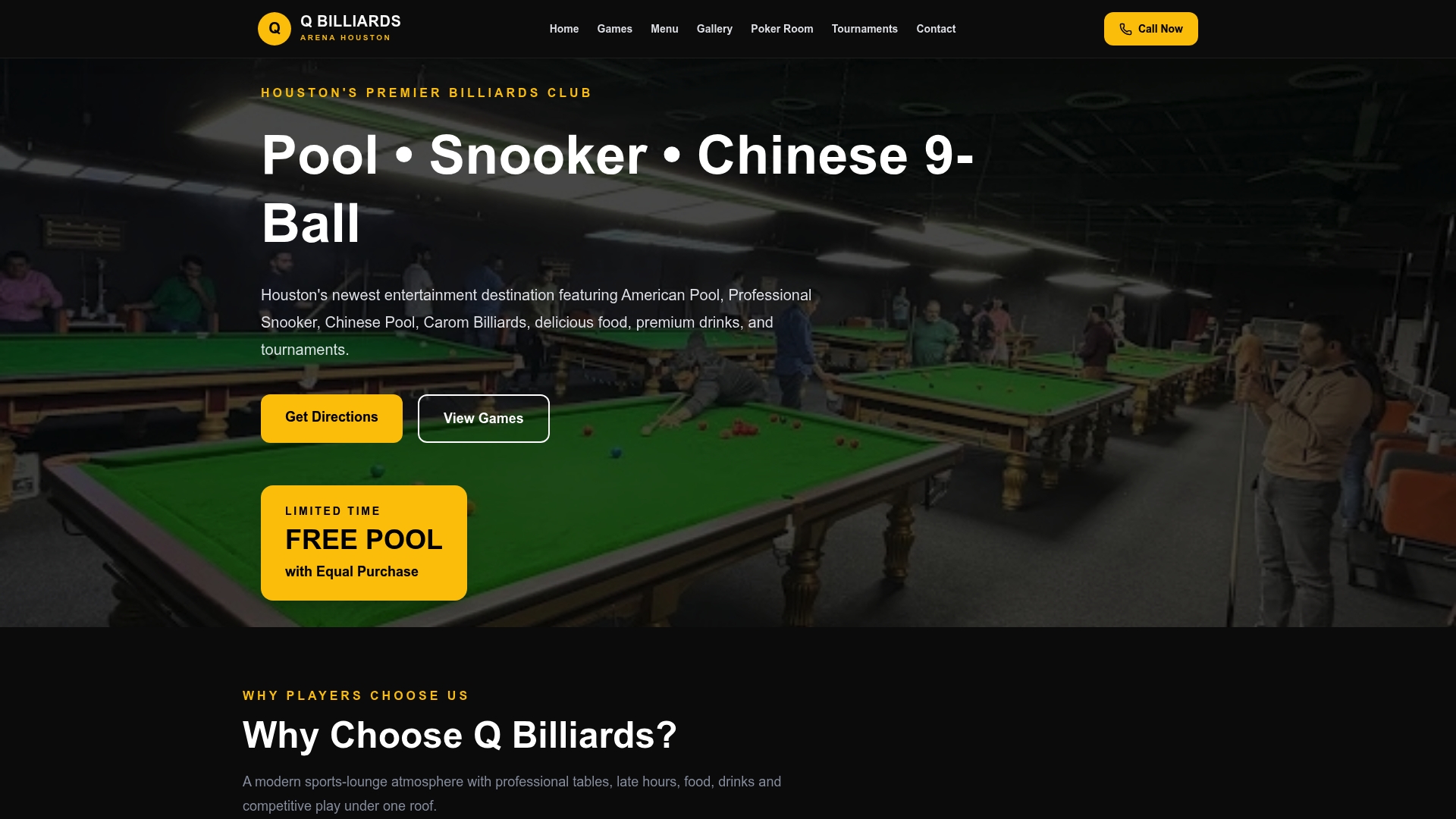
Groups can also reserve our poker room for a private event, and the kitchen serves food, snacks and drinks while you play. Details are on the poker room page and the menu page.
Perspective
Every player who walks into our room wants to draw the ball. It is the shot people film. But the players who improve fastest are the ones who start with the stun shot and the follow shot, learn where the cue ball goes, and only then lower the tip.
Our view is simple: spin is a feel you earn with table time, and the space matters. We built Q Billiards Arena as a large club, with 25 professional-grade tables across 11,000 square feet, so you can set up a ladder drill on one table while friends play on the next. Casual players, league players and tournament regulars all share the same room.
The mix of games helps too. American pool, snooker, Chinese 9-ball and carom billiards each reward spin differently. A player who practices draw on a snooker table and follow on a pool table understands the cue ball in a way that one table alone does not teach.
And because we stay open until 2 to 4 AM, you can practice when it is quiet and play in the tournaments when it is busy. Come hungry: the food and drinks are made to be eaten between racks.
Q
FAQ
Is backspin the same as draw in pool?
Yes. Backspin, draw and "screw" (a term some players use) all mean hitting the cue ball below center so it spins backward. Topspin is called follow or roll. The names change by region and by player, but the contact point is what matters.
How do you draw the cue ball without miscuing?
Chalk the tip, aim low, keep the cue level and accelerate smoothly through the ball. Stay inside the miscue limit of about half the ball's radius from center, which is where the stripe edge sits on a striped ball. A lower, slower stroke is more reliable than a harder one.
Why does my draw shot stop short, or fail on long shots?
Backspin fades as the cue ball travels, and worn or humid cloth takes it away faster. On a long draw, you need a longer, smoother stroke and a low hit so the spin survives to the object ball. Practice the distance ladder to learn how much more it takes at each distance.
Should beginners learn follow or draw first?
Follow first, because it matches how the cue ball naturally rolls. Add the stun shot next, then draw. Each one gives you a reference for the next.
Sources
- Differing Amounts of Spin, TableSkills
- Draw Shot Basics: Getting Backspin, Pool Hall Pros
- CB Control, Dr. Dave Alciatore, January 2020
- Draw Shot Control, Dr. Dave Alciatore, May 2024
- Draw Shot Physics, Dr. Dave Alciatore, April 2009
- 1/8 Rule for Stop/Follow/Draw, Dr. Dave Pool Info
- The Physics of Cue Ball Spin, WPA Pool
- The Physics of Pool Shots, MyPoolCue
- Billiards with Spin Interactive Lab, Sandbox Physics
- What determines whether a pool ball will bounce backwards, Physics Stack Exchange
- Intro to Spin, Basic Billiards