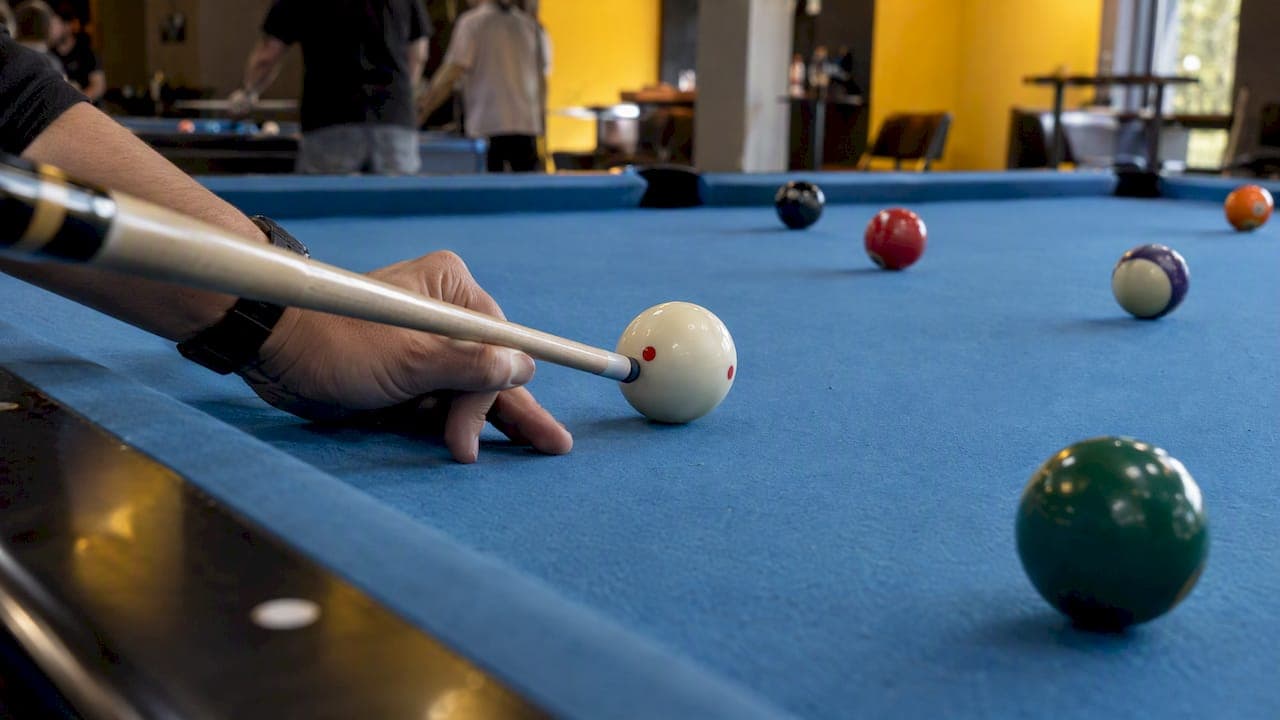
English is sidespin on the cue ball. You make it by striking the cue ball left or right of its vertical centerline, and its main job is to change how the cue ball rebounds off a cushion so you can reach a better position for your next shot. Use it sparingly, keep the tip offset small, chalk every time, and learn what it does to your aim before you rely on it in a game.
This guide covers what English does, how to apply it, when it is worth the risk, the mistakes that cost games, and a practice routine you can run on any table.
TL;DR
- English means sidespin: hit the cue ball left or right of center and it changes the rebound angle off a rail, not the path to the first object ball.
- Running (inside) English widens and speeds the rebound. Reverse (outside) English narrows and slows it.
- Stay within about half the cue ball's radius of center (9/16 inch on a standard ball) and chalk first, or you risk a miscue.
- Sidespin brings squirt, swerve and throw, so your aim has to change with it. Strong players use as little as the shot needs.
- Practice with a cue ball alone, one rail at a time, before you try it in a game.
Table of Contents
- What English Actually Is
- How to Apply English Without Miscuing
- The Three Side Effects: Squirt, Swerve and Throw
- When English Is Worth Using
- When Not to Use It
- A Practice Routine You Can Run in One Session
- Perspective: What We See on 25 Tables
- Practice English at Q Billiards Arena
- Quick Reference: Choosing Your English
- FAQ
- Sources
What English Actually Is
The word is just pool slang for sidespin. Dr. Dave Alciatore's terminology guide defines it as spin applied by striking the cue ball left or right of its vertical centerline. Physicist Rod Cross uses the same definition in his peer-reviewed 2008 paper in the American Journal of Physics: English is the sidespin made by hitting the ball off center to one side.
Two terms come up constantly:
- Inside English (running): the spin points toward the direction the shot is heading, for example right English on a ball cut to the right.
- Outside English (reverse): the spin points away from that direction.
The key idea is easy to lose in the jargon. According to Dr. Dave's sidespin tutorial, the principal purpose of English is to change the cue ball's path when it contacts a rail cushion. Sidespin does not send the cue ball somewhere different after it hits the object ball in the way that it changes what happens at the cushion. Beginners often think English "bends" the cue ball toward the pocket. It does not, and that misunderstanding is behind a lot of missed shots.
Running versus reverse at the rail
When the cue ball hits a cushion with running English, it rebounds at a wider angle and picks up speed off the rail. With reverse English it rebounds at a narrower angle and slows down, as Dr. Dave's terminology page explains. A simple way to remember it: running English "keeps going" along the rail, and reverse English "fights" it and closes the angle.
This is why English is mostly a position tool. If you are shooting a ball and need the cue ball to come back toward the middle of the table after a rail, a little reverse English can pull the angle in. If you need it to travel farther along the rail toward the other end, running English opens it up.
How to Apply English Without Miscuing
The mechanics are simple. The difficulty is doing them the same way every time.
- Chalk before every shot. In Cross's measurements, a chalked tip grips the ball better and produces a smaller deflection than an unchalked one (Cross, 2008).
- Choose the tip position. Aim at the left or right side of the cue ball's equator for pure sidespin. Adding height changes the effect again (follow or draw combined with side), so beginners should start at the horizontal center line.
- Keep the offset small. Larger offsets make more spin, but Dr. Dave recommends a maximum offset of about half the cue ball's radius to limit miscue risk. On a 2¼-inch ball, that is 9/16 inch.
- Keep the cue level and the stroke straight. A tip that is struck too far to the side, especially if it is unchalked or poorly shaped, is the classic cause of a miscue, per the same Billiards Digest article.
- Mind your speed. The same tip position gives a different cue-ball response at different speeds, so a tip-position chart is a starting point, not a promise.
How much deflection should you expect? Cross found that sidespin normally pushes the cue ball off the cue's aiming line by only a few degrees, and his measurements showed deflection below about 8° for hits up to half a ball diameter off-axis. The farther toward the edge you go, the bigger the deviation gets, and a near-edge hit can miscue (Cross, 2008). Small offsets are not only safer, they are more predictable.
The Three Side Effects: Squirt, Swerve and Throw
Every time you add sidespin, three things happen that you must account for.
Squirt. The cue ball leaves slightly to the side opposite the English you applied, away from the line you aimed along. Dr. Dave's 2018 physics article explains that off-center impact causes this initial sideways deflection. Squirt grows with the amount of sidespin and with the endmass of the shaft. Low-squirt shafts reduce it, but they do not remove it.
Swerve. If the cue is elevated even a little, the cue ball curves as it travels. The effect is small on short, fast shots and more noticeable on long, slow ones.
Throw. Friction between a spinning cue ball and the object ball can push the object ball off its expected line. The same 2018 article covers spin-induced throw.

Adjusting your aim
Players compensate in a few ways. Dr. Dave describes basic back-hand English: you pivot the cue around a natural pivot length so the squirt is cancelled. It works best on fast, short shots where swerve is small. For longer or slower shots, he recommends accounting for swerve instead of assuming back-hand English alone cancels everything (back-hand and front-hand English). His aiming guide suggests pure back-hand English for short, fast shots, pure front-hand English for long, slow shots, and a mix in between (Systems for Aiming with Sidespin).
The honest takeaway: net deflection can be reduced or cancelled for a particular shot, but the right compensation depends on your cue, speed, distance, elevation and the amount of spin (Sidespin Squirt, Swerve, and Throw Effects). You find it by hitting shots on a real table, with your own cue, not by memorizing a formula.

When English Is Worth Using
Sidespin earns its place in a few situations:
- Position off a rail. You need the cue ball to open or close its angle to land on a specific spot.
- Multi-rail routes. Spin lets the cue ball travel the way you want over two or three cushions, for example to get back up table.
- Getting around an obstacle. A little spin and elevation can curve the cue ball around a blocking ball.
- Changing the object ball's direction. Throw can make a slightly under-cut shot go in, once you know how much your cue ball throws.
- Kick shots. Spin changes how the cue ball comes off the first rail on the way to your target.
As Dr. Dave notes in a Billiards Digest piece on cue-ball control, controlling the cue ball is what lets you pocket the next ball, avoid scratches, execute break-outs, aim carom shots and avoid obstacles. English is one of the tools, not the whole kit.
If your goal is solid position play overall, our guide to cue ball control drills for amateurs covers the speed and stun-follow-draw foundation that sidespin sits on top of.
When Not to Use It
This is the part most tutorials bury. The Colorado State sidespin guide advises against spending much time on sidespin until your fundamentals, stroke and basic stun, follow and draw control are solid. It also says to learn squirt, swerve and throw before relying on sidespin seriously, because ignoring them causes missed shots and slows your learning (When to Learn, Use, and Not Use Sidespin).
A practical rule we give newer players: if you can get the same position with center-ball and a different speed or a different angle, do that. Each bit of English adds a variable. Treat spin as the answer when the table leaves you no cleaner option.
Three specific habits to drop:
- Using English on every shot "just because." It makes your aim less consistent.
- Hitting near the edge of the ball for more spin. You gain a little spin and a lot of miscue risk.
- Switching cues or chalk mid-session and expecting the same squirt. Shaft changes alter deflection.
In a game with ball-in-hand fouls, a miscue can also hand the opponent the table. Our article on cue ball fouls and how to avoid them shows how costly those errors become.
A Practice Routine You Can Run in One Session
Sidespin becomes reliable through repetition with feedback. This progression moves from simple to complex, which fits the order Dr. Dave's BU Boot Camp sidespin examples use: single-rail rebound changes first, then multi-rail routes, throw, kicks and swerve.
Step 1: Cue ball alone, one rail
Robert Byrne's classic advice, summarized in The Illustrated Principles of Pool and Billiards, is to learn cushion effects with only the cue ball. Shoot it down the table with different amounts of sidespin and bank it toward marked target points on the side rails. Put a small marker (a chalk cube or coin) on the rail at the point you aim for, and note where the ball ends up with center-ball, then with running and reverse English.
Step 2: A no-English reference shot
Joe Waldron's Colorado State drill starts with a reference shot: pocket an object ball while sending the cue ball to a marked target. Once you can do that without spin, you use the setup to make controlled one-diamond changes in where the cue ball ends up (Cue Ball Control: The Revised Wagon Wheel). The reference shot tells you whether a change came from the spin or from a bad stroke.
Step 3: Add one variable at a time
The BU Boot Camp list is a good menu: left and right spin to change rebound angles, running and reverse spin, double-the-rail shots, outside draw, inside follow, drag follow, kick shots with spin, spin-induced throw, and swerve around an obstacle. Do one for ten minutes, write down what you saw, then move on.
Step 4: Put it in a game
After a few sessions, use English only when the position payoff is clear. For ideas on drills that make small aim changes stick, see our piece on six side spin drills. If you play 8-ball, planning backward from the eight shows you exactly which shots need position, and therefore where a touch of English is justified.
Perspective: What We See on 25 Tables
We watch a lot of players learn English, and the pattern is consistent. The player who adds spin to every shot misses more, not fewer. The player who spends one session shooting the cue ball alone, learning where it goes with a half-tip of spin, starts getting position that looks like luck to everyone else.
So our advice is plain. Get your stroke and speed right first. Then add English one rail at a time, and notice how your table and cue respond. Cloth speed, cushion condition and the shaft in your hand all change the result, which is why we encourage you to practice on a few different tables rather than one corner. The tables are the same size and the cloth is similar, but a different pocket or rail can change your read.
And remember the game's competitive reality. The best players use as little sidespin as they can get away with, because every added variable makes the shot harder. That is a good habit for the rest of us too.
— Q
Practice English at Q Billiards Arena
Sidespin is a feel skill, and feel comes from table time. Our Houston club has 25 professional-grade tables, and American pool starts at $10 per hour, so a focused hour of cue-ball drills is an inexpensive way to improve. If you want snooker's longer shots and tighter pockets to test your spin control, standard snooker is $15 per hour and heated snooker is $20 per hour. See all table rates and games.
We stay open late, so you can run drills when the room is quieter, then put them to work in a league night. The Tuesday and Friday night pool tournaments each cost $10 to enter, and details are on our pool tournaments page. Ask the staff about the free pool with an equal purchase offer, and grab something from the food and drink menu between racks.
Playing three-cushion or carom? Spin matters even more there, and our three cushion strategy guide shows how to plan routes around it.
Quick Reference: Choosing Your English
| Situation | Tip position | What to expect | Watch out for |
|---|---|---|---|
| Need a wider rebound off a rail | Running (inside) English, small offset | Wider angle, more speed off the cushion | Over-running past your target |
| Need a tighter rebound | Reverse (outside) English, small offset | Narrower angle, less speed | Cue ball dying early |
| Short, fast shot with sidespin | Back-hand English pivot | Squirt largely cancelled | Swerve on slower attempts |
| Long, slow shot with sidespin | Account for swerve, front-hand English | Curve toward the spin side | Elevation changes the curve |
| Slight cut that needs help | Gentle English for throw | Object ball pushed off its line | Throw varies with speed |
Treat the table as a starting point. Your own cue, cloth and speed will change the numbers, so test each one with the cue-ball-only drill.
FAQ
How do you properly use English in pool?
Hit the cue ball left or right of its vertical centerline, with a chalked tip and a level cue. Keep the offset within about half the cue ball's radius to avoid miscues. Expect the cue ball to squirt slightly away from the side you hit, and adjust your aim accordingly.
Does English change where the cue ball goes after hitting the object ball?
Not much. Its main effect is on the rebound off a cushion. It can, however, create spin-induced throw that pushes the object ball off its line, and it makes the cue ball deflect when the tip makes contact.
Is English pool harder than American pool?
If you mean the sport, English pool uses smaller pockets and smaller balls than American pool, so it is generally considered tougher on accuracy. If you mean the technique, English (sidespin) makes any shot harder because it adds variables. At our club, American pool is $10 per hour and a good place to start.
How much English should a beginner use?
As little as possible, and often none. Build a consistent stroke and center-ball control first, then learn squirt, swerve and throw before using sidespin in games.
What is the best drill for learning English?
Shoot the cue ball alone down the table to a marked rail point, changing only the amount of sidespin. Write down where it lands each time, then repeat with running and reverse English.
Sources
- Sidespin and English Terminology and Uses, Dr. Dave
- Cross, squirt paper (American Journal of Physics, 2008)
- How to Use Sidespin, Dr. Dave
- Illustrated Principles: Draw, Billiards Digest (2006)
- Illustrated Principles: Got English? (2018)
- Back-Hand English and Front-Hand English
- Systems for Aiming with Sidespin
- Sidespin Squirt, Swerve, and Throw Effects
- Billiards Digest, cue-ball control (January 2020)
- When to Learn, Use, and Not Use Sidespin
- BU Boot Camp sidespin examples
- Cue Ball Control: The Revised Wagon Wheel
- The Illustrated Principles of Pool and Billiards