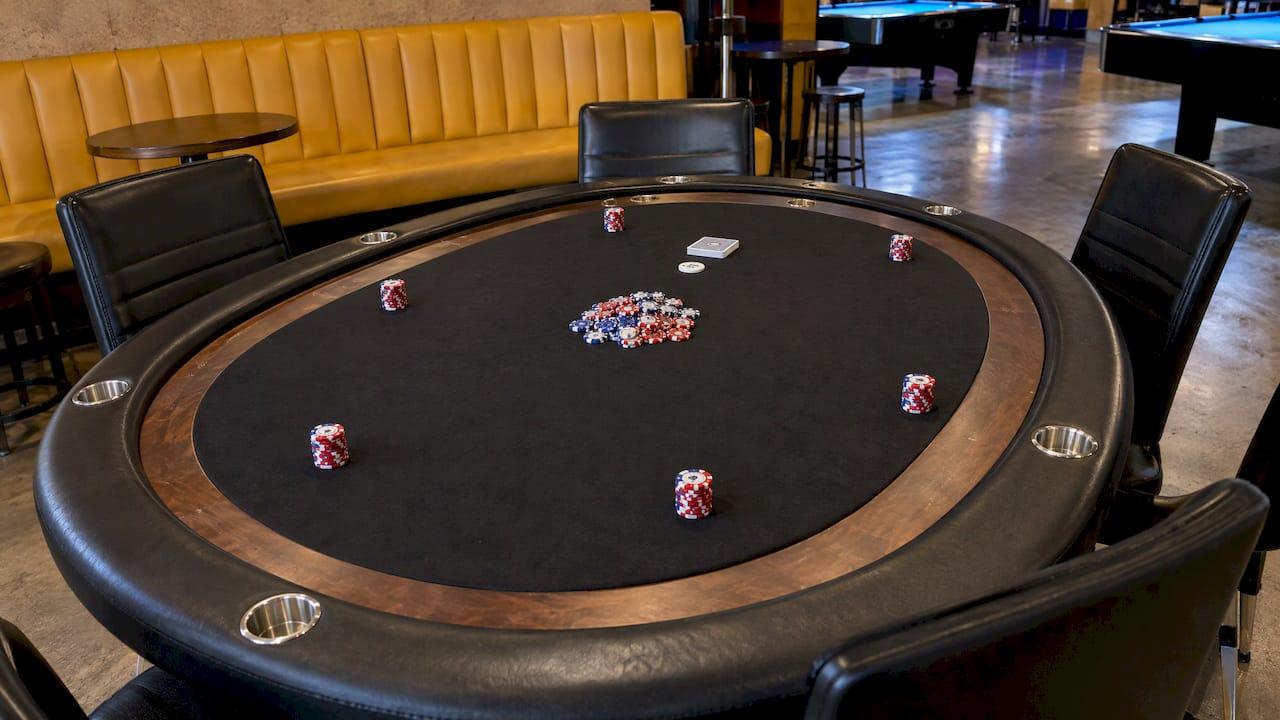
A bomb pot is a poker hand in which every player posts the same ante, the hole cards are dealt, and the hand skips preflop betting and goes straight to the flop. From there it plays like any other hand. That one change makes the pot big, the table multiway and the action fast. If you are planning a poker night in a private room, the rules below are the ones to settle with your group before the first bomb pot is dealt.
At Q Billiards Arena in Houston we offer a private poker room for rent for events, so we know how much smoother a game runs when everyone has agreed on the house rules in advance. Bomb pots are the best example, because the format is a table agreement and not a fixed rule of poker.
TL;DR
- Every player dealt in posts the same ante, blinds included. Nobody bets preflop, and betting starts on the flop with the first active player to the left of the button.
- The turn, river and showdown follow the normal rules of the game you are playing, Hold'em or Omaha.
- In a double board bomb pot, the pot is split in half: one half to the best hand on the top board, one half to the best hand on the bottom board. Win both and you scoop.
- Agree on four things before the first one: the ante, the game, one board or two, and how betting works across the boards.
- Odd chips, button movement and sitting out are house decisions, so write them down before play starts.
Table of Contents
- What a bomb pot is
- The rules, step by step
- Bomb pot or straddle?
- Double board bomb pot rules
- Which game: Hold'em or Omaha?
- What to agree on before the first bomb pot
- Writing the rules down for a private game
- Why bomb pot rules favor a private room
- Book the room for your game
- FAQ
- Sources
What a bomb pot is
In a regular hand, only the small and big blinds are in the pot before the cards come out. Players then act one by one preflop, and many fold, so the flop usually sees two or three players.
A bomb pot replaces all of that. Each player puts the same predetermined amount in the pot before the deal. BARGE, a US poker tournament organization, states that there is no preflop betting, the three-card flop is dealt, and action starts with the player to the left of the button. It also notes that bomb pots are common in no-limit Texas Hold'em and Omaha cash games, and that details vary from room to room.
The result is a hand that is multiway by design. Nobody can fold before the flop, so everyone who anted sees it, and the pot is already several times its usual size when the first bet goes in. There is also no preflop raiser, so nobody has a built-in reason to continue-bet and nobody is "in position" on a raise. Hands play more like a postflop puzzle than a preflop one.

The rules, step by step
1. Everyone antes the same amount
Every player dealt into the hand posts an equal ante. That includes the players who would normally be in the blinds: with no blinds in a bomb pot, everyone pays the same. The ante is fixed before the hand, not chosen by each player.
Ante size depends on the game. Card Player notes that some games use $1 or $2 antes while others run $5, $10 or higher. A simple illustration: in a $1/$3 game with eight players and a $10 ante, the pot is $80 before a card is dealt. At a friendly home-style game, the ante is usually a small multiple of the big blind, and the whole table should say yes to it.
If you do not want to ante, you sit out that hand. Whether a player can sit one out is a table decision, so decide it in advance rather than in the middle of a dispute.

2. The deal
Hole cards go out as usual: two for Hold'em, four for Pot-Limit Omaha. The dealer then goes directly to the flop. Some rulebooks skip the burn card here because there is no preflop action to protect, while others burn one card as normal. Pick one and stay consistent.
The Maryland gaming standard for poker adds a formal point: players must tell the dealer before the flop is dealt if they want a bomb pot, and the table cannot be a tournament table. That is a regulated rule for licensed facilities in that state, but the logic applies to any game: call it before the flop, not after. You can read the Maryland poker standard rules for the full wording.
3. Betting starts on the flop
No betting occurs before the flop. Once the flop is out, the first active player to the left of the button acts first. BARGE states that the minimum bet is the size of the ante, so the first bet on the flop cannot be smaller than what everyone put in before the deal. A dealer button is still used and moves as usual.
You can fold from the flop on whenever it is your turn and someone has bet. Your ante stays in the pot, so folding costs nothing extra.
4. Turn, river and showdown
After the flop, the hand is ordinary. PokerNews' bomb pot rules describe three betting rounds, flop, turn and river, with the pot awarded at showdown to the best hand under normal rankings and split in the usual way if several players tie.
If your game is no-limit, bets and raises follow no-limit rules. If it is pot-limit, the pot is the large antes plus any bets, so pot-sized bets get big quickly. Players new to the format should know that before they sit down.
5. What happens to the button
Houses differ here, which is why it belongs on your rulesheet. Some rooms move the button as normal after a bomb pot. Others leave it where it was so the next regular hand has the same positions. BARGE says the button is still used and rotated, while the Maryland standard allows the button to stay in position for the following hand. Either is fine if it is announced.
Bomb pot or straddle?
They are not the same. A straddle is a voluntary blind raise before the cards are dealt, and normal preflop betting still happens. A bomb pot is a forced, equal ante from everybody, and preflop betting disappears. If your group mixes the two, a clear label on the rulesheet keeps new players from guessing.
Double board bomb pot rules
The second question players ask is about double boards. In a double board bomb pot, the dealer puts out two separate flops, then two turns and two rivers. Each street adds one card to each board, and there is one betting round per street that covers both boards together.
At showdown, the pot is split in half. One half goes to the best hand on the top board, the other half goes to the best hand on the bottom board. Two things matter most:
- Hands are never mixed between boards. Your hole cards play against each board separately.
- If one player wins both boards, they scoop the whole pot. If two different players win, each takes half.
The top and bottom boards are named by position: in common practice the board closest to the dealer is the bottom board and the farther one is the top board. Say it out loud when the flops are dealt, especially at a new table.
A worked example
Four players each ante $5, so the pot is $20 with no blinds and no preflop betting. Two flops come down. One player bets $5, another calls, and the others fold, so the pot is $30. The rest of the hand plays out, and at showdown the top board is won by an ace-high flush and the bottom board by three queens. The pot splits $15 and $15 between those two players. If the same player had held both hands, they would take all $30. If two players tie for the top board, they share that board's $15, which is how a player can end up with a quarter of the pot.
Odd chips and burn cards
With two boards, the pot sometimes does not split evenly. The Asian Poker Tour's double board rules give one clear answer: an odd chip during the split goes to the hand that wins the top board, and an odd chip within a board's split goes to the first active player immediately clockwise from the button. The same rules have the dealer burn a single card before each street and deal one card to each board. You can use that approach or write your own, but write it down.
The Maryland standard words the winners as the highest-ranking hand on the first board and the highest-ranking hand on the second board, with the dealer burning a card before dealing the first and second flops.
Which game: Hold'em or Omaha?
Bomb pots work in both, but Omaha makes them more dramatic because four hole cards and two boards create many strong draws. If your group is deciding between the two, our guide to Texas Hold'em vs Omaha covers the rules and betting of each. A table can also let the player with a special bomb pot button choose the game for that hand. That is a house option, not a requirement.
If your group already likes the idea of splitting boards, you may also enjoy our explainer on running it twice, which covers a different way of dealing out multiple boards after betting is over.
What to agree on before the first bomb pot
A bomb pot is a convention of the table, not a universal rule of poker. Before the first one is dealt, settle these:
- Ante amount. A fixed number, such as a multiple of the big blind, that everybody accepts.
- Trigger. Once per orbit, at every dealer change, or when the button reaches a certain seat. Pick one.
- Game. Hold'em or Omaha, and who chooses.
- Boards. One or two, and how the pot splits.
- Sitting out. Whether a player may skip a bomb pot and what that costs them.
- Button and burn cards. Whether the button moves, and how cards are burned.
- Odd chips. Who gets them on a split.
Bomb pots are mostly a cash-game feature, so they rarely belong in a tournament. If you are choosing between formats for your night, cash vs tournament poker will help you decide. For tournaments, our guide on poker tournament structure shows how to plan blinds and timing instead.
Writing the rules down for a private game
The cleanest way to avoid a dispute at a bomb pot is a short written rulesheet that every player reads before sitting down. Keep it to one page: ante, trigger, game, boards, button, odd chips and sitting out. Our guide to private poker room rules shows how hosts can build one, and home game etiquette covers the ten habits that stop most arguments.
Before any ante goes in, say the key terms aloud: "Eight players, $10 ante, Omaha, double board, top board gets half." A thirty-second announcement beats a ten-minute argument over a pot.
Why bomb pot rules favor a private room
Bomb pots work best when everybody has agreed on the format, and that is easiest in a game you organize yourself. At a public table, a stranger may not know the local version. In a private game, your friends and teammates sign off on one rulesheet and the dealer, or the group, just follows it.
That is what a rented room is for. Quiet space, a table that is yours for the evening, and snacks within reach mean the group can focus on the hand instead of the logistics.
We run a billiards club, and we see every night how much a group enjoys itself when the rules are clear before the first shot. The same goes for cards. A bomb pot is exciting because everyone is in, so it only stays fun if everyone agrees on what that means.
Our private poker room is rented for events, with a minimum purchase or a paid reservation, which gives a group a space of its own to set its own rules. Bring a one-page rulesheet and the ante and board decisions are already made. Pair it with fresh food and drinks from our menu and the night keeps its pace.
The pool tables are next door, so a group can mix a few frames with its cards. That is the social, late-night, competitive mix we built the arena around.
Q
Book the room for your game
If you want to run bomb pots with your own group, our poker room rental is made for events like that, available with a minimum purchase or a paid reservation. Ask for the current terms on the page. Order from our food and drink menu to keep the table fed between hands, and if your group wants a break from cards, our pool and snooker tables start at $10 per hour for American pool.

We are open late, with hours running until 2 to 4 AM, so a long game does not have to end early.
FAQ
What is a bomb pot in poker?
A bomb pot is a hand where every player antes the same amount before the deal, preflop betting is skipped, and the action starts on the flop. The pot is large from the first card, and everybody who anted sees the flop.
Who acts first in a bomb pot?
The first active player to the left of the button acts first on the flop. After that, the turn, river and showdown follow the normal rules for the game being played.
How is the pot split in a double board bomb pot?
The pot is split in half. One half goes to the best hand on the top board and the other half goes to the best hand on the bottom board. A player who wins both boards takes the whole pot, and a tie on one board splits that board's half.
Can I fold in a bomb pot?
Yes, from the flop onward, whenever it is your turn and someone has bet. Your ante stays in the pot, so folding costs nothing more. Before the deal, a player who does not want to ante sits out the hand, if the table allows it.
How big should the ante be?
There is no fixed amount. Card Player notes that antes range from $1 or $2 up to $5, $10 or more, depending on stakes and venue. Choose a number your whole group is comfortable with and write it on the rulesheet.
Sources
- Bomb Pot, BARGE Rulebook
- Bomb Pot Poker Rules, PokerNews
- Poker Standard Rules Version 1.6, Maryland gaming
- Double Board Bomb Pot, Omaha, Asian Poker Tour
- Bomb Pot in Poker Explained, Card Player