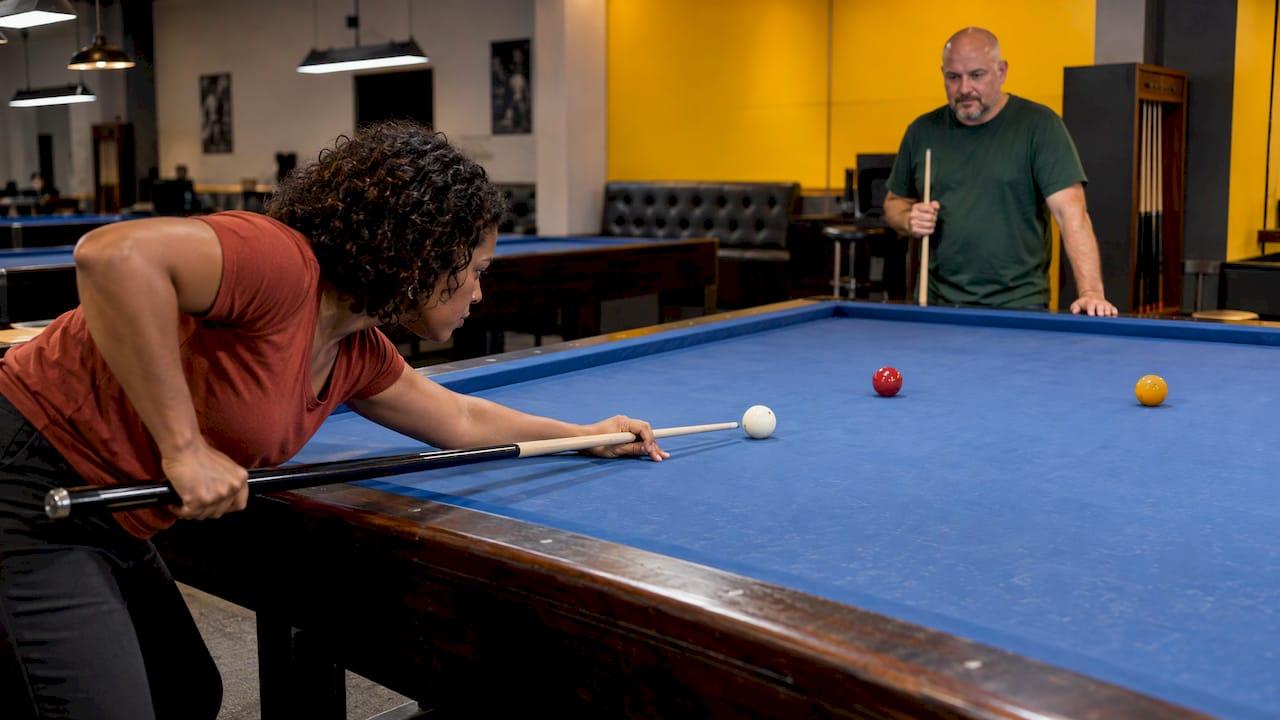
Carom billiards is the cue sport with no pockets. You play with three balls on a big, pocketless table, and you score a point every time your cue ball hits both of the other balls in a single shot. That is the whole idea. Everything else, from the three-cushion rule to the heated table, exists to make that one shot harder and more interesting. If you already play American pool, you have the stroke you need. You only have to change what you aim at.
If you want to try it in Houston, carom tables at Q Billiards Arena are $15 per hour, and you can walk through everything below on a real table.
TL;DR
- Carom billiards uses three balls and a table with no pockets. One point comes from your cue ball touching both other balls on one shot, and you keep shooting until you miss.
- A regulation table is 10 by 5 feet with a playing surface of about 9.3 by 4.7 feet, much bigger than a typical pool table.
- The three families you will hear about are straight rail, balkline and three-cushion. Three-cushion is the one most players mean today.
- Carom balls are heavier than pool balls, and carom cues are longer and stiffer, with a thicker tip. Cloth and bed are built for fast, steady rolling.
- Carom tables at Q Billiards Arena cost $15 per hour, and the club runs tournaments for other cue sports on a weekly basis.
Table of Contents
- What carom billiards is
- The table: size, dimensions and features
- How a basic game works
- Three formats you will hear about
- What changes if you come from pool
- Play carom billiards in Houston
- Our view: start with the carom
- FAQ
- Sources
What carom billiards is
Carom billiards, also called French billiards, is a family of cue sports played on cloth-covered tables with no pockets. Most versions use three balls: a white cue ball, a yellow cue ball and a red object ball. Each player owns one of the two cue balls, and the goal is to drive your cue ball into both of the other balls.
Britannica describes the same setup: three balls, two white and one red, a table without pockets, and one point for each carom completed. A "carom" (you will also hear "cannon") simply means your ball has struck the other two.
That makes it very different from pool in three ways:
- No pockets. Nothing is sunk. You never clear the table.
- Three balls, not sixteen. Pool uses sixteen balls on a table with six pockets, and carom uses three on a table bounded only by cushions.
- One point per shot. Most carom games award one point per successful shot, with no penalty for a plain miss.
A word on terms. In everyday pool talk, a "carom shot" or "kiss shot" is a trick where your cue ball hits an object ball and then rebounds to hit another. Carom billiards is the full game built around that single idea, and it is what you play on a pocketless table.
The table: size, dimensions and features
The first thing you notice at a carom table is how long it is. Britannica gives the standard size as 5 by 10 feet (152 by 305 cm). That is the overall table. The part you play on is smaller.
Playing surface
A regulation 10-by-5-foot table has a playing surface of 2.84 by 1.42 meters, which works out to about 9 feet 3.8 inches by 4 feet 7.9 inches, give or take 5 mm. The playing surface is measured between the cushions, which is why it is shorter than the table's nominal length.
In the US, the Billiard Congress of America's equipment specifications recognize carom tables in two sizes: 4½ by 9 feet and 5 by 10 feet. On a 5-by-10 table, the playing area is 56 inches wide by 112 inches long, and the bed height is 29¼ to 30¼ inches. North American carom rules also list 4 by 8 and 6 by 12 foot tables, so you may meet a different size depending on the room.
| Measurement | Regulation 5 by 10 table |
|---|---|
| Overall table | 5 by 10 ft (152 by 305 cm) |
| Playing surface | 2.84 by 1.42 m (about 9.3 by 4.7 ft) |
| Playing area, cushion to cushion (BCA) | 56 by 112 in |
| Pockets | None |
| Balls | Three |
Bed, cloth and cushions
Under the UMB World Rules of Carom Billiard, which have been in force since January 1, 1989, tables used in official tournaments need an electric heater that keeps humidity out of the slate and cloth. The slate bed is often heated about 5 °C above room temperature, which keeps the cloth dry and the play consistent and faster. Electric heating is required under international tournament rules.
The cloth is a fine, smooth worsted wool. The UMB rules also set a slate bed at least 45 mm (1.77 in) thick, cushions with a nose height of 37 mm (1.46 in), and a table height of 75 to 80 cm (29.5 to 31.5 in), according to a summary of the UMB specifications. You do not need to memorize these. The practical point is that a carom table is built to roll true and quick, so a ball shot gently can still travel a long way.

Balls and cues
Carom balls are 61 to 61.5 mm across and weigh 205 to 220 g, typically about 210 g. That is a little larger and heavier than pool balls, so they behave differently when they strike each other.

Carom cues are typically 54 to 56 inches long and 470 to 520 g, with a stiffer shaft, thicker butt and an 11 to 12 mm tip. That design reduces deflection ("squirt") when you play with heavy balls and a lot of side spin. You can start with house equipment. What matters on your first day is a smooth stroke, not a custom cue.
How a basic game works
The World Confederation of Billiards Sports sums up the object this way: drive one cue ball into both other balls, score one point for each successful carom, and keep shooting until you miss. Matches are played to an agreed point total, and a shoot-out settles ties.
The break
In USBA three-cushion, the standard in the US, the opening works like this, according to the World Confederation of Billiards Sports:
- Players lag (shoot to the far cushion and back) to decide who breaks.
- The breaker chooses a cue ball, white or yellow.
- The red ball goes on the foot spot, and the opponent's cue ball goes on the head spot.
- The breaker's ball sits on the head string, 18.25 cm (7 3/16 in) to the left or right of the head spot.
- The break must hit the red ball first.
The head spot and foot spot are the marked spots near the two short ends of the table. If you have played pool, you know the head spot as the area where the break is shot from.
Turns, points and misses
A carom counts as a point when the shot is legal and no foul occurs. Your turn, called an inning, continues until you miss or foul. If you do not complete the carom, the referee may announce a miss and your turn ends. A run of points in one inning is what separates strong players from beginners.
There is no ball in hand. In USBA three-cushion, a foul ends the inning with no point deduction and no ball in hand. The incoming player shoots the balls where they lie, and a ball that left the table is spotted. This is a big difference from pool, where a cue ball foul can hand your opponent the table. If you want to see how pool handles it, our guide to cue ball fouls and ball in hand shows the contrast.
Games are usually played to an agreed number of points, often 50. Shooting the wrong cue ball costs a point and your turn in that version.
Common fouls
The UMB rules list fouls that apply across carom games, including:
- a ball leaving the table;
- shooting before the balls have come to rest;
- using any part of the cue other than the leather tip to strike the ball;
- touching a ball with anything but the tip;
- push shots;
- having no foot on the floor.
The full list is in the UMB general regulations. For a plain-language walk through the rules with three beginner drills, read our carom billiards rules and drills guide.
Three formats you will hear about
Carom is a family, not one game. Each discipline puts different conditions on the basic carom, but each successful carom is still worth one point.
Straight rail
The simplest version. A point is scored when the cue ball contacts both other balls on one shot. There are no cushion requirements. It is easy to learn, which is why it is a good first goal.
Balkline
In America it is called balkline, and elsewhere it is called cadre. The table is divided into six or nine zones with lines 47 cm or 71 cm from the rails. In 47/2, a second carom inside a zone must drive at least one object ball out of it. You may also hear 18.1/18.2 or 28.1/28.2 balkline, which are the same games with the measurements in inches. Britannica says balkline was designed to stop "nursing", where a player lightly rolls the balls along the rail into a corner for very long scoring streaks.
Three-cushion
The version most players now mean. The cue ball must contact both object balls and make at least three cushion contacts before touching the second ball. The cushion contacts may happen before the first ball, between the two balls, or split around them. The cue ball does not have to touch three different cushions: three total contacts in any order is enough.
That rule is where the strategy comes from. You are not just aiming at a ball, you are planning a path around the table. For a detailed look at what scores and what does not, see what counts as a point under three-cushion rules.
| Format | What counts as a point | Table lines |
|---|---|---|
| Straight rail | Cue ball touches both other balls | None |
| Balkline (cadre) | Same, with limits inside zones | Lines at 47 or 71 cm from rails |
| Three-cushion | Both balls touched, at least three cushion contacts before the second ball | None |
What changes if you come from pool
Pool players have a head start with stroke, cue alignment and cue ball speed. A few adjustments help right away.
- Think in paths, not pockets. You are choosing where your cue ball travels, not where an object ball ends.
- Respect the distance. The table is much bigger than a typical pool table, so shots take more room and more patience.
- Use speed you can repeat. With a quick cloth and heavy balls, a controlled stroke beats a hard one.
- Expect a miss to cost little. There is no penalty for a plain miss, so play for position as well as the point.
- Watch where the balls stop. Your next shot starts wherever the last one ended, and no ball in hand means you live with the layout.
A simple first-hour plan: spend the first ten minutes hitting the cue ball around the table to learn how far it rolls. Then play straight-rail shots to learn the carom. Then try three-cushion paths and keep score for a short game to 10 or 15 points.
Play carom billiards in Houston
Q Billiards Arena lists carom billiards tables at $15 per hour, alongside American pool at $10 per hour, standard snooker at $15 per hour, heated snooker at $20 per hour and Chinese 9-ball at $15 per hour. You can see the full list on our games page.
The club has 25 professional-grade tables across 11,000 square feet, keeps late-night hours and serves fresh food and drinks, so a long practice session does not have to end when you get hungry. You can see the room on our gallery page or browse the food and drink menu.

If you are bringing friends, our poker room rental is available for private events. If you want to compete, we run weekly tournaments: the Tuesday and Friday night pool tournaments are $10 each to enter, and the 1-Red Snooker Tournament is $20.
Our view: start with the carom
We think carom billiards is the best way for a pool player to get better at cue ball control. When there are no pockets, every shot is about where the cue ball goes, and that is a skill that carries into every game on the floor.
That is why we keep carom tables next to American pool, snooker and Chinese 9-ball. Different games teach different things: snooker teaches patience and position, pool teaches pattern play and carom teaches angles and speed.
Our advice to a new player is simple. Book an hour, learn how far the ball rolls, and score your first points with the straight-rail carom. Then try three-cushion. Bring a friend, order something from the kitchen and keep score. A new game is easier to learn when you are enjoying yourself.
Q
FAQ
What is carom billiards?
Carom billiards is a family of cue sports played on a table with no pockets, usually with three balls. You score a point when your cue ball hits both of the other balls in one shot. You keep shooting until you miss.
What size is a carom billiards table?
The standard carom table is 5 by 10 feet overall. Its playing surface is 2.84 by 1.42 meters, about 9.3 by 4.7 feet. In the US, 4½ by 9 foot tables are also recognized by the BCA.
What are the main features of a carom table?
A carom table has no pockets, a slate bed and a fine wool cloth. Tables used in official tournaments must have an electric heater to keep moisture out of the slate and cloth. The cushions run all the way around the table.
Is carom billiards harder than pool?
It is different rather than simply harder. You do not have to sink balls, but you have to control where the cue ball travels, often across several cushions. Pool players already have the stroke, so the learning curve is mostly angles and speed.
What is the difference between three-cushion and straight rail?
In straight rail, a point is scored when the cue ball touches both other balls. In three-cushion, the cue ball must also make at least three cushion contacts before it touches the second ball. That is why three-cushion is the more demanding game.
Sources
- Carom billiards, Britannica Kids
- Billiards, Britannica Kids
- Carom billiards, Wikipedia
- Carom billiards equipment, Wikipedia (2024)
- Comparison of cue sports, Wikipedia
- Billiard table, Wikipedia
- Three-cushion billiards, Wikipedia
- UMB World Rules of Carom Billiard
- How to Play Carom, World Confederation of Billiards Sports
- How to Play 3-Cushion Billiards, USBA
- Balkline, USBA
- BCA Equipment Specifications
- Carom Billiard Rules (North America)
- Carom Billiards: The Game With No Pockets
- Carom Billiards Rules: Table Size, Setup, Scoring and Fouls