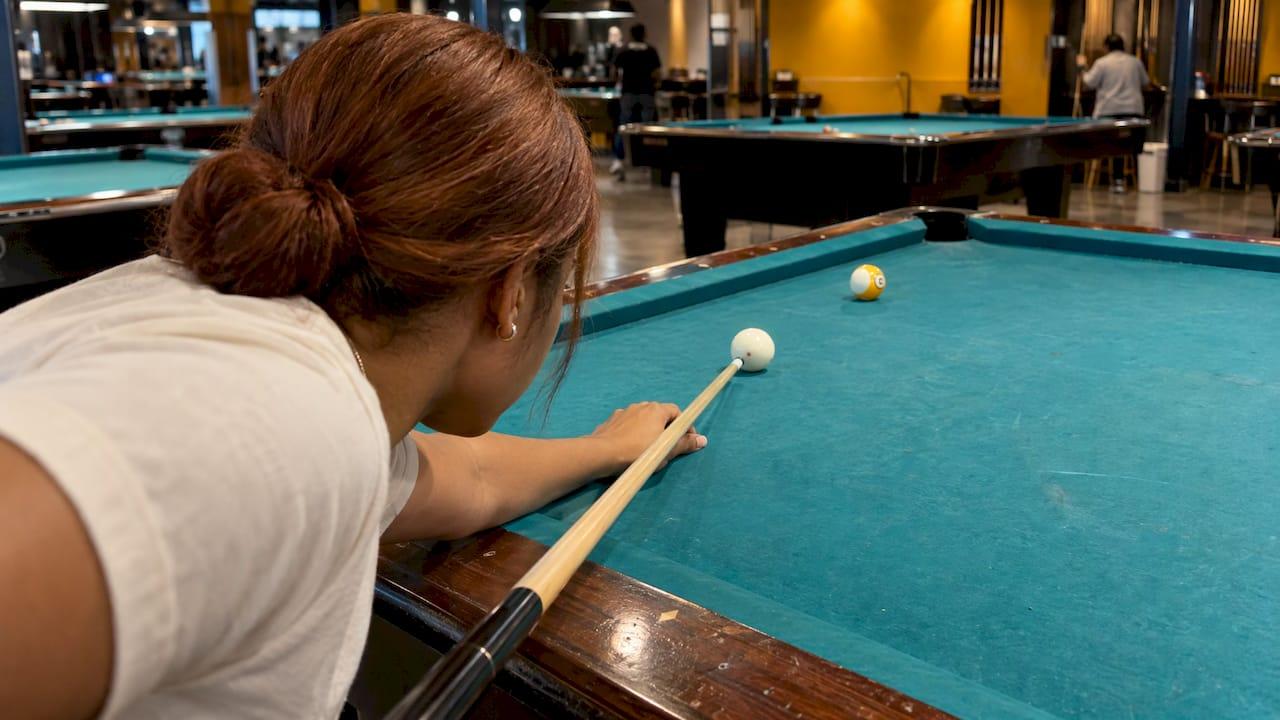
Billiards for beginners comes down to three things: knowing the equipment and the rules of 8-ball, building a stroke that repeats, and getting table time with simple drills. You can learn the rules in one sitting. The stroke takes a few weeks of short, focused practice. This guide covers all three, in the order you will need them.
TL;DR
- 8-ball is the best first game: one player takes solids (1-7), the other stripes (9-15), and whoever clears their group and legally pockets the 8-ball wins.
- Every foul gives your opponent ball in hand, so the first skill is simply hitting your own ball first and keeping the cue ball on the table.
- A repeatable stroke beats power: stand still, keep the cue level, and finish through the ball.
- Practice with one or two drills per session, written down, rather than endless random games.
- In Houston, our hourly American pool tables start at $10 per hour, and our Tuesday and Friday night tournaments are $10 to enter.
Table of Contents
- What You Need to Start
- Pool Vocabulary in Plain Words
- How to Play 8-Ball, Step by Step
- Fouls Beginners Make Most
- Stance, Grip, Bridge and Stroke
- Beginner Pool Drills That Work
- How to Structure Practice and Track Progress
- Etiquette When You Play in a Pool Hall
- Our Perspective
- Where to Practice in Houston
- Moving Beyond 8-Ball
- FAQ
- Sources
What You Need to Start
Pool needs less gear than most people expect. A table, a set of balls, a cue, chalk and a triangle rack are all the equipment you will touch. At a pool hall the house provides almost all of it.
The WPA 8-ball beginner guide lists the standard setup: a table of 7, 8 or 9 feet, a white cue ball and 15 object balls (all 2¼ inches across), cue sticks 57 to 58 inches long weighing 18 to 21 ounces, a triangle rack, chalk, and optionally a bridge stick. The object balls are seven solids numbered 1 to 7, seven stripes numbered 9 to 15, and the black 8-ball.

A standard table has six pockets: one in each corner and one in the middle of each long side. A regulation table is twice as long as it is wide, so a 7-foot table is 3.5 feet wide, as wikiHow's pool guide notes. If you are curious how much room a table needs, our guide to pool table sizes and room requirements has the dimensions.
Choosing a house cue
For a beginning student, almost any cue will do. The Professional Billiard Instructors Association says it is hard to buy a truly bad cue today. Pick one that looks straight when you roll it on the table, has a tip with some chalk grip, and feels comfortable in your hand. Heavier or lighter is a matter of feel, and the 18 to 21 ounce range above is the normal window.
If you later want to build your own kit, our pool hall essentials checklist covers a five-item bag.
Pool Vocabulary in Plain Words
A few terms come up in the first five minutes of any game:
- Cue ball: the white ball, the only ball you ever strike with the cue.
- Object balls: the numbered balls you try to pocket.
- Solids and stripes: balls 1-7 and 9-15.
- Rack: the triangle that holds the balls at the start, and the act of setting them up.
- Break: the opening shot that scatters the rack.
- Head string and kitchen: the line across the table near you at the start, and the area behind it, where the cue ball is placed for the break.
- Foot spot: the mark where the front ball of the rack sits.
- Bridge: your guide hand, which holds the cue steady (or the stick used when a shot is out of reach).
- Scratch: the cue ball goes into a pocket or off the table, which is a foul.
- Ball in hand: after a foul, your opponent may place the cue ball anywhere.
How to Play 8-Ball, Step by Step
Eight-ball is the most common version of the game. The Wisconsin Billiards Hall of Fame explains that after the break, a player is assigned a group once a ball from it is legally pocketed, and the goal is to legally pocket the 8-ball after clearing that group.
- Decide who breaks. A coin flip works, or players can lag (both shoot to the far rail and the closer ball wins).
- Rack the balls. Under the WPA Rules of Play, the 15 balls are racked as tightly as possible in a triangle, with the front ball on the foot spot and the 8-ball directly below the front ball, in the middle of the third row. One solid and one stripe sit on the two back corners.
- Break. The cue ball starts in hand behind the head string, no ball is called, and the cue ball does not have to hit a specific ball first. If no ball is pocketed, at least four object balls must be driven to a rail or it is an illegal break, per the same WPA rules.
- The table is open. The first player to legally pocket a ball takes that group, and the opponent gets the other.
- Clear your group. You keep shooting as long as you legally pocket a ball. Call the ball and pocket whenever the shot is not obvious.
- Shoot the 8-ball. Once your seven balls are down, call a pocket for the 8 and make it.
The WPA rules also say your whole group must be off the table before you attempt the 8-ball, and that shots are called.
House rules vary from table to table. Some halls and bars play "slop" (any pocket counts) or allow different break rules, so ask before the first rack.
Fouls Beginners Make Most
The official WPA Rules of Play give your opponent ball in hand after every foul, meaning they can place the cue ball anywhere on the table. Standard fouls include a scratch, hitting the wrong ball first, no rail after contact, a ball driven off the table, touching a ball, a double hit, a push shot, playing out of turn and slow play.
The USA Today illustrated guide adds plain examples of scratches: the cue ball bouncing off the table, going into a pocket, not hitting anything, or a push shot where the cue stays against the ball instead of striking it.
The 8-ball itself carries the harshest penalties. Under the WPA rules you lose the game if you pocket it in an uncalled pocket, pocket it before your group is cleared, drive it off the table, or pocket it and foul. For a closer look, read our guides on 8-ball fouls and instant-loss rules and cue ball fouls and how to avoid them.
A beginner's shortcut: before every shot, ask three questions. Which ball do I hit first? Where will the cue ball end up? Which pocket am I calling?
Stance, Grip, Bridge and Stroke
Most beginner frustration comes from the stroke, not the rules. The stroke is the only thing that moves the ball, so a small, repeatable motion is worth more than strength.
Stand and set
The Fargo Billiard Academy's Foundations Course describes the set position: hold your body completely still for at least three seconds, with the forearm vertical, the tip close to the cue ball, and your eyes moving from the cue ball to the target spot. Its Foundations courses use five seconds. Notice how that pause feels. It is the quickest way to stop jerky shots.
Bridge and grip
Your bridge hand sits on the table and forms a groove for the cue to slide through. Keep the bridge about as far from the cue ball as feels comfortable, since the follow-through is roughly that same distance. Hold the cue lightly with the back hand, like holding a small bird: firm enough not to drop it, loose enough not to strangle it.
The stroke itself
An instructional sample from playing-pool.com compares the stroke to a throw: pull back slowly, then accelerate forward, with the cue moving as straight and parallel to the table as possible and going "through" the ball. The cue comes to rest after a distance about equal to the gap between the cue ball and your bridge hand.
The Fargo course makes the same point from another angle: improvement rests on consistently executing a simple stroke sequence and leaving out needless motion.
Aiming
Start with straight and gentle angles. Line the cue ball, the object ball and the pocket in your mind, aim the cue ball at the contact point on the far side of the object ball, and stay down through the shot. The American Poolplayers Association offers instructional videos by co-founder Terry Bell covering equipment, fundamentals, aiming and basic positioning, and they are a good free complement to table time.
Beginner Pool Drills That Work
Random games teach you slowly because you cannot tell which part failed. Drills isolate one skill so you get clear feedback. Pick one or two per session.
Drill 1: the one-handed stroke drill
From the Fargo Billiard Academy: place a paper hole reinforcer (a donut) about six inches from a rail near a pocket, rest your bridge hand on the rail close to the cue without touching it, and use a pendulum stroke to pocket the ball in the opposite corner pocket. Repeat it at least ten times until your body stays still, your elbow stays in place and the ball goes into the center of the pocket.

Drill 2: stop shot ladder
Put an object ball on a spot with the cue ball a foot straight back. Pocket the ball and try to stop the cue ball dead. Then move the cue ball back and repeat, a little farther each time. The CueCards drill guide calls this the best single diagnostic of striking, since it demands a level cue, center-ball contact and enough pace.
Drill 3: follow and draw pairs
Use the same straight shot, but say out loud before each attempt whether the cue ball will finish a foot forward (follow) or a foot back (draw). Naming the result first is what turns it into practice instead of observation. For more position work, try our five cue ball control drills.
Drill 4: ghost match
Play a full rack of 8-ball alone, taking ball in hand after each of your own misses as though an opponent had fouled you. It is a realistic way to practice calling shots and thinking ahead. Once that feels natural, our 8-ball strategy guide shows how to plan backward from the eight.
How to Structure Practice and Track Progress
Keep sessions short enough that you stay focused. Dr. Dave Pool Info advises taking a break when you get bored or sloppy, and says several short, focused sessions with clear goals beat one long, unfocused session.
A simple plan for a session:
- Warm up with stroke work, such as the one-handed drill.
- Spend time on shotmaking, with straight shots first and then angles.
- Practice position with the follow and draw pairs.
- Finish with a ghost match.
Write down the drill, attempts and successes. Mark Finkelstein recommends keeping statistics over time, choosing skills to develop, testing weekly and keeping score to track progress. A notebook is enough. If last week you made 4 of 10 and now you make 7 of 10, you are improving.
Etiquette When You Play in a Pool Hall
A few habits make you welcome at any table. Wait until your opponent has finished before moving around the table. Stay still and quiet while someone is shooting. Do not offer advice unless asked. Chalk your cue away from the table surface, and never lean on or sit on the table.
These are the same shared-space manners you see anywhere people are moving around each other. A good primer on dance floor etiquette basics makes the same point about awareness and respect for other people's space. For pool specifics, including what "sharking" means and how league play changes things, see our pool hall etiquette guide.
Our Perspective
We think the fastest way to learn billiards is to play on good tables, in a room where other people are playing too. Watching a confident player rack, break and run is worth hours of reading.
That is why we built Q Billiards Arena in Houston around 25 professional-grade tables and a wide range of games: American pool, standard and heated snooker, Chinese 9-ball and carom. A beginner can start on American pool, and when you are curious, try a different cue sport without leaving the building.
We also think learning sticks when it is social. Our weekly tournaments and league-style events let new players see how rules play out in real games, while the food and drink menu keeps a two-hour session comfortable. Our late hours mean you can practice when the crowd is lighter.
Start with short sessions, pick one drill, and come back to it. The stroke you build in your first month is the one you will keep.
Q
Where to Practice in Houston
If you are ready to put this into practice, Q Billiards Arena has you covered. Our American Pool tables are $10 per hour. Standard snooker, Chinese 9-ball and carom billiards are $15 per hour, and heated snooker is $20 per hour. Our club offers late-night hours, and we run promotional offers such as free pool with an equal purchase, so ask us what is current when you visit.
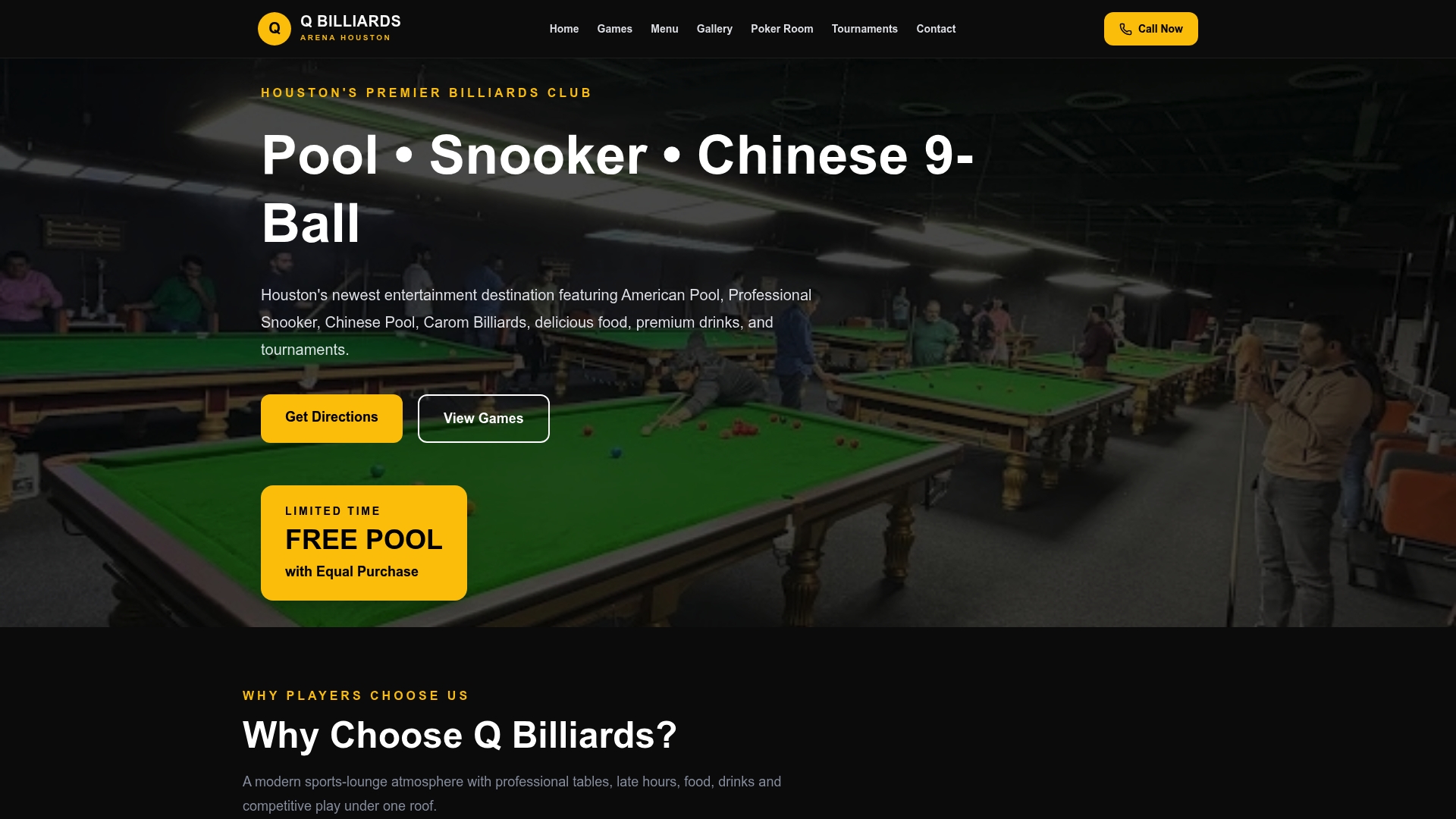
When you want to play against others, our Tuesday and Friday night pool tournaments are $10 to enter. If snooker catches your eye, the 1-Red Snooker Tournament is $20, and our events page lists the Snooker Coaching Camp. Check our food and drink menu for snacks to enjoy between racks.
Moving Beyond 8-Ball
Once 8-ball feels comfortable, other games sharpen different skills. Nine-ball rewards break and position play, so our guide to 9-ball rules on breaks and push outs is a good next read. Straight pool teaches pattern play, covered in our straight pool rules and break ball drill. If you want to try a different tradition, Chinese 8-ball rules feature a four-contact break, and you can try Chinese 9-Ball in Houston at our club.
FAQ
Is billiards the same as pool?
In everyday American usage, people say billiards and pool interchangeably, but billiards is the wider family of cue sports. Pool (8-ball, 9-ball, straight pool) uses a six-pocket table and numbered balls. Carom billiards has no pockets, and snooker uses a larger table with its own rules. At our club you can try American pool, snooker, Chinese 9-ball and carom billiards.
What is the easiest pool game for a beginner?
Eight-ball is the usual starting point. It uses a single set of rules: take solids or stripes, clear your group, then legally pocket the 8-ball. It is also the game most bars, leagues and pool halls play, so what you learn transfers easily.
How long does it take to get decent at pool?
The rules take an afternoon, while a reliable stroke takes longer and depends on how often you practice. Short, focused sessions with a written log of one or two drills tend to show progress faster than long, unfocused games. Track your makes weekly to see the change.
Do I need my own cue to start?
No. House cues are fine for learning, and the Professional Billiard Instructors Association notes that nearly any cue works for a beginner. At our club, the hourly table fee covers the table, and you can ask the staff about cues when you arrive.
Sources
- WPA: How to Play 8-Ball Pool beginner guide
- wikiHow: How to Play Pool
- Wisconsin Billiards Hall of Fame: Games
- WPA Rules of Play (2026 edition)
- WPA Rules of Play (2025)
- USA Today: How to play pool, illustrated 8-ball guide
- Fargo Billiard Academy Foundations Course
- playing-pool.com free sample
- American Poolplayers Association: Terry Bell instruction
- CueCards: 7 Pool Drills for Beginners
- Dr. Dave Pool Info: Advice on How to Practice
- PoolDawg Academy: Measuring Your Progress
- Dance floor etiquette essentials