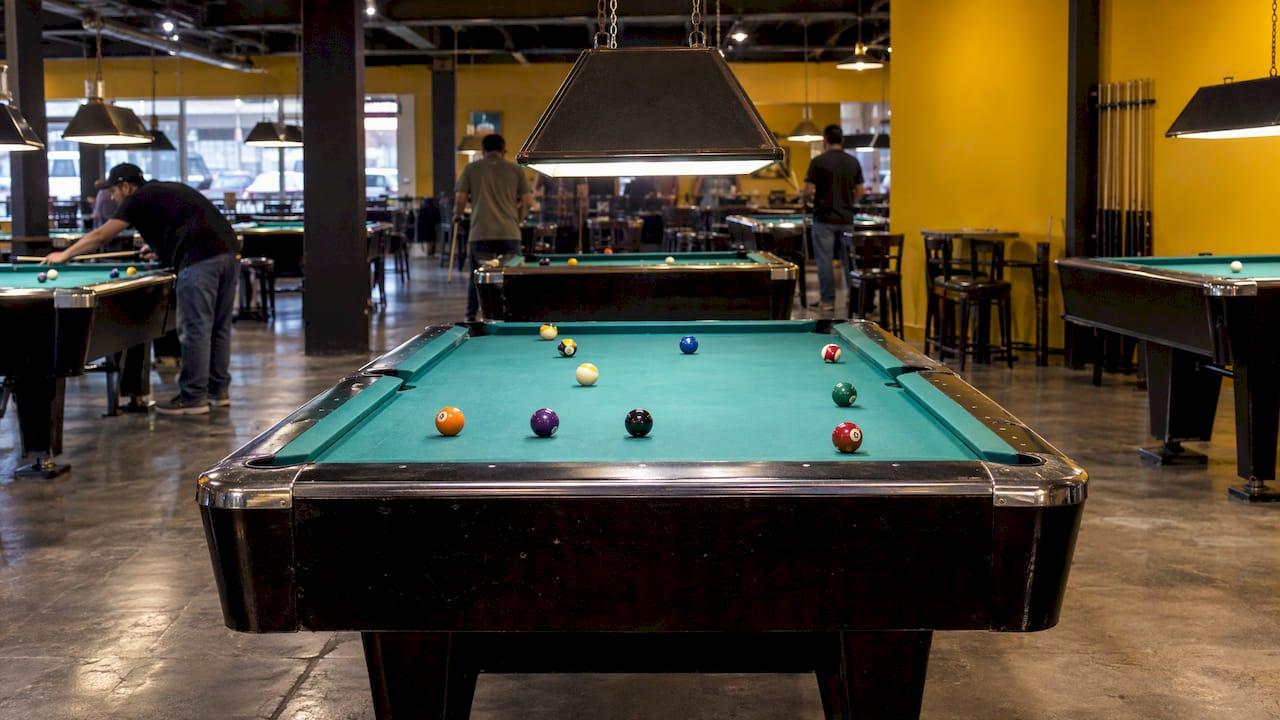
For a home or game-room table, hang the bottom of the shade 30 to 36 inches above the cloth, and start at 32 to 34 inches. Go toward 36 or higher if anyone jumps balls or plays masse shots. Tournament rooms follow a stricter standard that sets a higher minimum for the light and a minimum brightness at every point on the table. If you would rather play under pro-level conditions than build them, our 25 professional-grade tables in Houston are open late and rent from $10 an hour.
This guide covers the height, how to measure it, where to center the light, how long the fixture should be and how bright and what color it should be. It is written for players, so every number comes with the reason behind it.
TL;DR
- Home standard: bottom of the shade 30 to 36 inches above the playing surface. 32 to 34 inches is a safe starting point.
- Tournament standard: the WPA asks for at least 40 inches above the bed for a movable fixture and 65 inches for a fixed one.
- Measure from the cloth to the bottom edge of the shade, not to the bulb and not from the rail top.
- Center the light over the table, size it to about two-thirds of the playing length, and aim for even, glare-free light.
- Neutral white light of about 4000 K keeps ball colors easy to tell apart.
Table of Contents
- The height that works for most tables
- Why tournament rooms hang lights higher
- How to measure the distance correctly
- Where to center the light
- Fixture length: the spec people miss
- How bright should the light be
- A quick setup checklist
- Play under tournament-style light in Houston
- Our view on lighting
- FAQ
- Sources
The height that works for most tables
The most common answer from manufacturers and installers is a band, not a single number. Simonis, the maker of the cloth used on most professional tables, says the lamp should generally sit 30 to 33 inches from the bottom edge of the shade to the playing surface. A lighting guide from Billiard Factory puts the range at 32 to 36 inches. Blatt Billiards narrows it to 31 to 33 inches and says that range applies to 7-foot, 8-foot and 9-foot tables.

The ranges overlap at 32 to 33 inches. That is why 32 to 34 inches is a sensible first position: you can still move it up or down after you see how it plays.
Height is the one number that does not change with table size. The length of the fixture does, and we get to that below.
What goes wrong when it is too high or too low
Too high, the light spreads thin. Blatt warns that hanging above 36 inches weakens intensity and coverage. The middle of the cloth can look fine while the rails and corners fall into shadow.
Too low, you create a hazard. Below 30 inches the fixture can block your sightline, and players bump it during shots. The same source notes both problems. Anyone who has raised a cue for a long bridge shot under a low shade knows the feeling.
Why tournament rooms hang lights higher
If you play league or tournament pool, you will notice that the light in a good room hangs above eye level, nothing like the 33 inches in a basement. The World Pool-Billiard Association (WPA) sets this in its Recommended Equipment Specifications: a fixture a referee can move aside should be no lower than 40 inches above the bed, and a non-movable fixture no lower than 65 inches.
The reason is the cue. According to GameRoomWise, on jump and masse shots the butt of the cue rises steeply, and a fixture at 30 inches can be in the way. Their advice: if anyone at home jumps balls or practices masse, hang the light at 36 to 40 inches and buy a brighter fixture to make up for the extra height.
So the right height depends on how you play:
| Your situation | Starting height above the cloth |
|---|---|
| Casual home play, no jump or masse shots | 32 to 34 inches |
| Regular practice with jump shots or masse | 36 to 40 inches, with a brighter fixture |
| Tournament standard, movable fixture | At least 40 inches |
| Tournament standard, fixed fixture | At least 65 inches |
The higher figures only work if the fixture puts out enough light, which is the next section.
How to measure the distance correctly
Most mistakes come from measuring the wrong thing. LeaguePool's height guide gives the clearest rule: measure from the cloth to the bottom edge of the shade, not to the bulb, and not from the top of the rails. On an LED panel, measure to the light-emitting face.
That matters because rails sit a couple of inches above the cloth. Measure from the rail and you will hang the light too high by that amount.
Measuring before the table is in the room
If the table is not set up yet, work from the floor. Simonis lists the playing surface height as 29-1/4 to 31 inches from the floor. Here is a worked example with a table whose bed sits 30 inches off the floor:
- Choose your target: 33 inches above the cloth.
- Add the bed height: 30 + 33 = 63 inches.
- Hang the bottom of the shade 63 inches above the floor.
If your bed is 31 inches high, the same target means 64 inches. Several retailers quote floor figures in the low-to-mid 60s for this reason, such as Pearson Cues, which gives 61 to 63 inches for its 32 to 36 inch target. Always re-measure from the cloth once the table is leveled.
Fine-tuning with a second person
If you can, hang the fixture on adjustable chains first. Billiards.com suggests having someone give feedback on how well the light works while you raise and lower it. Walk around the table. Look for shadows under the rails, glare on the balls from your shooting stance and a spot where your head or cue touches the shade.
LeaguePool also recommends angling the chains outward in a V of about 45 degrees rather than running them straight up. That keeps the fixture from swinging and takes strain off the hardware.
Where to center the light
Height gets the attention, but position matters just as much. Find the center of the table, then transfer that point to the ceiling with a plumb line or laser level. LeaguePool points out that moving the table after the light is wired can leave the fixture off-center.
Cue & Case advises centering the light both lengthwise and across the width to minimize shadows. If the ceiling box is not exactly over the table center, a common fix is to swag the chains with the power cord over to the power source, as Peters Billiards describes. The simplest wiring puts one box directly above the center.
Check level once it is up. Blatt recommends a bubble level or laser line so the fixture is perfectly horizontal. A tilted bar throws more light to one rail than the other.
If you are still planning the room itself, our guide to pool table sizes and room requirements covers the clearances you need around the table, and the ceiling height you need follows from them. A 9-foot table also needs a longer fixture, as the nine-foot table advantages article explains.
Fixture length: the spec people miss
A light at the right height can still fail if it is too short. BilliardBeast states that the Billiard Congress of America (BCA) recommends the fixture span at least two-thirds of the playing surface length. By that rule an 8-foot table needs a fixture of 54 to 58 inches, and a 9-foot table needs at least 60 inches.
Retail fixtures are often a little longer than that minimum. Peters Billiards notes that most 7-foot and 8-foot tables use a three-shade light on a bar about 52 inches long, while 9-foot tables typically use a four-shade light around 68 inches. Treat these as typical products, not rules.
The reason to care is simple. A short fixture lights the middle well and leaves the ends dim, and the ends are where the awkward shots happen. Billiard Factory also suggests choosing a fixture slightly narrower than the table so the light lands on the cloth and never in a player's eyes.

How bright should the light be
Brightness is the second half of the height question, because a higher fixture has to put out more light. The one hard standard is again the WPA's: at least 520 lux (48 footcandles) at every point on the bed and rails. Lux measures the light that actually lands on a surface, so it is a better guide than the wattage printed on a box.
The same document says a screen or reflector arrangement is advised so the center does not receive noticeably more light than the rails and corners. It also says light aimed at players should not be blinding, and it puts blinding light at 5000 lux (465 footcandles) in direct view. In practice: bright on the cloth, hidden bulbs, no glare in your eyes.
A few practical points from home-setup guidance:
- Shades matter. Billiard Factory's guide stresses that the shade that hides the bulb matters more than a dimmer bulb. Frosted or diffused shades also keep glare off polished balls.
- Add a dimmer. Blatt suggests a dimmer switch so you can adjust brightness for time of day and room conditions.
- Keep the room softer than the table. The game should be the brightest thing in the room without leaving everyone else in the dark. The WPA asks for at least 50 lux in the surrounding venue.
- Mind the windows. One home-design guide advises keeping the table away from windows to avoid glare on the felt.
For a reference on how aim and glare control work in lighting generally, this piece on lighting angle and glare basics explains the same principles of beam angle, color rendering and reduced glare.
Color temperature and ball colors
Pool balls are color-coded, and the wrong bulb makes some of them blur together. GameRoomWise recommends LED bulbs in neutral white, about 4000 to 5000 K, with a color rendering index (CRI) of 90 or higher. CRI is a 0 to 100 score for how faithfully a light shows colors.
The same source points out that the 3 is red, the 5 orange and the 7 maroon, with the striped 11, 13 and 15 repeating those colors. Very warm light around 2700 K pushes all three toward the same reddish brown. Neutral, high-CRI light keeps them distinct from across the table.
Another guide puts the professional sweet spot at 3500 to 4500 K and recommends 3,000 to 4,000 lumens for a standard 8-foot table to reach the WPA's 520 lux. Treat the lumen figure as a starting estimate for shopping, since the real test is the light on your cloth.
A quick setup checklist
- Decide how you play: casual, or jump and masse shots.
- Pick a fixture about two-thirds of the playing length or longer, with shades that hide the bulbs.
- Choose neutral white LEDs, around 4000 K, with CRI 90 or higher.
- Mark the table center and transfer it to the ceiling with a plumb line or laser.
- Hang the bottom of the shade 32 to 34 inches above the cloth, or 36 to 40 if you jump balls.
- Level the fixture and angle the chains in a V.
- Walk the table with a helper and adjust until the rails and corners are as bright as the center.
- Add a dimmer so the room can go softer around the game.
Play under tournament-style light in Houston
Getting the light right takes measurements, an electrician for the ceiling box and a few trial adjustments. If you mainly want to play, you can skip that and rent a table by the hour.
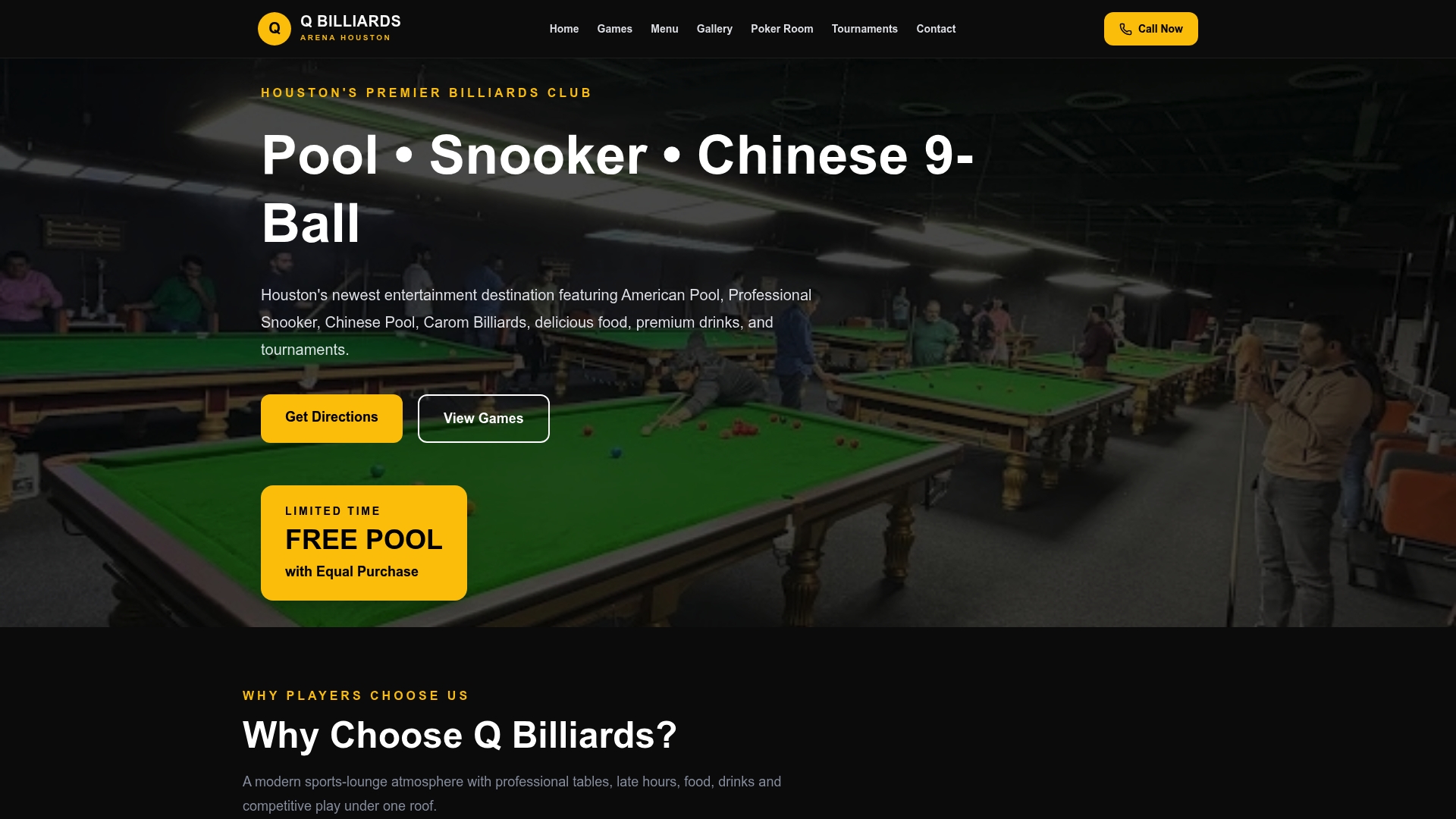
Q Billiards Arena in Houston has 25 professional-grade tables across 11,000 square feet. American pool is $10 per hour, and standard snooker, Chinese 9-ball and carom billiards are $15 per hour. Heated snooker is $20 per hour. We stay open late, until 2 to 4 AM, which suits night-owl players. Our weekly Tuesday and Friday night pool tournaments are a $10 entry, and the menu covers food, snacks and drinks while you play. Groups can look at poker room rental for private events.
If you are comparing rooms, our notes on pool hall ambiance and late-night pool strategies explain what to look for when you play after midnight. For your first visit, drinks on a pool table covers where to set your glass.
Our view on lighting
Lighting is the quiet half of a good game. Players notice a poor table surface at once, but they rarely notice that a rail shadow is costing them their position play until someone points it out.
We think the right way to judge a room is by how the cloth looks from your stance. Is it even from rail to rail, with no glare in your eyes and no spots where the ball colors blur? That is the standard the WPA writes down, and it is the standard players carry in their heads when they walk into a hall.
It is also why we built Q Billiards Arena around full-size, professional-grade tables, a wide choice of games and late hours. Pool, snooker, Chinese 9-ball and carom each reward clear sightlines, and the tournament nights on Tuesday and Friday bring that same focus to a social room with food on hand.
If you are setting up at home, use the numbers above. If you want to play, come in and shoot.
Q
FAQ
How high should a light hang over an 8-foot pool table?
Height is the same for 7-, 8- and 9-foot tables: 30 to 36 inches from the cloth to the bottom of the shade for home play, with 32 to 34 inches a good start. What changes with an 8-foot table is the fixture length, which should span about 54 to 58 inches under the BCA two-thirds guideline.
How bright should a pool table light be?
The WPA calls for at least 520 lux (48 footcandles) at every point on the bed and rails. A standard 8-foot table typically needs a fixture producing around 3,000 to 4,000 lumens to get there. Use a dimmer so you can lower the level for the rest of the room.
Do I measure from the rail or from the cloth?
From the cloth to the bottom edge of the shade. Measuring from the rail makes the light hang a couple of inches too high. On an LED panel, measure to the light-emitting face.
Why is tournament lighting so much higher?
The WPA sets at least 40 inches for a movable fixture and 65 inches for a fixed one, so the cue can rise on jump and masse shots without hitting the light. Higher fixtures need to be larger and brighter to keep the same light level on the cloth.
What color of bulb is best for pool?
Neutral white, around 4000 K, with a CRI of 90 or higher. Very warm bulbs near 2700 K make the red, orange and maroon balls look alike, and cooler light at 5000 K or above can cause glare on polished balls.
Sources
- WPA Recommended Equipment Specifications
- Simonis Cloth: General Information
- Billiard Factory: Lighting Buying Guide
- Blatt Billiards: How High Should a Pool Table Light Be?
- LeaguePool: Pool Table Light Height
- Pearson Cues: Pool Table Light Height
- Billiards.com: How to Hang a Pool Table Light
- Cue & Case: How to Pick Out and Hang Billiard Lighting
- Peters Billiards: Lighting Tips
- BilliardBeast: Best Pool Table Lights
- GameRoomWise: Pool Table Lighting
- The Family Game Room: Best Lighting for Over a Pool Table
- E-A-A: Add a Pool Table to Your Game Room
- Lighting angle and glare basics