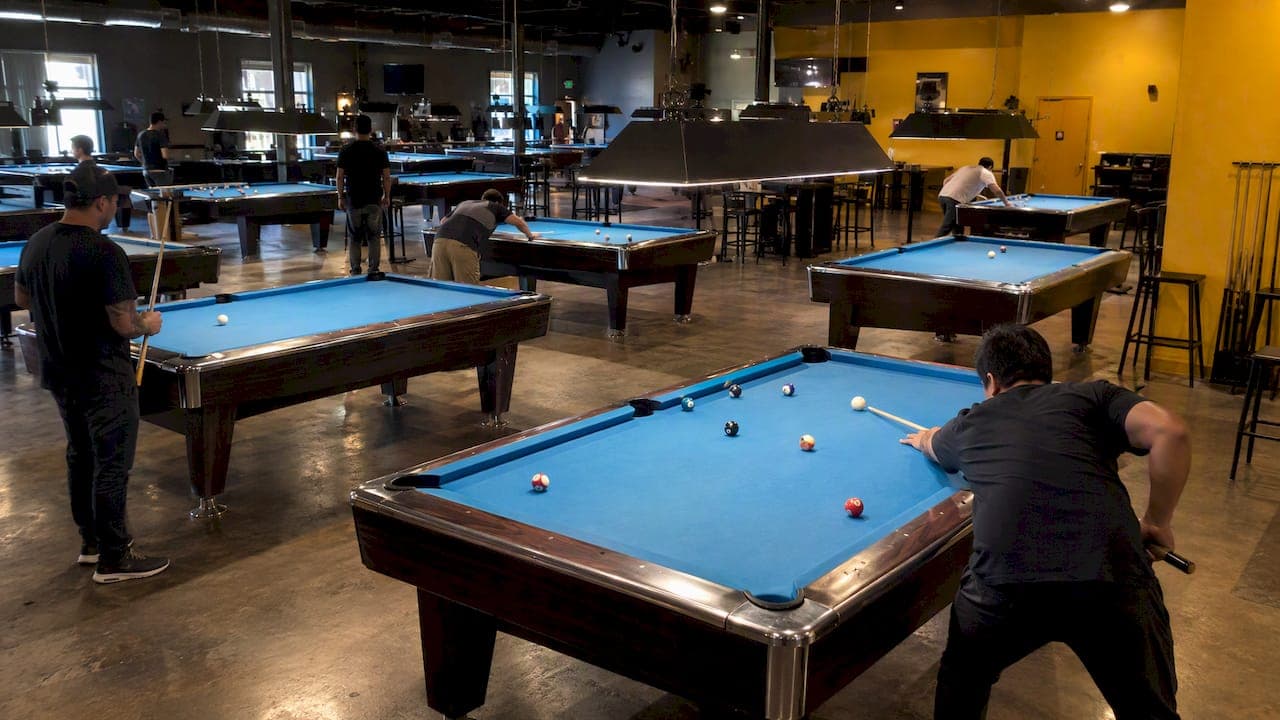
Pool hall ambiance comes down to five things you can check in about ten minutes: the light over the felt, the noise level, how the room is zoned, who is playing, and whether you can eat and sit comfortably between games. Get those right and a room feels welcoming whether you are there for a quiet rack or a Friday tournament. Get one wrong and you will notice it all night.
This guide explains what each element does, how to read it when you walk in, and how we think about it at Q Billiards Arena in Houston.
TL;DR
- Good pool hall ambiance is partly technical: even, glare-free light over the table and sound that does not bounce off hard surfaces.
- A well-planned room separates zones, so serious players, casual groups and people eating are not on top of each other.
- The crowd sets the tone as much as the decor. Check in at the counter, learn the house rules, and match the room to your goal.
- At Q Billiards Arena, 25 professional-grade tables across 11,000 square feet, a food and drink menu and late-night hours are built around that idea.
- Tables at our Houston club start at 10 USD per hour for American pool.
Table of Contents
- What people mean by pool hall ambiance
- Light: the part of ambiance that affects your game
- Sound: why some halls feel calm and others feel like a cafeteria
- Layout and zoning: where the room tells you what it is for
- The crowd: ambiance you cannot buy
- Food and drink: the dwell-time factor
- Reading a room in ten minutes
- Our perspective: ambiance is built for different players at once
- How the games change the mood
- Tournaments and league nights: the competitive atmosphere
- Planning a night at Q Billiards Arena
- Come see the room
- FAQ
- Sources
What people mean by pool hall ambiance
Search the phrase and you will find sound-effect libraries, speakeasy-style bar listings and forum threads. They all circle the same idea: the feel of a room where cue balls click, conversation hums and nobody is rushing you.
That feel is not an accident. It is the sum of choices about lighting, materials, layout and house culture. A dim bar with a single table by the restrooms and a dedicated cue-sport room with 25 tables are both "pool halls," but they deliver very different evenings. Knowing which you want is the first decision.
There is a real split in the market. Some players want a loud, social bar where pool is the side activity. Others, as one r/billiards thread about quiet, sophisticated halls shows in its framing, want somewhere calmer where the game is the point. Many of us want both on different nights. The best halls make room for each.
Light: the part of ambiance that affects your game
Mood lighting gets the photographs, but on a pool table light is functional first. Designers of commercial game lounges recommend deep-cone pendant lights hung 32 to 36 inches above the table, so the felt and balls are lit without glare or shadows. That matters most in competitive play, where you are judging thin cuts and small angles.
What that means for you as a visitor:
- Look at the felt, not the ceiling. Can you see the whole table evenly, including the corners, or does your own head cast a shadow on the cue ball?
- Check for glare. If a bright bulb is in your eyeline when you get down on a shot, you will fight it all night.
- Expect dim surroundings. Pools of light over tables with softer lighting around them is the classic look, and it works because the contrast keeps your attention on the game.
A room that is dark everywhere is atmospheric but hard to play in. A room that is bright everywhere plays well but feels like a gym. The sweet spot is bright on the table, relaxed everywhere else.
Sound: why some halls feel calm and others feel like a cafeteria
Hard floors, bare walls and high ceilings make an echo chamber, and cue sports add sharp sounds: breaks, balls dropping, laughter. Hall designers point out that acoustics define the experience, and that successful venues use fabric wall panels, ceiling tiles or carpet to manage noise. The payoff is conversation-friendly levels that encourage people to stay longer.

A quick test: stand at the counter and talk to the person next to you. If you have to raise your voice, the room is working against you.
The sounds you do want are the ones that give a pool hall its character. A writer describing a Tuesday night in a St. Louis hall captures the click of a ball dropping and a player who chalks quietly before studying the next shot. That is the texture: a steady, low rhythm of play with enough space around it to hear it.
Music should sit under that rhythm, not over it. If you cannot hear your opponent say "scratch," the volume is too high for pool.
Layout and zoning: where the room tells you what it is for
Look at how a space is arranged and you can tell who it was designed for. Industry guidance on games lounges describes zoning by activity: loud entertainment kept apart from quiet, serious billiards areas, plus a lounge where groups can sit, order food and drinks, and wait for a table.
Three zones are worth looking for:
- The play zone. Tables with enough space around them to swing a cue without hitting a wall or a chair. Crowded tables are the most common complaint about any pool room.
- The social zone. Seating, a service counter and food. This is where people who are waiting or watching actually want to be.
- The event zone. Tournaments and leagues need space too, and a hall that squeezes them onto casual tables ends up frustrating everyone.
A bar with one table can only ever be a bar. A room with dozens of tables has the space to do all three.
The crowd: ambiance you cannot buy
You can fit out a room perfectly and still lose the atmosphere if the culture is wrong. Etiquette is what keeps a shared room pleasant, and it is why serious halls tend to feel calm.
A few norms show up in nearly every good room:
- Check in first. Most dedicated pool halls, unlike dive bars, have you check in at a counter to be assigned a table, because many tables are held for league or tournament play.
- Respect line of sight. Wait for a player to finish a shot before walking behind them, and avoid crossing in front of their table while they are down.
- Protect the cloth. Food and drinks do not belong on the rails, and chalking should happen over the floor, not the table, since spills and chalk dust damage the felt.
- Inspect before you play. Look over the cloth for tears and tell staff right away so you are not blamed for existing damage.
If you are new, our guide to pool hall etiquette for beginners and league play covers the unwritten rules in more depth, including how to avoid sharking.
Dress and tone
Most casual nights need nothing special. Tournaments are different: weekly events commonly ask for a clean, neat look and rule out tank tops, ripped clothing and flip-flops. If you are not sure what fits, our pool hall dress code guide lays it out for casual play and competition.
Food and drink: the dwell-time factor
A room where you can eat is a room where you stay. Designers of game lounges treat that as a core principle: a lounge atmosphere where groups can sit and order food and drinks while they wait for tables turns a quick game into a whole evening.
For players the benefit is simple. You are not choosing between a hot meal and your table. You step away, eat at a seat, and come back to chalk up with clean hands. That is also how you keep food off the felt.
Reading a room in ten minutes
When you walk into a hall for the first time, run this checklist before you pay for a table.
| What to check | A good sign | A warning sign |
|---|---|---|
| Light over the table | Even, no glare in your eyeline | Dark corners, bare bulbs |
| Noise | You can talk at normal volume | Echo, music over the games |
| Table spacing | Room to swing a cue freely | Chairs or walls in your stroke |
| Check-in | A counter assigns tables | Tables claimed ad hoc, disputes likely |
| Cloth | Clean, no tears | Rips, stains, burn marks |
| Seating and food | Places to sit and order | Nowhere to put a drink but the rail |
| Crowd | Mixed skill levels, friendly | Heavy drinking, loud arguments |
If you want a more structured way to match a room to what you are after, we wrote a piece on how to choose a pool hall for your goal, not its star rating.
Our perspective: ambiance is built for different players at once
We built Q Billiards Arena around a simple problem. Houston has plenty of places to play pool, but a lot of them force a choice: a lively bar with a single table, or a quiet room with nothing to eat and nowhere to hang out. We wanted one room that could handle both.
That is why the space is 11,000 square feet with 25 professional-grade tables. Size is what lets us separate things. A league player warming up before a Tuesday night tournament does not need to share elbow room with a birthday group, and a birthday group does not need to feel watched by serious players. The more tables you have, the more people can be comfortable at the same time.
We also think a modern sports lounge should feel like one. That means fresh food and drinks within reach of the tables, late-night hours for people who finish work after most halls have closed, and a tournament atmosphere that is welcoming rather than intimidating. Our weekly events cost 10 USD for the Tuesday and Friday pool tournaments, so a first-timer can try competition without a big commitment.
We offer more than one game because different games create different atmospheres. American pool is quick and social. Snooker is slower and quieter, with a concentration all its own. Chinese 9-ball and carom billiards bring players who have their own culture around the table. Under one roof they make the room more interesting, not more chaotic.
One principle guides all of it: ambiance should support the game, never compete with it. Light on the felt, sound you can talk over, space to move, and people who respect the table.
— Q
How the games change the mood
The game you pick shapes your evening as much as the room does.
- American pool is the easiest entry point and the most social. It is 10 USD per hour at our club.
- Standard snooker (15 USD per hour) and heated snooker (20 USD per hour) are slower and more tactical. Expect quieter tables and longer silences between shots.
- Chinese 9-ball and carom billiards are both 15 USD per hour, and suit players who already know the game or want to learn something different.
These are the prices published on our games and pricing page. For context, U.S. halls commonly charge between $10 and $20 per table per hour, with rates varying by day, time and table quality. Our full breakdown of what it really costs to play pool walks through the math for a group night.
If Chinese 9-ball is new to you, there is a dedicated page for Chinese 9-ball in Houston.
Tournaments and league nights: the competitive atmosphere
A tournament night has a different energy. Players arrive early, equipment is out, and there is a bit of nervous quiet before matches are called. Most weekly tournaments ask you to sign up 15 to 30 minutes before the start, and forfeits are common if you are not at the table with your gear when your match comes up. Entry fees typically run $10 to $30 and are often cash-only, so check ahead.
Our schedule includes a Tuesday Night Pool Tournament and a Friday Night Pool Tournament at 10 USD each, plus a 1-Red Snooker Tournament at 20 USD. You can see the details on our pool tournament page, the snooker page and the tournaments and events page. We also run a Snooker Coaching Camp, listed on our events page, for players who want to build fundamentals.
First time? Read up on ball-in-hand and cue ball fouls before your first match so the rules do not surprise you.

Planning a night at Q Billiards Arena
Here is how we suggest approaching a first visit, depending on your goal.
For a casual night out
Arrive with your group, check in at the counter, and ask for a table. Start with American pool, order something from the menu, and settle in. If you want to avoid a wait on a busy night, our guide to reserving a pool table online explains how booking and pricing rules work.
For late-night play
Our hours run late, until 2 to 4 AM, which is a big part of why players choose us after dinner or after a shift. Late hours also change the mood: the room settles, the tables loosen up, and the crowd skews to people who really want to play.
For competition
Come on a tournament night, sign up early, and dress neatly. Bring your own cue if you have one. Our essentials guide covers table sizes, rules and a five-item bag.
For a private event
If you want the space for a group, our poker room is available for rental. Details are on the poker room page, and pricing is arranged with us directly because it is not published.
Come see the room
Photos only go so far with ambiance. If you are in Houston and want to see the light, hear the room and try a table, browse our games and hourly rates, look at the gallery for a preview, and check the food and drink menu so you know what to order between games. Our offer of free pool with an equal purchase is a good reason to make a first visit a full evening.
FAQ
What do you wear to a pool hall?
For casual play, comfortable clothes you can move in are fine. For tournaments, aim for clean and neat: tank tops, ripped clothing and flip-flops are commonly prohibited. Closed shoes are a safe default. Our dress code guide has more detail.
How much do pool halls charge per hour?
U.S. halls typically charge $10 to $20 per table per hour, with off-peak specials sometimes much lower. At Q Billiards Arena, American pool is 10 USD per hour, standard snooker, Chinese 9-ball and carom are 15 USD, and heated snooker is 20 USD.
What do you do at a pool hall?
You check in at the counter, get assigned a table, and play by the hour. Between games you can eat, watch other players, or join a tournament or league night. At our club you can also try snooker, Chinese 9-ball or carom billiards.
Can I eat and drink while I play?
Yes, but keep food and drinks off the rails and playing surface, because spills damage the felt. We serve food, snacks and hot, cold and house special drinks, so you can sit and eat between games.
Is a pool hall good for beginners?
It can be, if the room is welcoming and the tables are not crowded. Start with American pool at an off-peak time, learn the basic etiquette, and do not be shy about asking staff for help.
Sources
- Planning and Designing a Commercial Games Lounge, Let's Renovate
- Pool Hall Etiquette: Rules, Pricing, and Table Reservations, AnswerHarbor
- What to Expect at a Pool Hall in St. Louis
- Your First Pool Tournament: What to Expect and What to Bring, Billiard Action Time
- r/billiards: More quiet or sophisticated pool halls a thing?