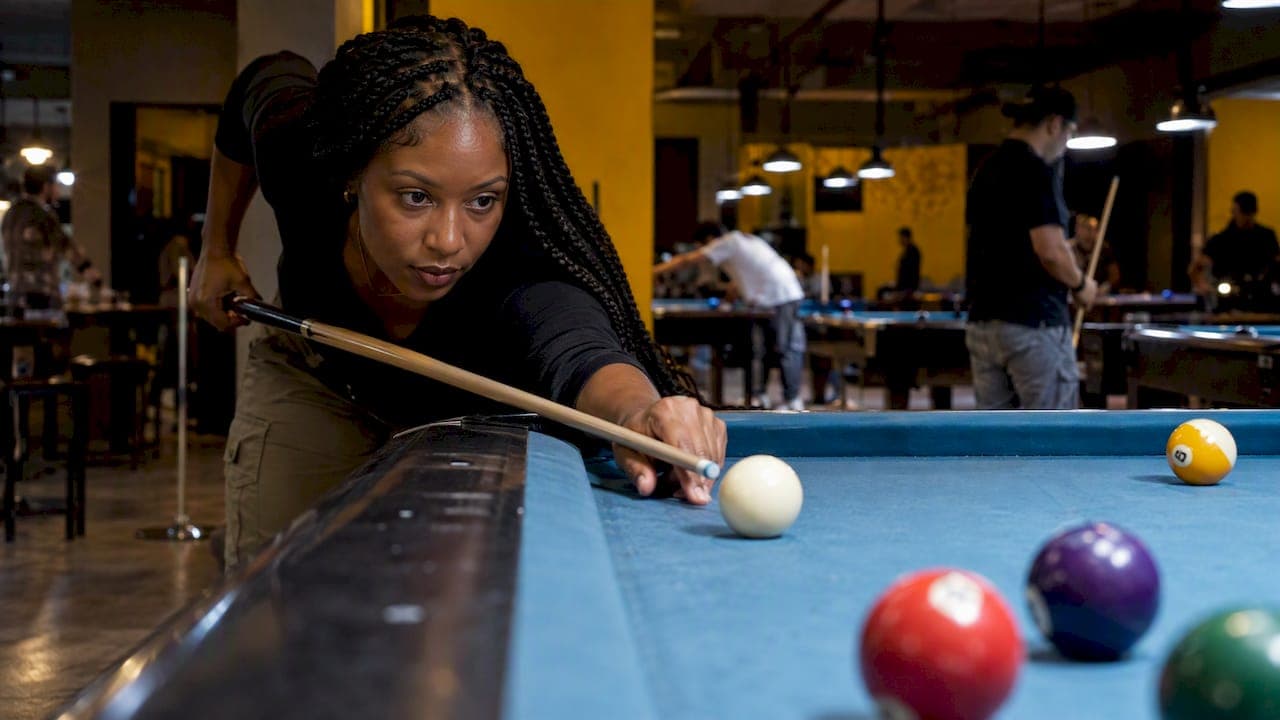
The best late night pool strategy is to play simpler as the night gets longer. Lean on the shots you make most often, keep one fixed routine before every stroke, control the cue ball before you chase pockets, and manage food, drinks and breaks so your stroke is still there at 1 AM. Below is how to do each of those at the table, whether you are playing a casual session with friends or a late league or tournament match.
TL;DR
- Cut your shot menu down as fatigue builds: stop, follow, draw and medium cuts win more racks than ambitious banks and jumps at 1 AM.
- Run the same pre-shot routine every time. If the stance does not feel right, stand up and start over.
- Arrive early, learn the table speed and lighting, and keep your pace steady: league guidance suggests about 20 seconds on routine shots.
- Eat light, drink slowly, and keep the mood friendly so the session lasts.
- At Q Billiards Arena in Houston you can play American pool from $10 per hour, with late hours and weekly tournaments.
Table of Contents
- Why late night pool is a different game
- Build your game on a short list of shots
- Control the cue ball first, pockets second
- Protect your focus with a repeatable routine
- Arrive early and read the room
- Pace yourself: breaks, food and drinks
- Late league and tournament strategy
- Keep it social and fair
- Our perspective: what we see after midnight
- Play late at Q Billiards Arena
- A late night game plan you can use tonight
- FAQ
- Sources
Why late night pool is a different game
By midnight, a few things have changed. Your eyes are tired, your focus comes in shorter bursts, the room is busier or quieter than it was at 7 PM, and the table may play differently than it did when you started. Players who ignore this tend to keep shooting like it is the first rack and wonder why the misses pile up.
Strategy at this hour is mostly about removing risk and removing decisions. Fewer hero shots, fewer new experiments, more repetition of what you already own. The rest of this guide is built on that idea.
Build your game on a short list of shots
When you are tired, fundamentals hold up and fancy shots do not. A beginner-focused breakdown recommends stop, follow and draw shots as the base of cue ball control, and cut shots between 30 and 45 degrees as the angles to practice until pocketing becomes consistent. The ghost-ball method, where you picture where the cue ball must be at contact, is a useful way to see those cuts.
The skill list used by a formal instruction body points the same direction. Billiard University's fundamentals curriculum tests cut shots, stop, follow, draw, stun, potting, cue-ball direction control and position control. Safeties, kicks, banks, jumps and masse sit in the next level up. That is a handy ranking of what to trust late at night: if a shot lives in the second tier, think twice before attempting it after a long evening.
Shot selection when you are tired
A simple filter works well:
- Is there a straightforward shot? Take it, and play for the next ball.
- Is the shot a 30 to 45 degree cut or easier? Good. Pocket it with controlled speed.
- Is it a long bank, a jump or a thin cut? If you would not bet on it in the first hour, do not bet on it in the fifth.
- Is there a safe play that leaves your opponent nothing? At that point, a quiet safety usually beats a low-percentage attempt.
A bar-pool player's advice on how to play at a bar adds a physical cue: get low so your eyes are close to the table surface, which helps line up shots. When you are fatigued, standing tall and shooting from the hip is where alignment drifts first.
Make the easy balls count
One piece of advice from the pool community is to treat easy balls as if they genuinely count, because you cannot afford to miss them. That way the hard shots stop being the only ones that matter. It sounds obvious, yet late in a session most misses are the easy ones taken casually. Give each simple shot the same routine as a hard one.
Control the cue ball first, pockets second
Good late night play is mostly about where the white ball ends up. Dr. Dave's shot catalogue treats speed control as its own essential skill: bridge length choices, rolling, stun and draw speeds, equal-distance control and position play off the rails. The same catalogue also reminds players to account for scratch routes, including tangent-line and natural-angle scratches, instead of thinking only about the object ball.
That scratch point matters more late, because tired players tend to hit harder to "make sure" and send the cue ball where they did not mean to.
Practical habits:
- Pick the next ball before you shoot. Decide where the cue ball should stop, then choose the speed.
- Use less power. A medium-speed stroke with good contact is more repeatable than a hard one.
- Look for the scratch lines on every shot near a pocket, not just the obvious ones.
- Leave yourself angles, not distance. A short, simple next shot beats a long one after you have been up for hours.
If position play is your weak spot, our walkthrough of five drills that fix position play gives you something concrete to run on a quieter table before the late crowd arrives.
Protect your focus with a repeatable routine
Focus is the first thing to fade after midnight, and the fix is structure, not willpower. Dr. Dave's guidance on the pre-shot routine says a good routine is consistent, purposeful and disciplined, with proper vision-center alignment and a consistent eye pattern. His mental game page adds quiet focus in the stance, confidence in practiced skills and positive self-talk.
Here is a version you can use:
- Assess. Stand behind the shot, pick the line and the cue ball's destination.
- Visualize. See the ball drop and the cue ball stop where you want it.
- Step in and settle. Get low, align, take your practice strokes.
- Lock and fire. Once you are in your final stance, stop collecting information. A coaching course cited in Dr. Dave's resources says that after the lock phase you should not gather more external information.
The most useful rule for late nights: if the alignment or feel is not right while you are down, stand up and restart. Forcing the shot is how a fatigued player turns a 90 percent shot into a coin flip.
Arrive early and read the room
Preparation starts before the first ball is struck. Advice for league players recommends arriving early to check lighting and table speed, maintaining your cue tip and getting comfortable with the venue. All of that applies to a casual late session too.
A short pre-game checklist:
- Chalk up and check your tip before you start, not halfway through the night.
- Hit a few stop, follow and draw shots to feel how the cloth is playing.
- Notice the lighting over your table and the room around it. A busier room is noisier, so plan for more distractions.
- Grab a table you like. At our club, rates are posted by game, so you can choose the table type before you settle in.
Planning the whole outing helps too. If you are organizing a group, tools for table reservation management show how venues handle bookings and seating, and the same idea applies to calling ahead so your group is not waiting at the door at 11 PM.
Pace yourself: breaks, food and drinks
Late night sessions are long, and what you put in your body shows up in your stroke.
Eating and drinking
A pool-instruction library recommends avoiding big meals and monitoring alcohol, noting that most players perform better with one or two beers and worse beyond that. Heavy food makes you sluggish, and heavy drinking wrecks the fine motor control that pool depends on.
A practical approach:
- Eat something light before you play, then snack in small amounts between racks.
- Alternate any alcohol with water or another cold drink.
- Do not eat or drink in the middle of a match; use the gaps.
We have written separate guides on drinks that keep your aim steady and the best snacks for pool night if you want specifics.
How you sit between shots
The same library points out that slumping while you wait gives opponents clues about your physical and mental state. Sit up, stay loose, breathe. It helps your focus as well as your image.

Late league and tournament strategy
Late matches reward players who are efficient. League guidance from APA says play must be continuous, that players should be ready at the table when called, that shots should take no more than about 20 seconds (45 seconds on hard ones), and that coaching time-outs should last one minute or less. The same page says not to let food, drinks or errands interrupt a match.
Official time guidelines add context: individual 9-Ball matches should average 30 to 40 minutes, while 8-Ball team matches should take no more than four hours. Know the rules of your own league, because formats differ, but the principle holds: steady pace protects your rhythm and keeps the night from dragging.
A few strategy points for late events:
- Be ready on time. Warm up before your match is called, not after.
- Shorten your decisions. Use the shot filter above so you are not debating every position.
- Respect the rules of the event. APA tournament regulations, for example, prohibit laser devices and training aids.
- Review afterward. Expert sources recommend post-match analysis that notes both strengths and weaknesses. Write down two things that worked and one to fix while it is fresh.
For more, see our weeknight pool league tips and the pool tournament checklist for a smoother 8-ball event.
Keep it social and fair
Not every late session is a competition. With friends, the strategy is keeping everyone in the game. APA's team manual calls for sportsmanship, which includes no profanity, abuse or aggression toward people or equipment, and says playing within the Spirit of the Rules promotes harmony, friendship and good times. That is a good standard for any table, league or not.
Some ways to keep a group night fun:
- Agree on house rules (call-pocket or not, how to handle scratches) before the first break.
- Rotate partners so stronger players are not always together.
- Try formats that let beginners compete, which we cover in our pool night group games guide.
- Not sure what to wear? Our pool hall dress code post covers it, and if it is a date night, see our pool hall date ideas.
Our perspective: what we see after midnight
We run a club with 25 professional-grade tables across 11,000 square feet, open late, with games from American pool to snooker, Chinese 9-ball and carom. After midnight, the pattern is clear to us. The players who look best at 1 AM are rarely the ones with the flashiest shots. They are the ones who set a pace early, ate something sensible, stuck to a routine and kept their shot selection honest.
We also see that the best nights are social. Regulars come in for league and tournament energy, but they stay because the room is friendly. A late game that ends with everyone wanting another rack is a successful one, whatever the score.
Our advice: pick the table that fits your game, keep the menu light while you play, and treat the last hour as a chance to practice what you know, not to try what you do not.
— Q
Play late at Q Billiards Arena
If you want a place built for this kind of night, we are open late, with hours running until 2 to 4 AM, so check our site for the current schedule. American pool is $10 per hour, standard snooker, Chinese 9-ball and carom billiards are $15 per hour, and heated snooker is $20 per hour. Our food and drink menu covers snacks, hot and cold drinks and house specials, so you can eat between racks.
Want competition? Our Tuesday and Friday night pool tournaments have a $10 entry, and the 1-Red Snooker tournament is $20. For more ideas on where to spend a night out, see our guide to late night things to do in Houston. Ask about our free pool with an equal purchase offer when you visit, since promotions can change.
A late night game plan you can use tonight
Putting it together, here is a plan for a three-hour session:
Hour one: calibrate. Chalk up, hit stop, follow and draw shots, and note how the table plays. Play your normal game and enjoy it.
Hour two: consolidate. Keep your shot filter on. Take the high-percentage option every time, and focus on cue ball destination. Snack lightly and drink water.
Hour three: protect. When your focus starts to slip, shorten your decisions, rely on your routine, and avoid new experiments. If a shot feels wrong in the stance, stand up and restart. Finish with a quick review: what held up, what did not.
That is not a magic system. It is a way of acting on the tired-player basics that every source above keeps returning to: fundamentals, routine, pace and fair play.
FAQ
What are the basic pool shots to rely on late at night?
Stop, follow and draw shots give you reliable cue ball control, and cut shots between 30 and 45 degrees are the angles worth practicing until they are consistent. Add speed control and position play, and you have the core of a game that holds up when you are tired. Save banks, jumps and masse for when you are fresh.
How do I stay focused as a late session goes on?
Use the same pre-shot routine every time: assess, visualize, settle into your stance, then commit. If your alignment does not feel right once you are down, stand up and begin again rather than forcing it. Quiet focus and positive self-talk help you stay calm and in the moment.
Should I drink or eat during a late pool session?
Keep meals light and snack between racks, not during a shot. Instruction sources suggest most players perform better with one or two beers and worse beyond that, so pace yourself and drink water in between. Avoid letting food or drinks interrupt a match.
How long should a league match take?
It depends on the league and format. APA guidelines say individual 9-Ball matches should average 30 to 40 minutes, while 8-Ball team matches should take no more than four hours. Being ready when called and keeping shots to about 20 seconds helps matches finish on time.
Sources
- Basic Pool Shots for Beginners
- Exam Learning Resources, Billiard University
- Video Encyclopedia of Pool Shots, Disc I
- How To Play Pool At A Bar
- Pre-Shot Routine Best Practices, Dr. Dave Pool Info
- Mental Game, Dr. Dave Pool Info
- Foundations Course, Dr. Dave Pool Info
- How to Prepare for a Pool League Match
- Waiting for Your Match, PoolDawg
- League night time guidelines, APA Tucson
- Time Guidelines, APA League Play
- APA Team Manual
- APA Team Manual, sportsmanship rules
- Table reservation management for venues