
Rotation is a 15 ball points game: every object ball is worth its own number, all 15 balls together add up to 120 points, and the first player to bank 61 wins the frame. The one key rule in every shot, including the break, is that the cue ball must hit the lowest numbered ball on the table first.
TL;DR:
- The game’s target score of 61 points guarantees a win once achieved, making some frames end early due to accumulated points rather than clearing the table.
- The standard rack positions the 1 ball at the apex over the foot spot, with the 15 ball in the center, but some houses set the 15 ball on the foot spot, affecting break strategy.
- Fouls such as failing to hit the lowest numbered ball first or scratching result in ball-in-hand penalties and may lead to losing the frame after three consecutive fouls.
- Each player can only use two safeties per frame where the cue ball only touches a cushion, encouraging strategic shot planning and safe play.
- Scoring differs between formats: standard rotation awards points equal to ball numbers, while American Rotation assigns 1 point for balls 1-10 and 2 points for balls 11-15, with matches often played to higher totals like 150.
Table of Contents
- What Are the Rotation Pool Rules for Scoring?
- How Do You Rack Balls for Rotation Pool?
- What Counts as a Legal Shot in Rotation?
- What Fouls Cost You Points in Rotation?
- What Are the Safety Rules in Rotation Pool?
- How Does the Break Work in Rotation?
- Rotation vs. American Rotation vs. Nine-Ball: What's the Difference?
- Where Did Rotation Pool Come From?
- Which Governing Bodies Standardize Rotation Rules?
- How Many Points Is Each Ball Worth in Rotation?
- What Strategies Work Best in Rotation Pool?
- How Does a Rotation Frame Actually End?
- Why Rotation Builds Better Position Play
- Play Rotation Rules the Right Way at Q Billiards Arena
- Where to Read More on Rotation Pool Rules
- Sources
- FAQ
What Are the Rotation Pool Rules for Scoring?
Forget call shots and forget style points. In rotation, the number on the ball is the value of the ball. Pocket the 9, you get 9 points. Pocket the 14, you get 14. Add up every ball from 1 through 15 and you get 120 total points on the table), which is why the winning threshold sits at 61, one more than half.
That threshold matters because it's mathematically guaranteed. Once a player crosses 61, the opponent cannot catch up even by running every remaining ball, so frames often end before the table is cleared.
- Each ball's point value equals its number (1 through 15).
- Total points available per rack: 120.
- First player to reach 61 wins the frame outright.
- If both players are tied at 60 when the last ball drops, the player who legally pocketed the final ball receives a bonus point to break the tie.
Most club and league play uses a race format, best of three or best of five frames, rather than a single 120 point rack. Tournament brackets at venues that run weekly rotation nights typically post the race length on the sheet before play starts, so check that before you rack.
How Do You Rack Balls for Rotation Pool?
Proper racking prevents more disputes than any other single habit in this game. Get it wrong and you're arguing about a re-rack before anyone's even broken.
The standard rack places the 1 ball at the apex, directly over the foot spot. The 2 and 3 balls go in the two rear corners of the triangle. The 15 ball sits dead center. Every other ball fills in randomly, but the whole rack has to sit tight, touching, with no gaps a cue ball could sneak through on the break.
- 1 ball: apex position, on the foot spot.
- 2 and 3 balls: rear corners of the rack.
- 15 ball: center of the triangle.
- Remaining balls: random placement, all touching.
Some clubs push the entire rack forward so the 15 lands on the foot spot instead of the 1. It's a common house variation, and it changes break geometry slightly, so confirm which version your opponent expects before the first shot.
What Counts as a Legal Shot in Rotation?
Every shot must begin with the cue ball contacting the lowest numbered ball remaining on the table, called the "ball on."
A legal shot requires the cue ball to hit the ball on first, followed by either pocketing a ball or driving any ball to a cushion; failure to do so is a foul.
Here's the part that trips up players coming from 8-ball or 9-ball: rotation is not a call shot game. If you're aiming at the 4 and the 4 drops while the 7 also falls into a different pocket off a carom, both count. Incidental pocketing is legal as long as the shot itself was legal, which changes how you calculate risk on a crowded table.
- Legal shot: ball on contacted first, then a ball is pocketed or a ball reaches a cushion.
- Illegal shot: cue ball hits a higher numbered ball first, or nothing reaches a cushion after contact.
- Turn ends immediately on any missed shot or foul, passing the table to your opponent.
- Any ball pocketed on a legal shot counts, called or not.
What Fouls Cost You Points in Rotation?
Fouls in rotation include failing to hit the lowest numbered ball first, scratching, failing to drive a ball to a cushion, and knocking a ball off the table.
- Failing to contact the lowest numbered ball first.
- Scratching the cue ball into a pocket.
- Failing to drive any ball to a cushion after legal contact.
- Knocking any ball off the table entirely.
Any ball pocketed illegally, or knocked off the table, gets spotted back onto the table rather than staying pocketed for points. After a foul, the incoming player gets ball in hand behind the head string to shoot from within that area. Three consecutive fouls by the same player result in loss of frame.
Pro Tip: Count fouls out loud between racks if you're playing a long match. It's the single easiest rule to lose track of, and the three-foul penalty is brutal if nobody's kept score.
What Are the Safety Rules in Rotation Pool?
Rotation isn't just offense. Defensive play, called a safety, is built into the rules with a specific limit most casual players don't know exists.
Each player gets two safeties per frame, where the shot only sends the ball on to its closest cushion and nothing else happens. Beyond that limit, any additional simple safety of that type becomes a foul. Other safeties are allowed without limit if the ball on is struck first and either two object balls move or the ball on reaches a cushion that is not the closest.
- Two "closest cushion only" safeties allowed per player, per frame.
- Additional simple safeties beyond that count as fouls.
- Legal safeties otherwise: ball on hit first, plus real movement on the table.
Because you're always forced to play the lowest ball regardless of position, rotation punishes players who don't plan two or three shots ahead. Pro Tip: When the low ball leaves you a bad angle, a well placed safety that tucks the cue ball behind traffic beats a low-percentage attempt at a tough shot almost every time. Our cue ball control drills cover the position-planning skills rotation demands.
How Does the Break Work in Rotation?
Rotation uses an open break, meaning the breaker has no obligation to call a shot or pocket a specific ball, only to follow the low ball first rule and legal shot requirements like any other turn.
If the break doesn't pocket a ball or drive a ball to a cushion, it's a foul, and the incoming player gets ball in hand behind the head string. Some rule sets and tournament formats let the incoming player instead demand a full re-rack if the break was particularly weak or scattered the balls unfavorably for neither side.
- Open break: no called ball required, standard low-ball-first rule applies.
- Weak or foul break: opponent gets ball in hand or can request a re-rack, depending on house rules.
- American Rotation and some organized formats add push-out options after the break, similar to nine-ball conventions.
Break rules vary more than almost any other part of this game between clubs. Verify break penalties and re-rack policy with the tournament director before your match starts, not after a disputed opening shot.
Rotation vs. American Rotation vs. Nine-Ball: What's the Difference?
The rotation family splits into a few distinct versions, and mixing them up mid-match causes more scoring arguments than any foul on this list.
Standard 15-ball rotation uses face-value scoring straight through, first to 61 out of 120. American Rotation changes the math: balls 1 through 10 are worth 1 point each, balls 11 through 15 are worth 2 points each, and matches play to a preset total, commonly 100, 125, or 150 points across multiple racks rather than one. American Rotation also typically requires called shots and permits push-outs after the break, borrowing structure from nine-ball tournament play.
- Standard rotation: face-value points, 120 total, win at 61, no called shots.
- American Rotation: 1–10 worth 1 point, 11–15 worth 2 points, race to a set total like 150, called shots and push-outs common.
- Short-rack formats (6-ball, 7-ball, 9-ball, 10-ball): sequential lowest-ball-first pocketing without point totals, first to legally pocket the highest numbered ball wins.
Nine-ball and ten-ball share rotation's low-ball-first DNA but drop the point system entirely. If you've played nine-ball breaks and push-outs, the shot mechanics of rotation will feel immediately familiar, even though the scoring logic is completely different.
Where Did Rotation Pool Come From?
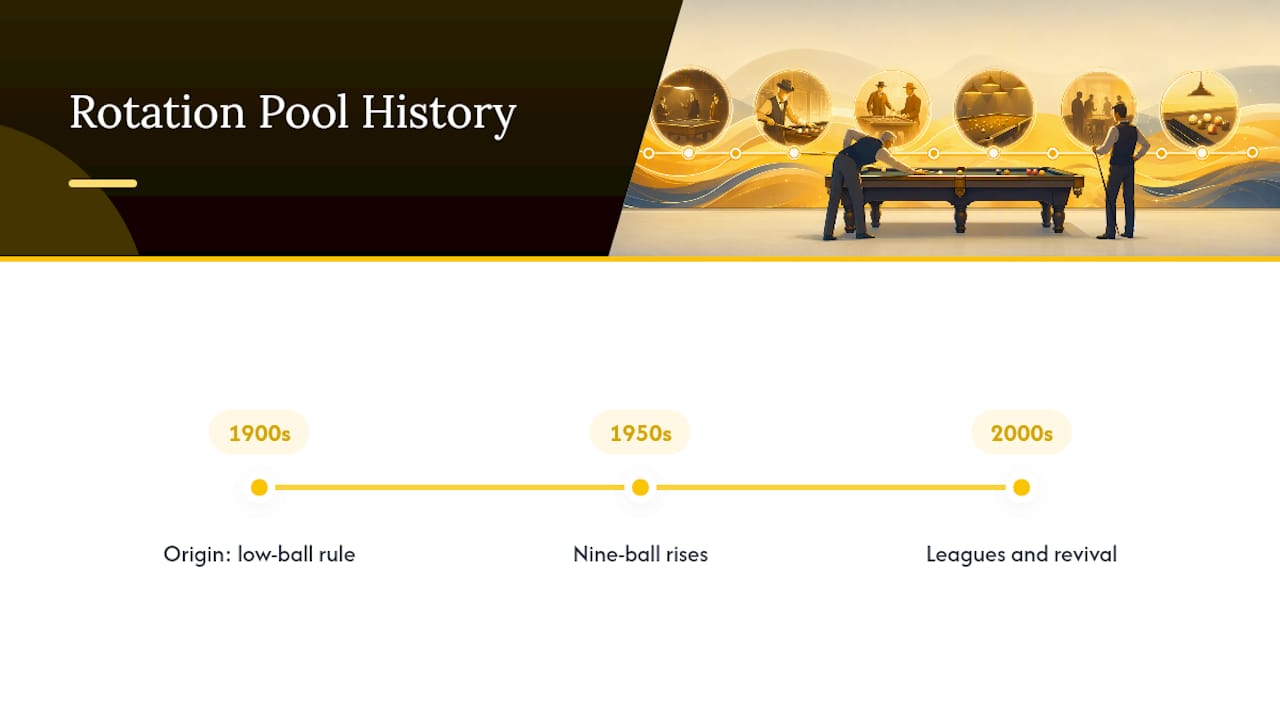
Rotation traces back to the early 20th century American pool hall scene, evolving alongside straight pool as one of the earliest point-scoring alternatives to games decided purely by pocketing the last ball. Where straight pool let players call any ball on the table in any order, rotation introduced the sequential low-ball-first discipline that forced a completely different kind of shot selection.
That forced sequence is what separates rotation from most of its pool ancestors. You can't simply hunt for the easiest shot on the table. You have to deal with whatever ball happens to be lowest, wherever it landed, which turned rotation into a proving ground for players who wanted to sharpen position play rather than just potting ability.
The game's popularity dipped through the mid-20th century as nine-ball, itself a rotation derivative, took over as the dominant fast-paced tournament format in American rooms. Nine-ball's shorter rack and simpler win condition, first to pocket the 9, made it a better spectator game and a faster gambling format. Rotation never disappeared, though. It persisted in league play and among players who valued its scoring depth over nine-ball's quicker resolution, and it's seen renewed interest as instructors and coaches point to its position-play demands as superior training for players moving up in skill level. The 15-ball structure forces a level of table management that shorter rack games simply don't require, which is part of why serious players still return to it between tournament seasons.
Which Governing Bodies Standardize Rotation Rules?
No single global body enforces one universal rotation rulebook, and that's a big part of why house rules vary as much as they do from room to room.
The most widely referenced rules for standard 15-ball rotation come from community-maintained references like the Wikipedia rotation pool entry, which compiles the scoring, foul, and safety structure most clubs default to when nothing else is specified. For American Rotation specifically, with its modified point values and called-shot requirements, Dr. Dave Pool Info maintains one of the more detailed breakdowns used by instructors and tournament organizers.
Regional pool leagues and individual venues often layer their own house rules on top of these baselines, particularly around break handling and three-foul enforcement. That's not a flaw in the system so much as a reflection of rotation's long, informal history. Unlike nine-ball, which has cleaner alignment around World Pool-Billiard Association style rules in most competitive circuits, rotation's rule variations are common enough that confirming specifics with a tournament director before play starts is standard practice rather than an edge case. If you're organizing a rotation event yourself, publishing your exact scoring, break, and foul rules ahead of time prevents the majority of disputes before they happen.
How Many Points Is Each Ball Worth in Rotation?
The scoring logic could not be simpler on paper, though it's worth walking through the full table since it changes how you think about risk on every shot.
| Ball | Point Value | Notes |
|---|---|---|
| 1–9 | Equal to ball number | Low-value balls, often played early by rule |
| 10 | 10 points | First double-digit value |
| 11–14 | Equal to ball number | High-value targets late in the rack |
| 15 | 15 points | Highest single-ball value on the table |
Because the numbers stack directly, the back half of the rack carries most of the frame's value. Balls 11 through 15 alone total 65 points, more than half the 120 point rack, even though they're only five of the fifteen balls. That's a meaningful strategic wrinkle: a player who's fallen behind early can still win by running the high-value balls late, provided the low-ball-first rule allows it.
This is also where American Rotation's flattened scoring, 1 point for balls 1 through 10 and 2 points for balls 11 through 15, changes the math meaningfully. Standard rotation rewards precise late-rack execution disproportionately. American Rotation smooths that curve out, which is part of why the two formats produce different playing styles even though the shot mechanics look identical from the rail.
What Strategies Work Best in Rotation Pool?
Rotation strategy revolves around one constraint every other pool game lets you ignore: you don't get to choose your next shot. Whatever ball is lowest is your ball on, whether it's buried behind a cluster or sitting wide open.
That constraint rewards players who think several shots ahead rather than one shot at a time. Because rotation forces sequential play regardless of position, the best players are constantly asking not "can I make this ball" but "where does the cue ball need to land for the ball after this one, and the one after that." It's the same forward-planning discipline that shows up in straight pool's break ball concept, except rotation removes your ability to choose which ball sets up that next shot.
A few practical habits separate strong rotation players from average ones. First, track the table in clusters of two or three balls ahead rather than focusing purely on the immediate shot. Second, treat your two allowed closest-cushion safeties as a resource to spend deliberately, not something to burn early out of frustration with a tough angle. Third, resist the urge to force a low-percentage shot at a high-value ball late in the rack when a controlled safety keeps your point lead intact. Since scoring accumulates rather than resetting, protecting a lead through smart defense is often more valuable than chasing a risky 15 ball for the extra points.
How Does a Rotation Frame Actually End?
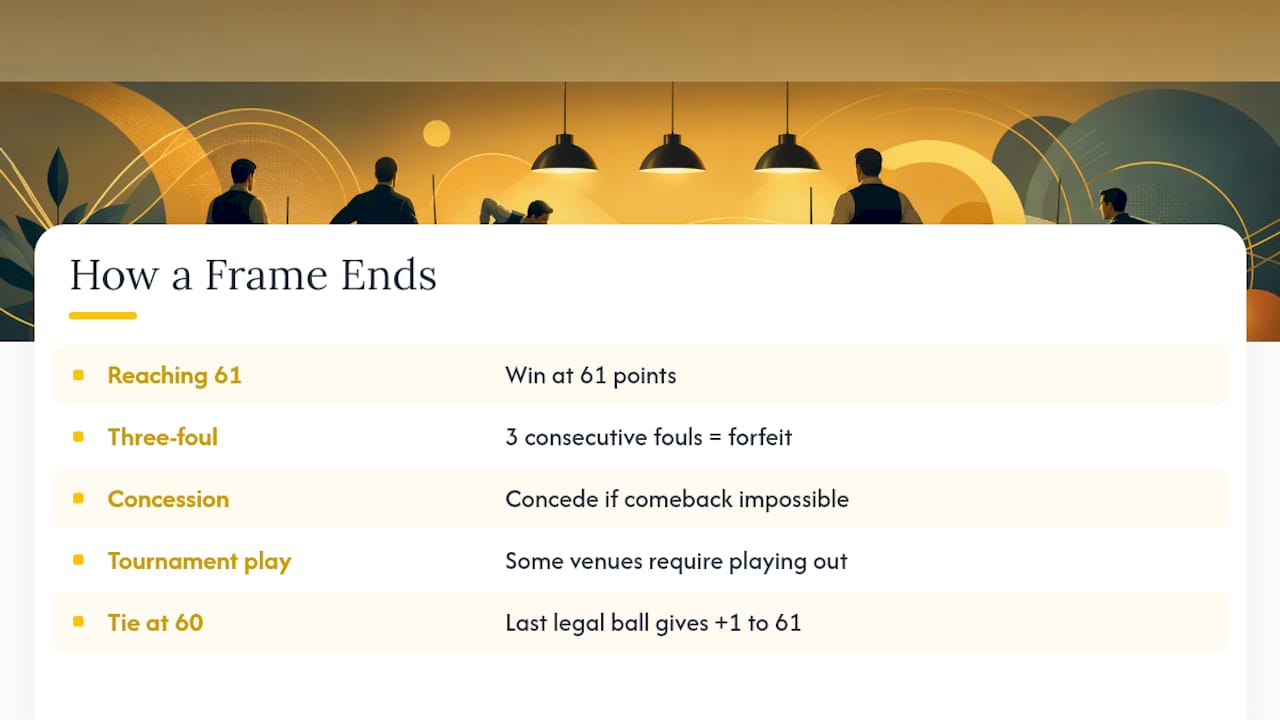
Reaching 61 points is the clean, textbook ending, but plenty of frames wrap up before anyone actually hits that number outright.
The most common early finish happens through the three-foul rule: a player who commits three consecutive fouls without a legal shot in between forfeits the frame regardless of the score. This matters more than it sounds, because a player who's ahead on points can still lose the frame entirely through repeated fouls under pressure, which is exactly why tracking fouls carefully matters as much as tracking score.
Concession is another common ending, especially in casual and league play. Once the math makes a comeback mathematically impossible, meaning the trailing player cannot reach 61 even by running every remaining ball, most players concede the frame rather than finishing it out for show. Tournament play sometimes requires the frame to be played to its literal conclusion regardless of the mathematical outcome, so check house rules if you're in a formal bracket.
The tie-at-60 scenario deserves its own mention since it catches new players off guard. If both players are sitting at 60 points when the final ball on the table is pocketed, the frame doesn't end in a draw. The player who legally pocketed that last ball receives a bonus point, pushing them to 61 and securing the win. It's a clean, built-in tiebreaker that avoids the need for a decider ball or extra rack in a standard single-frame contest.
Why Rotation Builds Better Position Play
Rotation forces you to plan for a ball you didn't choose, which is exactly why it sharpens cue-ball control faster than most practice games. Run rotation drills in club sessions, and the discipline carries straight into tournament pressure.
— Q
Play Rotation Rules the Right Way at Q Billiards Arena
Reading the rules is one thing. Testing them under real pressure, on a table with true rails and consistent pockets, is another. The venue offers numerous professional-grade tables in a spacious setting with late operating hours, so you can run rotation drills or a full frame long after most halls have locked up.

If you want structured practice, the weekly Tuesday and Friday night pool tournaments put these exact rules to work in a live bracket setting, entry starts at $10 a night. Prefer to book table time first and work through the scoring and safety rules at your own pace? Reserve a table through the full games lineup, where American Pool runs $10 an hour and Chinese 9-Ball runs $15 an hour. Either way, the next step is simple: pick a night, show up, and put the low-ball-first rule to the test on a real rack.
Where to Read More on Rotation Pool Rules
For the complete formal rule set covering scoring, fouls, and safeties, the Wikipedia entry on rotation pool remains the most detailed community-maintained reference available. For American Rotation's modified scoring and called-shot conventions, Dr. Dave Pool Info offers the clearer breakdown, particularly useful before organized or tournament play.
Sources
FAQ
Can you move the cue ball if you don't hit anything?
No. Failing to make legal contact with the lowest numbered ball, or failing to drive any ball to a cushion, is a foul, and the incoming player gets ball in hand behind the head string.
What are the rules of 15-ball rotation pool?
Each ball scores its face value, all 15 balls total 120 points, and the first player to reach 61 wins the frame, provided every shot contacts the lowest numbered ball first.
Can you shoot backwards off a foul in the pool?
After a foul in rotation, the incoming player gets ball in hand behind the head string and can place the cue ball anywhere in that zone, including angles that let them shoot back toward the rack.
What are the new pool rules for scoring ties?
The main scoring update worth knowing: if both players sit at 60 points when the last ball is pocketed, the player who legally sank it gets a bonus point to reach 61 and win, rather than the frame ending in a tie.
How is American Rotation different from standard rotation?
American Rotation scores balls 1 through 10 at 1 point each and balls 11 through 15 at 2 points each, with matches racing to a set total like 150 rather than a single 120 point rack.