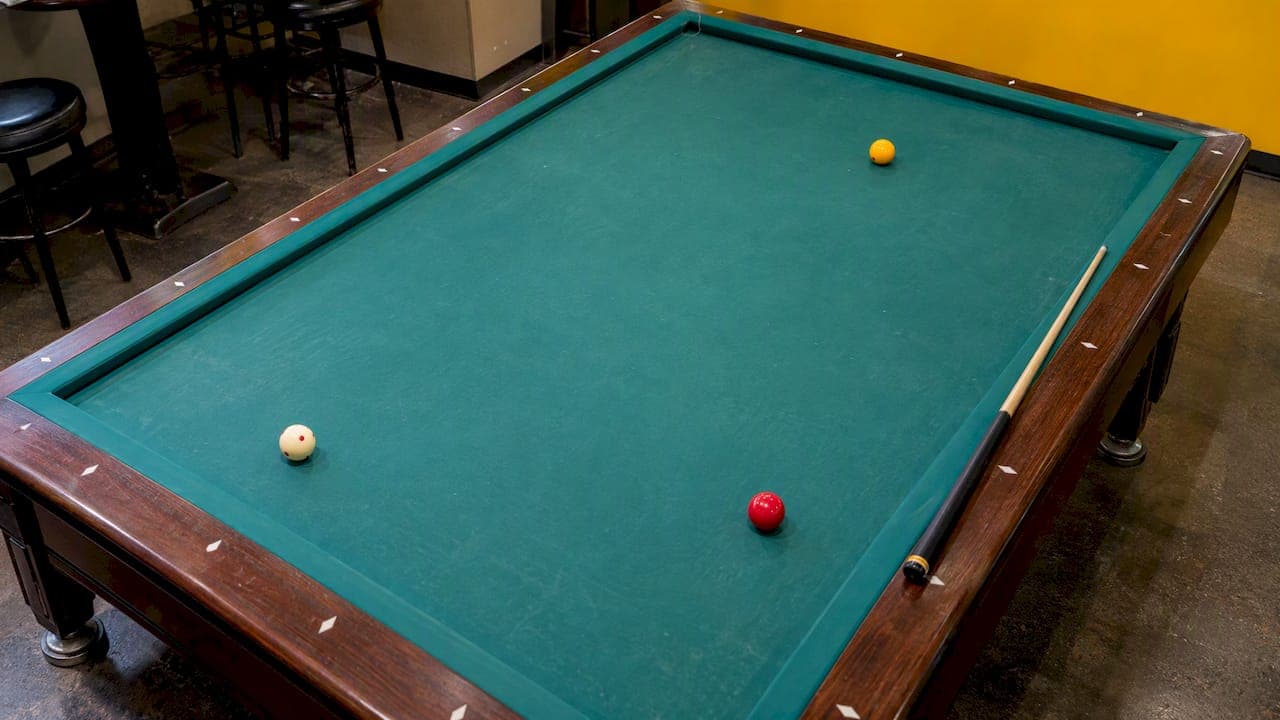
Good three cushion strategy comes down to three decisions made in order: where the cue ball needs to travel, how thick you hit the first ball, and where all three balls will sit when the shot is over. Players who aim first and think later miss a lot. Players who choose the route first, then match speed and spin to it, start scoring in runs. This guide walks through that process shot by shot, with drills you can use on your next visit to the table.
TL;DR
- Decide the route before you aim: first cushion or first ball, then how the cue ball reaches the third cushion and the second ball.
- Contact thickness and speed matter as much as spin. Keep the stroke smooth and controlled instead of hard.
- Treat diamond systems as a starting estimate. Every table plays a little differently, so test and adjust.
- Pick shots that score and also leave the balls in a friendly position, not just the shot that looks easiest right now.
- Practice one variable at a time and write down where the cue ball lands.
Table of Contents
- What you have to do to score
- How hard is three cushion, really?
- Choose the route before you aim
- Contact thickness and speed
- Spin: let the table help you
- Using the diamonds as a grid
- Attack or defend: choosing the shot
- Practice plan for beginners
- Common mistakes to avoid
- Where to practice in Houston
- Our perspective: strategy is a habit, not a trick
- FAQ
- Sources
What you have to do to score
Before strategy, the scoring condition. In three-cushion billiards, the cue ball must contact both other balls and at least three cushions in one shot, and the three-cushion requirement has to be met before the cue ball touches the final ball. The first player to reach an agreed number of points wins, according to the USBA's guide to the game. The cue ball does not need to touch three different cushions, only to contact a cushion three times in total, as this overview of the game explains.
If you want the finer points on fouls and what does and does not count, our breakdown of what counts as a point under three cushion rules covers them.
The USBA describes three basic shot families:
- The standard shot: the cue ball hits an object ball first.
- The bank shot: the cue ball hits three or more cushions before reaching the first ball.
- The rail-first shot: the cue ball touches a cushion before it touches a ball.
Every strategy choice below is really a choice among these three families.
How hard is three cushion, really?
Honest answer: very hard, and that shapes how you should set your goals. Averaging one point per inning is usually national-level play, and 1.5 or more is world-class. An average of 1 means you score on about half of your turns at the table.
For a newer player, that means a run of three points is a good day. Do not judge your progress by pro highlight reels. Judge it by whether your misses are getting closer and whether you leave the opponent difficult shots when you do miss.
Choose the route before you aim
The most common beginner error is to stare at the first ball and hit it. A better habit is to think backward from the finish. The USBA's Three-Slate System lesson sets out a sequence: choose where the first object ball should end up (ideally a high-percentage corner or scoring lane), then work out the first-cushion angle, the stroke and the speed. After that, decide whether to play the second ball short or long, and which side of it to hit.
In practice, ask four questions before every shot:
- Which cushion or ball will the cue ball touch first?
- Where will the first object ball go after contact?
- Which route carries the cue ball around the other cushions? Typical patterns include long-short-long, inside or reverse routes, and bank routes.
- What speed gets it there without overshooting?
Aiming, as Carambole's three-cushion lesson puts it, means choosing a first target (an object ball or a cushion) and accounting for speed, contact thickness and spin together. If you change one without adjusting the others, the route changes.
Contact thickness and speed
Thickness decides how much speed the cue ball keeps and where it deflects. As a rule of thumb:
| Contact | What happens to the cue ball | Typical use |
|---|---|---|
| Full hit | Transfers a lot of energy and leaves the cue ball slow | Short routes, controlled position |
| Half-ball hit | Medium deflection | Standard two-way routes |
| Thin hit | Keeps more speed | Long routes around the table |
The USBA lesson gives examples that show how these trade off. A 1/8-ball cut with 4 o'clock English suits a shot on the far side of the table with a short stroke. A one-third hit with 3 o'clock English works with a normal stroke. A half-ball hit with 3 o'clock English needs a little more speed.
Notice what the examples share: the tip position changes only a little, but thickness and speed change to fit the route. Most missed shots are not wrong aim. They are the right aim with the wrong speed.
Spin: let the table help you
Side spin is a tool for lengthening or shortening the cue ball's path. Running spin generally lengthens the route off the cushions, and reverse spin shortens it, though results vary from table to table, according to Carambole's lesson on diamonds, spin and systems.
That table-to-table variation is the reason beginners should start with natural shots, meaning running English that works with the cue ball's motion off the rail. Natural shots let you learn how speed, spin and thickness blend before you add trickier reverse-English routes. Cloth speed, humidity and ball cleanliness all change how a given shot behaves, so a shot that works on Tuesday may need a half-tip adjustment on Friday.
Using the diamonds as a grid
Diamond systems turn the rails into a coordinate grid. You note where the cue ball starts, pick a first-cushion target, and a simple calculation estimates where the ball will arrive after the third cushion. Many systems exist, from the beginner-friendly corner-based methods to full books of formulas for bank and cross-table shots.
The key to using any of them is to treat the number as a starting estimate. Speed and side spin move the arrival point, and Carambole advises treating systems as guides, not automatic solutions, and practicing on the specific table you will play.
A simple way to build the habit:
- Set the cue ball on a rail diamond and place the two object balls out of the way.
- Shoot the same route five times at the same speed with no side spin and note where the cue ball arrives.
- Change only the spin by a small amount and shoot five more.
- Change only the thickness of first contact.
- Record each result. Patterns appear within a session.
Changing one variable at a time is the whole point. If you change speed, spin and aim in the same shot, you learn nothing from the miss.
Attack or defend: choosing the shot
No one scores every inning, so shot selection is partly about what happens if you miss. A blended approach works best. When you are not confident of the point, play the shot that gives you a reasonable chance and also leaves your opponent a hard layout if it fails. Playing off the opponent's cue ball position with soft speed is a classic way to do that, since a soft miss tends to stay near where it started.
There is research behind the idea of thinking beyond the current shot. Mathieu Bouville's mathematical study of position play in carom billiards describes shot selection as choosing a scoring shot that also leaves a favorable next position. Because the difficulty of the next shot depends on where the balls end up, the expected leave belongs in your decision, not only the immediate point. Successful shots tend to create easier positions, which is why scoring comes in runs and not as isolated random events.

The simplest practical rule: favor shots that keep the three balls in the middle of the table or along a long rail. Balls tied up in a corner or stuck on a short rail make the next shot much harder.
A quick shot-choice checklist
- Is there a scoring route that leaves the balls open?
- If I miss, what does my opponent see?
- Can I score with less speed than I first planned?
- Does the first object ball finish in a high-percentage zone?
That last question is the core of the Three-Slate approach: placing the first ball in a good scoring zone is the primary focus of advanced play.
Practice plan for beginners
Three-cushion rewards patient, structured practice, and beginners tend to shoot too hard and rely on luck. A weekly plan you can run in about 90 minutes:
Warm-up (15 minutes). Practice basic caroms to build aim and stroke. The same skill supports three-cushion even if the ball weights differ.
Route drill (30 minutes). Set a long-short-long layout, shoot without side spin, then repeat with small left and right spin changes. Then vary first-ball contact thickness. Log where the cue ball ends up each time.
Position drill (30 minutes). Pick a scoring shot, then also try to finish with the cue ball and object balls in the middle or along a long rail. Our cue ball control drills for amateurs fit nicely here, and our carom billiards rules and drills for beginners cover the basics of the wider carom family.
Play (15 minutes). Play a short game to 5 points with a friend. Use the checklist above and talk through your route choices out loud.

Beyond solo drills, take lessons from someone knowledgeable and spend time watching and playing with a stronger player. Seeing how a good player chooses routes is worth more than another hour of random shooting.
Common mistakes to avoid
- Hitting too hard. Hard shots magnify small errors in aim and spin. Smooth, medium speed gives you more control.
- Aiming at the ball instead of the route. Know which cushion comes first and what the cue ball will do after contact.
- Changing everything at once. Adjust one variable at a time when practicing.
- Trusting a system blindly. Diamond numbers are estimates. Test them on your table.
- Ignoring the leave. A point that leaves the balls tied up often costs you the next one.
- Skipping the miss review. Ask whether the miss was aim, speed, spin or thickness before you reset.
If you cross over from pool, some habits transfer well, such as thinking one shot ahead. Our 8-ball strategy guide on planning backward from the eight uses the same mindset.
Where to practice in Houston
To practice what you read here, you need table time. At Q Billiards Arena in Houston, carom billiards is available at $15 per hour, and other tables run from $10 per hour for American pool to $15 per hour for standard snooker and Chinese 9-ball, with heated snooker at $20 per hour. You can see every game and rate on our games page. With 25 professional-grade tables and late hours, you can fit in a position drill after work and still have the room to yourself later in the evening.
When you want to test your routes under pressure, our tournaments and events page lists the weekly competitions, and our food and drink menu keeps you fueled between sessions. If you want a table for a longer drill session, check the Q Billiards Arena homepage for current hours.
Our perspective: strategy is a habit, not a trick
We see the same pattern at our tables week after week. The players who improve fastest are not the ones who learn the most exotic systems. They are the ones who slow down, name their route before they shoot, and keep notes on what the table does. A cue ball does not care about confidence. It responds to speed, spin and thickness, and those three are things you can measure.
Our advice is to learn the language of the game across cue sports. A player who understands cue ball control in snooker has a head start on position play in carom, and the reverse is true too. If you like thinking in routes and leaves, our snooker safety play drills train the same defensive mindset: leave your opponent something hard when you cannot score.
Most of all, enjoy the difficulty. A game where one point per inning is serious accomplishment is a game where every clean three-cushion score feels earned.
— Q
FAQ
What is the best strategy for three-cushion billiards?
Choose the route before you aim, then match thickness, speed and spin to it. Pick shots that score and also leave the balls in the middle of the table or along a long rail. Practice by changing only one variable at a time.
Is three-cushion billiards harder than pool?
Most players find it harder, mainly because the scoring condition is so demanding and there are only three balls to work with. Averaging one point per inning is usually national-level play, so progress is measured differently than in pool. Start with basic caroms and natural shots.
Do I have to hit three different cushions?
No. The cue ball must contact a cushion at least three times in total, and that requirement must be met before it touches the final ball. The cue ball also has to contact both object balls on the shot.
Should beginners use diamond systems?
Yes, as a guide. Systems give you a first estimate of where the cue ball will arrive, but speed and side spin shift the result. Test each route on your table and adjust, rather than trusting the number blindly.
Sources
- How to Play 3-Cushion Billiards, USBA
- Big Ball Position Shots, The Three-Slate System, USBA
- Three-cushion lesson: diamonds, spin and systems, Carambole
- Le replacement au billard carambole comme processus de décision, Mathieu Bouville
- Three-cushion billiards, Wikipedia