
One Pocket is won by the first player to legally score a specified winning number of balls into their own designated foot pocket. Neutral-pocket balls get spotted, not counted, and any foul costs one ball. String together three consecutive fouls and you lose the rack outright. Everything else in the game, from the break to the safety battles that make One Pocket famous, exists to protect or attack that single number.
TL;DR:
- Players must securely establish which foot pocket belongs to each before the game starts to avoid later disputes and confusion.
- The break is legal if the cue ball contacts the rack and either pockets a ball or touches a rail afterward, with a soft break often favored for strategic control.
- An inning continues only if the player pockets a ball into their designated foot pocket without fouling; balls into neutral pockets are spotted after the turn ends.
- Three consecutive fouls typically result in losing the rack, with some formats allowing warnings or alternative penalties, so players should be aware of specific event rules.
- Official rules prohibit jump cues, require accurate spotting of balls, and emphasize score tracking by players, making rule knowledge crucial for competitive success.
Table of Contents
- What Is the Object of the Game in One Pocket?
- What Counts as a Legal Break in One Pocket?
- When Does a Player's Turn Continue in One Pocket?
- How Do Safety and Frozen-Ball Rules Work?
- Can You Use a Jump Cue in One Pocket?
- What Are the Standard Fouls and Penalties?
- What Happens After Three Consecutive Fouls?
- How Do You Spot Balls Correctly?
- How Do You Keep Track of Score and Resolve Disputes?
- What House Rules and Handicaps Are Common?
- What Rules Differ at Tournament Level?
- What Strategy Actually Follows From These Rules?
- Why Learning the Official Rules Changes How You Play
- Where to Practice One Pocket Under Official Rules
- Sources
- FAQ
What Is the Object of the Game in One Pocket?
Before the balls even hit the felt, both players agree on the terms that decide everything that follows: who racks, who breaks, and which corner pocket belongs to whom.
The rack uses all the standard balls with no numerical order required, apex ball on the foot spot, similar to a standard eight-ball or nine-ball rack. There is no call-shot obligation and no requirement to sink balls in sequence. What matters is direction: every ball you pocket has to drop in your own foot pocket, one of the two corner pockets at the foot of the table, to count toward your score.
The breaker chooses which of the two foot pockets belongs to them before the cue ball is struck. The opponent automatically gets the other one. According to the official One Pocket rules, the standard winning score is a fixed target number of balls, though many rooms and leagues shorten or lengthen that target for casual play or handicap matches.
Key setup points to lock in before the first shot:
- 15-ball rack, apex ball on the foot spot, no forced numerical order.
- The breaker picks a foot pocket; the opponent gets the remaining one.
- Race to 8 balls is standard; handicap formats can raise or lower that target for one or both players.
- Tournament play typically opens with a lag for the first break, then alternates breaks each subsequent rack, following WPA-style rule guidance for general pocket-billiard formatting.
Getting the pocket assignment settled out loud, before the rack, avoids nearly every "wait, which pocket is mine" argument that crops up later in the match.
What Counts as a Legal Break in One Pocket?
The cue ball starts in hand behind the head string, giving the breaker full control over speed and angle. A legal break requires either pocketing a ball or driving the cue ball or an object ball to touch at least one rail after the cue ball makes contact with the rack; otherwise it is a foul.
That low bar exists because One Pocket breaks are almost never about running the table. A hard, table-length break that scatters balls toward the opponent's pocket is a tactical mistake, so most players tap the rack softly and focus on rail contact rather than power.
- Cue ball in hand behind the head string to open the game.
- A ball must be pocketed, or the cue ball/an object ball must reach a rail after contact, or it's a foul.
- A scratch on the break typically hands the incoming player ball-in-hand behind the head string; some rooms allow a re-rack option instead, so confirm house policy first.
- Because a soft break can leave the table wide open for a defensive-minded opponent, many tournaments use alternate break formats rather than winner-breaks, which keeps one player from controlling every rack.
If you're new to rack setup and break mechanics generally, the fundamentals carry over closely from how you'd rack a 9-ball game, just with a softer touch here.
When Does a Player's Turn Continue in One Pocket?
An inning keeps going only as long as the shooter legally pockets a ball in their own foot pocket without fouling. Miss, foul, or fail to pocket anything in your pocket, and the turn passes to your opponent.
Balls that fall into a neutral pocket, meaning any pocket other than either player's assigned foot pocket, don't score for anyone. They get spotted back on the table at the end of the inning. A ball that drops into your opponent's foot pocket scores for your opponent, provided no foul occurred on that shot.
Occasionally both players' target balls fall on the same legal stroke, one dropping into each foot pocket at once. When that happens, the shooter who pocketed the balls wins that exchange outright, per the official rules.
- Inning continues only while the shooter pockets legally into their own pocket.
- Neutral-pocket balls are spotted at the end of the inning, not immediately, unless the table has been cleared.
- If the table clears with the winning score still unreached, all owed and neutral balls are spotted at once and play resumes from there.
- Balls dropping into the opponent's pocket count for the opponent unless the shot itself was a foul.
How Do Safety and Frozen-Ball Rules Work?
One Pocket has no formal "call safety" mechanic the way some casual games do. Every shot must meet the legal-shot standard: contact a ball and drive either the cue ball or an object ball to a rail, or pocket something. Inside that framework, playing a deliberate safety, freezing the cue ball against a rail, or tucking it behind a cluster, is completely legitimate strategy.
Frozen balls, ones touching another ball or a rail, get inspected before the shot if either player asks. Once frozen, you're generally allowed to shoot away from the contact point without being required to drive that specific ball anywhere, as long as the overall shot still satisfies rail-contact or pocketing requirements.
Classic One Pocket safeties include freezing the cue ball on the rail near the opponent's pocket, or leaving it snug behind a cluster of balls that blocks a clean path to either foot pocket.
Can You Use a Jump Cue in One Pocket?
Most formal rule sets, including official One Pocket guidance, prohibit specialized jump cues. Any jump shot you need to play has to come off your regular playing cue, not a separate shorter jump stick.
The rationale is straightforward: a dedicated jump cue gives a real equipment advantage on shots that are otherwise genuinely difficult, and tournament directors want skill deciding those moments, not gear. Before any match that matters, confirm the house or tournament policy directly. Some casual rooms allow jump cues informally; sanctioned events almost never do.
What Are the Standard Fouls and Penalties?
The foul list in One Pocket mirrors general pocket-billiard rules, with penalties that hit harder because of how the scoring works. A standard foul ends your inning and costs you one ball, which gets spotted back on the table before your opponent's turn or credited against your total, depending on the specific foul.
Common fouls include:
- Scratching the cue ball or knocking it off the table entirely.
- Failing to make the cue ball or an object ball reach a rail after contact (no-rail foul).
- Pushing or double-hitting the cue ball.
- Touching a ball with anything other than the tip of the cue during a legal stroke.
- Playing an otherwise illegal stroke, such as shooting out of turn or with the wrong ball frozen improperly.
A scratch or a cue ball driven off the table carries a heavier consequence than a standard foul. That gives the incoming player ball-in-hand behind the head string, per both the official rules and WPA-style references. Balls pocketed during a foul stroke are generally spotted, not scored, since the shot that dropped them was illegal to begin with.
What Happens After Three Consecutive Fouls?
Three fouls in a row, without a legal shot in between, typically costs you the entire rack under official rules. Good etiquette, and standard tournament enforcement, calls for a verbal warning after the second foul so nobody loses a game on a technicality they didn't see coming.
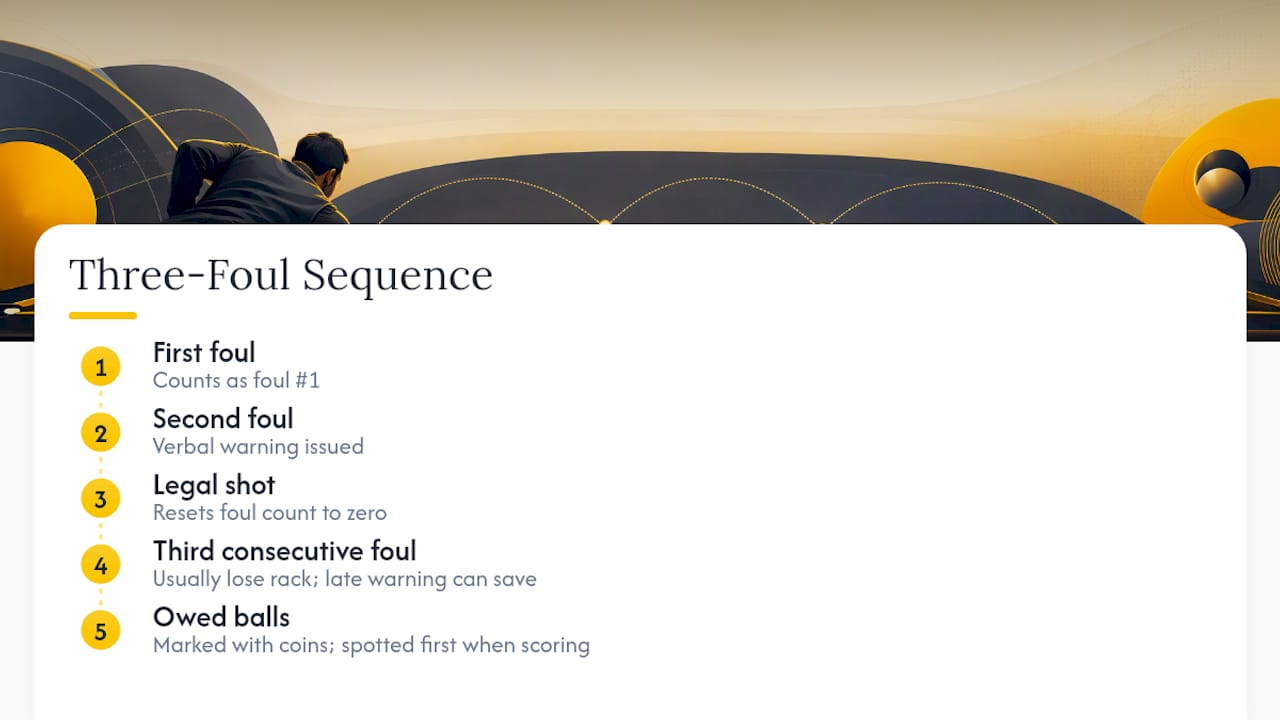
One nuance worth knowing: if a referee fails to issue that warning before the third foul's shot is already underway, some rule sets treat the next shot as if the player is still only on two fouls rather than immediately forfeiting. This nuance matters in close matches.
Owed balls, meaning balls you're penalized but haven't yet had spotted, are commonly tracked with coins or a marker near the table. When you eventually score again, owed balls get spotted first, before any new balls count toward your total. Some tournament formats waive the three-foul loss in favor of a negative-score system instead, so check the event rules before you play.
How Do You Spot Balls Correctly?
A spotted ball goes on the foot spot, or in a straight line beneath it toward the foot rail if the spot itself is occupied. That's true whether the ball landed in a neutral pocket or was pocketed illegally during a foul.
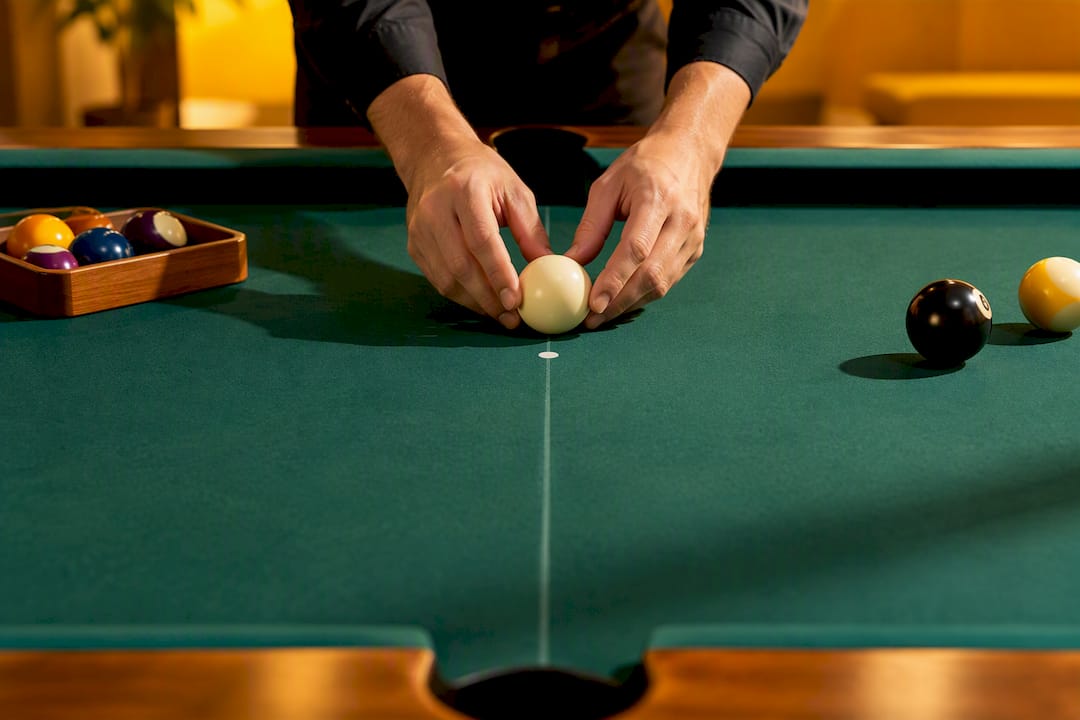
Timing matters here. Neutral-pocket balls are typically spotted at the end of the current inning, not mid-turn, unless the table has been completely cleared with neither player having reached the winning score. In that clearing scenario, every owed and neutral ball goes back on the table at once, and play simply continues.
Most regular players keep the process honest with small habits: a coin or poker chip near the table edge for each owed ball, a quick verbal "that's two you owe me" before the next shot, or a rack tray kept visible so nobody has to reconstruct the inning from memory. None of this is written into any rulebook. It just prevents arguments.
How Do You Keep Track of Score and Resolve Disputes?
Score tracking in One Pocket is each player's own responsibility, not the referee's or opponent's, per the official rules. That means you should be counting your own balls pocketed the moment they drop, not reconstructing the inning three shots later.
Pocket assignment gets settled before the break and should never change mid-rack, even if the breaker's chosen pocket turns out to favor them heavily on that particular layout. If a dispute arises, most rooms default to three fixes: restoring disturbed balls as close to their original position as possible, calling a referee if one is present, or, in truly deadlocked cases, agreeing to rerack. Moving or touching a ball you assume has already scored, before your opponent confirms it, is a common and entirely avoidable source of forfeited games.
What House Rules and Handicaps Are Common?
Because One Pocket rewards patience and defensive skill over raw shot-making, handicapping is common even among friends who play regularly. The most typical method sets uneven target scores, something like 10 balls for the stronger player against 6 for the weaker one, with spotting rules applied exactly as they would be in an even match.
Frequently used house variations include:
- Winner-breaks-next-rack instead of strict alternating breaks.
- A re-break option when the breaker scratches, rather than awarding ball-in-hand.
- Softened three-foul enforcement during casual, after-hours play, sometimes replaced with a simple point deduction.
None of these variants are wrong to use among friends, but they can cause real friction if one player assumes tournament rules apply and the other assumes house rules do. Agree on the exceptions out loud, the same way you'd settle any house-rule debate in a casual game, before the rack is even broken.
What Rules Differ at Tournament Level?
Sanctioned events tend to formalize things casual players treat loosely. Lagging for the first break, alternating breaks in every subsequent rack, and enforcing time limits per shot or per match are standard at most sanctioned tournaments, including the 2025 International Open.
Jump cues are banned outright, referees issue foul warnings at two fouls rather than letting the count run silently, and spotting procedures are handled by tournament officials rather than the players themselves. Etiquette matters more too: call the referee for any disputed ball rather than arguing with your opponent, never touch a ball you believe has already scored until it's confirmed, and treat a missed safety or a lucky roll the same way, without commentary. Sportsmanship gets noticed at events just as much as ball-striking does.
What Strategy Actually Follows From These Rules?
Because there's no call-shot requirement, a ball that accidentally drops into your pocket counts just as much as one you planned three rails in advance. That single fact shapes almost every decision in the game.
A soft, controlled break that keeps the rack tight near the foot cushion protects you far better than a hard scattering break that hands your opponent easy position. Once balls are in play, the constant question is whether to pocket a ball now or leave it as a blocker, since removing a ball from the table can open a lane for your opponent just as easily as it scores for you. Strong players build two-way shots, ones that either score or leave the cue ball tucked safely, rather than committing fully to offense on every turn.
Pro Tip: Before attempting any shot near your pocket, ask whether missing it gives your opponent a runway to theirs. If the answer is yes, play the safety instead. In One Pocket, the shot you don't take often wins more racks than the one you do.
A short checklist for tournament-minded play: break soft and check for rail contact, track owed balls the moment a foul happens, confirm pocket assignment before the rack, and never assume a ball has scored until it's spotted or confirmed.
Why Learning the Official Rules Changes How You Play
Q Billiards hosts weekly tournaments on its tables, and enforcing the official One Pocket rules consistently is what keeps those events fair from the first rack to the last. Players who actually know the three-foul provision, the spotting timing, and the jump-cue restriction play a noticeably deeper strategic game than those relying on house-rule guesswork. Rule literacy isn't a formality here. It's a competitive edge.
— Q
Where to Practice One Pocket Under Official Rules
Reading the rules gets you halfway there. The rest comes from playing racks under real pressure, against people who know the game, on equipment built for it.

Q Billiards Arena runs American Pool, Standard Snooker, Heated Snooker, Chinese 9-Ball, and Carom Billiards across 25 professional-grade tables in an 11,000-square-foot space, with hours that run late enough to finish a real match instead of rushing it. If you want structured competition rather than a casual rack with friends, the Tuesday Night Pool Tournament and Friday Night Pool Tournament both run at $10 entry and enforce the exact foul, spotting, and break rules covered above, so you get tournament-ready reps instead of guesswork. Hourly table rental fees for American Pool are commonly charged, with specific prices available on billiards venues' official websites. Book a table or check the next tournament date directly on the Q Billiards site to get on the schedule this week.
Sources
The rules above draw directly from the Official One Pocket Rules and its companion PDF version, both maintained as the primary reference for the game. WPA/BCA-aligned guidance appears in the Concise WPA-Style Rules of One Pocket, and tournament-specific exceptions come from the 2025 International Open One-Pocket Rules. Check the event-specific document before any sanctioned match, since variants do exist.
- Official One Pocket Rules
- Concise WPA-Style Rules of One Pocket
- 2025 International Open One-Pocket Rules
FAQ
Can You Use a Jump Cue in One Pocket?
No, most official rule sets, including OnePocket.org's, require jump shots to be played with your regular playing cue rather than a specialized jump cue. Confirm the specific policy with tournament staff or house rules before an important match, since enforcement can vary by venue.
Why Is One Pocket So Popular Among Serious Players?
One Pocket rewards defensive skill, patience, and cue-ball control in a way that rotation games like eight-ball or nine-ball don't, since there's no call-shot requirement and defense is a legitimate offensive weapon. That depth is exactly why Q Billiards runs regular tournaments built around it, giving players a place to develop that strategic side of their game.
Do You Lose If You Hit the Wrong Ball Into a Pocket?
Pocketing a ball into a neutral pocket, or into your opponent's foot pocket, doesn't cause an automatic loss. Neutral-pocket balls simply get spotted and don't count for anyone, while a ball dropped into your opponent's pocket scores for them, provided your shot didn't also foul.
Is There a Call-Shot Rule in One Pocket?
No, One Pocket does not require calling shots. Any ball that legally drops into your designated foot pocket counts toward your score, even if you didn't call it, which is part of what makes defensive and two-way shot strategy so central to the game.
What Happens After Three Consecutive Fouls?
Three fouls in a row without a legal shot between them typically costs you the rack under official rules. Good practice calls for a warning after the second foul, and some formats replace the automatic loss with a point penalty instead, so confirm the format before you start.