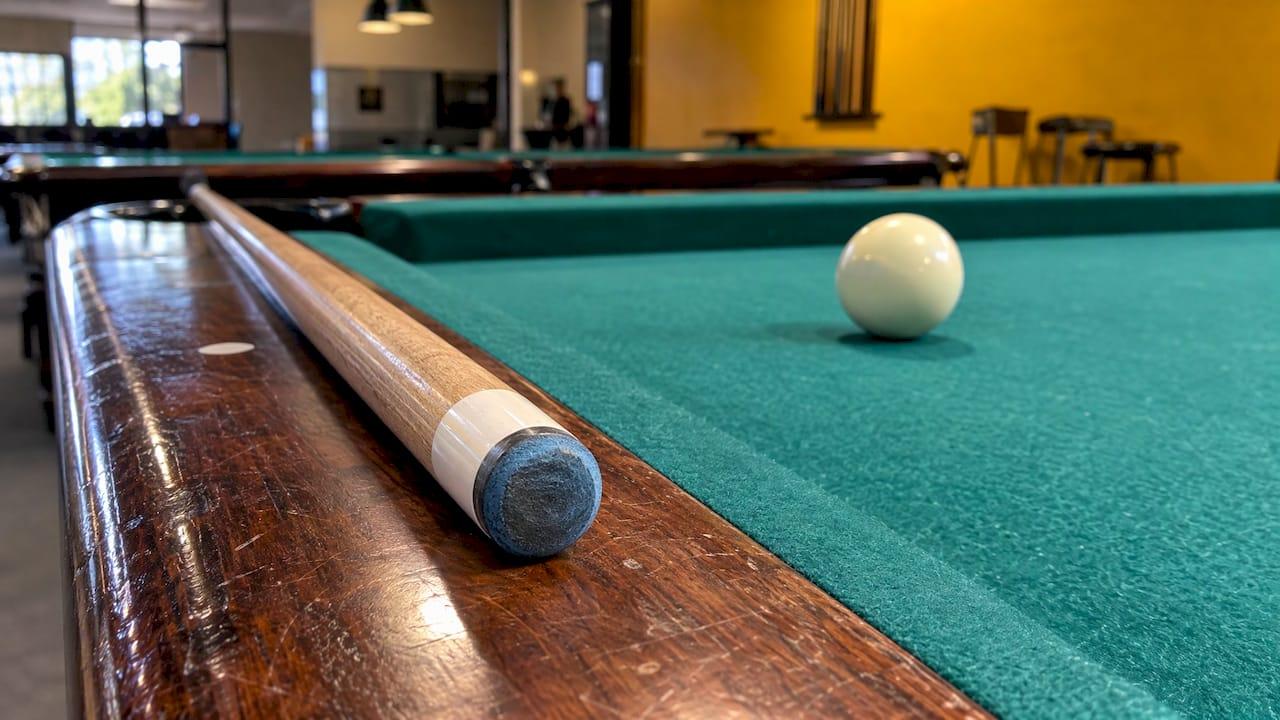
Cue tip hardness describes how much the leather compresses when it meets the cue ball. A soft tip squashes more and stays on the ball a fraction longer. A hard tip squashes less and gives a crisper, more direct hit. For most players, a medium tip is the right starting point, and the best way to settle the question is to play the same shots with different tips on a good table. At Q Billiards Arena in Houston, American pool tables are $10 per hour, so you can work through a few tips without much cost.
This guide covers what the hardness numbers mean, how soft and hard tips really differ, why the labels on the packaging can mislead you, and how to match a tip to your stroke.
TL;DR
- Hardness is usually measured on the Shore A durometer scale. Playing tips mostly fall between the mid-60s and low 90s, and phenolic break tips read higher.
- Soft tips feel forgiving and hold chalk well but mushroom and wear faster. Hard tips hold their shape longer and give a firmer hit.
- Brands grade their own tips, so one maker's "medium" can feel like another maker's "soft" or "hard".
- Within the normal playing range, hardness has little direct effect on how much spin you can apply. Chalk and tip shape matter more.
- If you are unsure, start with a medium or medium-hard layered tip, keep it shaped and scuffed, and change only one thing at a time.
Table of Contents
- What cue tip hardness actually means
- Soft vs. hard tips: what really changes
- Does a softer tip give you more spin?
- Why the label on the package can mislead you
- Construction: layered, pressed and phenolic
- Which hardness fits your game
- Keep your tip in shape
- How to compare tips fairly
- Try your tip where the game happens
- Our view on tip hardness
- FAQ
- Sources
What cue tip hardness actually means
The tip is the only part of the cue that touches the ball. It is a small disc of leather, usually 12 to 14 mm across, glued to the ferrule at the end of the shaft. Hardness is how firm that disc is. A hard tip resists squashing, and a soft tip gives under impact.
That difference is measured with a durometer, a spring-loaded needle that is pressed into the tip under a set force. The reading is given on the Shore A scale for most leather tips. One widely read tip guide, based on testing more than 100 tips, places soft tips at roughly 66 to 74, medium at 75 to 84, hard at 85 to 92, and extra-hard break tips at 93 and above. Other guides draw the lines a few points differently, which is the first hint that these categories are loose.
Here is a practical way to read the ranges:
| Category | Typical Shore A reading | What to expect |
|---|---|---|
| Soft | about 66 to 76 | Muted feel, more give, quicker wear |
| Medium | about 75 to 84 | Balanced feel, a good all-round choice |
| Hard | about 85 to 92 | Crisp feedback, holds its shape |
| Break/jump (phenolic, G10) | mid-90s and up | Very firm, built for power shots |
The overlap in the first two rows is deliberate. Different makers and testers set the boundaries differently, so treat the numbers as a rough map rather than a rulebook.
Soft vs. hard tips: what really changes
The core idea is dwell time, the brief moment the tip stays in contact with the cue ball. A softer tip compresses more, dwells longer and grips more firmly, while a harder tip rebounds faster and transfers energy more directly. From that one change come most of the differences players notice.
| Quality | Soft tip | Hard tip |
|---|---|---|
| Feel | Cushioned, forgiving contact | Firm, crisp, direct |
| Chalk | Holds chalk well, easy to scuff | Needs good scuffing to hold chalk |
| Shape | Mushrooms and flattens faster | Keeps its dome longer |
| Maintenance | More frequent shaping and trimming | Less shaping |
| Lifespan | Shorter | Longer, often several years when cared for |
| Stroke feedback | Hides small flaws | Shows every flaw in your stroke |
The lifespan point has a practical side. No maker gives a fixed replacement interval. Replace a tip when almost nothing remains above the ferrule, when it has mushroomed past fixing, or when scuffing no longer makes it hold chalk. A hard, well-kept tip can last several years, while a soft tip used heavily may need replacing much sooner.
Why harder tips get a reputation for miscues
Players often say hard tips slip. The more accurate version is that a glazed tip slips. A hard tip that has gone shiny and smooth has nothing to grab the chalk. A hard tip in good shape will not slip any sooner than a soft one. Soft tips are simply easier to scuff back to a chalk-friendly surface, which is why they feel more forgiving.
Does a softer tip give you more spin?
This is the question most players really want answered, and the common advice says yes. The American Poolplayers Association's equipment lesson says that the softer the tip, the more it grabs the cue ball and the more spin it can impart, while a harder tip keeps its shape longer. That matches what many players feel at the table.
There is a more precise way to see it. Dr. Dave Alciatore, a mechanical engineering professor who has studied pool physics for years, writes that within the normal playing range, hardness has no direct effect on the amount of spin you can apply. Spin is limited by how far from center you can strike before the cue slips off the ball, and a well-chalked tip of any normal hardness reaches roughly the same limit. He adds that a harder tip transfers energy a little more efficiently, which can give slightly more ball speed for the same stroke, a small plus on draw shots.

So how do you reconcile the two views? Softer tips tend to feel grippier, forgive a slightly off-center hit and stay chalked more easily. That confidence lets players use more of the spin they already had. If you want to see how offset and speed produce spin, our guide to using English in pool and the one on backspin and topspin walk through it.
Why the label on the package can mislead you
There is no universal standard that makes one maker's "medium" equal another's. Brands grade their own tips, and hardness is also not the whole story. KAMUI's own guidance explains that hardness and elasticity are different properties, so two tips can measure the same and still respond differently. Its advice is to treat the range as a spectrum where neither end is better.

Published durometer readings show how wide the gaps can be. In one comparison of 14 mm tips, a soft tip from one brand read 66.3, while another brand's soft read 75.3, nearly as firm as a third brand's medium at 75.5. Moving from soft to hard inside a single brand shifted readings by 9 to 21 points, while the mediums from the different brands landed within about 5 points of each other.
Two more things make the numbers soft:
- Layered tips are hard to test. The tip is built from many thin leather sheets, and one maker notes that durometer testing of layered tips is inconclusive because the standard test is taken 12 mm from an edge, which a 14 mm tip does not have. Results also vary with wetting and technique.
- Tips change as you play. A worn, thinner tip plays harder, and soft tips harden with use. The tip you bought is not the tip you have three months later.
The takeaway: use the category (soft, medium, hard) to narrow your choice, then judge by how the tip plays rather than by the number printed on the box.
Construction: layered, pressed and phenolic
Hardness is tied to how a tip is made.
- Pressed tips are cut from a single piece of compressed hide. They are inexpensive and can vary more from one tip to the next.
- Layered tips bond six to ten or more thin leather sheets. Layered tips grip the ball better than hard leather tips without breaking down as easily as soft ones. They are the usual choice for players who want consistency.
- Phenolic and similar tips (phenolic resin, G10, fiberglass-reinforced) often read in the mid-90s. They are made for break and jump cues, not for everyday shot-making.
For general American pool, a medium-hard layered leather tip sized to the shaft, usually 12 to 13 mm, is a sensible start. Size matters too: the tip should match the shaft diameter your cue was built for.
Which hardness fits your game
Most players do well with a medium tip. PoolDawg's selection advice puts it at 75 to 84 on the Shore A scale and links style to hardness like this:
- Smooth, flowing stroke: soft or medium. The extra give suits a relaxed delivery.
- Firm, controlled stroke: medium to hard. You get a crisper hit and a tip that holds its shape.
- Developing player: lean soft or medium for forgiveness while your stroke settles.
- Power stroke: medium or hard.
By skill and format, a few patterns show up in coaching advice. A pool coaching site recommends medium tips to most of its players and suggests intermediate league players try medium and soft tips, with a separate break cue that has a hard phenolic tip. It also notes that straight pool specialists often like hard tips, while one-pocket players often like softer ones for position control. The APA's lesson adds that most pros play with a medium-hard or hard tip.
Casual players
If you play a few nights a month, choose a medium layered tip and spend your energy on chalk and tip shape. These matter more than the last couple of points on a durometer.
League and tournament players
If you play weekly, you will notice tip wear. A medium or medium-hard tip balances feel and longevity. Add a dedicated break cue if you break often, so your playing tip is not battered by the hardest shot in the game.
Snooker and carom players
Snooker cues use smaller tips, and the sport has its own tip sizes and conventions, so match the tip to your cue's shaft and the game you play. The same hardness logic applies: softer for feel and grip, harder for durability.
Keep your tip in shape
A well-kept tip of any hardness plays better than a neglected one. The basics:
- Shape it to a curve about the radius of a nickel or dime. Shaping and scuffing wear tips down faster, so use a light touch.
- Scuff it so it grips chalk. This is the single biggest fix for miscues on any tip.
- Chalk before every shot. The tip's job is to hold chalk at contact.
- Replace it when it no longer holds chalk after scuffing, when it is damaged, when the glue joint fails, or when little tip is left on the ferrule shoulder.
Our step-by-step cue tip maintenance routine shows how many shaping strokes and scuffs a tune-up needs. A clean shaft helps too, and our guide to cue shaft cleaning covers a daily routine.
How to compare tips fairly
Because labels vary, a fair comparison takes a little discipline.
- Change one variable. Swap only the tip, not the chalk, shaft or table at the same time.
- Give it time. A new tip needs shaping and a few hours of play to settle in.
- Run the same drills. Use a repeatable set: stop shots, draw shots of a set length, and a few controlled side-spin shots. Drills such as the ones in our speed control guide and cue ball control drills give you a consistent yardstick.
- Judge feel and consistency, not spin alone. Ask whether your miscues drop, whether your speed control improves and whether you trust the hit.
There is a mental side as well. Dr. Dave's bottom line is that tip hardness does not matter much, and if you believe your choice is best and like how it feels, you will probably play better with it. Confidence is part of the equipment.
Try your tip where the game happens
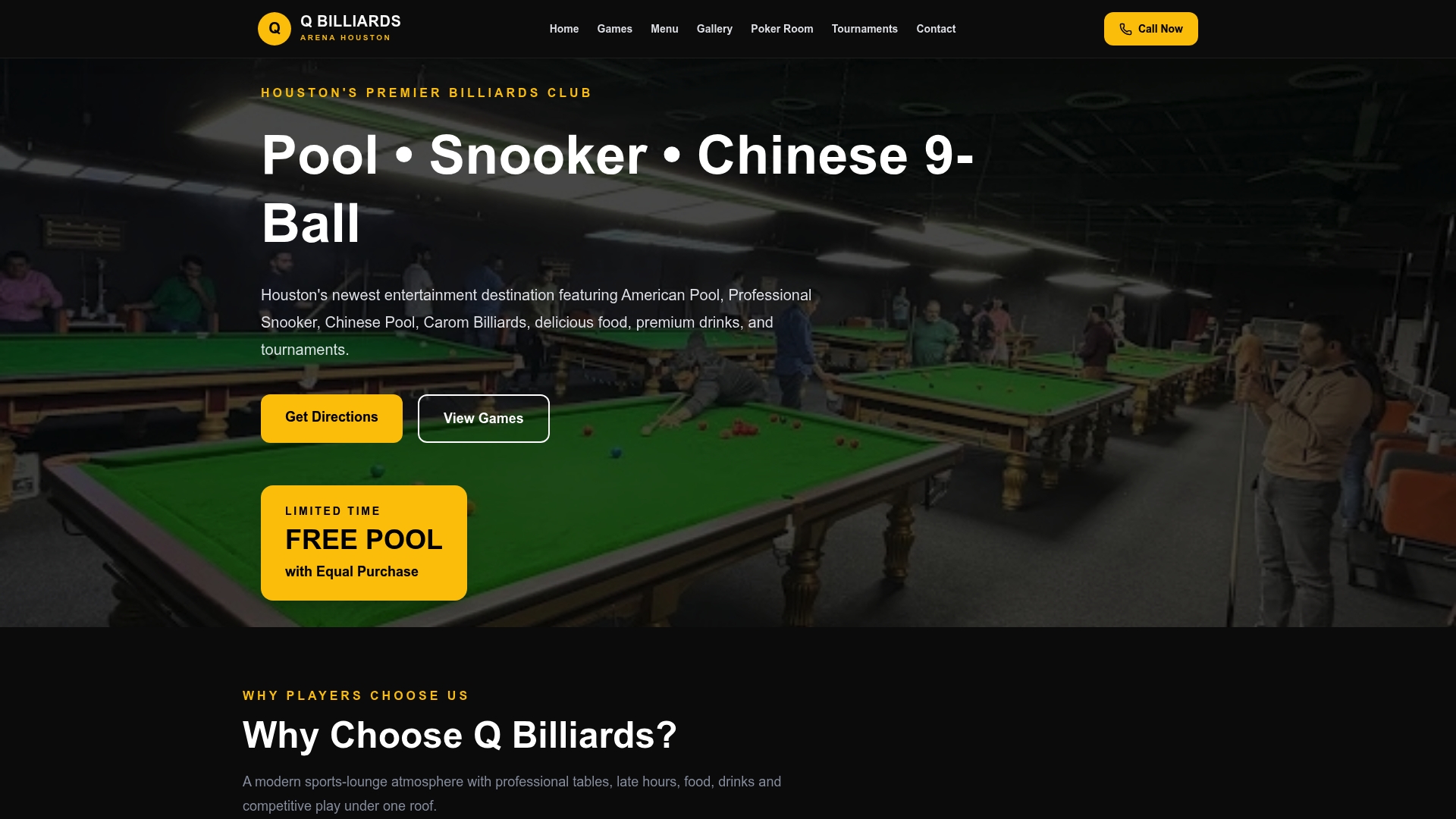
Tip choice shows up in real conditions: a full-size table, a long draw shot, a late-night league match. Q Billiards Arena in Houston has 25 professional-grade tables, and American pool is $10 per hour, with Chinese 9-ball, carom billiards and standard snooker at $15 per hour and heated snooker at $20 per hour. That gives you room to work through drills with a new tip before a tournament.
If you want to put a tip to the test against real opposition, the Tuesday and Friday night pool tournaments have a $10 entry, and the club's late hours run until 2 to 4 AM, so you can practice after the crowds thin out. Our food and drinks menu keeps a long session going.
Our view on tip hardness
We watch a lot of cue tips in a lot of hands, and the pattern we care about is not which hardness is best. It is whether the player trusts the tip they are holding.
Our advice is simple. Start with a medium or medium-hard layered tip. Keep it shaped and scuffed. Change one thing at a time. Then play on a table where the cloth, pockets and lighting do not add noise to what you are testing.
That is why we built Q Billiards Arena the way we did: 25 professional-grade tables, American pool, snooker, Chinese pool and carom under one roof, and late hours so you can practice when you want to. Whether you are shaping a new tip before a Tuesday night tournament or getting a feel for heated snooker, the game is the best teacher.
Q
FAQ
Is a soft or hard cue tip better for beginners?
A soft or medium tip is usually the easier start. The extra give is forgiving, and soft tips are quick to scuff so they hold chalk. A medium layered tip is the safest all-round choice while your stroke is still developing.
Do hard tips really give less spin?
Not by much, if at all, within the normal playing range. Dr. Dave Alciatore reports that spin is limited by how far off-center you can hit before the cue slips, and a well-chalked hard tip can reach the same limit. Soft tips often feel grippier, which helps players trust more offset.
How do I know when to replace my cue tip?
Replace it when almost no tip remains above the ferrule, when it has mushroomed or flattened past fixing, or when scuffing no longer makes it hold chalk. Hard, well-kept tips can last several years, while soft tips used often wear sooner.
Is a medium from one brand the same as a medium from another?
No. Makers grade their own tips, and published durometer readings show one brand's soft can read as firm as another's medium. Use the category as a starting point and judge by how the tip plays.
What tip should I use on a break cue?
Break and jump cues commonly use phenolic or similar very hard tips, which read in the mid-90s on the durometer. Their firmness suits power shots, and a separate break cue keeps your playing tip protected.
Sources
- The Ultimate Pool Cue Tip Guide: Soft vs Medium vs Hard
- Cue Tip Hardness Explained: Soft, Medium, Hard and Layered
- Soft vs Medium vs Hard Cue Tips: Which Is Better?
- Cue Tip Size and Hardness: What Actually Changes a Shot
- Lesson 9: Your Equipment Demystified, American Poolplayers Association
- Cue Tip Hardness Effects, Dr. Dave Pool Info
- Soft, Medium or Hard? KAMUI Tip Hardness
- Best Pool Cue Tips: Brands, Hardness Chart and Picks
- FAQs, Ultraskin Layered Pool Cue Tips
- Complete Pool Cue Tip Guide: Size, Hardness, Construction
- Choosing the Right Pool Cue Tip, Cue and Case
- What Pool Cue Tip Should I Use? Picks by Player Type
- Pool Cue Tips: Complete Material Analysis and Selection Guide
- Billiards Digest article on tip care, June 2021