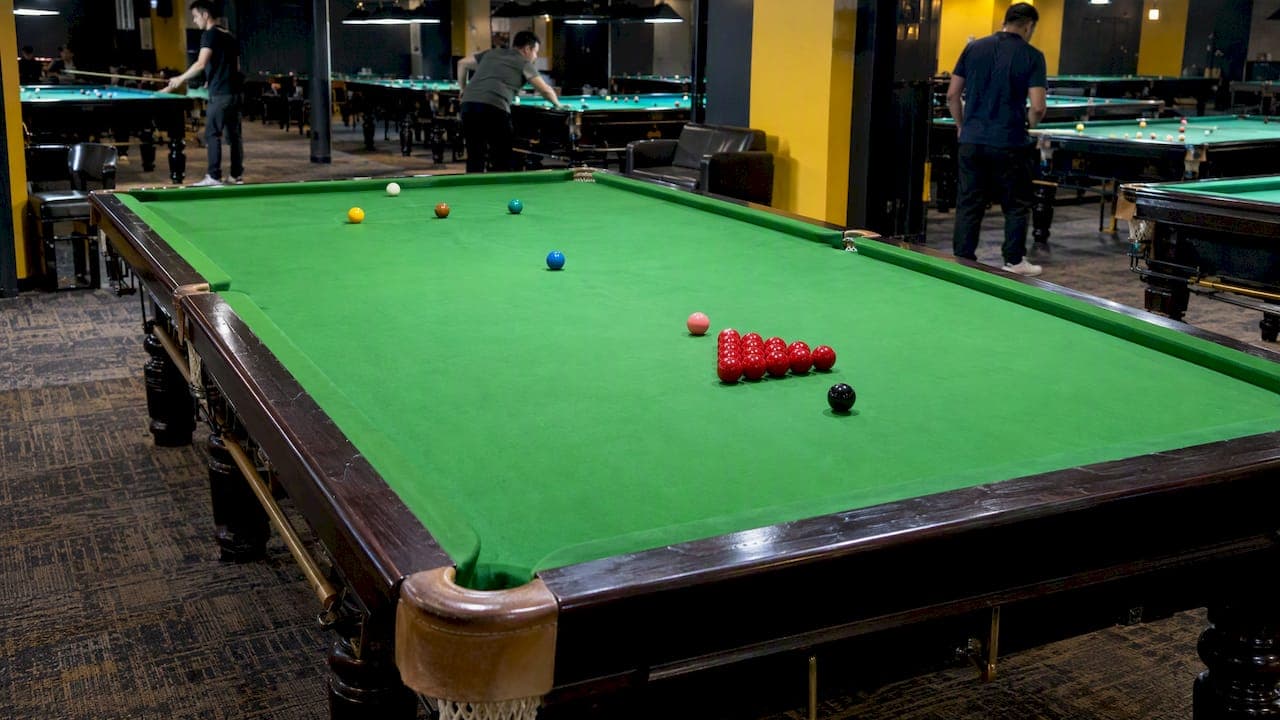
Reds are worth 1 point each, and the six colours score yellow 2, green 3, brown 4, blue 5, pink 6 and black 7, while the white cue ball scores nothing. A full frame uses 15 reds, six colours and the cue ball. The standard maximum break is 147, built from 15 reds, each followed by the black, then the six colours.
TL;DR:
- While reds remain, pot one before any colour; colours return to their spots until the final red, then clear yellow through black in order.
- A foul gives the opponent at least 4 points and transfers the turn; penalty rises to the value of the ball involved, up to 7.
- Six red and 10 red formats retain the same colour values but reduce the number of reds, so their maximum breaks fall below 147.
- On the scoreboard, add legal pots to the striker and foul points to the opponent, reset the break after each turn, and track points remaining.
Table of Contents
- 1. Snooker ball list: what each ball is worth
- 2. How scoring works in a frame
- 3. What fouls cost you in points
- 4. How to keep score on a snooker scoreboard
- 5. Ball and table specs behind the rules
- 6. How ball values shape strategy
- 7. How snooker's ball values came about
- 8. How ball values change in snooker variants
- 9. What we've learned from watching players learn these rules
- 10. Put these rules into practice on a real table
- FAQ
- Sources
1. Snooker ball list: what each ball is worth
A standard set has 22 balls: one cue ball, 15 reds and six colours, as the WPBSA rulebook lays out. The 21 object balls are the reds plus the colours. The reds are fifteen separate balls, each worth the same single point, so no red outranks another.
- White cue ball: no point value. It is the only ball you strike with the cue, and potting it is a foul.
- Red (15 balls): 1 point each. Every break starts with one while any remain.
- Yellow: 2 points, the lowest colour and the first in the clearance.
- Green: 3 points.
- Brown: 4 points.
- Blue: 5 points.
- Pink: 6 points.
- Black: 7 points, the highest value on the table.
Short formats change how many reds are on the table, not what the colours are worth. A six-red or 10-red game still uses yellow 2 through black 7, so everything you learn here carries over. Authoritative explainers such as BBC Sport's snooker guide list the same set and values, and they point out how snooker differs from pool sets with numbered balls.
2. How scoring works in a frame
Scoring in snooker follows a rhythm, and once you see it the numbers make sense. While at least one red remains on the table, you must pot a red first, which scores 1 point. Then you may nominate any colour, from yellow at 2 up to black at 7. Standard rule summaries describe this same loop.
- Pot a red for 1 point.
- Choose a colour and pot it for 2 to 7 points.
- The colour goes back to its spot, so it stays available for the next visit.
- Repeat until the last red is gone, then take one more colour.
- Clear the colours in ascending order: yellow, green, brown, blue, pink, black. From here, each colour stays off the table once potted.
That clearance order is easy to remember by value: 2, 3, 4, 5, 6, 7.
The respotting is why high breaks are possible. A player can sink the black again and again, because it returns to its spot after each red.
The standard maximum break is 147: 15 reds with 15 blacks make 120 points, and the six colours add 27 more. A free ball can push a break past 147.
If you want a deeper walkthrough, our snooker scoring explainer covers breaks in more detail, and our piece on the free ball and the 153 break shows how a total above 147 can happen.
3. What fouls cost you in points
A foul never takes points away from the player who commits it. The penalty is added to the opponent's score, and the turn passes to them. Under WPBSA rules, the minimum penalty is 4 points, and it rises to the value of the ball involved when that value is higher. That is why typical penalties run from 4 to 7.
Common fouls include:
- Failing to hit any ball with the cue ball.
- Potting the cue ball, known as going in-off.
- Hitting the wrong ball first.
- Striking the cue ball twice in one shot.
- Jumping the cue ball over a ball or off the table.
A foul on the black costs 7, while a foul on a pink costs 6, so a careless shot late in a frame can hand over a lot.
Pro Tip: A penalty is always added to your opponent's tally, never subtracted from yours, so double-check the ball on before you play a risky shot.
Our guide on snooker fouls club players need to know shows how to stop giving away points.
4. How to keep score on a snooker scoreboard
A scoreboard is just running arithmetic, and a few habits keep it accurate. The WPBSA rulebook sets out how a frame is decided: the player with the higher score wins once the frame-ending conditions are met.
- Add each legally potted ball to the striker's running score as it drops.
- Add any foul penalty to the opponent's score, not the offender's.
- Note the current break and reset it to zero when the turn ends.
- Track the points still on the table to see whether the trailing player needs snookers to catch up.
- Agree the displayed score with your opponent as you go. Players and referees share the job of spotting errors, so speak up the moment a total looks wrong.
Frame wins are tallied separately, and a match is decided by the pre-set number of frames.
5. Ball and table specs behind the rules
A few equipment numbers come up often alongside ball values. The WPBSA equipment rules give:
- Ball diameter: 52.5 mm, with a tolerance of ±0.05 mm.
- Set weight spread: no more than 3 g between the heaviest and lightest ball.
- Point values: fixed by the rules, so size or weight within tolerance never changes what a colour scores.
- Short formats: these change only the number of reds, while colours keep their values.
Measured notes on full-size tables put the playing area at about 356.9 × 177.8 cm, with tight tournament-style pockets.
6. How ball values shape strategy
The values drive nearly every decision. Because the black is worth 7, players try to keep their cue ball near the black spot after each red, which lets them score 8 per visit. The pink at 6 sits close to the pyramid of reds, so players often use it to break the pack open while staying in position.
Late in a frame, the points left on the table matter more than the shots themselves. When the trailing player needs more than the table offers, they need a snooker: a position that leaves the opponent with no direct route to the ball on. Fouls feed into this too, since a 7-point penalty on the black can swing a frame in a single shot.
Safety play also depends on values. Leaving your opponent a tough red is worth more than a risky colour that could cost you 4 or more. Newer players often chase the high colours too early. A steady run of reds and blues beats a missed black every time.
For a look at the tactics that make big runs possible, see our guide to century breaks and how to build one.

7. How snooker's ball values came about
The scoring system traces back to the 1870s, when British Army officers in India are said to have invented the game as a mix of pool and pyramid. As the Rules of snooker overview explains, the structure is unusual: reds act as repeatable one-point starters, while colours provide the tactical choice.
The point values, 1 for red and 2 through 7 for the colours, climb in a simple ladder. That makes totals easy to add in your head and makes the black the prize ball. Over time, governing bodies standardized the rules, and today the WPBSA maintains them.
The lasting appeal of the ladder is that it rewards both skill and risk. A low colour is safe but earns little, and a high colour pays well if you can play it. Players have been weighing that trade-off for well over a century.
8. How ball values change in snooker variants
The colour values stay the same in the formats most clubs play. What changes is the number of reds, which shortens the frame. The WPBSA rules treat a six-red or 10-red game as a change to the reds only. Yellow is still 2 and black is still 7.
That also changes the maximum break. With fewer reds, the top possible score is lower than 147, since there are fewer reds and fewer follow-up blacks to pot. A one-red frame is a quick shootout where a single red, then a colour, then the clearance decide the result.

Pool games work differently, using numbered balls and no ladder of values like this one. If you also play pool, you can read about scoring in another social game, such as axe throwing scoring, to see how rule systems vary by sport.
If you're setting up a table, our guide to racking snooker balls correctly helps you get the triangle of reds right.
9. What we've learned from watching players learn these rules
We see the same thing: players who know the values by heart make better decisions at the table. Knowing that the black is worth 7 and a foul on it costs 7 changes how you approach every shot. The fastest way to build that feel is to play. Our professional-grade tables, regular tournaments and a Snooker Coaching Camp give you room to practice the rules in real frames, with feedback.
— Q
10. Put these rules into practice on a real table
Rules stick best when you play them. At Q Billiards Arena we offer standard snooker at $15 per hour, so you can work through a full frame at your own pace. Our 1-Red Snooker Tournament costs $20 and gives you a quick, competitive way to use scoring in a match. If you'd like guidance, sign up for the Snooker Coaching Camp on our events page.

Book a table, grab a drink from our menu and try a 15-red frame this week.
FAQ
How do you use a snooker scoreboard?
Add each legally potted ball to the striker's score, and add foul penalties to the opponent's score. Reset the break when the turn ends. The WPBSA rulebook says the higher score wins once the frame ends.
How do you remember the snooker ball order?
Think by value, from lowest to highest: yellow, green, brown, blue, pink, black. That fixed order is also the colours-only clearance sequence, and the values climb from 2 to 7 as you go.
How much should a snooker ball weigh?
The rules set an exact diameter instead of one fixed weight. The WPBSA equipment rules allow a maximum 3 g difference between the heaviest and lightest ball in a set.
How many points is a foul in snooker?
A foul starts at a minimum of 4 points, and it can be higher when the ball involved is worth more. Under WPBSA rules, that means typical penalties of 4 to 7, added to the opponent's score.